
Every event we host is designed with intention, from the atmosphere we create to the way each session flows.
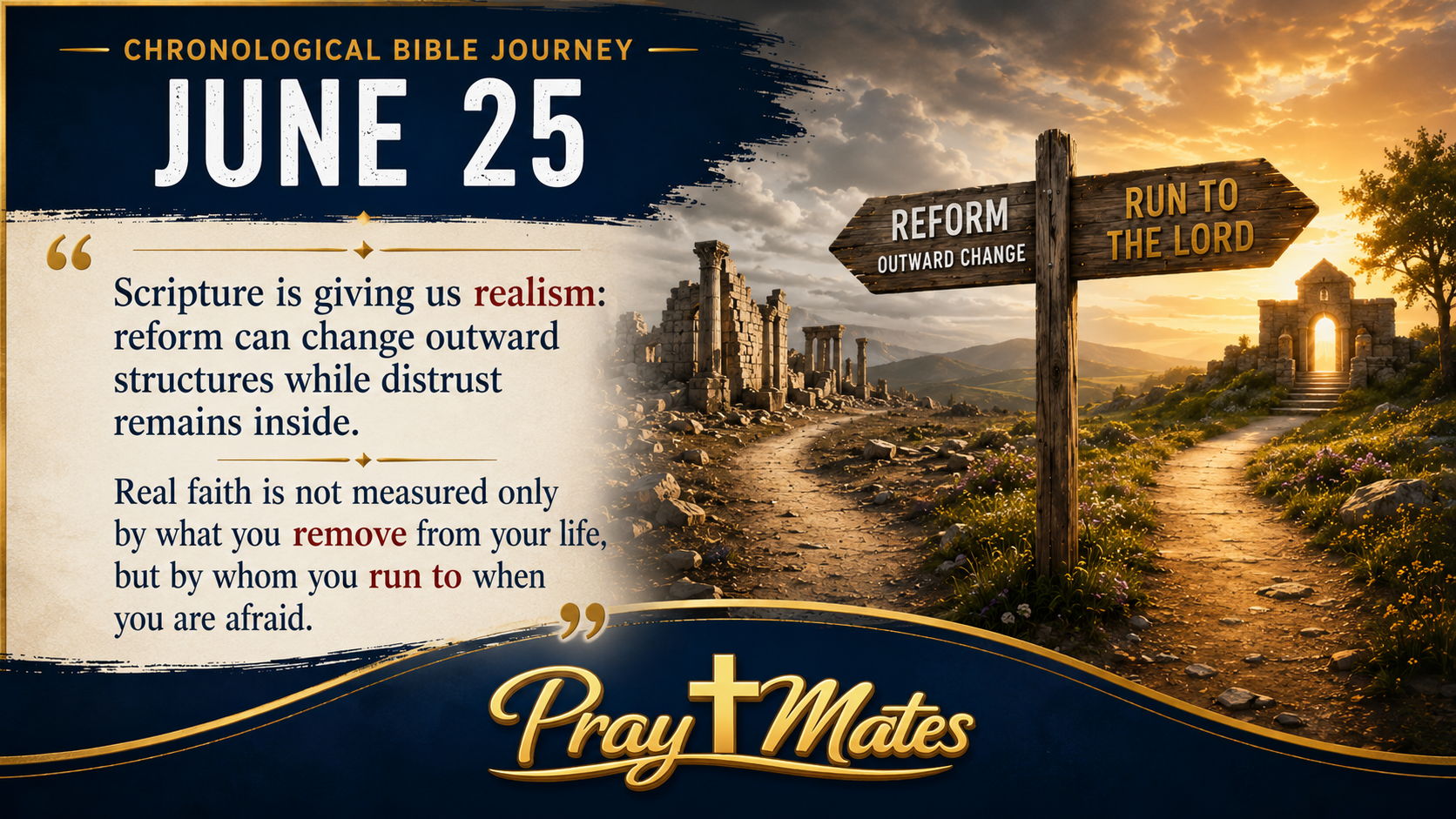
June 25 — Reform Is Not the Same as Trust
June 25 — Reform Is Not the Same as Trust
SCRIPTURE READING:
1 Kings 15; 2 Chronicles 13-16
SCRIPTURE:
Passage: 1 Kings 15
¹ Now in the eighteenth year of king Jeroboam the son of Nebat reigned Abijam over Judah.
² Three years reigned he in Jerusalem. and his mother's name was Maachah, the daughter of Abishalom.
³ And he walked in all the sins of his father, which he had done before him: and his heart was not perfect with the LORD his God, as the heart of David his father.
⁴ Nevertheless for David's sake did the LORD his God give him a lamp in Jerusalem, to set up his son after him, and to establish Jerusalem:
⁵ Because David did that which was right in the eyes of the LORD, and turned not aside from any thing that he commanded him all the days of his life, save only in the matter of Uriah the Hittite.
⁶ And there was war between Rehoboam and Jeroboam all the days of his life.
⁷ Now the rest of the acts of Abijam, and all that he did, are they not written in the book of the chronicles of the kings of Judah? And there was war between Abijam and Jeroboam.
⁸ And Abijam slept with his fathers; and they buried him in the city of David: and Asa his son reigned in his stead.
⁹ And in the twentieth year of Jeroboam king of Israel reigned Asa over Judah.
¹⁰ And forty and one years reigned he in Jerusalem. And his mother's name was Maachah, the daughter of Abishalom.
¹¹ And Asa did that which was right in the eyes of the LORD, as did David his father.
¹² And he took away the sodomites out of the land, and removed all the idols that his fathers had made.
¹³ And also Maachah his mother, even her he removed from being queen, because she had made an idol in a grove; and Asa destroyed her idol, and burnt it by the brook Kidron.
¹⁴ But the high places were not removed: nevertheless Asa's heart was perfect with the LORD all his days.
¹⁵ And he brought in the things which his father had dedicated, and the things which himself had dedicated, into the house of the LORD, silver, and gold, and vessels.
¹⁶ And there was war between Asa and Baasha king of Israel all their days.
¹⁷ And Baasha king of Israel went up against Judah, and built Ramah, that he might not suffer any to go out or come in to Asa king of Judah.
¹⁸ Then Asa took all the silver and the gold that were left in the treasures of the house of the LORD, and the treasures of the king's house, and delivered them into the hand of his servants: and king Asa sent them to Benhadad, the son of Tabrimon, the son of Hezion, king of Syria, that dwelt at Damascus, saying,
¹⁹ There is a league between me and thee, and between my father and thy father: behold, I have sent unto thee a present of silver and gold; come and break thy league with Baasha king of Israel, that he may depart from me.
²⁰ So Benhadad hearkened unto king Asa, and sent the captains of the hosts which he had against the cities of Israel, and smote Ijon, and Dan, and Abelbethmaachah, and all Cinneroth, with all the land of Naphtali.
²¹ And it came to pass, when Baasha heard thereof, that he left off building of Ramah, and dwelt in Tirzah.
²² Then king Asa made a proclamation throughout all Judah; none was exempted: and they took away the stones of Ramah, and the timber thereof, wherewith Baasha had builded; and king Asa built with them Geba of Benjamin, and Mizpah.
²³ The rest of all the acts of Asa, and all his might, and all that he did, and the cities which he built, are they not written in the book of the chronicles of the kings of Judah? Nevertheless in the time of his old age he was diseased in his feet.
²⁴ And Asa slept with his fathers, and was buried with his fathers in the city of David his father: and Jehoshaphat his son reigned in his stead.
²⁵ And Nadab the son of Jeroboam began to reign over Israel in the second year of Asa king of Judah, and reigned over Israel two years.
²⁶ And he did evil in the sight of the LORD, and walked in the way of his father, and in his sin wherewith he made Israel to sin.
²⁷ And Baasha the son of Ahijah, of the house of Issachar, conspired against him; and Baasha smote him at Gibbethon, which belonged to the Philistines; for Nadab and all Israel laid siege to Gibbethon.
²⁸ Even in the third year of Asa king of Judah did Baasha slay him, and reigned in his stead.
²⁹ And it came to pass, when he reigned, that he smote all the house of Jeroboam; he left not to Jeroboam any that breathed, until he had destroyed him, according unto the saying of the LORD, which he spake by his servant Ahijah the Shilonite:
³⁰ Because of the sins of Jeroboam which he sinned, and which he made Israel sin, by his provocation wherewith he provoked the LORD God of Israel to anger.
³¹ Now the rest of the acts of Nadab, and all that he did, are they not written in the book of the chronicles of the kings of Israel?
³² And there was war between Asa and Baasha king of Israel all their days.
³³ In the third year of Asa king of Judah began Baasha the son of Ahijah to reign over all Israel in Tirzah, twenty and four years.
³⁴ And he did evil in the sight of the LORD, and walked in the way of Jeroboam, and in his sin wherewith he made Israel to sin.
Passage: 2 Chronicles 13
¹ Now in the eighteenth year of king Jeroboam began Abijah to reign over Judah.
² He reigned three years in Jerusalem. His mother's name also was Michaiah the daughter of Uriel of Gibeah. And there was war between Abijah and Jeroboam.
³ And Abijah set the battle in array with an army of valiant men of war, even four hundred thousand chosen men: Jeroboam also set the battle in array against him with eight hundred thousand chosen men, being mighty men of valour.
⁴ And Abijah stood up upon mount Zemaraim, which is in mount Ephraim, and said, Hear me, thou Jeroboam, and all Israel;
⁵ Ought ye not to know that the LORD God of Israel gave the kingdom over Israel to David for ever, even to him and to his sons by a covenant of salt?
⁶ Yet Jeroboam the son of Nebat, the servant of Solomon the son of David, is risen up, and hath rebelled against his lord.
⁷ And there are gathered unto him vain men, the children of Belial, and have strengthened themselves against Rehoboam the son of Solomon, when Rehoboam was young and tenderhearted, and could not withstand them.
⁸ And now ye think to withstand the kingdom of the LORD in the hand of the sons of David; and ye be a great multitude, and there are with you golden calves, which Jeroboam made you for gods.
⁹ Have ye not cast out the priests of the LORD, the sons of Aaron, and the Levites, and have made you priests after the manner of the nations of other lands? so that whosoever cometh to consecrate himself with a young bullock and seven rams, the same may be a priest of them that are no gods.
¹⁰ But as for us, the LORD is our God, and we have not forsaken him; and the priests, which minister unto the LORD, are the sons of Aaron, and the Levites wait upon their business:
¹¹ And they burn unto the LORD every morning and every evening burnt sacrifices and sweet incense: the shewbread also set they in order upon the pure table; and the candlestick of gold with the lamps thereof, to burn every evening: for we keep the charge of the LORD our God; but ye have forsaken him.
¹² And, behold, God himself is with us for our captain, and his priests with sounding trumpets to cry alarm against you. O children of Israel, fight ye not against the LORD God of your fathers; for ye shall not prosper.
¹³ But Jeroboam caused an ambushment to come about behind them: so they were before Judah, and the ambushment was behind them.
¹⁴ And when Judah looked back, behold, the battle was before and behind: and they cried unto the LORD, and the priests sounded with the trumpets.
¹⁵ Then the men of Judah gave a shout: and as the men of Judah shouted, it came to pass, that God smote Jeroboam and all Israel before Abijah and Judah.
¹⁶ And the children of Israel fled before Judah: and God delivered them into their hand.
¹⁷ And Abijah and his people slew them with a great slaughter: so there fell down slain of Israel five hundred thousand chosen men.
¹⁸ Thus the children of Israel were brought under at that time, and the children of Judah prevailed, because they relied upon the LORD God of their fathers.
¹⁹ And Abijah pursued after Jeroboam, and took cities from him, Bethel with the towns thereof, and Jeshanah with the towns thereof, and Ephraim with the towns thereof.
²⁰ Neither did Jeroboam recover strength again in the days of Abijah: and the LORD struck him, and he died.
²¹ But Abijah waxed mighty, and married fourteen wives, and begat twenty and two sons, and sixteen daughters.
²² And the rest of the acts of Abijah, and his ways, and his sayings, are written in the story of the prophet Iddo.
Passage: 2 Chronicles 14
¹ So Abijah slept with his fathers, and they buried him in the city of David: and Asa his son reigned in his stead. In his days the land was quiet ten years.
² And Asa did that which was good and right in the eyes of the LORD his God:
³ For he took away the altars of the strange gods, and the high places, and brake down the images, and cut down the groves:
⁴ And commanded Judah to seek the LORD God of their fathers, and to do the law and the commandment.
⁵ Also he took away out of all the cities of Judah the high places and the images: and the kingdom was quiet before him.
⁶ And he built fenced cities in Judah: for the land had rest, and he had no war in those years; because the LORD had given him rest.
⁷ Therefore he said unto Judah, Let us build these cities, and make about them walls, and towers, gates, and bars, while the land is yet before us; because we have sought the LORD our God, we have sought him, and he hath given us rest on every side. So they built and prospered.
⁸ And Asa had an army of men that bare targets and spears, out of Judah three hundred thousand; and out of Benjamin, that bare shields and drew bows, two hundred and fourscore thousand: all these were mighty men of valour.
⁹ And there came out against them Zerah the Ethiopian with an host of a thousand thousand, and three hundred chariots; and came unto Mareshah.
¹⁰ Then Asa went out against him, and they set the battle in array in the valley of Zephathah at Mareshah.
¹¹ And Asa cried unto the LORD his God, and said, LORD, it is nothing with thee to help, whether with many, or with them that have no power: help us, O LORD our God; for we rest on thee, and in thy name we go against this multitude. O LORD, thou art our God; let no man prevail against thee.
¹² So the LORD smote the Ethiopians before Asa, and before Judah; and the Ethiopians fled.
¹³ And Asa and the people that were with him pursued them unto Gerar: and the Ethiopians were overthrown, that they could not recover themselves; for they were destroyed before the LORD, and before his host; and they carried away very much spoil.
¹⁴ And they smote all the cities round about Gerar; for the fear of the LORD came upon them: and they spoiled all the cities; for there was exceeding much spoil in them.
¹⁵ They smote also the tents of cattle, and carried away sheep and camels in abundance, and returned to Jerusalem.
Passage: 2 Chronicles 15
¹ And the Spirit of God came upon Azariah the son of Oded:
² And he went out to meet Asa, and said unto him, Hear ye me, Asa, and all Judah and Benjamin; The LORD is with you, while ye be with him; and if ye seek him, he will be found of you; but if ye forsake him, he will forsake you.
³ Now for a long season Israel hath been without the true God, and without a teaching priest, and without law.
⁴ But when they in their trouble did turn unto the LORD God of Israel, and sought him, he was found of them.
⁵ And in those times there was no peace to him that went out, nor to him that came in, but great vexations were upon all the inhabitants of the countries.
⁶ And nation was destroyed of nation, and city of city: for God did vex them with all adversity.
⁷ Be ye strong therefore, and let not your hands be weak: for your work shall be rewarded.
⁸ And when Asa heard these words, and the prophecy of Oded the prophet, he took courage, and put away the abominable idols out of all the land of Judah and Benjamin, and out of the cities which he had taken from mount Ephraim, and renewed the altar of the LORD, that was before the porch of the LORD.
⁹ And he gathered all Judah and Benjamin, and the strangers with them out of Ephraim and Manasseh, and out of Simeon: for they fell to him out of Israel in abundance, when they saw that the LORD his God was with him.
¹⁰ So they gathered themselves together at Jerusalem in the third month, in the fifteenth year of the reign of Asa.
¹¹ And they offered unto the LORD the same time, of the spoil which they had brought, seven hundred oxen and seven thousand sheep.
¹² And they entered into a covenant to seek the LORD God of their fathers with all their heart and with all their soul;
¹³ That whosoever would not seek the LORD God of Israel should be put to death, whether small or great, whether man or woman.
¹⁴ And they sware unto the LORD with a loud voice, and with shouting, and with trumpets, and with cornets.
¹⁵ And all Judah rejoiced at the oath: for they had sworn with all their heart, and sought him with their whole desire; and he was found of them: and the LORD gave them rest round about.
¹⁶ And also concerning Maachah the mother of Asa the king, he removed her from being queen, because she had made an idol in a grove: and Asa cut down her idol, and stamped it, and burnt it at the brook Kidron.
¹⁷ But the high places were not taken away out of Israel: nevertheless the heart of Asa was perfect all his days.
¹⁸ And he brought into the house of God the things that his father had dedicated, and that he himself had dedicated, silver, and gold, and vessels.
¹⁹ And there was no more war unto the five and thirtieth year of the reign of Asa.
Passage: 2 Chronicles 16
¹ In the six and thirtieth year of the reign of Asa Baasha king of Israel came up against Judah, and built Ramah, to the intent that he might let none go out or come in to Asa king of Judah.
² Then Asa brought out silver and gold out of the treasures of the house of the LORD and of the king's house, and sent to Benhadad king of Syria, that dwelt at Damascus, saying,
³ There is a league between me and thee, as there was between my father and thy father: behold, I have sent thee silver and gold; go, break thy league with Baasha king of Israel, that he may depart from me.
⁴ And Benhadad hearkened unto king Asa, and sent the captains of his armies against the cities of Israel; and they smote Ijon, and Dan, and Abelmaim, and all the store cities of Naphtali.
⁵ And it came to pass, when Baasha heard it, that he left off building of Ramah, and let his work cease.
⁶ Then Asa the king took all Judah; and they carried away the stones of Ramah, and the timber thereof, wherewith Baasha was building; and he built therewith Geba and Mizpah.
⁷ And at that time Hanani the seer came to Asa king of Judah, and said unto him, Because thou hast relied on the king of Syria, and not relied on the LORD thy God, therefore is the host of the king of Syria escaped out of thine hand.
⁸ Were not the Ethiopians and the Lubims a huge host, with very many chariots and horsemen? yet, because thou didst rely on the LORD, he delivered them into thine hand.
⁹ For the eyes of the LORD run to and fro throughout the whole earth, to shew himself strong in the behalf of them whose heart is perfect toward him. Herein thou hast done foolishly: therefore from henceforth thou shalt have wars.
¹⁰ Then Asa was wroth with the seer, and put him in a prison house; for he was in a rage with him because of this thing. And Asa oppressed some of the people the same time.
¹¹ And, behold, the acts of Asa, first and last, lo, they are written in the book of the kings of Judah and Israel.
¹² And Asa in the thirty and ninth year of his reign was diseased in his feet, until his disease was exceeding great: yet in his disease he sought not to the LORD, but to the physicians.
¹³ And Asa slept with his fathers, and died in the one and fortieth year of his reign.
¹⁴ And they buried him in his own sepulchres, which he had made for himself in the city of David, and laid him in the bed which was filled with sweet odours and divers kinds of spices prepared by the apothecaries' art: and they made a very great burning for him.
DEVOTIONAL:
These chapters tell stories of kings who begin with promise and then reveal the deeper test: will they trust the LORD when pressure rises? 2 Chronicles 13 describes Abijah facing Jeroboam with a bold appeal to covenant worship, reminding Israel that the LORD is their God and that the priests and sacrifices in Jerusalem are according to God’s command. The victory is attributed to God hearing His people, showing that reliance matters more than numbers.
Asa’s reign begins with reforms that sound like revival. He removes idols, repairs the altar, and calls Judah to seek the LORD. In 2 Chronicles 14 and 15, God grants peace, victory, and covenant renewal. The prophet’s message is straightforward: the LORD is with you while you are with Him. This is not salvation by works. It is covenant truth: fellowship with God requires faithfulness, and rebellion brings discipline.
Yet 2 Chronicles 16 records a sorrowful turn. When threatened, Asa relies on an alliance with Syria rather than relying on the LORD. A prophet confronts him, and Asa responds with anger, even oppressing some of the people. Later he seeks physicians in his disease but not the LORD. The point is not that medical care is wrong. The point is that Asa’s heart has shifted from dependence to self-reliance, and the shift shows itself in how he handles warning and weakness.
1 Kings 15 complements this by showing that even “good” kings often have mixed legacies. High places remain, and hearts are tested. Scripture is giving us realism: reform can change outward structures while distrust remains inside. Real faith is not measured only by what you remove from your life, but by whom you run to when you are afraid.
Jesus is the faithful King who never substituted alliances for obedience. He trusted the Father in weakness, endured suffering without bitterness, and welcomed correction because His heart was perfectly aligned with God. In Him, we find both forgiveness for our half-hearted trust and power to persevere. The gospel calls us not merely to reform behavior but to rely on the LORD with a whole heart.
In daily life, celebrate the grace of reform, but do not stop there. Ask whether your heart turns to the LORD first or last when stress hits. Practice prayer as reflex, not as backup. In the church, cultivate a culture where warnings from Scripture are received with humility rather than with defensiveness, because perseverance requires teachability.
In U.S. civic life, the virtue of reliance on truth rather than on manipulation matters because fear can drive leaders into unwise alliances and citizens into panic. Pray for wisdom in international and local relationships, and pray for leaders to seek what is right rather than merely what is expedient. Christians should show up as people who trust God more than strategies and who pursue integrity even when it feels costly.
DISCUSSION QUESTIONS:
What does Abijah’s appeal in 2 Chronicles 13 teach about covenant worship and reliance on God?
How does Asa’s story warn against trusting reforms without cultivating ongoing dependence on the LORD?
Where do you tend to look for “alliances” or substitutes when you feel threatened or weak?
What would it look like for you to treat prayer as reflex rather than as backup?
PRAYER:
ADORATION:
LORD, You are the One who hears Your people when they cry and who strengthens those who rely on You. Your eyes search the earth, and Your help is sure.
CONFESSION:
I confess that I often begin well and then drift into self-reliance. I have treated warning as irritation and sought quick solutions instead of seeking You. Forgive me and restore my trust.
THANKSGIVING:
Thank You for the victories You give by grace and for the prophets You send to call Your people back. Thank You for Jesus, the faithful King who trusted the Father to the end.
SUPPLICATION – GENERAL:
Teach me to rely on You in fear, sickness, and uncertainty. Give me a teachable spirit and a quick repentance. Strengthen our church to receive correction with humility and to keep seeking You with a whole heart.
SUPPLICATION – U.S. / CIVIC:
Grant wisdom to leaders making decisions under pressure, and restrain fear-driven compromises. Guide our nation toward truth and integrity in relationships at home and abroad. Make Christians steady people whose trust in God produces courage and honesty.
SCRIPTURE: For the eyes of the LORD run to and fro throughout the whole earth, to shew himself strong in the behalf of them whose heart is perfect toward him. 2 Chronicles 16:9
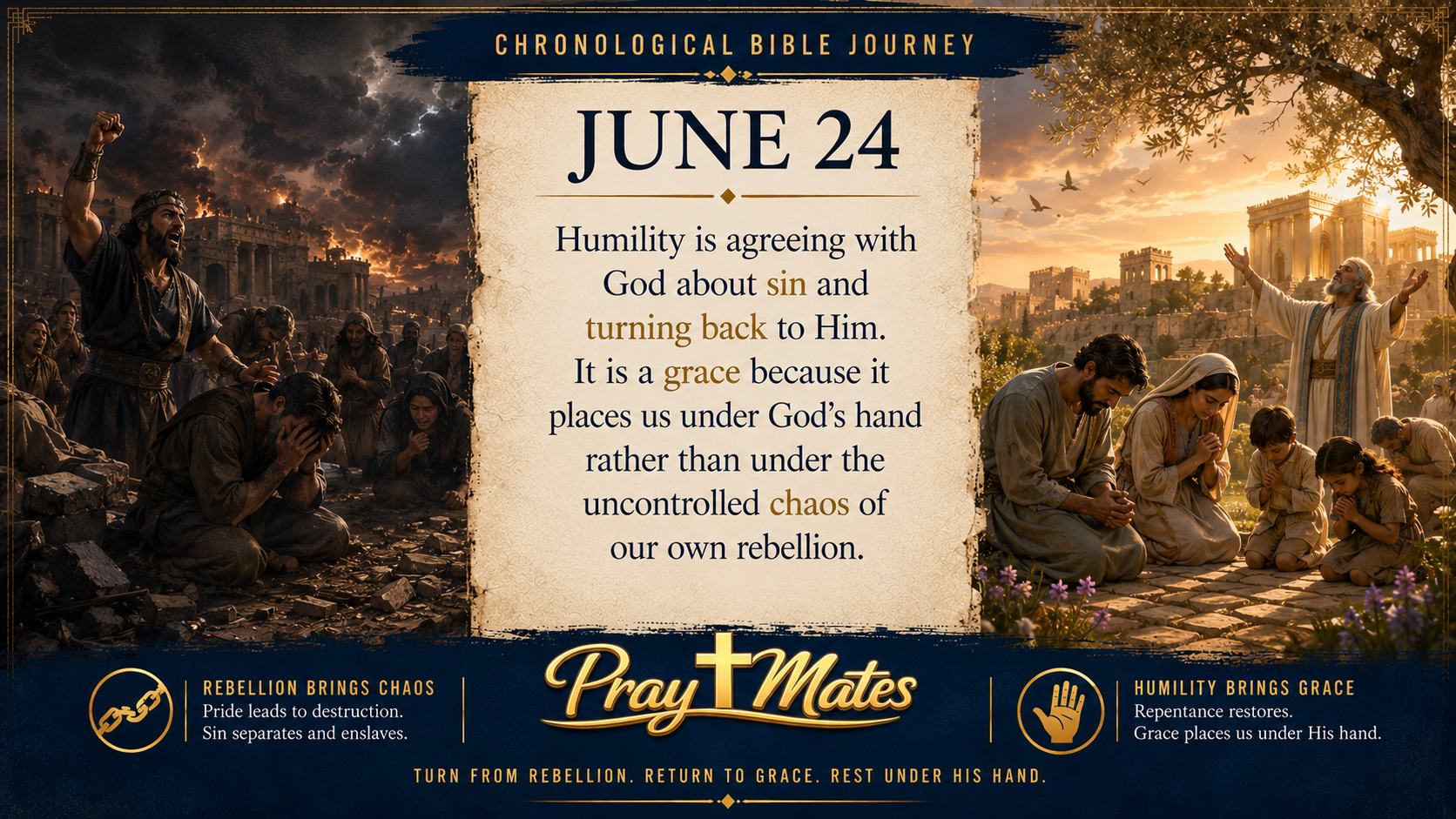
June 24 — Pride, Plunder, and a Merciful Humbling
June 24 — Pride, Plunder, and a Merciful Humbling
SCRIPTURE READING:
2 Chronicles 10-12
SCRIPTURE:
Passage: 2 Chronicles 10
¹ And Rehoboam went to Shechem: for to Shechem were all Israel come to make him king.
² And it came to pass, when Jeroboam the son of Nebat, who was in Egypt, whither he fled from the presence of Solomon the king, heard it, that Jeroboam returned out of Egypt.
³ And they sent and called him. So Jeroboam and all Israel came and spake to Rehoboam, saying,
⁴ Thy father made our yoke grievous: now therefore ease thou somewhat the grievous servitude of thy father, and his heavy yoke that he put upon us, and we will serve thee.
⁵ And he said unto them, Come again unto me after three days. And the people departed.
⁶ And king Rehoboam took counsel with the old men that had stood before Solomon his father while he yet lived, saying, What counsel give ye me to return answer to this people?
⁷ And they spake unto him, saying, If thou be kind to this people, and please them, and speak good words to them, they will be thy servants for ever.
⁸ But he forsook the counsel which the old men gave him, and took counsel with the young men that were brought up with him, that stood before him.
⁹ And he said unto them, What advice give ye that we may return answer to this people, which have spoken to me, saying, Ease somewhat the yoke that thy father did put upon us?
¹⁰ And the young men that were brought up with him spake unto him, saying, Thus shalt thou answer the people that spake unto thee, saying, Thy father made our yoke heavy, but make thou it somewhat lighter for us; thus shalt thou say unto them, My little finger shall be thicker than my father's loins.
¹¹ For whereas my father put a heavy yoke upon you, I will put more to your yoke: my father chastised you with whips, but I will chastise you with scorpions.
¹² So Jeroboam and all the people came to Rehoboam on the third day, as the king bade, saying, Come again to me on the third day.
¹³ And the king answered them roughly; and king Rehoboam forsook the counsel of the old men,
¹⁴ And answered them after the advice of the young men, saying, My father made your yoke heavy, but I will add thereto: my father chastised you with whips, but I will chastise you with scorpions.
¹⁵ So the king hearkened not unto the people: for the cause was of God, that the LORD might perform his word, which he spake by the hand of Ahijah the Shilonite to Jeroboam the son of Nebat.
¹⁶ And when all Israel saw that the king would not hearken unto them, the people answered the king, saying, What portion have we in David? and we have none inheritance in the son of Jesse: every man to your tents, O Israel: and now, David, see to thine own house. So all Israel went to their tents.
¹⁷ But as for the children of Israel that dwelt in the cities of Judah, Rehoboam reigned over them.
¹⁸ Then king Rehoboam sent Hadoram that was over the tribute; and the children of Israel stoned him with stones, that he died. But king Rehoboam made speed to get him up to his chariot, to flee to Jerusalem.
¹⁹ And Israel rebelled against the house of David unto this day.
Passage: 2 Chronicles 11
¹ And when Rehoboam was come to Jerusalem, he gathered of the house of Judah and Benjamin an hundred and fourscore thousand chosen men, which were warriors, to fight against Israel, that he might bring the kingdom again to Rehoboam.
² But the word of the LORD came to Shemaiah the man of God, saying,
³ Speak unto Rehoboam the son of Solomon, king of Judah, and to all Israel in Judah and Benjamin, saying,
⁴ Thus saith the LORD, Ye shall not go up, nor fight against your brethren: return every man to his house: for this thing is done of me. And they obeyed the words of the LORD, and returned from going against Jeroboam.
⁵ And Rehoboam dwelt in Jerusalem, and built cities for defence in Judah.
⁶ He built even Bethlehem, and Etam, and Tekoa,
⁷ And Bethzur, and Shoco, and Adullam,
⁸ And Gath, and Mareshah, and Ziph,
⁹ And Adoraim, and Lachish, and Azekah,
¹⁰ And Zorah, and Aijalon, and Hebron, which are in Judah and in Benjamin fenced cities.
¹¹ And he fortified the strong holds, and put captains in them, and store of victual, and of oil and wine.
¹² And in every several city he put shields and spears, and made them exceeding strong, having Judah and Benjamin on his side.
¹³ And the priests and the Levites that were in all Israel resorted to him out of all their coasts.
¹⁴ For the Levites left their suburbs and their possession, and came to Judah and Jerusalem: for Jeroboam and his sons had cast them off from executing the priest's office unto the LORD:
¹⁵ And he ordained him priests for the high places, and for the devils, and for the calves which he had made.
¹⁶ And after them out of all the tribes of Israel such as set their hearts to seek the LORD God of Israel came to Jerusalem, to sacrifice unto the LORD God of their fathers.
¹⁷ So they strengthened the kingdom of Judah, and made Rehoboam the son of Solomon strong, three years: for three years they walked in the way of David and Solomon.
¹⁸ And Rehoboam took him Mahalath the daughter of Jerimoth the son of David to wife, and Abihail the daughter of Eliab the son of Jesse;
¹⁹ Which bare him children; Jeush, and Shamariah, and Zaham.
²⁰ And after her he took Maachah the daughter of Absalom; which bare him Abijah, and Attai, and Ziza, and Shelomith.
²¹ And Rehoboam loved Maachah the daughter of Absalom above all his wives and his concubines: (for he took eighteen wives, and threescore concubines; and begat twenty and eight sons, and threescore daughters.)
²² And Rehoboam made Abijah the son of Maachah the chief, to be ruler among his brethren: for he thought to make him king.
²³ And he dealt wisely, and dispersed of all his children throughout all the countries of Judah and Benjamin, unto every fenced city: and he gave them victual in abundance. And he desired many wives.
Passage: 2 Chronicles 12
¹ And it came to pass, when Rehoboam had established the kingdom, and had strengthened himself, he forsook the law of the LORD, and all Israel with him.
² And it came to pass, that in the fifth year of king Rehoboam Shishak king of Egypt came up against Jerusalem, because they had transgressed against the LORD,
³ With twelve hundred chariots, and threescore thousand horsemen: and the people were without number that came with him out of Egypt; the Lubims, the Sukkiims, and the Ethiopians.
⁴ And he took the fenced cities which pertained to Judah, and came to Jerusalem.
⁵ Then came Shemaiah the prophet to Rehoboam, and to the princes of Judah, that were gathered together to Jerusalem because of Shishak, and said unto them, Thus saith the LORD, Ye have forsaken me, and therefore have I also left you in the hand of Shishak.
⁶ Whereupon the princes of Israel and the king humbled themselves; and they said, The LORD is righteous.
⁷ And when the LORD saw that they humbled themselves, the word of the LORD came to Shemaiah, saying, They have humbled themselves; therefore I will not destroy them, but I will grant them some deliverance; and my wrath shall not be poured out upon Jerusalem by the hand of Shishak.
⁸ Nevertheless they shall be his servants; that they may know my service, and the service of the kingdoms of the countries.
⁹ So Shishak king of Egypt came up against Jerusalem, and took away the treasures of the house of the LORD, and the treasures of the king's house; he took all: he carried away also the shields of gold which Solomon had made.
¹⁰ Instead of which king Rehoboam made shields of brass, and committed them to the hands of the chief of the guard, that kept the entrance of the king's house.
¹¹ And when the king entered into the house of the LORD, the guard came and fetched them, and brought them again into the guard chamber.
¹² And when he humbled himself, the wrath of the LORD turned from him, that he would not destroy him altogether: and also in Judah things went well.
¹³ So king Rehoboam strengthened himself in Jerusalem, and reigned: for Rehoboam was one and forty years old when he began to reign, and he reigned seventeen years in Jerusalem, the city which the LORD had chosen out of all the tribes of Israel, to put his name there. And his mother's name was Naamah an Ammonitess.
¹⁴ And he did evil, because he prepared not his heart to seek the LORD.
¹⁵ Now the acts of Rehoboam, first and last, are they not written in the book of Shemaiah the prophet, and of Iddo the seer concerning genealogies? And there were wars between Rehoboam and Jeroboam continually.
¹⁶ And Rehoboam slept with his fathers, and was buried in the city of David: and Abijah his son reigned in his stead.
DEVOTIONAL:
2 Chronicles 10 parallels the painful story of the kingdom’s division, but Chronicles emphasizes a spiritual lens: the word was of God, yet the human sin was real. Rehoboam’s refusal to serve the people produces rebellion, and the fracture becomes the new reality of Israel’s life. Scripture does not present this as a mere political event. It is covenant consequence: pride and folly carry national weight.
Chapter 11 shows God’s mercy even in division. The LORD restrains civil war through the prophet Shemaiah, and many Levites and faithful worshipers move toward Jerusalem because Jeroboam’s worship is corrupted. God is preserving true worship and keeping a remnant near the house where His name dwells. Even when judgment comes, mercy is at work, gathering those who fear the LORD.
Chapter 12 then records Shishak’s invasion and the plundering of treasures. The loss of gold is more than economic setback; it is a visible sign of spiritual decline. Yet when the princes of Israel humble themselves, the LORD speaks again: “They have humbled themselves; therefore I will not destroy them.” The discipline is real, but it is tempered with mercy. God’s aim is not annihilation for its own sake. His aim is to bring His people back from hardness.
Chronicles is teaching us that humility is not humiliation. Humility is agreeing with God about sin and turning back to Him. It is a grace because it places us under God’s hand rather than under the uncontrolled chaos of our own rebellion. When Rehoboam humbles himself, wrath is turned, and that mercy becomes a window into God’s character.
Jesus embodies true humility without ever needing repentance for sin. He lowered Himself, taking the form of a servant, and He bore the plundering of judgment that our pride deserved. Through His cross, the humbled King becomes the Savior of humbled sinners. In Him, repentance is not merely damage control. It is a return to the God who disciplines for restoration.
In daily life, receive God’s discipline as mercy when it drives you to humility. Do not waste consequences by hardening your heart. Confess quickly, seek counsel, and rebuild obedience patiently. In church life, cultivate a culture where repentance is normal, because pride thrives in secrecy and humility thrives in light.
In U.S. civic life, the virtue of humility is essential for any lasting health because arrogance refuses accountability. Pray for leaders and communities to respond to failures with honest repentance rather than blame-shifting. Christians should show up as people who can admit wrong, seek reconciliation, and model a repentance that is rooted in the gospel.
DISCUSSION QUESTIONS:
What does Chronicles emphasize about God’s mercy even in the midst of the kingdom’s division?
How does Shishak’s plundering function as a spiritual sign as well as a political event?
What is the difference between humiliation and biblical humility, and how can you practice humility rightly?
How does Jesus’ humility shape the way you respond to correction, consequences, and repentance?
PRAYER:
ADORATION:
Merciful LORD, You are righteous in discipline and tender in restoration. You restrain destruction and call Your people back with patient kindness.
CONFESSION:
I confess the pride that resists correction and the excuses that avoid repentance. I have blamed others and hardened my heart. Forgive me and make me humble.
THANKSGIVING:
Thank You for mercy that turns wrath away when Your people humble themselves. Thank You for Jesus, who humbled Himself for our salvation and brings repentant sinners home.
SUPPLICATION – GENERAL:
Teach me to repent quickly and sincerely. Use discipline to restore me, not to embitter me. Strengthen our church to walk in humility, to confess sin openly, and to pursue reconciliation with courage and gentleness.
SUPPLICATION – U.S. / CIVIC:
Grant humility to leaders and citizens when failures are exposed. Restrain prideful blame-shifting and give wisdom for honest reform. Make Christians a visible example of repentance, reconciliation, and steady integrity in public life.
SCRIPTURE: And when the LORD saw that they humbled themselves, the word of the LORD came to Shemaiah, saying, They have humbled themselves; therefore I will not destroy them, but I will grant them some deliverance; 2 Chronicles 12:7
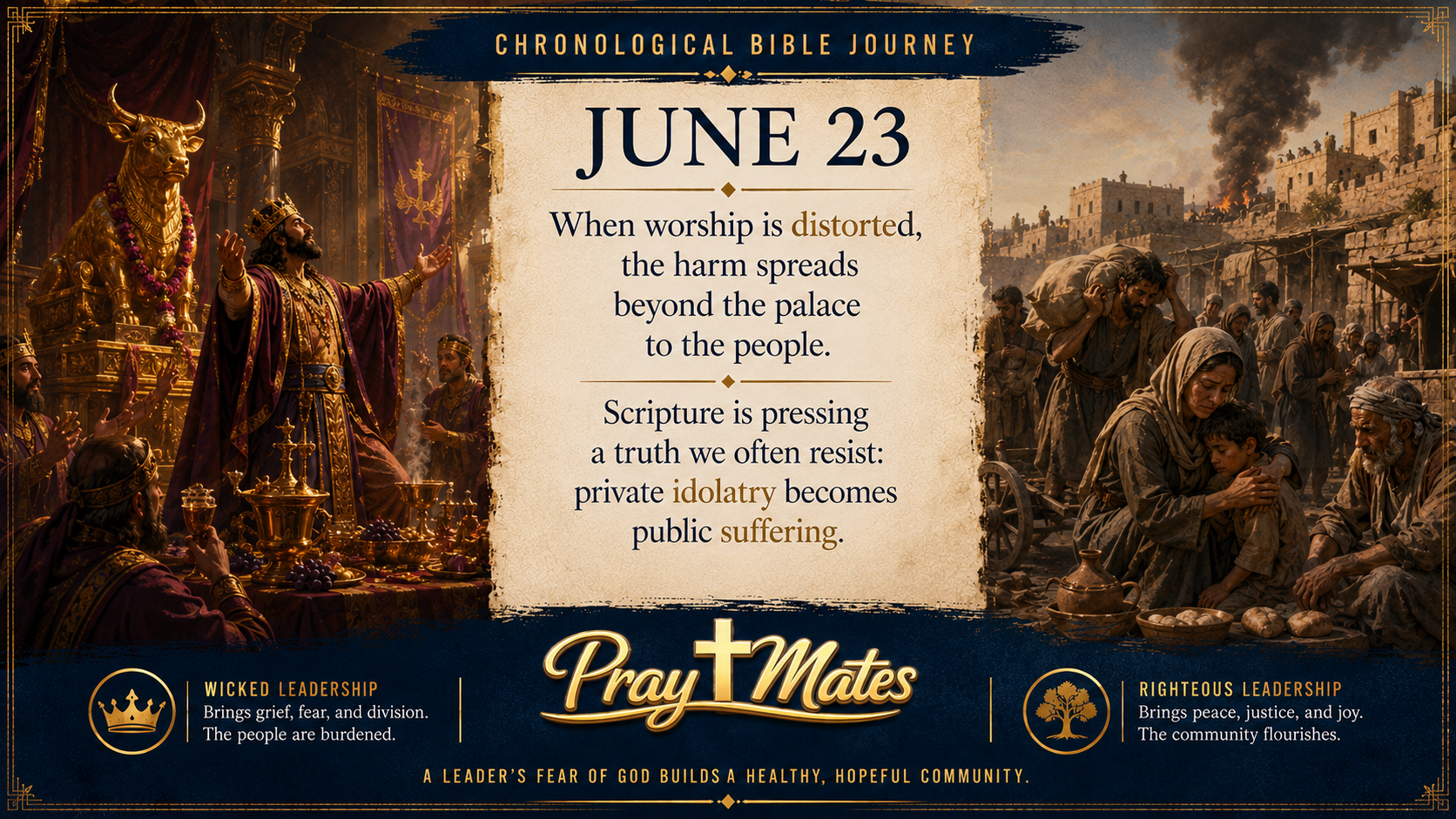
June 23 — Divided Hearts, Divided Kingdom
June 23 — Divided Hearts, Divided Kingdom
SCRIPTURE READING:
1 Kings 12-14
SCRIPTURE:
Passage: 1 Kings 12
¹ And Rehoboam went to Shechem: for all Israel were come to Shechem to make him king.
² And it came to pass, when Jeroboam the son of Nebat, who was yet in Egypt, heard of it, (for he was fled from the presence of king Solomon, and Jeroboam dwelt in Egypt;)
³ That they sent and called him. And Jeroboam and all the congregation of Israel came, and spake unto Rehoboam, saying,
⁴ Thy father made our yoke grievous: now therefore make thou the grievous service of thy father, and his heavy yoke which he put upon us, lighter, and we will serve thee.
⁵ And he said unto them, Depart yet for three days, then come again to me. And the people departed.
⁶ And king Rehoboam consulted with the old men, that stood before Solomon his father while he yet lived, and said, How do ye advise that I may answer this people?
⁷ And they spake unto him, saying, If thou wilt be a servant unto this people this day, and wilt serve them, and answer them, and speak good words to them, then they will be thy servants for ever.
⁸ But he forsook the counsel of the old men, which they had given him, and consulted with the young men that were grown up with him, and which stood before him:
⁹ And he said unto them, What counsel give ye that we may answer this people, who have spoken to me, saying, Make the yoke which thy father did put upon us lighter?
¹⁰ And the young men that were grown up with him spake unto him, saying, Thus shalt thou speak unto this people that spake unto thee, saying, Thy father made our yoke heavy, but make thou it lighter unto us; thus shalt thou say unto them, My little finger shall be thicker than my father's loins.
¹¹ And now whereas my father did lade you with a heavy yoke, I will add to your yoke: my father hath chastised you with whips, but I will chastise you with scorpions.
¹² So Jeroboam and all the people came to Rehoboam the third day, as the king had appointed, saying, Come to me again the third day.
¹³ And the king answered the people roughly, and forsook the old men's counsel that they gave him;
¹⁴ And spake to them after the counsel of the young men, saying, My father made your yoke heavy, and I will add to your yoke: my father also chastised you with whips, but I will chastise you with scorpions.
¹⁵ Wherefore the king hearkened not unto the people; for the cause was from the LORD, that he might perform his saying, which the LORD spake by Ahijah the Shilonite unto Jeroboam the son of Nebat.
¹⁶ So when all Israel saw that the king hearkened not unto them, the people answered the king, saying, What portion have we in David? neither have we inheritance in the son of Jesse: to your tents, O Israel: now see to thine own house, David. So Israel departed unto their tents.
¹⁷ But as for the children of Israel which dwelt in the cities of Judah, Rehoboam reigned over them.
¹⁸ Then king Rehoboam sent Adoram, who was over the tribute; and all Israel stoned him with stones, that he died. Therefore king Rehoboam made speed to get him up to his chariot, to flee to Jerusalem.
¹⁹ So Israel rebelled against the house of David unto this day.
²⁰ And it came to pass, when all Israel heard that Jeroboam was come again, that they sent and called him unto the congregation, and made him king over all Israel: there was none that followed the house of David, but the tribe of Judah only.
²¹ And when Rehoboam was come to Jerusalem, he assembled all the house of Judah, with the tribe of Benjamin, an hundred and fourscore thousand chosen men, which were warriors, to fight against the house of Israel, to bring the kingdom again to Rehoboam the son of Solomon.
²² But the word of God came unto Shemaiah the man of God, saying,
²³ Speak unto Rehoboam, the son of Solomon, king of Judah, and unto all the house of Judah and Benjamin, and to the remnant of the people, saying,
²⁴ Thus saith the LORD, Ye shall not go up, nor fight against your brethren the children of Israel: return every man to his house; for this thing is from me. They hearkened therefore to the word of the LORD, and returned to depart, according to the word of the LORD.
²⁵ Then Jeroboam built Shechem in mount Ephraim, and dwelt therein; and went out from thence, and built Penuel.
²⁶ And Jeroboam said in his heart, Now shall the kingdom return to the house of David:
²⁷ If this people go up to do sacrifice in the house of the LORD at Jerusalem, then shall the heart of this people turn again unto their lord, even unto Rehoboam king of Judah, and they shall kill me, and go again to Rehoboam king of Judah.
²⁸ Whereupon the king took counsel, and made two calves of gold, and said unto them, It is too much for you to go up to Jerusalem: behold thy gods, O Israel, which brought thee up out of the land of Egypt.
²⁹ And he set the one in Bethel, and the other put he in Dan.
³⁰ And this thing became a sin: for the people went to worship before the one, even unto Dan.
³¹ And he made an house of high places, and made priests of the lowest of the people, which were not of the sons of Levi.
³² And Jeroboam ordained a feast in the eighth month, on the fifteenth day of the month, like unto the feast that is in Judah, and he offered upon the altar. So did he in Bethel, sacrificing unto the calves that he had made: and he placed in Bethel the priests of the high places which he had made.
³³ So he offered upon the altar which he had made in Bethel the fifteenth day of the eighth month, even in the month which he had devised of his own heart; and ordained a feast unto the children of Israel: and he offered upon the altar, and burnt incense.
Passage: 1 Kings 13
¹ And, behold, there came a man of God out of Judah by the word of the LORD unto Bethel: and Jeroboam stood by the altar to burn incense.
² And he cried against the altar in the word of the LORD, and said, O altar, altar, thus saith the LORD; Behold, a child shall be born unto the house of David, Josiah by name; and upon thee shall he offer the priests of the high places that burn incense upon thee, and men's bones shall be burnt upon thee.
³ And he gave a sign the same day, saying, This is the sign which the LORD hath spoken; Behold, the altar shall be rent, and the ashes that are upon it shall be poured out.
⁴ And it came to pass, when king Jeroboam heard the saying of the man of God, which had cried against the altar in Bethel, that he put forth his hand from the altar, saying, Lay hold on him. And his hand, which he put forth against him, dried up, so that he could not pull it in again to him.
⁵ The altar also was rent, and the ashes poured out from the altar, according to the sign which the man of God had given by the word of the LORD.
⁶ And the king answered and said unto the man of God, Intreat now the face of the LORD thy God, and pray for me, that my hand may be restored me again. And the man of God besought the LORD, and the king's hand was restored him again, and became as it was before.
⁷ And the king said unto the man of God, Come home with me, and refresh thyself, and I will give thee a reward.
⁸ And the man of God said unto the king, If thou wilt give me half thine house, I will not go in with thee, neither will I eat bread nor drink water in this place:
⁹ For so was it charged me by the word of the LORD, saying, Eat no bread, nor drink water, nor turn again by the same way that thou camest.
¹⁰ So he went another way, and returned not by the way that he came to Bethel.
¹¹ Now there dwelt an old prophet in Bethel; and his sons came and told him all the works that the man of God had done that day in Bethel: the words which he had spoken unto the king, them they told also to their father.
¹² And their father said unto them, What way went he? For his sons had seen what way the man of God went, which came from Judah.
¹³ And he said unto his sons, Saddle me the ass. So they saddled him the ass: and he rode thereon,
¹⁴ And went after the man of God, and found him sitting under an oak: and he said unto him, Art thou the man of God that camest from Judah? And he said, I am.
¹⁵ Then he said unto him, Come home with me, and eat bread.
¹⁶ And he said, I may not return with thee, nor go in with thee: neither will I eat bread nor drink water with thee in this place:
¹⁷ For it was said to me by the word of the LORD, Thou shalt eat no bread nor drink water there, nor turn again to go by the way that thou camest.
¹⁸ He said unto him, I am a prophet also as thou art; and an angel spake unto me by the word of the LORD, saying, Bring him back with thee into thine house, that he may eat bread and drink water. But he lied unto him.
¹⁹ So he went back with him, and did eat bread in his house, and drank water.
²⁰ And it came to pass, as they sat at the table, that the word of the LORD came unto the prophet that brought him back:
²¹ And he cried unto the man of God that came from Judah, saying, Thus saith the LORD, Forasmuch as thou hast disobeyed the mouth of the LORD, and hast not kept the commandment which the LORD thy God commanded thee,
²² But camest back, and hast eaten bread and drunk water in the place, of the which the Lord did say to thee, Eat no bread, and drink no water; thy carcase shall not come unto the sepulchre of thy fathers.
²³ And it came to pass, after he had eaten bread, and after he had drunk, that he saddled for him the ass, to wit, for the prophet whom he had brought back.
²⁴ And when he was gone, a lion met him by the way, and slew him: and his carcase was cast in the way, and the ass stood by it, the lion also stood by the carcase.
²⁵ And, behold, men passed by, and saw the carcase cast in the way, and the lion standing by the carcase: and they came and told it in the city where the old prophet dwelt.
²⁶ And when the prophet that brought him back from the way heard thereof, he said, It is the man of God, who was disobedient unto the word of the LORD: therefore the LORD hath delivered him unto the lion, which hath torn him, and slain him, according to the word of the LORD, which he spake unto him.
²⁷ And he spake to his sons, saying, Saddle me the ass. And they saddled him.
²⁸ And he went and found his carcase cast in the way, and the ass and the lion standing by the carcase: the lion had not eaten the carcase, nor torn the ass.
²⁹ And the prophet took up the carcase of the man of God, and laid it upon the ass, and brought it back: and the old prophet came to the city, to mourn and to bury him.
³⁰ And he laid his carcase in his own grave; and they mourned over him, saying, Alas, my brother!
³¹ And it came to pass, after he had buried him, that he spake to his sons, saying, When I am dead, then bury me in the sepulchre wherein the man of God is buried; lay my bones beside his bones:
³² For the saying which he cried by the word of the LORD against the altar in Bethel, and against all the houses of the high places which are in the cities of Samaria, shall surely come to pass.
³³ After this thing Jeroboam returned not from his evil way, but made again of the lowest of the people priests of the high places: whosoever would, he consecrated him, and he became one of the priests of the high places.
³⁴ And this thing became sin unto the house of Jeroboam, even to cut it off, and to destroy it from off the face of the earth.
Passage: 1 Kings 14
¹ At that time Abijah the son of Jeroboam fell sick.
² And Jeroboam said to his wife, Arise, I pray thee, and disguise thyself, that thou be not known to be the wife of Jeroboam; and get thee to Shiloh: behold, there is Ahijah the prophet, which told me that I should be king over this people.
³ And take with thee ten loaves, and cracknels, and a cruse of honey, and go to him: he shall tell thee what shall become of the child.
⁴ And Jeroboam's wife did so, and arose, and went to Shiloh, and came to the house of Ahijah. But Ahijah could not see; for his eyes were set by reason of his age.
⁵ And the LORD said unto Ahijah, Behold, the wife of Jeroboam cometh to ask a thing of thee for her son; for he is sick: thus and thus shalt thou say unto her: for it shall be, when she cometh in, that she shall feign herself to be another woman.
⁶ And it was so, when Ahijah heard the sound of her feet, as she came in at the door, that he said, Come in, thou wife of Jeroboam; why feignest thou thyself to be another? for I am sent to thee with heavy tidings.
⁷ Go, tell Jeroboam, Thus saith the LORD God of Israel, Forasmuch as I exalted thee from among the people, and made thee prince over my people Israel,
⁸ And rent the kingdom away from the house of David, and gave it thee: and yet thou hast not been as my servant David, who kept my commandments, and who followed me with all his heart, to do that only which was right in mine eyes;
⁹ But hast done evil above all that were before thee: for thou hast gone and made thee other gods, and molten images, to provoke me to anger, and hast cast me behind thy back:
¹⁰ Therefore, behold, I will bring evil upon the house of Jeroboam, and will cut off from Jeroboam him that pisseth against the wall, and him that is shut up and left in Israel, and will take away the remnant of the house of Jeroboam, as a man taketh away dung, till it be all gone.
¹¹ Him that dieth of Jeroboam in the city shall the dogs eat; and him that dieth in the field shall the fowls of the air eat: for the LORD hath spoken it.
¹² Arise thou therefore, get thee to thine own house: and when thy feet enter into the city, the child shall die.
¹³ And all Israel shall mourn for him, and bury him: for he only of Jeroboam shall come to the grave, because in him there is found some good thing toward the LORD God of Israel in the house of Jeroboam.
¹⁴ Moreover the LORD shall raise him up a king over Israel, who shall cut off the house of Jeroboam that day: but what? even now.
¹⁵ For the LORD shall smite Israel, as a reed is shaken in the water, and he shall root up Israel out of this good land, which he gave to their fathers, and shall scatter them beyond the river, because they have made their groves, provoking the LORD to anger.
¹⁶ And he shall give Israel up because of the sins of Jeroboam, who did sin, and who made Israel to sin.
¹⁷ And Jeroboam's wife arose, and departed, and came to Tirzah: and when she came to the threshold of the door, the child died;
¹⁸ And they buried him; and all Israel mourned for him, according to the word of the LORD, which he spake by the hand of his servant Ahijah the prophet.
¹⁹ And the rest of the acts of Jeroboam, how he warred, and how he reigned, behold, they are written in the book of the chronicles of the kings of Israel.
²⁰ And the days which Jeroboam reigned were two and twenty years: and he slept with his fathers, and Nadab his son reigned in his stead.
²¹ And Rehoboam the son of Solomon reigned in Judah. Rehoboam was forty and one years old when he began to reign, and he reigned seventeen years in Jerusalem, the city which the LORD did choose out of all the tribes of Israel, to put his name there. And his mother's name was Naamah an Ammonitess.
²² And Judah did evil in the sight of the LORD, and they provoked him to jealousy with their sins which they had committed, above all that their fathers had done.
²³ For they also built them high places, and images, and groves, on every high hill, and under every green tree.
²⁴ And there were also sodomites in the land: and they did according to all the abominations of the nations which the LORD cast out before the children of Israel.
²⁵ And it came to pass in the fifth year of king Rehoboam, that Shishak king of Egypt came up against Jerusalem:
²⁶ And he took away the treasures of the house of the LORD, and the treasures of the king's house; he even took away all: and he took away all the shields of gold which Solomon had made.
²⁷ And king Rehoboam made in their stead brasen shields, and committed them unto the hands of the chief of the guard, which kept the door of the king's house.
²⁸ And it was so, when the king went into the house of the LORD, that the guard bare them, and brought them back into the guard chamber.
²⁹ Now the rest of the acts of Rehoboam, and all that he did, are they not written in the book of the chronicles of the kings of Judah?
³⁰ And there was war between Rehoboam and Jeroboam all their days.
³¹ And Rehoboam slept with his fathers, and was buried with his fathers in the city of David. And his mother's name was Naamah an Ammonitess. And Abijam his son reigned in his stead.
DEVOTIONAL:
The division of the kingdom in 1 Kings 12 is a disaster born of pride, fear, and bad counsel. Rehoboam rejects the elders’ wisdom and chooses harshness, treating people as a means to prove strength. The result is fracture. Scripture is not romantic about politics or leadership; it shows how arrogance can tear a community in two. Even when God’s sovereign purposes are at work, human sin remains truly sinful and truly destructive.
Jeroboam’s response exposes another layer of the tragedy. Instead of seeking the LORD, he manufactures a convenient religion. He sets up golden calves, declares new worship centers, and appoints priests apart from God’s commands. This is a replay of Israel’s earlier idolatry, and it shows how quickly hearts trade obedience for convenience. Jeroboam fears losing power, so he builds a counterfeit altar.
Chapters 13 and 14 show that God does not leave such rebellion unaddressed. A prophet confronts the altar, and judgment is announced. Yet even these confrontations include glimpses of mercy, because God warns before He destroys. The LORD is calling His people back to covenant faithfulness, refusing to let them drift into idolatry without resistance.
This narrative also teaches that spiritual leaders and families are not insulated from consequence. Rehoboam’s household and Jeroboam’s household both experience the pain of sin’s ripple effect. When worship is distorted, the harm spreads beyond the palace to the people. Scripture is pressing a truth we often resist: private idolatry becomes public suffering.
Jesus is the King who heals division at the deepest level. He does not gather people by manipulation, and He does not preserve His reign by false worship. He rules by truth, and He unites Jew and Gentile into one new man through His cross. The broken kingdom of Israel points forward to our need for a righteous Son of David who can reconcile sinners to God and sinners to one another.
In daily life, examine where pride is making you harsh or defensive. Seek counsel with humility, and do not despise wisdom because it comes from elders or from Scripture that confronts you. Refuse counterfeit worship that offers convenience without obedience. In the church, pursue unity rooted in truth, remembering that false peace built on compromise is not the peace of Christ.
In U.S. civic life, the virtue of humility expressed through listening can prevent needless fracture. Pray for leaders to serve rather than dominate, and pray for communities torn by distrust to find paths of reconciliation. Christians should show up as peacemakers who refuse idolatry of power and who keep worship of the true God at the center of their public witness.
DISCUSSION QUESTIONS:
What does Rehoboam’s rejection of the elders’ counsel reveal about the danger of pride in leadership?
How does Jeroboam’s counterfeit worship show the connection between fear and idolatry?
Where are you tempted to choose convenience over obedience in your own spiritual life?
How does Jesus’ kingship offer hope for unity that is deeper than political agreement?
PRAYER:
ADORATION:
LORD, You are the true King whose rule is righteous and whose counsel is wise. You alone deserve worship, and Your ways lead to life.
CONFESSION:
I confess my pride and my desire to control outcomes. I have sometimes chosen harshness over service and convenience over obedience. Forgive me and turn my heart back.
THANKSGIVING:
Thank You that You warn before judgment and that You pursue Your people even when they drift. Thank You for Jesus, who reconciles and reigns with truth and mercy.
SUPPLICATION – GENERAL:
Make me humble, teachable, and faithful in worship. Give me wisdom to listen, courage to obey, and grace to pursue unity grounded in truth. Strengthen our church to resist idolatry and to live as one body in Christ.
SUPPLICATION – U.S. / CIVIC:
Grant humility and servant-hearted wisdom to leaders in our communities. Heal divisions that are fueled by pride and fear. Make Christians steady peacemakers who refuse idolizing power and who honor You in the public square.
SCRIPTURE: And they spake unto him, saying, If thou wilt be a servant unto this people this day, and wilt serve them, and answer them, and speak good words to them, then they will be thy servants for ever. 1 Kings 12:7
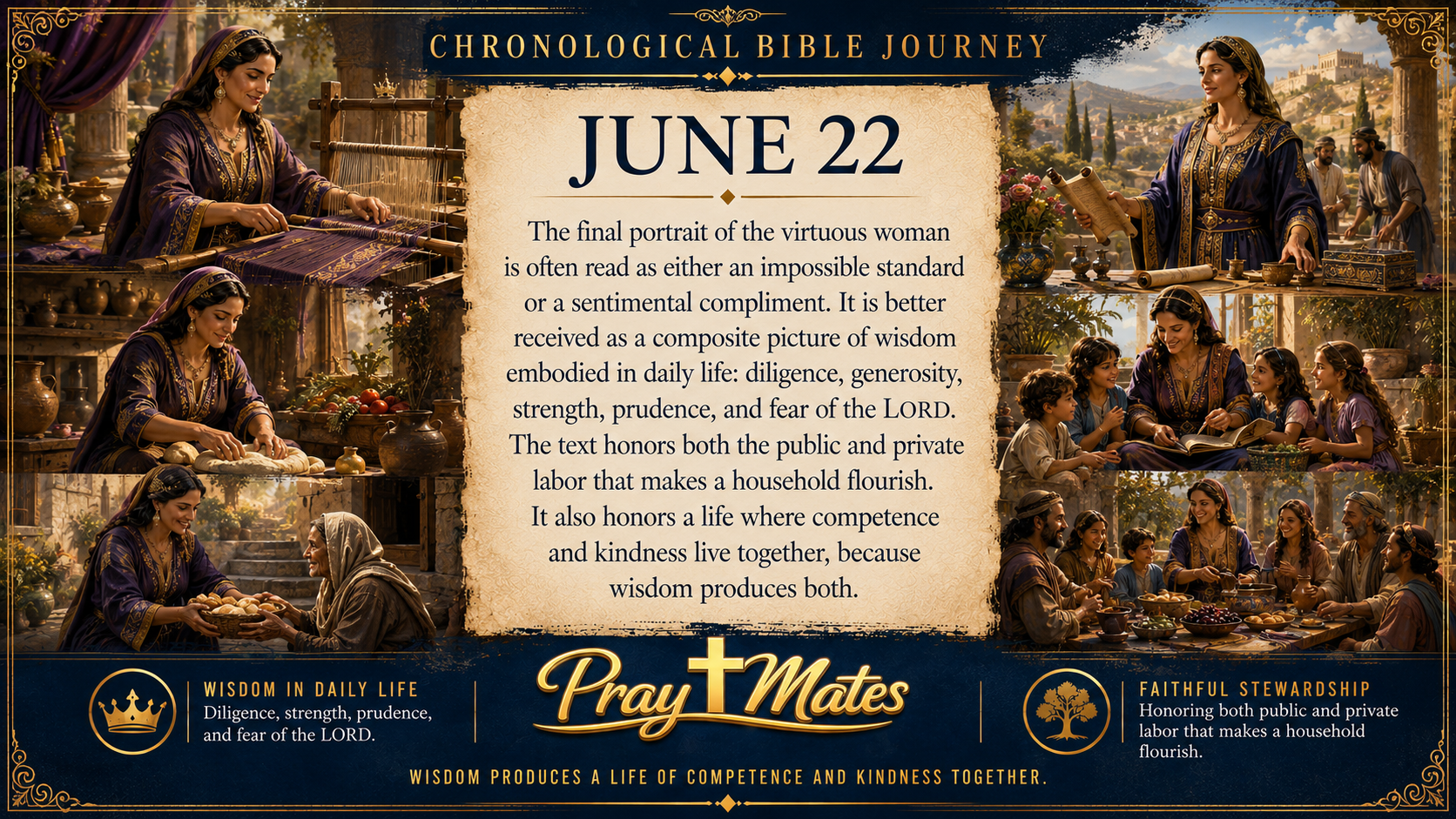
June 22 — Strength That Serves
June 22 — Strength That Serves
SCRIPTURE READING:
Proverbs 30-31
SCRIPTURE:
Passage: Proverbs 30
¹ The words of Agur the son of Jakeh, even the prophecy: the man spake unto Ithiel, even unto Ithiel and Ucal,
² Surely I am more brutish than any man, and have not the understanding of a man.
³ I neither learned wisdom, nor have the knowledge of the holy.
⁴ Who hath ascended up into heaven, or descended? who hath gathered the wind in his fists? who hath bound the waters in a garment? who hath established all the ends of the earth? what is his name, and what is his son's name, if thou canst tell?
⁵ Every word of God is pure: he is a shield unto them that put their trust in him.
⁶ Add thou not unto his words, lest he reprove thee, and thou be found a liar.
⁷ Two things have I required of thee; deny me them not before I die:
⁸ Remove far from me vanity and lies: give me neither poverty nor riches; feed me with food convenient for me:
⁹ Lest I be full, and deny thee, and say, Who is the LORD? or lest I be poor, and steal, and take the name of my God in vain.
¹⁰ Accuse not a servant unto his master, lest he curse thee, and thou be found guilty.
¹¹ There is a generation that curseth their father, and doth not bless their mother.
¹² There is a generation that are pure in their own eyes, and yet is not washed from their filthiness.
¹³ There is a generation, O how lofty are their eyes! and their eyelids are lifted up.
¹⁴ There is a generation, whose teeth are as swords, and their jaw teeth as knives, to devour the poor from off the earth, and the needy from among men.
¹⁵ The horseleach hath two daughters, crying, Give, give. There are three things that are never satisfied, yea, four things say not, It is enough:
¹⁶ The grave; and the barren womb; the earth that is not filled with water; and the fire that saith not, It is enough.
¹⁷ The eye that mocketh at his father, and despiseth to obey his mother, the ravens of the valley shall pick it out, and the young eagles shall eat it.
¹⁸ There be three things which are too wonderful for me, yea, four which I know not:
¹⁹ The way of an eagle in the air; the way of a serpent upon a rock; the way of a ship in the midst of the sea; and the way of a man with a maid.
²⁰ Such is the way of an adulterous woman; she eateth, and wipeth her mouth, and saith, I have done no wickedness.
²¹ For three things the earth is disquieted, and for four which it cannot bear:
²² For a servant when he reigneth; and a fool when he is filled with meat;
²³ For an odious woman when she is married; and an handmaid that is heir to her mistress.
²⁴ There be four things which are little upon the earth, but they are exceeding wise:
²⁵ The ants are a people not strong, yet they prepare their meat in the summer;
²⁶ The conies are but a feeble folk, yet make they their houses in the rocks;
²⁷ The locusts have no king, yet go they forth all of them by bands;
²⁸ The spider taketh hold with her hands, and is in kings' palaces.
²⁹ There be three things which go well, yea, four are comely in going:
³⁰ A lion which is strongest among beasts, and turneth not away for any;
³¹ A greyhound; an he goat also; and a king, against whom there is no rising up.
³² If thou hast done foolishly in lifting up thyself, or if thou hast thought evil, lay thine hand upon thy mouth.
³³ Surely the churning of milk bringeth forth butter, and the wringing of the nose bringeth forth blood: so the forcing of wrath bringeth forth strife.
Passage: Proverbs 31
¹ The words of king Lemuel, the prophecy that his mother taught him.
² What, my son? and what, the son of my womb? and what, the son of my vows?
³ Give not thy strength unto women, nor thy ways to that which destroyeth kings.
⁴ It is not for kings, O Lemuel, it is not for kings to drink wine; nor for princes strong drink:
⁵ Lest they drink, and forget the law, and pervert the judgment of any of the afflicted.
⁶ Give strong drink unto him that is ready to perish, and wine unto those that be of heavy hearts.
⁷ Let him drink, and forget his poverty, and remember his misery no more.
⁸ Open thy mouth for the dumb in the cause of all such as are appointed to destruction.
⁹ Open thy mouth, judge righteously, and plead the cause of the poor and needy.
¹⁰ Who can find a virtuous woman? for her price is far above rubies.
¹¹ The heart of her husband doth safely trust in her, so that he shall have no need of spoil.
¹² She will do him good and not evil all the days of her life.
¹³ She seeketh wool, and flax, and worketh willingly with her hands.
¹⁴ She is like the merchants' ships; she bringeth her food from afar.
¹⁵ She riseth also while it is yet night, and giveth meat to her household, and a portion to her maidens.
¹⁶ She considereth a field, and buyeth it: with the fruit of her hands she planteth a vineyard.
¹⁷ She girdeth her loins with strength, and strengtheneth her arms.
¹⁸ She perceiveth that her merchandise is good: her candle goeth not out by night.
¹⁹ She layeth her hands to the spindle, and her hands hold the distaff.
²⁰ She stretcheth out her hand to the poor; yea, she reacheth forth her hands to the needy.
²¹ She is not afraid of the snow for her household: for all her household are clothed with scarlet.
²² She maketh herself coverings of tapestry; her clothing is silk and purple.
²³ Her husband is known in the gates, when he sitteth among the elders of the land.
²⁴ She maketh fine linen, and selleth it; and delivereth girdles unto the merchant.
²⁵ Strength and honour are her clothing; and she shall rejoice in time to come.
²⁶ She openeth her mouth with wisdom; and in her tongue is the law of kindness.
²⁷ She looketh well to the ways of her household, and eateth not the bread of idleness.
²⁸ Her children arise up, and call her blessed; her husband also, and he praiseth her.
²⁹ Many daughters have done virtuously, but thou excellest them all.
³⁰ Favour is deceitful, and beauty is vain: but a woman that feareth the LORD, she shall be praised.
³¹ Give her of the fruit of her hands; and let her own works praise her in the gates.
DEVOTIONAL:
Proverbs 30 opens with humility that feels almost shocking in a wisdom book. Agur confesses his limitations and then prays for a life protected from vanity and lies. He asks for neither poverty nor riches, but for daily bread that keeps his heart from pride and from desperation. Wisdom here is not self-confidence. It is God-conscious dependence that recognizes how easily circumstances can shape the soul.
Agur’s sayings also warn against careless speech, against arrogant eyes, and against appetites that never say “enough.” The proverbs about small creatures that are exceeding wise train us to notice God’s wisdom in ordinary places. Wisdom is attentive. It learns from ants, conies, locusts, and spiders because it believes God’s world is full of instruction for the humble.
Proverbs 31 then addresses kings and strength. Lemuel is warned not to give strength to destructive passions and not to use authority for self-indulgence. Instead, he is urged to open his mouth for the mute and to defend the poor and needy. Scripture refuses to separate leadership from justice. Power is a trust, not a toy, and it is meant to protect those who cannot protect themselves.
The final portrait of the virtuous woman is often read as either an impossible standard or a sentimental compliment. It is better received as a composite picture of wisdom embodied in daily life: diligence, generosity, strength, prudence, and fear of the LORD. The text honors both the public and private labor that makes a household flourish. It also honors a life where competence and kindness live together, because wisdom produces both.
Jesus fulfills the call of Proverbs 31 in His kingship. He does not use strength for self-protection; He uses it for sacrifice. He opens His mouth for the voiceless, and He bears judgment so that the guilty can be forgiven. In Him, strength is redefined as love that serves. The Spirit then forms that same pattern in God’s people, so that our work and leadership become a testimony to the gospel.
In daily life, pray Agur’s prayer in your own words. Ask God to guard your heart from lies and from appetites that never rest. Practice strength that serves in your home by taking responsibility rather than avoiding it. In church life, honor the quiet labor of faithful women and men, and build a culture where service is celebrated more than self-promotion.
In U.S. civic life, the virtue of temperance joined with advocacy reflects Proverbs 31: leaders and citizens alike must restrain destructive desires and defend the vulnerable. Pray for those who cannot easily speak for themselves, including the poor, the abused, and the unborn. Christians should show up as people who practice self-control and who use their voices to protect life and pursue justice.
DISCUSSION QUESTIONS:
Why is Agur’s prayer for neither poverty nor riches a form of wisdom rather than a lack of ambition?
What appetites or patterns in your life most need the restraint Proverbs 30 describes?
How does Proverbs 31 define righteous leadership in relation to the vulnerable?
How can you honor the “virtuous woman” portrait without turning it into either condemnation or sentimentality?
PRAYER:
ADORATION:
Wise God, You know our frame and You give daily bread with faithful mercy. You are strong and righteous, defending the needy and ruling with truth.
CONFESSION:
I confess my tendency to crave more, to trust in possessions, and to speak carelessly. I have also been slow to defend the vulnerable. Forgive me and change my heart.
THANKSGIVING:
Thank You for wisdom that trains our desires and for Scripture that honors faithful labor. Thank You for Jesus, the King who serves and the Savior who redeems.
SUPPLICATION – GENERAL:
Remove far from me vanity and lies. Give me contentment, diligence, and kindness in my speech. Help me serve my household and church with strength that is humble and steady.
SUPPLICATION – U.S. / CIVIC:
Raise up leaders who protect the poor and needy and who restrain destructive passions. Guard the vulnerable in our nation, and make Your church courageous in advocacy, compassionate in service, and steady in truth.
SCRIPTURE: Open thy mouth for the dumb in the cause of all such as are appointed to destruction. Proverbs 31:8
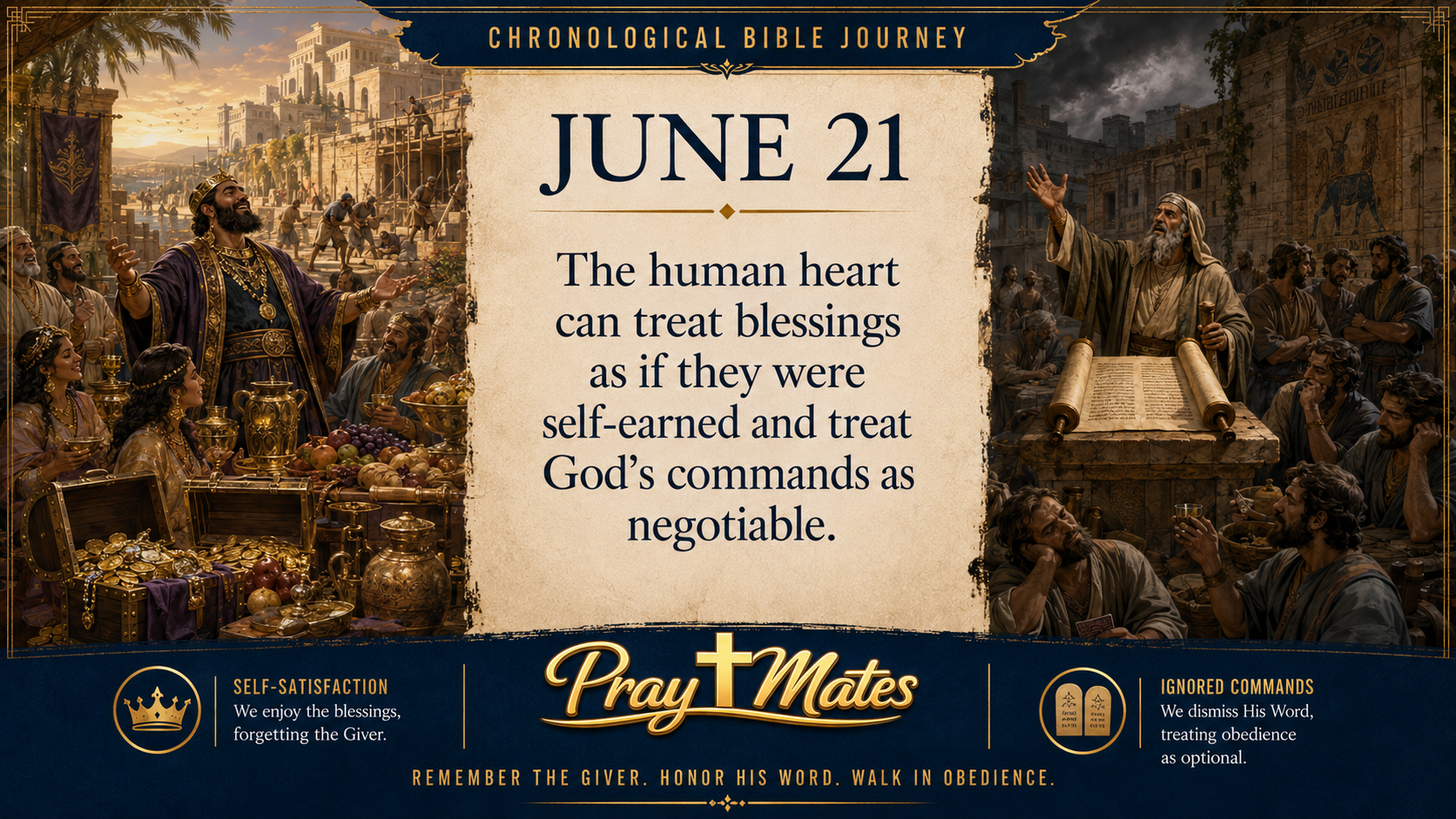
June 21 — When Splendor Becomes a Snare
June 21 — When Splendor Becomes a Snare
SCRIPTURE READING:
1 Kings 10-11; 2 Chronicles 9
SCRIPTURE:
Passage: 1 Kings 10
¹ And when the queen of Sheba heard of the fame of Solomon concerning the name of the LORD, she came to prove him with hard questions.
² And she came to Jerusalem with a very great train, with camels that bare spices, and very much gold, and precious stones: and when she was come to Solomon, she communed with him of all that was in her heart.
³ And Solomon told her all her questions: there was not any thing hid from the king, which he told her not.
⁴ And when the queen of Sheba had seen all Solomon's wisdom, and the house that he had built,
⁵ And the meat of his table, and the sitting of his servants, and the attendance of his ministers, and their apparel, and his cupbearers, and his ascent by which he went up unto the house of the LORD; there was no more spirit in her.
⁶ And she said to the king, It was a true report that I heard in mine own land of thy acts and of thy wisdom.
⁷ Howbeit I believed not the words, until I came, and mine eyes had seen it: and, behold, the half was not told me: thy wisdom and prosperity exceedeth the fame which I heard.
⁸ Happy are thy men, happy are these thy servants, which stand continually before thee, and that hear thy wisdom.
⁹ Blessed be the LORD thy God, which delighted in thee, to set thee on the throne of Israel: because the LORD loved Israel for ever, therefore made he thee king, to do judgment and justice.
¹⁰ And she gave the king an hundred and twenty talents of gold, and of spices very great store, and precious stones: there came no more such abundance of spices as these which the queen of Sheba gave to king Solomon.
¹¹ And the navy also of Hiram, that brought gold from Ophir, brought in from Ophir great plenty of almug trees, and precious stones.
¹² And the king made of the almug trees pillars for the house of the LORD, and for the king's house, harps also and psalteries for singers: there came no such almug trees, nor were seen unto this day.
¹³ And king Solomon gave unto the queen of Sheba all her desire, whatsoever she asked, beside that which Solomon gave her of his royal bounty. So she turned and went to her own country, she and her servants.
¹⁴ Now the weight of gold that came to Solomon in one year was six hundred threescore and six talents of gold,
¹⁵ Beside that he had of the merchantmen, and of the traffick of the spice merchants, and of all the kings of Arabia, and of the governors of the country.
¹⁶ And king Solomon made two hundred targets of beaten gold: six hundred shekels of gold went to one target.
¹⁷ And he made three hundred shields of beaten gold; three pound of gold went to one shield: and the king put them in the house of the forest of Lebanon.
¹⁸ Moreover the king made a great throne of ivory, and overlaid it with the best gold.
¹⁹ The throne had six steps, and the top of the throne was round behind: and there were stays on either side on the place of the seat, and two lions stood beside the stays.
²⁰ And twelve lions stood there on the one side and on the other upon the six steps: there was not the like made in any kingdom.
²¹ And all king Solomon's drinking vessels were of gold, and all the vessels of the house of the forest of Lebanon were of pure gold; none were of silver: it was nothing accounted of in the days of Solomon.
²² For the king had at sea a navy of Tharshish with the navy of Hiram: once in three years came the navy of Tharshish, bringing gold, and silver, ivory, and apes, and peacocks.
²³ So king Solomon exceeded all the kings of the earth for riches and for wisdom.
²⁴ And all the earth sought to Solomon, to hear his wisdom, which God had put in his heart.
²⁵ And they brought every man his present, vessels of silver, and vessels of gold, and garments, and armour, and spices, horses, and mules, a rate year by year.
²⁶ And Solomon gathered together chariots and horsemen: and he had a thousand and four hundred chariots, and twelve thousand horsemen, whom he bestowed in the cities for chariots, and with the king at Jerusalem.
²⁷ And the king made silver to be in Jerusalem as stones, and cedars made he to be as the sycomore trees that are in the vale, for abundance.
²⁸ And Solomon had horses brought out of Egypt, and linen yarn: the king's merchants received the linen yarn at a price.
²⁹ And a chariot came up and went out of Egypt for six hundred shekels of silver, and an horse for an hundred and fifty: and so for all the kings of the Hittites, and for the kings of Syria, did they bring them out by their means.
Passage: 1 Kings 11
¹ But king Solomon loved many strange women, together with the daughter of Pharaoh, women of the Moabites, Ammonites, Edomites, Zidonians, and Hittites:
² Of the nations concerning which the LORD said unto the children of Israel, Ye shall not go in to them, neither shall they come in unto you: for surely they will turn away your heart after their gods: Solomon clave unto these in love.
³ And he had seven hundred wives, princesses, and three hundred concubines: and his wives turned away his heart.
⁴ For it came to pass, when Solomon was old, that his wives turned away his heart after other gods: and his heart was not perfect with the LORD his God, as was the heart of David his father.
⁵ For Solomon went after Ashtoreth the goddess of the Zidonians, and after Milcom the abomination of the Ammonites.
⁶ And Solomon did evil in the sight of the LORD, and went not fully after the LORD, as did David his father.
⁷ Then did Solomon build an high place for Chemosh, the abomination of Moab, in the hill that is before Jerusalem, and for Molech, the abomination of the children of Ammon.
⁸ And likewise did he for all his strange wives, which burnt incense and sacrificed unto their gods.
⁹ And the LORD was angry with Solomon, because his heart was turned from the LORD God of Israel, which had appeared unto him twice,
¹⁰ And had commanded him concerning this thing, that he should not go after other gods: but he kept not that which the LORD commanded.
¹¹ Wherefore the LORD said unto Solomon, Forasmuch as this is done of thee, and thou hast not kept my covenant and my statutes, which I have commanded thee, I will surely rend the kingdom from thee, and will give it to thy servant.
¹² Notwithstanding in thy days I will not do it for David thy father's sake: but I will rend it out of the hand of thy son.
¹³ Howbeit I will not rend away all the kingdom; but will give one tribe to thy son for David my servant's sake, and for Jerusalem's sake which I have chosen.
¹⁴ And the LORD stirred up an adversary unto Solomon, Hadad the Edomite: he was of the king's seed in Edom.
¹⁵ For it came to pass, when David was in Edom, and Joab the captain of the host was gone up to bury the slain, after he had smitten every male in Edom;
¹⁶ (For six months did Joab remain there with all Israel, until he had cut off every male in Edom:)
¹⁷ That Hadad fled, he and certain Edomites of his father's servants with him, to go into Egypt; Hadad being yet a little child.
¹⁸ And they arose out of Midian, and came to Paran: and they took men with them out of Paran, and they came to Egypt, unto Pharaoh king of Egypt; which gave him an house, and appointed him victuals, and gave him land.
¹⁹ And Hadad found great favour in the sight of Pharaoh, so that he gave him to wife the sister of his own wife, the sister of Tahpenes the queen.
²⁰ And the sister of Tahpenes bare him Genubath his son, whom Tahpenes weaned in Pharaoh's house: and Genubath was in Pharaoh's household among the sons of Pharaoh.
²¹ And when Hadad heard in Egypt that David slept with his fathers, and that Joab the captain of the host was dead, Hadad said to Pharaoh, Let me depart, that I may go to mine own country.
²² Then Pharaoh said unto him, But what hast thou lacked with me, that, behold, thou seekest to go to thine own country? And he answered, Nothing: howbeit let me go in any wise.
²³ And God stirred him up another adversary, Rezon the son of Eliadah, which fled from his lord Hadadezer king of Zobah:
²⁴ And he gathered men unto him, and became captain over a band, when David slew them of Zobah: and they went to Damascus, and dwelt therein, and reigned in Damascus.
²⁵ And he was an adversary to Israel all the days of Solomon, beside the mischief that Hadad did: and he abhorred Israel, and reigned over Syria.
²⁶ And Jeroboam the son of Nebat, an Ephrathite of Zereda, Solomon's servant, whose mother's name was Zeruah, a widow woman, even he lifted up his hand against the king.
²⁷ And this was the cause that he lifted up his hand against the king: Solomon built Millo, and repaired the breaches of the city of David his father.
²⁸ And the man Jeroboam was a mighty man of valour: and Solomon seeing the young man that he was industrious, he made him ruler over all the charge of the house of Joseph.
²⁹ And it came to pass at that time when Jeroboam went out of Jerusalem, that the prophet Ahijah the Shilonite found him in the way; and he had clad himself with a new garment; and they two were alone in the field:
³⁰ And Ahijah caught the new garment that was on him, and rent it in twelve pieces:
³¹ And he said to Jeroboam, Take thee ten pieces: for thus saith the LORD, the God of Israel, Behold, I will rend the kingdom out of the hand of Solomon, and will give ten tribes to thee:
³² (But he shall have one tribe for my servant David's sake, and for Jerusalem's sake, the city which I have chosen out of all the tribes of Israel:)
³³ Because that they have forsaken me, and have worshipped Ashtoreth the goddess of the Zidonians, Chemosh the god of the Moabites, and Milcom the god of the children of Ammon, and have not walked in my ways, to do that which is right in mine eyes, and to keep my statutes and my judgments, as did David his father.
³⁴ Howbeit I will not take the whole kingdom out of his hand: but I will make him prince all the days of his life for David my servant's sake, whom I chose, because he kept my commandments and my statutes:
³⁵ But I will take the kingdom out of his son's hand, and will give it unto thee, even ten tribes.
³⁶ And unto his son will I give one tribe, that David my servant may have a light alway before me in Jerusalem, the city which I have chosen me to put my name there.
³⁷ And I will take thee, and thou shalt reign according to all that thy soul desireth, and shalt be king over Israel.
³⁸ And it shall be, if thou wilt hearken unto all that I command thee, and wilt walk in my ways, and do that is right in my sight, to keep my statutes and my commandments, as David my servant did; that I will be with thee, and build thee a sure house, as I built for David, and will give Israel unto thee.
³⁹ And I will for this afflict the seed of David, but not for ever.
⁴⁰ Solomon sought therefore to kill Jeroboam. And Jeroboam arose, and fled into Egypt, unto Shishak king of Egypt, and was in Egypt until the death of Solomon.
⁴¹ And the rest of the acts of Solomon, and all that he did, and his wisdom, are they not written in the book of the acts of Solomon?
⁴² And the time that Solomon reigned in Jerusalem over all Israel was forty years.
⁴³ And Solomon slept with his fathers, and was buried in the city of David his father: and Rehoboam his son reigned in his stead.
Passage: 2 Chronicles 9
¹ And when the queen of Sheba heard of the fame of Solomon, she came to prove Solomon with hard questions at Jerusalem, with a very great company, and camels that bare spices, and gold in abundance, and precious stones: and when she was come to Solomon, she communed with him of all that was in her heart.
² And Solomon told her all her questions: and there was nothing hid from Solomon which he told her not.
³ And when the queen of Sheba had seen the wisdom of Solomon, and the house that he had built,
⁴ And the meat of his table, and the sitting of his servants, and the attendance of his ministers, and their apparel; his cupbearers also, and their apparel; and his ascent by which he went up into the house of the LORD; there was no more spirit in her.
⁵ And she said to the king, It was a true report which I heard in mine own land of thine acts, and of thy wisdom:
⁶ Howbeit I believed not their words, until I came, and mine eyes had seen it: and, behold, the one half of the greatness of thy wisdom was not told me: for thou exceedest the fame that I heard.
⁷ Happy are thy men, and happy are these thy servants, which stand continually before thee, and hear thy wisdom.
⁸ Blessed be the LORD thy God, which delighted in thee to set thee on his throne, to be king for the LORD thy God: because thy God loved Israel, to establish them for ever, therefore made he thee king over them, to do judgment and justice.
⁹ And she gave the king an hundred and twenty talents of gold, and of spices great abundance, and precious stones: neither was there any such spice as the queen of Sheba gave king Solomon.
¹⁰ And the servants also of Huram, and the servants of Solomon, which brought gold from Ophir, brought algum trees and precious stones.
¹¹ And the king made of the algum trees terraces to the house of the LORD, and to the king's palace, and harps and psalteries for singers: and there were none such seen before in the land of Judah.
¹² And king Solomon gave to the queen of Sheba all her desire, whatsoever she asked, beside that which she had brought unto the king. So she turned, and went away to her own land, she and her servants.
¹³ Now the weight of gold that came to Solomon in one year was six hundred and threescore and six talents of gold;
¹⁴ Beside that which chapmen and merchants brought. And all the kings of Arabia and governors of the country brought gold and silver to Solomon.
¹⁵ And king Solomon made two hundred targets of beaten gold: six hundred shekels of beaten gold went to one target.
¹⁶ And three hundred shields made he of beaten gold: three hundred shekels of gold went to one shield. And the king put them in the house of the forest of Lebanon.
¹⁷ Moreover the king made a great throne of ivory, and overlaid it with pure gold.
¹⁸ And there were six steps to the throne, with a footstool of gold, which were fastened to the throne, and stays on each side of the sitting place, and two lions standing by the stays:
¹⁹ And twelve lions stood there on the one side and on the other upon the six steps. There was not the like made in any kingdom.
²⁰ And all the drinking vessels of king Solomon were of gold, and all the vessels of the house of the forest of Lebanon were of pure gold: none were of silver; it was not any thing accounted of in the days of Solomon.
²¹ For the king's ships went to Tarshish with the servants of Huram: every three years once came the ships of Tarshish bringing gold, and silver, ivory, and apes, and peacocks.
²² And king Solomon passed all the kings of the earth in riches and wisdom.
²³ And all the kings of the earth sought the presence of Solomon, to hear his wisdom, that God had put in his heart.
²⁴ And they brought every man his present, vessels of silver, and vessels of gold, and raiment, harness, and spices, horses, and mules, a rate year by year.
²⁵ And Solomon had four thousand stalls for horses and chariots, and twelve thousand horsemen; whom he bestowed in the chariot cities, and with the king at Jerusalem.
²⁶ And he reigned over all the kings from the river even unto the land of the Philistines, and to the border of Egypt.
²⁷ And the king made silver in Jerusalem as stones, and cedar trees made he as the sycomore trees that are in the low plains in abundance.
²⁸ And they brought unto Solomon horses out of Egypt, and out of all lands.
²⁹ Now the rest of the acts of Solomon, first and last, are they not written in the book of Nathan the prophet, and in the prophecy of Ahijah the Shilonite, and in the visions of Iddo the seer against Jeroboam the son of Nebat?
³⁰ And Solomon reigned in Jerusalem over all Israel forty years.
³¹ And Solomon slept with his fathers, and he was buried in the city of David his father: and Rehoboam his son reigned in his stead.
DEVOTIONAL:
The visit of the queen of Sheba is one of the Bible’s most dazzling scenes. She comes with hard questions, and she leaves astonished, praising the LORD for giving Solomon wisdom and a kingdom ordered by justice. 1 Kings 10 and 2 Chronicles 9 present Solomon’s riches and honor in almost overwhelming detail. The point is not to entice us with luxury. The point is to show that God kept His promise to bless the son of David with wisdom and with splendor that the nations could not ignore.
Yet the narrative moves quickly from marvel to warning. The same chapters that describe gold and tribute sit next to 1 Kings 11, where Solomon’s heart turns. Solomon multiplies wives and allows those loves to draw him toward idolatry. This is not a private failure; it is covenant treason. Deuteronomy had warned kings not to multiply horses, wives, and silver, because abundance can quietly teach the heart to trust in gifts rather than in God.
The tragedy is not that Solomon had success. The tragedy is that success became a spiritual blind spot. The human heart can treat blessings as if they were self-earned and treat God’s commands as negotiable. Solomon’s downfall shows that wisdom as a gift is not the same as faithfulness as a habit. The story is written to warn us that the greatest threat to devotion may not be hardship, but comfort without vigilance.
God’s response is righteous. The kingdom will be torn, not because God forgot His promise to David, but because God will not endorse idolatry. Even in judgment, God preserves a remnant for David’s sake, showing that covenant promises endure even when covenant kings fail. The Davidic line remains, not because human rulers are reliable, but because God is.
Jesus stands as the faithful King Solomon could not be. He welcomes the nations without being seduced by their treasures. He rejects the devil’s offer of kingdoms without the cross. He rules by obedience, not by indulgence, and He gathers a people whose hearts are turned by grace. In Him, splendor is not a snare, because His glory is bound to holiness and love.
In daily life, let Solomon’s story teach you to watch your loves. Ask what you are multiplying: comforts, distractions, entertainments, or devotion. Practice gratitude without entitlement, and build habits of worship that keep your heart tender. In church life, be honest that giftedness and success do not guarantee holiness. Pursue accountability that protects the heart, and pray for leaders to finish well.
In U.S. civic life, the virtue of integrity in prosperity matters because wealth and influence can distort judgment. Pray for those with power, money, and public platforms to fear the LORD and to resist compromise. Christians should show up as people who model contentment, practice generosity, and refuse to excuse sin simply because it comes wrapped in success.
DISCUSSION QUESTIONS:
What does the queen of Sheba’s response teach you about God’s intention for Solomon’s wisdom and kingdom?
How does Solomon’s drift show the danger of “multiplied” comforts and unchecked loves?
Why is God’s judgment on Solomon both righteous and still marked by covenant faithfulness?
What safeguards could help you and your church pursue holiness alongside blessing?
PRAYER:
ADORATION:
LORD, You are the faithful King over all kings, generous in blessing and righteous in judgment. Your covenant promises stand firm, and Your holiness cannot be bribed.
CONFESSION:
I confess that my heart is easily drawn to comfort and that I sometimes excuse compromises because they seem small. Forgive me for loving gifts more than the Giver.
THANKSGIVING:
Thank You for the warning of Solomon’s story and for the mercy that calls us back before ruin. Thank You for Jesus, the faithful King who never turns aside.
SUPPLICATION – GENERAL:
Guard my heart from idolatry. Teach me contentment, strengthen my worship, and give me courage to cut off what slowly turns me from You. Protect our church leaders from compromise and help us finish well.
SUPPLICATION – U.S. / CIVIC:
Give integrity to those with wealth and influence in our nation. Expose corruption, restrain exploitation, and grant leaders a fear of the LORD that is stronger than ambition. Make Christians known for generosity, humility, and steady holiness.
SCRIPTURE: For it came to pass, when Solomon was old, that his wives turned away his heart after other gods: and his heart was not perfect with the LORD his God, as was the heart of David his father. 1 Kings 11:4
June 20 — Remember Your Creator While You Have Breath
une 20 — Remember Your Creator While You Have Breath
SCRIPTURE READING:
Ecclesiastes 7-12
SCRIPTURE:
Passage: Ecclesiastes 7
¹ A good name is better than precious ointment; and the day of death than the day of one's birth.
² It is better to go to the house of mourning, than to go to the house of feasting: for that is the end of all men; and the living will lay it to his heart.
³ Sorrow is better than laughter: for by the sadness of the countenance the heart is made better.
⁴ The heart of the wise is in the house of mourning; but the heart of fools is in the house of mirth.
⁵ It is better to hear the rebuke of the wise, than for a man to hear the song of fools.
⁶ For as the crackling of thorns under a pot, so is the laughter of the fool: this also is vanity.
⁷ Surely oppression maketh a wise man mad; and a gift destroyeth the heart.
⁸ Better is the end of a thing than the beginning thereof: and the patient in spirit is better than the proud in spirit.
⁹ Be not hasty in thy spirit to be angry: for anger resteth in the bosom of fools.
¹⁰ Say not thou, What is the cause that the former days were better than these? for thou dost not enquire wisely concerning this.
¹¹ Wisdom is good with an inheritance: and by it there is profit to them that see the sun.
¹² For wisdom is a defence, and money is a defence: but the excellency of knowledge is, that wisdom giveth life to them that have it.
¹³ Consider the work of God: for who can make that straight, which he hath made crooked?
¹⁴ In the day of prosperity be joyful, but in the day of adversity consider: God also hath set the one over against the other, to the end that man should find nothing after him.
¹⁵ All things have I seen in the days of my vanity: there is a just man that perisheth in his righteousness, and there is a wicked man that prolongeth his life in his wickedness.
¹⁶ Be not righteous over much; neither make thyself over wise: why shouldest thou destroy thyself?
¹⁷ Be not over much wicked, neither be thou foolish: why shouldest thou die before thy time?
¹⁸ It is good that thou shouldest take hold of this; yea, also from this withdraw not thine hand: for he that feareth God shall come forth of them all.
¹⁹ Wisdom strengtheneth the wise more than ten mighty men which are in the city.
²⁰ For there is not a just man upon earth, that doeth good, and sinneth not.
²¹ Also take no heed unto all words that are spoken; lest thou hear thy servant curse thee:
²² For oftentimes also thine own heart knoweth that thou thyself likewise hast cursed others.
²³ All this have I proved by wisdom: I said, I will be wise; but it was far from me.
²⁴ That which is far off, and exceeding deep, who can find it out?
²⁵ I applied mine heart to know, and to search, and to seek out wisdom, and the reason of things, and to know the wickedness of folly, even of foolishness and madness:
²⁶ And I find more bitter than death the woman, whose heart is snares and nets, and her hands as bands: whoso pleaseth God shall escape from her; but the sinner shall be taken by her.
²⁷ Behold, this have I found, saith the preacher, counting one by one, to find out the account:
²⁸ Which yet my soul seeketh, but I find not: one man among a thousand have I found; but a woman among all those have I not found.
²⁹ Lo, this only have I found, that God hath made man upright; but they have sought out many inventions.
Passage: Ecclesiastes 8
¹ Who is as the wise man? and who knoweth the interpretation of a thing? a man's wisdom maketh his face to shine, and the boldness of his face shall be changed.
² I counsel thee to keep the king's commandment, and that in regard of the oath of God.
³ Be not hasty to go out of his sight: stand not in an evil thing; for he doeth whatsoever pleaseth him.
⁴ Where the word of a king is, there is power: and who may say unto him, What doest thou?
⁵ Whoso keepeth the commandment shall feel no evil thing: and a wise man's heart discerneth both time and judgment.
⁶ Because to every purpose there is time and judgment, therefore the misery of man is great upon him.
⁷ For he knoweth not that which shall be: for who can tell him when it shall be?
⁸ There is no man that hath power over the spirit to retain the spirit; neither hath he power in the day of death: and there is no discharge in that war; neither shall wickedness deliver those that are given to it.
⁹ All this have I seen, and applied my heart unto every work that is done under the sun: there is a time wherein one man ruleth over another to his own hurt.
¹⁰ And so I saw the wicked buried, who had come and gone from the place of the holy, and they were forgotten in the city where they had so done: this is also vanity.
¹¹ Because sentence against an evil work is not executed speedily, therefore the heart of the sons of men is fully set in them to do evil.
¹² Though a sinner do evil an hundred times, and his days be prolonged, yet surely I know that it shall be well with them that fear God, which fear before him:
¹³ But it shall not be well with the wicked, neither shall he prolong his days, which are as a shadow; because he feareth not before God.
¹⁴ There is a vanity which is done upon the earth; that there be just men, unto whom it happeneth according to the work of the wicked; again, there be wicked men, to whom it happeneth according to the work of the righteous: I said that this also is vanity.
¹⁵ Then I commended mirth, because a man hath no better thing under the sun, than to eat, and to drink, and to be merry: for that shall abide with him of his labour the days of his life, which God giveth him under the sun.
¹⁶ When I applied mine heart to know wisdom, and to see the business that is done upon the earth: (for also there is that neither day nor night seeth sleep with his eyes:)
¹⁷ Then I beheld all the work of God, that a man cannot find out the work that is done under the sun: because though a man labour to seek it out, yet he shall not find it; yea farther; though a wise man think to know it, yet shall he not be able to find it.
Passage: Ecclesiastes 9
¹ For all this I considered in my heart even to declare all this, that the righteous, and the wise, and their works, are in the hand of God: no man knoweth either love or hatred by all that is before them.
² All things come alike to all: there is one event to the righteous, and to the wicked; to the good and to the clean, and to the unclean; to him that sacrificeth, and to him that sacrificeth not: as is the good, so is the sinner; and he that sweareth, as he that feareth an oath.
³ This is an evil among all things that are done under the sun, that there is one event unto all: yea, also the heart of the sons of men is full of evil, and madness is in their heart while they live, and after that they go to the dead.
⁴ For to him that is joined to all the living there is hope: for a living dog is better than a dead lion.
⁵ For the living know that they shall die: but the dead know not any thing, neither have they any more a reward; for the memory of them is forgotten.
⁶ Also their love, and their hatred, and their envy, is now perished; neither have they any more a portion for ever in any thing that is done under the sun.
⁷ Go thy way, eat thy bread with joy, and drink thy wine with a merry heart; for God now accepteth thy works.
⁸ Let thy garments be always white; and let thy head lack no ointment.
⁹ Live joyfully with the wife whom thou lovest all the days of the life of thy vanity, which he hath given thee under the sun, all the days of thy vanity: for that is thy portion in this life, and in thy labour which thou takest under the sun.
¹⁰ Whatsoever thy hand findeth to do, do it with thy might; for there is no work, nor device, nor knowledge, nor wisdom, in the grave, whither thou goest.
¹¹ I returned, and saw under the sun, that the race is not to the swift, nor the battle to the strong, neither yet bread to the wise, nor yet riches to men of understanding, nor yet favour to men of skill; but time and chance happeneth to them all.
¹² For man also knoweth not his time: as the fishes that are taken in an evil net, and as the birds that are caught in the snare; so are the sons of men snared in an evil time, when it falleth suddenly upon them.
¹³ This wisdom have I seen also under the sun, and it seemed great unto me:
¹⁴ There was a little city, and few men within it; and there came a great king against it, and besieged it, and built great bulwarks against it:
¹⁵ Now there was found in it a poor wise man, and he by his wisdom delivered the city; yet no man remembered that same poor man.
¹⁶ Then said I, Wisdom is better than strength: nevertheless the poor man's wisdom is despised, and his words are not heard.
¹⁷ The words of wise men are heard in quiet more than the cry of him that ruleth among fools.
¹⁸ Wisdom is better than weapons of war: but one sinner destroyeth much good.
Passage: Ecclesiastes 10
¹ Dead flies cause the ointment of the apothecary to send forth a stinking savour: so doth a little folly him that is in reputation for wisdom and honour.
² A wise man's heart is at his right hand; but a fool's heart at his left.
³ Yea also, when he that is a fool walketh by the way, his wisdom faileth him, and he saith to every one that he is a fool.
⁴ If the spirit of the ruler rise up against thee, leave not thy place; for yielding pacifieth great offences.
⁵ There is an evil which I have seen under the sun, as an error which proceedeth from the ruler:
⁶ Folly is set in great dignity, and the rich sit in low place.
⁷ I have seen servants upon horses, and princes walking as servants upon the earth.
⁸ He that diggeth a pit shall fall into it; and whoso breaketh an hedge, a serpent shall bite him.
⁹ Whoso removeth stones shall be hurt therewith; and he that cleaveth wood shall be endangered thereby.
¹⁰ If the iron be blunt, and he do not whet the edge, then must he put to more strength: but wisdom is profitable to direct.
¹¹ Surely the serpent will bite without enchantment; and a babbler is no better.
¹² The words of a wise man's mouth are gracious; but the lips of a fool will swallow up himself.
¹³ The beginning of the words of his mouth is foolishness: and the end of his talk is mischievous madness.
¹⁴ A fool also is full of words: a man cannot tell what shall be; and what shall be after him, who can tell him?
¹⁵ The labour of the foolish wearieth every one of them, because he knoweth not how to go to the city.
¹⁶ Woe to thee, O land, when thy king is a child, and thy princes eat in the morning!
¹⁷ Blessed art thou, O land, when thy king is the son of nobles, and thy princes eat in due season, for strength, and not for drunkenness!
¹⁸ By much slothfulness the building decayeth; and through idleness of the hands the house droppeth through.
¹⁹ A feast is made for laughter, and wine maketh merry: but money answereth all things.
²⁰ Curse not the king, no not in thy thought; and curse not the rich in thy bedchamber: for a bird of the air shall carry the voice, and that which hath wings shall tell the matter.
Passage: Ecclesiastes 11
¹ Cast thy bread upon the waters: for thou shalt find it after many days.
² Give a portion to seven, and also to eight; for thou knowest not what evil shall be upon the earth.
³ If the clouds be full of rain, they empty themselves upon the earth: and if the tree fall toward the south, or toward the north, in the place where the tree falleth, there it shall be.
⁴ He that observeth the wind shall not sow; and he that regardeth the clouds shall not reap.
⁵ As thou knowest not what is the way of the spirit, nor how the bones do grow in the womb of her that is with child: even so thou knowest not the works of God who maketh all.
⁶ In the morning sow thy seed, and in the evening withhold not thine hand: for thou knowest not whether shall prosper, either this or that, or whether they both shall be alike good.
⁷ Truly the light is sweet, and a pleasant thing it is for the eyes to behold the sun:
⁸ But if a man live many years, and rejoice in them all; yet let him remember the days of darkness; for they shall be many. All that cometh is vanity.
⁹ Rejoice, O young man, in thy youth; and let thy heart cheer thee in the days of thy youth, and walk in the ways of thine heart, and in the sight of thine eyes: but know thou, that for all these things God will bring thee into judgment.
¹⁰ Therefore remove sorrow from thy heart, and put away evil from thy flesh: for childhood and youth are vanity.
Passage: Ecclesiastes 12
¹ Remember now thy Creator in the days of thy youth, while the evil days come not, nor the years draw nigh, when thou shalt say, I have no pleasure in them;
² While the sun, or the light, or the moon, or the stars, be not darkened, nor the clouds return after the rain:
³ In the day when the keepers of the house shall tremble, and the strong men shall bow themselves, and the grinders cease because they are few, and those that look out of the windows be darkened,
⁴ And the doors shall be shut in the streets, when the sound of the grinding is low, and he shall rise up at the voice of the bird, and all the daughters of musick shall be brought low;
⁵ Also when they shall be afraid of that which is high, and fears shall be in the way, and the almond tree shall flourish, and the grasshopper shall be a burden, and desire shall fail: because man goeth to his long home, and the mourners go about the streets:
⁶ Or ever the silver cord be loosed, or the golden bowl be broken, or the pitcher be broken at the fountain, or the wheel broken at the cistern.
⁷ Then shall the dust return to the earth as it was: and the spirit shall return unto God who gave it.
⁸ Vanity of vanities, saith the preacher; all is vanity.
⁹ And moreover, because the preacher was wise, he still taught the people knowledge; yea, he gave good heed, and sought out, and set in order many proverbs.
¹⁰ The preacher sought to find out acceptable words: and that which was written was upright, even words of truth.
¹¹ The words of the wise are as goads, and as nails fastened by the masters of assemblies, which are given from one shepherd.
¹² And further, by these, my son, be admonished: of making many books there is no end; and much study is a weariness of the flesh.
¹³ Let us hear the conclusion of the whole matter: Fear God, and keep his commandments: for this is the whole duty of man.
¹⁴ For God shall bring every work into judgment, with every secret thing, whether it be good, or whether it be evil.
DEVOTIONAL:
Ecclesiastes 7 through 12 continues the Preacher’s sober wisdom and then lands with a clear conclusion. Along the way, we are told that a good name is better than precious ointment, that sorrow can teach what laughter cannot, and that death makes life’s priorities visible. Ecclesiastes does not romanticize pain, but it insists that suffering can pierce our illusions and train us to number our days.
The Preacher also observes the unpredictability of life. Time and chance happen, the righteous sometimes suffer, and the wicked sometimes prosper. That is not a denial of God’s justice; it is a confession that we cannot always read providence from the outside. Ecclesiastes teaches a humble faith that obeys without demanding to understand every outcome. Wisdom is learning to fear God when life does not fit our tidy expectations.
This section includes some of Scripture’s most tender realism about aging. The picture of fading strength, dimming sight, and finally returning to dust is not meant to mock the elderly. It is meant to awaken the young. “Remember now thy Creator” is a call to give God the early, strong years rather than offering Him leftovers. It is also an invitation to live in a way that will not collapse when the body weakens.
Ecclesiastes ends with clarity: “Fear God, and keep his commandments: for this is the whole duty of man.” The Preacher does not leave us in fog. He places human life before God’s final judgment. That judgment is sobering, but it is also stabilizing. It means evil will not have the last word. It means hidden deeds matter. It means our lives are not meaningless, because God Himself is the final reference point.
Jesus brings this conclusion into sharper focus. He is the Creator remembered, the Judge appointed, and the Savior provided. He lived the obedient life Ecclesiastes calls for, and He carried the judgment our sins deserve. In Him, fearing God is no longer terror for the condemned; it becomes reverent worship for the forgiven. Obedience becomes the fruit of grace, not the price of acceptance.
In daily life, learn to live with the end in view. Make choices today that you will not regret when you are older. Honor the elderly, listen to wise counsel, and cultivate habits of worship now rather than later. In your church, practice intergenerational love, caring for the aging and training the young, because the covenant community is meant to carry each other through every season.
In U.S. civic life, the virtue of responsibility to future generations is shaped by remembering the Creator and living honestly before judgment. Pray for caregivers, for the elderly who are lonely, and for policies and practices that honor life with dignity. Christians should show up as people who care for the weak, tell the truth about mortality, and live with steady hope in the coming kingdom.
DISCUSSION QUESTIONS:
How does Ecclesiastes challenge the way you respond to suffering, uncertainty, or aging?
What does it mean to fear God and keep His commandments without turning obedience into self-salvation?
Why is remembering the Creator early in life both wise and merciful?
How does Jesus transform the reality of judgment from terror into hope for the believer?
PRAYER:
ADORATION:
Creator and Judge, You are eternal and wise, and You will bring every work into judgment with perfect righteousness. Your ways are true, and Your mercy is astonishing.
CONFESSION:
I confess that I often live as if time were endless and accountability far away. I have postponed obedience and ignored the wisdom of Your Word. Forgive me and awaken my heart.
THANKSGIVING:
Thank You for the clarity of Scripture and for the mercy of Christ, who saves and teaches us to live wisely. Thank You for the hope of resurrection that makes obedience meaningful.
SUPPLICATION – GENERAL:
Teach me to remember You daily. Help me honor the elderly, pursue holiness now, and build habits of worship that endure. Strengthen our church to care for every generation with compassion and truth.
SUPPLICATION – U.S. / CIVIC:
Give wisdom to leaders and caregivers serving an aging population. Protect the vulnerable from neglect, and encourage those who feel alone. Make Your people known for honoring life, serving the weak, and speaking of hope beyond death.
SCRIPTURE: Let us hear the conclusion of the whole matter: Fear God, and keep his commandments: for this is the whole duty of man. Ecclesiastes 12:13
June 19 — Under the Sun and Out of Breath
June 19 — Under the Sun and Out of Breath
SCRIPTURE READING:
Ecclesiastes 1-6
SCRIPTURE:
Passage: Ecclesiastes 1
¹ The words of the Preacher, the son of David, king in Jerusalem.
² Vanity of vanities, saith the Preacher, vanity of vanities; all is vanity.
³ What profit hath a man of all his labour which he taketh under the sun?
⁴ One generation passeth away, and another generation cometh: but the earth abideth for ever.
⁵ The sun also ariseth, and the sun goeth down, and hasteth to his place where he arose.
⁶ The wind goeth toward the south, and turneth about unto the north; it whirleth about continually, and the wind returneth again according to his circuits.
⁷ All the rivers run into the sea; yet the sea is not full; unto the place from whence the rivers come, thither they return again.
⁸ All things are full of labour; man cannot utter it: the eye is not satisfied with seeing, nor the ear filled with hearing.
⁹ The thing that hath been, it is that which shall be; and that which is done is that which shall be done: and there is no new thing under the sun.
¹⁰ Is there any thing whereof it may be said, See, this is new? it hath been already of old time, which was before us.
¹¹ There is no remembrance of former things; neither shall there be any remembrance of things that are to come with those that shall come after.
¹² I the Preacher was king over Israel in Jerusalem.
¹³ And I gave my heart to seek and search out by wisdom concerning all things that are done under heaven: this sore travail hath God given to the sons of man to be exercised therewith.
¹⁴ I have seen all the works that are done under the sun; and, behold, all is vanity and vexation of spirit.
¹⁵ That which is crooked cannot be made straight: and that which is wanting cannot be numbered.
¹⁶ I communed with mine own heart, saying, Lo, I am come to great estate, and have gotten more wisdom than all they that have been before me in Jerusalem: yea, my heart had great experience of wisdom and knowledge.
¹⁷ And I gave my heart to know wisdom, and to know madness and folly: I perceived that this also is vexation of spirit.
¹⁸ For in much wisdom is much grief: and he that increaseth knowledge increaseth sorrow.
Passage: Ecclesiastes 2
¹ I said in mine heart, Go to now, I will prove thee with mirth, therefore enjoy pleasure: and, behold, this also is vanity.
² I said of laughter, It is mad: and of mirth, What doeth it?
³ I sought in mine heart to give myself unto wine, yet acquainting mine heart with wisdom; and to lay hold on folly, till I might see what was that good for the sons of men, which they should do under the heaven all the days of their life.
⁴ I made me great works; I builded me houses; I planted me vineyards:
⁵ I made me gardens and orchards, and I planted trees in them of all kind of fruits:
⁶ I made me pools of water, to water therewith the wood that bringeth forth trees:
⁷ I got me servants and maidens, and had servants born in my house; also I had great possessions of great and small cattle above all that were in Jerusalem before me:
⁸ I gathered me also silver and gold, and the peculiar treasure of kings and of the provinces: I gat me men singers and women singers, and the delights of the sons of men, as musical instruments, and that of all sorts.
⁹ So I was great, and increased more than all that were before me in Jerusalem: also my wisdom remained with me.
¹⁰ And whatsoever mine eyes desired I kept not from them, I withheld not my heart from any joy; for my heart rejoiced in all my labour: and this was my portion of all my labour.
¹¹ Then I looked on all the works that my hands had wrought, and on the labour that I had laboured to do: and, behold, all was vanity and vexation of spirit, and there was no profit under the sun.
¹² And I turned myself to behold wisdom, and madness, and folly: for what can the man do that cometh after the king? even that which hath been already done.
¹³ Then I saw that wisdom excelleth folly, as far as light excelleth darkness.
¹⁴ The wise man's eyes are in his head; but the fool walketh in darkness: and I myself perceived also that one event happeneth to them all.
¹⁵ Then said I in my heart, As it happeneth to the fool, so it happeneth even to me; and why was I then more wise? Then I said in my heart, that this also is vanity.
¹⁶ For there is no remembrance of the wise more than of the fool for ever; seeing that which now is in the days to come shall all be forgotten. And how dieth the wise man? as the fool.
¹⁷ Therefore I hated life; because the work that is wrought under the sun is grievous unto me: for all is vanity and vexation of spirit.
¹⁸ Yea, I hated all my labour which I had taken under the sun: because I should leave it unto the man that shall be after me.
¹⁹ And who knoweth whether he shall be a wise man or a fool? yet shall he have rule over all my labour wherein I have laboured, and wherein I have shewed myself wise under the sun. This is also vanity.
²⁰ Therefore I went about to cause my heart to despair of all the labour which I took under the sun.
²¹ For there is a man whose labour is in wisdom, and in knowledge, and in equity; yet to a man that hath not laboured therein shall he leave it for his portion. This also is vanity and a great evil.
²² For what hath man of all his labour, and of the vexation of his heart, wherein he hath laboured under the sun?
²³ For all his days are sorrows, and his travail grief; yea, his heart taketh not rest in the night. This is also vanity.
²⁴ There is nothing better for a man, than that he should eat and drink, and that he should make his soul enjoy good in his labour. This also I saw, that it was from the hand of God.
²⁵ For who can eat, or who else can hasten hereunto, more than I?
²⁶ For God giveth to a man that is good in his sight wisdom, and knowledge, and joy: but to the sinner he giveth travail, to gather and to heap up, that he may give to him that is good before God. This also is vanity and vexation of spirit.
Passage: Ecclesiastes 3
¹ To every thing there is a season, and a time to every purpose under the heaven:
² A time to be born, and a time to die; a time to plant, and a time to pluck up that which is planted;
³ A time to kill, and a time to heal; a time to break down, and a time to build up;
⁴ A time to weep, and a time to laugh; a time to mourn, and a time to dance;
⁵ A time to cast away stones, and a time to gather stones together; a time to embrace, and a time to refrain from embracing;
⁶ A time to get, and a time to lose; a time to keep, and a time to cast away;
⁷ A time to rend, and a time to sew; a time to keep silence, and a time to speak;
⁸ A time to love, and a time to hate; a time of war, and a time of peace.
⁹ What profit hath he that worketh in that wherein he laboureth?
¹⁰ I have seen the travail, which God hath given to the sons of men to be exercised in it.
¹¹ He hath made every thing beautiful in his time: also he hath set the world in their heart, so that no man can find out the work that God maketh from the beginning to the end.
¹² I know that there is no good in them, but for a man to rejoice, and to do good in his life.
¹³ And also that every man should eat and drink, and enjoy the good of all his labour, it is the gift of God.
¹⁴ I know that, whatsoever God doeth, it shall be for ever: nothing can be put to it, nor any thing taken from it: and God doeth it, that men should fear before him.
¹⁵ That which hath been is now; and that which is to be hath already been; and God requireth that which is past.
¹⁶ And moreover I saw under the sun the place of judgment, that wickedness was there; and the place of righteousness, that iniquity was there.
¹⁷ I said in mine heart, God shall judge the righteous and the wicked: for there is a time there for every purpose and for every work.
¹⁸ I said in mine heart concerning the estate of the sons of men, that God might manifest them, and that they might see that they themselves are beasts.
¹⁹ For that which befalleth the sons of men befalleth beasts; even one thing befalleth them: as the one dieth, so dieth the other; yea, they have all one breath; so that a man hath no preeminence above a beast: for all is vanity.
²⁰ All go unto one place; all are of the dust, and all turn to dust again.
²¹ Who knoweth the spirit of man that goeth upward, and the spirit of the beast that goeth downward to the earth?
²² Wherefore I perceive that there is nothing better, than that a man should rejoice in his own works; for that is his portion: for who shall bring him to see what shall be after him?
Passage: Ecclesiastes 4
¹ So I returned, and considered all the oppressions that are done under the sun: and behold the tears of such as were oppressed, and they had no comforter; and on the side of their oppressors there was power; but they had no comforter.
² Wherefore I praised the dead which are already dead more than the living which are yet alive.
³ Yea, better is he than both they, which hath not yet been, who hath not seen the evil work that is done under the sun.
⁴ Again, I considered all travail, and every right work, that for this a man is envied of his neighbour. This is also vanity and vexation of spirit.
⁵ The fool foldeth his hands together, and eateth his own flesh.
⁶ Better is an handful with quietness, than both the hands full with travail and vexation of spirit.
⁷ Then I returned, and I saw vanity under the sun.
⁸ There is one alone, and there is not a second; yea, he hath neither child nor brother: yet is there no end of all his labour; neither is his eye satisfied with riches; neither saith he, For whom do I labour, and bereave my soul of good? This is also vanity, yea, it is a sore travail.
⁹ Two are better than one; because they have a good reward for their labour.
¹⁰ For if they fall, the one will lift up his fellow: but woe to him that is alone when he falleth; for he hath not another to help him up.
¹¹ Again, if two lie together, then they have heat: but how can one be warm alone?
¹² And if one prevail against him, two shall withstand him; and a threefold cord is not quickly broken.
¹³ Better is a poor and a wise child than an old and foolish king, who will no more be admonished.
¹⁴ For out of prison he cometh to reign; whereas also he that is born in his kingdom becometh poor.
¹⁵ I considered all the living which walk under the sun, with the second child that shall stand up in his stead.
¹⁶ There is no end of all the people, even of all that have been before them: they also that come after shall not rejoice in him. Surely this also is vanity and vexation of spirit.
Passage: Ecclesiastes 5
¹ Keep thy foot when thou goest to the house of God, and be more ready to hear, than to give the sacrifice of fools: for they consider not that they do evil.
² Be not rash with thy mouth, and let not thine heart be hasty to utter any thing before God: for God is in heaven, and thou upon earth: therefore let thy words be few.
³ For a dream cometh through the multitude of business; and a fool's voice is known by multitude of words.
⁴ When thou vowest a vow unto God, defer not to pay it; for he hath no pleasure in fools: pay that which thou hast vowed.
⁵ Better is it that thou shouldest not vow, than that thou shouldest vow and not pay.
⁶ Suffer not thy mouth to cause thy flesh to sin; neither say thou before the angel, that it was an error: wherefore should God be angry at thy voice, and destroy the work of thine hands?
⁷ For in the multitude of dreams and many words there are also divers vanities: but fear thou God.
⁸ If thou seest the oppression of the poor, and violent perverting of judgment and justice in a province, marvel not at the matter: for he that is higher than the highest regardeth; and there be higher than they.
⁹ Moreover the profit of the earth is for all: the king himself is served by the field.
¹⁰ He that loveth silver shall not be satisfied with silver; nor he that loveth abundance with increase: this is also vanity.
¹¹ When goods increase, they are increased that eat them: and what good is there to the owners thereof, saving the beholding of them with their eyes?
¹² The sleep of a labouring man is sweet, whether he eat little or much: but the abundance of the rich will not suffer him to sleep.
¹³ There is a sore evil which I have seen under the sun, namely, riches kept for the owners thereof to their hurt.
¹⁴ But those riches perish by evil travail: and he begetteth a son, and there is nothing in his hand.
¹⁵ As he came forth of his mother's womb, naked shall he return to go as he came, and shall take nothing of his labour, which he may carry away in his hand.
¹⁶ And this also is a sore evil, that in all points as he came, so shall he go: and what profit hath he that hath laboured for the wind?
¹⁷ All his days also he eateth in darkness, and he hath much sorrow and wrath with his sickness.
¹⁸ Behold that which I have seen: it is good and comely for one to eat and to drink, and to enjoy the good of all his labour that he taketh under the sun all the days of his life, which God giveth him: for it is his portion.
¹⁹ Every man also to whom God hath given riches and wealth, and hath given him power to eat thereof, and to take his portion, and to rejoice in his labour; this is the gift of God.
²⁰ For he shall not much remember the days of his life; because God answereth him in the joy of his heart.
Passage: Ecclesiastes 6
¹ There is an evil which I have seen under the sun, and it is common among men:
² A man to whom God hath given riches, wealth, and honour, so that he wanteth nothing for his soul of all that he desireth, yet God giveth him not power to eat thereof, but a stranger eateth it: this is vanity, and it is an evil disease.
³ If a man beget an hundred children, and live many years, so that the days of his years be many, and his soul be not filled with good, and also that he have no burial; I say, that an untimely birth is better than he.
⁴ For he cometh in with vanity, and departeth in darkness, and his name shall be covered with darkness.
⁵ Moreover he hath not seen the sun, nor known any thing: this hath more rest than the other.
⁶ Yea, though he live a thousand years twice told, yet hath he seen no good: do not all go to one place?
⁷ All the labour of man is for his mouth, and yet the appetite is not filled.
⁸ For what hath the wise more than the fool? what hath the poor, that knoweth to walk before the living?
⁹ Better is the sight of the eyes than the wandering of the desire: this is also vanity and vexation of spirit.
¹⁰ That which hath been is named already, and it is known that it is man: neither may he contend with him that is mightier than he.
¹¹ Seeing there be many things that increase vanity, what is man the better?
¹² For who knoweth what is good for man in this life, all the days of his vain life which he spendeth as a shadow? for who can tell a man what shall be after him under the sun?
DEVOTIONAL:
Ecclesiastes begins with a sigh that is almost universal: “Vanity of vanities.” The Preacher looks at life “under the sun” and refuses to lie about how it feels. Work repeats, generations come and go, and the world keeps spinning. Wisdom cannot prevent death. Pleasure cannot satisfy forever. Ecclesiastes is Scripture’s refusal to let us anesthetize ourselves with optimism that ignores the curse.
This realism is not unbelief. It is a form of wisdom that forces idols into the light. If you build your meaning on achievement, you will eventually feel empty, because you cannot keep what you gain. If you build your meaning on pleasure, you will eventually feel numb, because appetite always grows. Ecclesiastes names the treadmill so you can step off. It exposes the lie that you can extract ultimate satisfaction from a world that cannot bear that weight.
Yet the book is not pure despair. It repeatedly calls ordinary gifts, like food, drink, and daily labor, “the gift of God.” The Preacher is not telling us to worship the gifts; he is telling us to receive them with gratitude rather than with grasping. Enjoyment becomes possible when it is not demanded as an idol. That is a subtle but powerful form of faith: acknowledging that God gives, and that life is lived before Him even when the outcomes are mysterious.
Ecclesiastes also confronts injustice and oppression, noticing that tears fall without comforters. That observation is painfully honest, and it prepares us to long for a righteous Judge. If there is no God, injustice is final. If there is a holy God, injustice is not ignored. Ecclesiastes is making room in the soul for a hope that must come from beyond the sun.
Jesus enters the world of vanity. He takes on the futility of a cursed creation, experiences grief, endures injustice, and dies. Yet He is not swallowed by it. His resurrection breaks the cycle, proving that the final word over creation is not vanity but renewal. In Him, meaning is not manufactured by our achievements. Meaning is received as a gift through union with the risen Lord.
In daily life, let Ecclesiastes rescue you from frantic striving. Work hard, but do not worship work. Enjoy God’s gifts, but do not treat them as saviors. When you feel the ache of futility, do not numb it with distractions; bring it to God in prayer and Scripture. In church life, make room for honest lament alongside praise, because biblical faith is sturdy enough to tell the truth.
In U.S. civic life, the virtue of humility about human progress helps us resist false utopias and deep cynicism. Pray for workers who are exhausted, for those facing injustice, and for leaders making economic and social decisions. Christians should show up as people who serve faithfully, speak honestly about brokenness, and hold out resurrection hope without denial.
DISCUSSION QUESTIONS:
What idol does Ecclesiastes most directly confront in your life: achievement, pleasure, control, or something else?
How does receiving daily gifts as “the gift of God” differ from using them as an escape from God?
Why is Ecclesiastes’ honesty about injustice important for a mature faith?
How does the resurrection of Jesus change what “vanity” can mean for a believer?
PRAYER:
ADORATION:
Eternal God, You are not fleeting, and Your purposes do not evaporate. You rule over time, and Your wisdom is deeper than what we see under the sun.
CONFESSION:
I confess my frantic striving and my attempts to squeeze ultimate meaning from temporary things. I have complained without praying and chased distractions instead of seeking You. Forgive me.
THANKSGIVING:
Thank You for daily gifts that come from Your hand and for the honesty of Scripture that names our weariness. Thank You for Jesus, who entered our futility and rose in victory.
SUPPLICATION – GENERAL:
Teach me contentment and gratitude. Help me work faithfully without worshiping work and to enjoy Your gifts without clinging. Strengthen those who suffer injustice, and make our church a place of honest lament and steady hope.
SUPPLICATION – U.S. / CIVIC:
Give wisdom to leaders shaping work, wages, and public policy, and protect the vulnerable from exploitation. Comfort the weary and provide for those in need. Make Your people a visible witness of humility, service, and resurrection hope.
SCRIPTURE: He hath made every thing beautiful in his time: also he hath set the world in their heart, so that no man can find out the work that God maketh from the beginning to the end. Ecclesiastes 3:11

June 18 — Fearing God More Than People
June 18 — Fearing God More Than People
SCRIPTURE READING:
Proverbs 27-29
SCRIPTURE:
Passage: Proverbs 27
¹ Boast not thyself of to morrow; for thou knowest not what a day may bring forth.
² Let another man praise thee, and not thine own mouth; a stranger, and not thine own lips.
³ A stone is heavy, and the sand weighty; but a fool's wrath is heavier than them both.
⁴ Wrath is cruel, and anger is outrageous; but who is able to stand before envy?
⁵ Open rebuke is better than secret love.
⁶ Faithful are the wounds of a friend; but the kisses of an enemy are deceitful.
⁷ The full soul loatheth an honeycomb; but to the hungry soul every bitter thing is sweet.
⁸ As a bird that wandereth from her nest, so is a man that wandereth from his place.
⁹ Ointment and perfume rejoice the heart: so doth the sweetness of a man's friend by hearty counsel.
¹⁰ Thine own friend, and thy father's friend, forsake not; neither go into thy brother's house in the day of thy calamity: for better is a neighbour that is near than a brother far off.
¹¹ My son, be wise, and make my heart glad, that I may answer him that reproacheth me.
¹² A prudent man foreseeth the evil, and hideth himself; but the simple pass on, and are punished.
¹³ Take his garment that is surety for a stranger, and take a pledge of him for a strange woman.
¹⁴ He that blesseth his friend with a loud voice, rising early in the morning, it shall be counted a curse to him.
¹⁵ A continual dropping in a very rainy day and a contentious woman are alike.
¹⁶ Whosoever hideth her hideth the wind, and the ointment of his right hand, which bewrayeth itself.
¹⁷ Iron sharpeneth iron; so a man sharpeneth the countenance of his friend.
¹⁸ Whoso keepeth the fig tree shall eat the fruit thereof: so he that waiteth on his master shall be honoured.
¹⁹ As in water face answereth to face, so the heart of man to man.
²⁰ Hell and destruction are never full; so the eyes of man are never satisfied.
²¹ As the fining pot for silver, and the furnace for gold; so is a man to his praise.
²² Though thou shouldest bray a fool in a mortar among wheat with a pestle, yet will not his foolishness depart from him.
²³ Be thou diligent to know the state of thy flocks, and look well to thy herds.
²⁴ For riches are not for ever: and doth the crown endure to every generation?
²⁵ The hay appeareth, and the tender grass sheweth itself, and herbs of the mountains are gathered.
²⁶ The lambs are for thy clothing, and the goats are the price of the field.
²⁷ And thou shalt have goats' milk enough for thy food, for the food of thy household, and for the maintenance for thy maidens.
Passage: Proverbs 28
¹ The wicked flee when no man pursueth: but the righteous are bold as a lion.
² For the transgression of a land many are the princes thereof: but by a man of understanding and knowledge the state thereof shall be prolonged.
³ A poor man that oppresseth the poor is like a sweeping rain which leaveth no food.
⁴ They that forsake the law praise the wicked: but such as keep the law contend with them.
⁵ Evil men understand not judgment: but they that seek the LORD understand all things.
⁶ Better is the poor that walketh in his uprightness, than he that is perverse in his ways, though he be rich.
⁷ Whoso keepeth the law is a wise son: but he that is a companion of riotous men shameth his father.
⁸ He that by usury and unjust gain increaseth his substance, he shall gather it for him that will pity the poor.
⁹ He that turneth away his ear from hearing the law, even his prayer shall be abomination.
¹⁰ Whoso causeth the righteous to go astray in an evil way, he shall fall himself into his own pit: but the upright shall have good things in possession.
¹¹ The rich man is wise in his own conceit; but the poor that hath understanding searcheth him out.
¹² When righteous men do rejoice, there is great glory: but when the wicked rise, a man is hidden.
¹³ He that covereth his sins shall not prosper: but whoso confesseth and forsaketh them shall have mercy.
¹⁴ Happy is the man that feareth alway: but he that hardeneth his heart shall fall into mischief.
¹⁵ As a roaring lion, and a ranging bear; so is a wicked ruler over the poor people.
¹⁶ The prince that wanteth understanding is also a great oppressor: but he that hateth covetousness shall prolong his days.
¹⁷ A man that doeth violence to the blood of any person shall flee to the pit; let no man stay him.
¹⁸ Whoso walketh uprightly shall be saved: but he that is perverse in his ways shall fall at once.
¹⁹ He that tilleth his land shall have plenty of bread: but he that followeth after vain persons shall have poverty enough.
²⁰ A faithful man shall abound with blessings: but he that maketh haste to be rich shall not be innocent.
²¹ To have respect of persons is not good: for for a piece of bread that man will transgress.
²² He that hasteth to be rich hath an evil eye, and considereth not that poverty shall come upon him.
²³ He that rebuketh a man afterwards shall find more favour than he that flattereth with the tongue.
²⁴ Whoso robbeth his father or his mother, and saith, It is no transgression; the same is the companion of a destroyer.
²⁵ He that is of a proud heart stirreth up strife: but he that putteth his trust in the LORD shall be made fat.
²⁶ He that trusteth in his own heart is a fool: but whoso walketh wisely, he shall be delivered.
²⁷ He that giveth unto the poor shall not lack: but he that hideth his eyes shall have many a curse.
²⁸ When the wicked rise, men hide themselves: but when they perish, the righteous increase.
Passage: Proverbs 29
¹ He, that being often reproved hardeneth his neck, shall suddenly be destroyed, and that without remedy.
² When the righteous are in authority, the people rejoice: but when the wicked beareth rule, the people mourn.
³ Whoso loveth wisdom rejoiceth his father: but he that keepeth company with harlots spendeth his substance.
⁴ The king by judgment establisheth the land: but he that receiveth gifts overthroweth it.
⁵ A man that flattereth his neighbour spreadeth a net for his feet.
⁶ In the transgression of an evil man there is a snare: but the righteous doth sing and rejoice.
⁷ The righteous considereth the cause of the poor: but the wicked regardeth not to know it.
⁸ Scornful men bring a city into a snare: but wise men turn away wrath.
⁹ If a wise man contendeth with a foolish man, whether he rage or laugh, there is no rest.
¹⁰ The bloodthirsty hate the upright: but the just seek his soul.
¹¹ A fool uttereth all his mind: but a wise man keepeth it in till afterwards.
¹² If a ruler hearken to lies, all his servants are wicked.
¹³ The poor and the deceitful man meet together: the LORD lighteneth both their eyes.
¹⁴ The king that faithfully judgeth the poor, his throne shall be established for ever.
¹⁵ The rod and reproof give wisdom: but a child left to himself bringeth his mother to shame.
¹⁶ When the wicked are multiplied, transgression increaseth: but the righteous shall see their fall.
¹⁷ Correct thy son, and he shall give thee rest; yea, he shall give delight unto thy soul.
¹⁸ Where there is no vision, the people perish: but he that keepeth the law, happy is he.
¹⁹ A servant will not be corrected by words: for though he understand he will not answer.
²⁰ Seest thou a man that is hasty in his words? there is more hope of a fool than of him.
²¹ He that delicately bringeth up his servant from a child shall have him become his son at the length.
²² An angry man stirreth up strife, and a furious man aboundeth in transgression.
²³ A man's pride shall bring him low: but honour shall uphold the humble in spirit.
²⁴ Whoso is partner with a thief hateth his own soul: he heareth cursing, and bewrayeth it not.
²⁵ The fear of man bringeth a snare: but whoso putteth his trust in the LORD shall be safe.
²⁶ Many seek the ruler's favour; but every man's judgment cometh from the LORD.
²⁷ An unjust man is an abomination to the just: and he that is upright in the way is abomination to the wicked.
DEVOTIONAL:
Proverbs 27 begins with a simple command that exposes much of human arrogance: do not boast of tomorrow. We pretend we can forecast and control, but wisdom calls us back to creatureliness. The future belongs to God, and that reality is not meant to paralyze us. It is meant to humble us, making us thankful for today and careful with our words.
These chapters also emphasize the gift and danger of relationships. Faithful wounds from a friend are better than the kisses of an enemy. Iron sharpening iron is not a cozy image; it is friction that produces usefulness. Covenant life requires relationships sturdy enough to correct us. A person who cannot be corrected is a person being quietly prepared for ruin. Wisdom therefore welcomes friends who love you enough to tell the truth.
Proverbs 28 and 29 put a spotlight on leadership, justice, and the fear of man. “The fear of man bringeth a snare” because it makes approval into a master. When people-pleasing rules the heart, truth becomes negotiable and courage disappears. Scripture contrasts that with trusting in the LORD, which provides safety not by removing hardship but by freeing the conscience to obey regardless of pressure.
These proverbs also expose how injustice multiplies. When the wicked bear rule, people mourn. When righteousness increases, people rejoice. Wisdom sees that sin is not only personal; it is communal. A leader’s character shapes a community’s health. That is why the fear of God matters so much: it is the only fear strong enough to put all lesser fears in their place.
Jesus is the One who feared God perfectly and therefore was not trapped by the fear of man. He did not tailor truth to crowds, nor did He retreat from obedience when opposition rose. He endured the cross, despising the shame, because His eyes were fixed on the Father’s will. In Him, courage becomes a gospel fruit, because our standing with God is secured by grace rather than by human approval.
In daily life, ask yourself who your heart is trying to impress. Let the fear of the LORD become the anchor that stabilizes your choices, your parenting, and your speech. Seek friendships that sharpen you, and be willing to offer faithful wounds with humility. In church life, pursue accountability that is loving and honest, because a community that cannot correct itself will be corrected by consequences.
In U.S. civic life, the virtue of courage rooted in truth is needed because fear can drive both silence and cruelty. Pray for leaders to fear God more than donors or crowds, and pray for citizens to pursue truth with humility. Christians should show up as people who speak honestly without malice, refuse intimidation, and remain faithful even when it is unpopular.
DISCUSSION QUESTIONS:
Where do you see the fear of man most shaping your decisions or your silence?
Why does Proverbs treat honest correction as a gift rather than as an insult?
How do these chapters connect righteous leadership with the well-being of a community?
What would it look like for you to fear God more than you fear being misunderstood or rejected?
PRAYER:
ADORATION:
LORD, You are the One whose approval matters most, the King whose judgment is true and whose mercy is sure. You are worthy of reverent fear and wholehearted trust.
CONFESSION:
I confess my people-pleasing and my cowardice. I have bent truth to avoid discomfort and sought applause more than faithfulness. Forgive me and steady my heart.
THANKSGIVING:
Thank You for wise friends who sharpen and correct, and for Your Word that refuses to flatter. Thank You for Jesus, who endured shame and remained faithful to the Father.
SUPPLICATION – GENERAL:
Free me from the fear of man. Give me courage to obey, humility to receive correction, and love to offer correction wisely. Build honest relationships in my home and in our church.
SUPPLICATION – U.S. / CIVIC:
Grant courageous truthfulness to leaders and citizens. Protect those who speak honestly at cost, and restrain mobs and manipulation. Make the church a calm, courageous witness that fears God and loves neighbor.
SCRIPTURE: The fear of man bringeth a snare: but whoso putteth his trust in the LORD shall be safe. Proverbs 29:25
June 17 — The Wisdom of Restraint
June 17 — The Wisdom of Restraint
SCRIPTURE READING:
Proverbs 25-26
SCRIPTURE:
Passage: Proverbs 25
¹ These are also proverbs of Solomon, which the men of Hezekiah king of Judah copied out.
² It is the glory of God to conceal a thing: but the honour of kings is to search out a matter.
³ The heaven for height, and the earth for depth, and the heart of kings is unsearchable.
⁴ Take away the dross from the silver, and there shall come forth a vessel for the finer.
⁵ Take away the wicked from before the king, and his throne shall be established in righteousness.
⁶ Put not forth thyself in the presence of the king, and stand not in the place of great men:
⁷ For better it is that it be said unto thee, Come up hither; than that thou shouldest be put lower in the presence of the prince whom thine eyes have seen.
⁸ Go not forth hastily to strive, lest thou know not what to do in the end thereof, when thy neighbour hath put thee to shame.
⁹ Debate thy cause with thy neighbour himself; and discover not a secret to another:
¹⁰ Lest he that heareth it put thee to shame, and thine infamy turn not away.
¹¹ A word fitly spoken is like apples of gold in pictures of silver.
¹² As an earring of gold, and an ornament of fine gold, so is a wise reprover upon an obedient ear.
¹³ As the cold of snow in the time of harvest, so is a faithful messenger to them that send him: for he refresheth the soul of his masters.
¹⁴ Whoso boasteth himself of a false gift is like clouds and wind without rain.
¹⁵ By long forbearing is a prince persuaded, and a soft tongue breaketh the bone.
¹⁶ Hast thou found honey? eat so much as is sufficient for thee, lest thou be filled therewith, and vomit it.
¹⁷ Withdraw thy foot from thy neighbour's house; lest he be weary of thee, and so hate thee.
¹⁸ A man that beareth false witness against his neighbour is a maul, and a sword, and a sharp arrow.
¹⁹ Confidence in an unfaithful man in time of trouble is like a broken tooth, and a foot out of joint.
²⁰ As he that taketh away a garment in cold weather, and as vinegar upon nitre, so is he that singeth songs to an heavy heart.
²¹ If thine enemy be hungry, give him bread to eat; and if he be thirsty, give him water to drink:
²² For thou shalt heap coals of fire upon his head, and the LORD shall reward thee.
²³ The north wind driveth away rain: so doth an angry countenance a backbiting tongue.
²⁴ It is better to dwell in the corner of the housetop, than with a brawling woman and in a wide house.
²⁵ As cold waters to a thirsty soul, so is good news from a far country.
²⁶ A righteous man falling down before the wicked is as a troubled fountain, and a corrupt spring.
²⁷ It is not good to eat much honey: so for men to search their own glory is not glory.
²⁸ He that hath no rule over his own spirit is like a city that is broken down, and without walls.
Passage: Proverbs 26
¹ As snow in summer, and as rain in harvest, so honour is not seemly for a fool.
² As the bird by wandering, as the swallow by flying, so the curse causeless shall not come.
³ A whip for the horse, a bridle for the ass, and a rod for the fool's back.
⁴ Answer not a fool according to his folly, lest thou also be like unto him.
⁵ Answer a fool according to his folly, lest he be wise in his own conceit.
⁶ He that sendeth a message by the hand of a fool cutteth off the feet, and drinketh damage.
⁷ The legs of the lame are not equal: so is a parable in the mouth of fools.
⁸ As he that bindeth a stone in a sling, so is he that giveth honour to a fool.
⁹ As a thorn goeth up into the hand of a drunkard, so is a parable in the mouths of fools.
¹⁰ The great God that formed all things both rewardeth the fool, and rewardeth transgressors.
¹¹ As a dog returneth to his vomit, so a fool returneth to his folly.
¹² Seest thou a man wise in his own conceit? there is more hope of a fool than of him.
¹³ The slothful man saith, There is a lion in the way; a lion is in the streets.
¹⁴ As the door turneth upon his hinges, so doth the slothful upon his bed.
¹⁵ The slothful hideth his hand in his bosom; it grieveth him to bring it again to his mouth.
¹⁶ The sluggard is wiser in his own conceit than seven men that can render a reason.
¹⁷ He that passeth by, and meddleth with strife belonging not to him, is like one that taketh a dog by the ears.
¹⁸ As a mad man who casteth firebrands, arrows, and death,
¹⁹ So is the man that deceiveth his neighbour, and saith, Am not I in sport?
²⁰ Where no wood is, there the fire goeth out: so where there is no talebearer, the strife ceaseth.
²¹ As coals are to burning coals, and wood to fire; so is a contentious man to kindle strife.
²² The words of a talebearer are as wounds, and they go down into the innermost parts of the belly.
²³ Burning lips and a wicked heart are like a potsherd covered with silver dross.
²⁴ He that hateth dissembleth with his lips, and layeth up deceit within him;
²⁵ When he speaketh fair, believe him not: for there are seven abominations in his heart.
²⁶ Whose hatred is covered by deceit, his wickedness shall be shewed before the whole congregation.
²⁷ Whoso diggeth a pit shall fall therein: and he that rolleth a stone, it will return upon him.
²⁸ A lying tongue hateth those that are afflicted by it; and a flattering mouth worketh ruin.
DEVOTIONAL:
Proverbs 25 tells us that these sayings were gathered and copied in the days of Hezekiah. That detail matters because it reminds us that wisdom is meant to be preserved and passed on. God’s people are not only commanded to obey; they are commanded to remember. These chapters feel like field-tested instruction for living among neighbors, rulers, fools, and enemies without losing your soul.
A major theme is restraint. Wisdom knows when to speak and when to stay quiet, when to confront and when to step back. Proverbs warns against meddling in strife that does not belong to you, and it cautions against the pride that rushes into honor. It also urges patience with rulers, showing that strength is not always loud. Restraint is not cowardice; it is disciplined love that refuses to be driven by ego.
Proverbs 26 deals directly with folly, and it is almost humorous in how it exposes it. A fool repeats patterns like a dog returning to vomit, which is disgusting because folly is disgusting. Yet wisdom must still engage reality. Proverbs shows that you cannot treat every fool the same way, because timing and context matter. Wisdom is neither naive nor cynical; it is alert to the way sin distorts conversation.
One of the most striking commands in Proverbs 25 is to feed your enemy when he is hungry. That is wisdom that looks like weakness until you realize it is rooted in trust. You can do good to an enemy because God is Judge, and because you are not responsible to manufacture vengeance. This is covenant ethics that anticipate the New Testament’s call to overcome evil with good.
Jesus embodies this restraint and this mercy. He could have called down judgment, but He chose the cross. He spoke truth without panic, and He loved enemies without pretending evil was good. In Him, restraint becomes a fruit of the Spirit rather than a mere personality style. The gospel frees us from the need to win every exchange, because our identity is secured in Christ.
In daily life, practice restraint with your tongue and with your reactions. Refuse the addictive rush of jumping into every argument, and learn to leave room for God to work. In your family, let patience be part of your leadership. In church relationships, deal with conflict honestly, but do not become a collector of quarrels. Wisdom is often quieter than pride.
In U.S. civic life, the virtue of moderation can keep communities from tearing themselves apart. Pray for public conversations to become more honest and less combustible, and pray for leaders to resist manipulation by outrage. Christians should show up as people who do good even to opponents, refusing vengeance and practicing neighbor-love with steady courage.
DISCUSSION QUESTIONS:
How do Proverbs 25-26 describe restraint as a form of strength rather than passivity?
What does feeding an enemy require you to believe about God and about justice?
How can you tell the difference between wise restraint and sinful avoidance?
Where do you most need the Spirit to help you stop “meddling” in strife that does not belong to you?
PRAYER:
ADORATION:
LORD, You are wise and just, slow to anger and mighty in power. You see every heart, and You judge with perfect righteousness.
CONFESSION:
I confess my impatience and my craving to be right in the eyes of others. I have rushed into quarrels and spoken without restraint. Forgive me and teach me wisdom.
THANKSGIVING:
Thank You that You are Judge and that I do not have to carry vengeance. Thank You for Jesus, who loved His enemies and gives His Spirit to form restraint in us.
SUPPLICATION – GENERAL:
Train my tongue and temper. Give me discernment about when to speak and when to stay quiet. Teach me to do good even when it is not returned, and make my home and church life marked by peace.
SUPPLICATION – U.S. / CIVIC:
Lower the temperature of our public life. Grant wisdom to leaders, citizens, and media to resist outrage and to pursue truthful dialogue. Make Christians recognizable by patient restraint and active kindness toward neighbors and opponents alike.
SCRIPTURE: If thine enemy be hungry, give him bread to eat; and if he be thirsty, give him water to drink: Proverbs 25:21

June 16 — Promises with Warnings Attached
June 16 — Promises with Warnings Attached
SCRIPTURE READING:
1 Kings 9; 2 Chronicles 8
SCRIPTURE:
Passage: 1 Kings 9
¹ And it came to pass, when Solomon had finished the building of the house of the LORD, and the king's house, and all Solomon's desire which he was pleased to do,
² That the LORD appeared to Solomon the second time, as he had appeared unto him at Gibeon.
³ And the LORD said unto him, I have heard thy prayer and thy supplication, that thou hast made before me: I have hallowed this house, which thou hast built, to put my name there for ever; and mine eyes and mine heart shall be there perpetually.
⁴ And if thou wilt walk before me, as David thy father walked, in integrity of heart, and in uprightness, to do according to all that I have commanded thee, and wilt keep my statutes and my judgments:
⁵ Then I will establish the throne of thy kingdom upon Israel for ever, as I promised to David thy father, saying, There shall not fail thee a man upon the throne of Israel.
⁶ But if ye shall at all turn from following me, ye or your children, and will not keep my commandments and my statutes which I have set before you, but go and serve other gods, and worship them:
⁷ Then will I cut off Israel out of the land which I have given them; and this house, which I have hallowed for my name, will I cast out of my sight; and Israel shall be a proverb and a byword among all people:
⁸ And at this house, which is high, every one that passeth by it shall be astonished, and shall hiss; and they shall say, Why hath the LORD done thus unto this land, and to this house?
⁹ And they shall answer, Because they forsook the LORD their God, who brought forth their fathers out of the land of Egypt, and have taken hold upon other gods, and have worshipped them, and served them: therefore hath the LORD brought upon them all this evil.
¹⁰ And it came to pass at the end of twenty years, when Solomon had built the two houses, the house of the LORD, and the king's house,
¹¹ (Now Hiram the king of Tyre had furnished Solomon with cedar trees and fir trees, and with gold, according to all his desire,) that then king Solomon gave Hiram twenty cities in the land of Galilee.
¹² And Hiram came out from Tyre to see the cities which Solomon had given him; and they pleased him not.
¹³ And he said, What cities are these which thou hast given me, my brother? And he called them the land of Cabul unto this day.
¹⁴ And Hiram sent to the king sixscore talents of gold.
¹⁵ And this is the reason of the levy which king Solomon raised; for to build the house of the LORD, and his own house, and Millo, and the wall of Jerusalem, and Hazor, and Megiddo, and Gezer.
¹⁶ For Pharaoh king of Egypt had gone up, and taken Gezer, and burnt it with fire, and slain the Canaanites that dwelt in the city, and given it for a present unto his daughter, Solomon's wife.
¹⁷ And Solomon built Gezer, and Bethhoron the nether,
¹⁸ And Baalath, and Tadmor in the wilderness, in the land,
¹⁹ And all the cities of store that Solomon had, and cities for his chariots, and cities for his horsemen, and that which Solomon desired to build in Jerusalem, and in Lebanon, and in all the land of his dominion.
²⁰ And all the people that were left of the Amorites, Hittites, Perizzites, Hivites, and Jebusites, which were not of the children of Israel,
²¹ Their children that were left after them in the land, whom the children of Israel also were not able utterly to destroy, upon those did Solomon levy a tribute of bondservice unto this day.
²² But of the children of Israel did Solomon make no bondmen: but they were men of war, and his servants, and his princes, and his captains, and rulers of his chariots, and his horsemen.
²³ These were the chief of the officers that were over Solomon's work, five hundred and fifty, which bare rule over the people that wrought in the work.
²⁴ But Pharaoh's daughter came up out of the city of David unto her house which Solomon had built for her: then did he build Millo.
²⁵ And three times in a year did Solomon offer burnt offerings and peace offerings upon the altar which he built unto the LORD, and he burnt incense upon the altar that was before the LORD. So he finished the house.
²⁶ And king Solomon made a navy of ships in Eziongeber, which is beside Eloth, on the shore of the Red sea, in the land of Edom.
²⁷ And Hiram sent in the navy his servants, shipmen that had knowledge of the sea, with the servants of Solomon.
²⁸ And they came to Ophir, and fetched from thence gold, four hundred and twenty talents, and brought it to king Solomon.
Passage: 2 Chronicles 8
¹ And it came to pass at the end of twenty years, wherein Solomon had built the house of the LORD, and his own house,
² That the cities which Huram had restored to Solomon, Solomon built them, and caused the children of Israel to dwell there.
³ And Solomon went to Hamathzobah, and prevailed against it.
⁴ And he built Tadmor in the wilderness, and all the store cities, which he built in Hamath.
⁵ Also he built Bethhoron the upper, and Bethhoron the nether, fenced cities, with walls, gates, and bars;
⁶ And Baalath, and all the store cities that Solomon had, and all the chariot cities, and the cities of the horsemen, and all that Solomon desired to build in Jerusalem, and in Lebanon, and throughout all the land of his dominion.
⁷ As for all the people that were left of the Hittites, and the Amorites, and the Perizzites, and the Hivites, and the Jebusites, which were not of Israel,
⁸ But of their children, who were left after them in the land, whom the children of Israel consumed not, them did Solomon make to pay tribute until this day.
⁹ But of the children of Israel did Solomon make no servants for his work; but they were men of war, and chief of his captains, and captains of his chariots and horsemen.
¹⁰ And these were the chief of king Solomon's officers, even two hundred and fifty, that bare rule over the people.
¹¹ And Solomon brought up the daughter of Pharaoh out of the city of David unto the house that he had built for her: for he said, My wife shall not dwell in the house of David king of Israel, because the places are holy, whereunto the ark of the LORD hath come.
¹² Then Solomon offered burnt offerings unto the LORD on the altar of the LORD, which he had built before the porch,
¹³ Even after a certain rate every day, offering according to the commandment of Moses, on the sabbaths, and on the new moons, and on the solemn feasts, three times in the year, even in the feast of unleavened bread, and in the feast of weeks, and in the feast of tabernacles.
¹⁴ And he appointed, according to the order of David his father, the courses of the priests to their service, and the Levites to their charges, to praise and minister before the priests, as the duty of every day required: the porters also by their courses at every gate: for so had David the man of God commanded.
¹⁵ And they departed not from the commandment of the king unto the priests and Levites concerning any matter, or concerning the treasures.
¹⁶ Now all the work of Solomon was prepared unto the day of the foundation of the house of the LORD, and until it was finished. So the house of the LORD was perfected.
¹⁷ Then went Solomon to Eziongeber, and to Eloth, at the sea side in the land of Edom.
¹⁸ And Huram sent him by the hands of his servants ships, and servants that had knowledge of the sea; and they went with the servants of Solomon to Ophir, and took thence four hundred and fifty talents of gold, and brought them to king Solomon.
DEVOTIONAL:
After dedication comes direction. In 1 Kings 9, the LORD appears to Solomon and speaks with both reassurance and sobriety. God has heard Solomon’s prayer, and He has hallowed the house. Yet the divine speech does not end in celebration. It turns to faithfulness. The temple is not a magic charm that guarantees blessing regardless of obedience. God’s promises are sure, but they are never meant to be divorced from covenant loyalty.
The LORD’s warning is clear: if Solomon or Israel turns away to serve other gods, the consequences will be severe, and the temple itself will become a byword. This is not God being fickle. It is God being faithful to His own holiness. Covenant love includes discipline, because the LORD will not bless idolatry as if it were harmless. The warning is mercy, because it confronts drift before drift becomes collapse.
2 Chronicles 8 then shows Solomon’s continued building and organization, including worship rhythms and provisions for priests and Levites. The picture is of a well-run kingdom that appears stable. That stability, however, can hide danger. It is possible to keep religious structures intact while a heart slowly turns. Scripture places the warning next to the accomplishments so that we learn to measure success by faithfulness, not by productivity.
These passages invite us to consider the difference between God’s presence and God’s approval. The temple is the chosen place of God’s name, yet God still calls His people to walk before Him with integrity. Religious activity can become camouflage for disobedience if it is not paired with repentance and love for God. The LORD does not want a preserved façade; He wants a faithful people.
Jesus is the faithful Son of David who never turned aside. He obeyed where Solomon drifted, and He fulfills the covenant promises without compromise. He also speaks warnings to His churches, not to threaten them with random punishment, but to call them back to first love and to truth. In Christ, warnings are gifts of grace meant to keep us near.
In daily life, do not treat God’s past help as a permission slip for present compromise. Receive His warnings as kindness, and let His Word search you before sin hardens. In family and church life, celebrate accomplishments with gratitude, but keep asking deeper questions about faithfulness, repentance, and love. Success without obedience is spiritual danger dressed in good news.
In U.S. civic life, the virtue of accountability fits this reading because power without accountability decays. Pray for leaders, institutions, and churches to welcome truth and correction. Christians should show up as people who refuse hypocrisy, practice repentance, and pursue integrity even when it costs convenience.
DISCUSSION QUESTIONS:
Why does God pair reassurance with warning when He speaks to Solomon after the temple dedication?
How can religious structures and successful projects mask spiritual drift?
What warnings from Scripture have you been tempted to ignore, and why?
How does Jesus’ faithfulness as the Son of David reshape your hope and your obedience?
PRAYER:
ADORATION:
Faithful LORD, You keep covenant and show mercy, and You are holy in all Your ways. You speak truthfully, warning and guiding Your people with wisdom.
CONFESSION:
I confess that I sometimes treat Your grace as if it were permission to be careless. I have hidden compromises behind religious activity. Forgive me and bring me back to wholehearted love.
THANKSGIVING:
Thank You for speaking warnings that protect and for promises that sustain. Thank You for Jesus, who obeyed perfectly and calls His people to repentance with tender authority.
SUPPLICATION – GENERAL:
Keep me faithful in the ordinary and in the hidden. Give me a responsive conscience, courage to repent, and love for Your Word. Strengthen our church to pursue integrity more than applause.
SUPPLICATION – U.S. / CIVIC:
Grant accountability and integrity to leaders and institutions in our nation. Expose corruption, restrain hypocrisy, and give courage to those who speak truth. Make Christians known as repentant people who practice what they confess.
SCRIPTURE: And if thou wilt walk before me, as David thy father walked, in integrity of heart, and in uprightness, to do according to all that I have commanded thee, and wilt keep my statutes and my judgments: 1 Kings 9:4