Every event we host is designed with intention, from the atmosphere we create to the way each session flows.
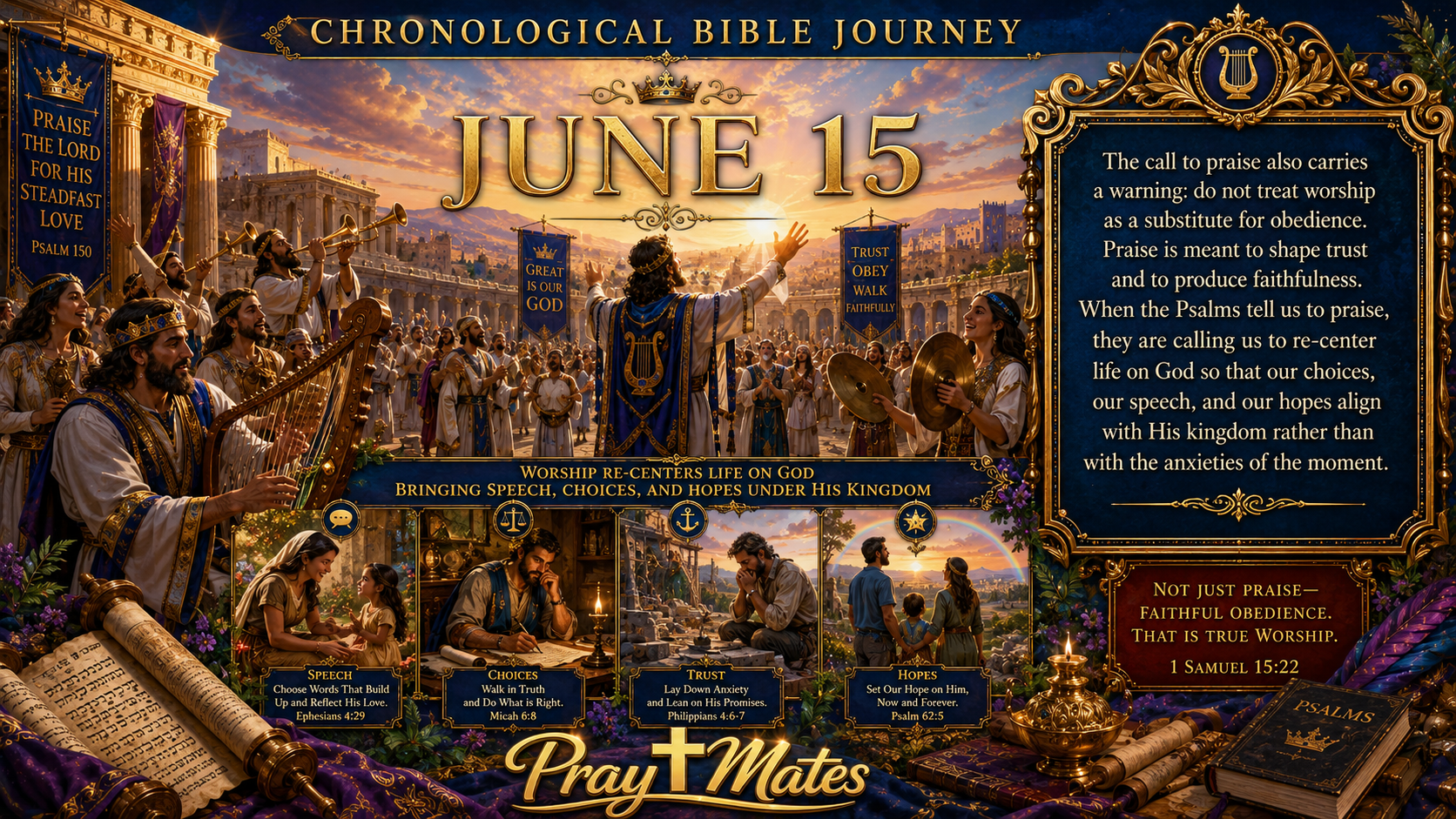
June 15 — Hallelujah in the Night Watch
June 15 — Hallelujah in the Night Watch
SCRIPTURE READING:
Psalms 134, 146-150
SCRIPTURE:
Passage: Psalm 134
A Song of degrees.
¹ Behold, bless ye the LORD, all ye servants of the LORD, which by night stand in the house of the LORD.
² Lift up your hands in the sanctuary, and bless the LORD.
³ The LORD that made heaven and earth bless thee out of Zion.
Passage: Psalm 146
¹ Praise ye the LORD. Praise the LORD, O my soul.
² While I live will I praise the LORD: I will sing praises unto my God while I have any being.
³ Put not your trust in princes, nor in the son of man, in whom there is no help.
⁴ His breath goeth forth, he returneth to his earth; in that very day his thoughts perish.
⁵ Happy is he that hath the God of Jacob for his help, whose hope is in the LORD his God:
⁶ Which made heaven, and earth, the sea, and all that therein is: which keepeth truth for ever:
⁷ Which executeth judgment for the oppressed: which giveth food to the hungry. The LORD looseth the prisoners:
⁸ The LORD openeth the eyes of the blind: the LORD raiseth them that are bowed down: the LORD loveth the righteous:
⁹ The LORD preserveth the strangers; he relieveth the fatherless and widow: but the way of the wicked he turneth upside down.
¹⁰ The LORD shall reign for ever, even thy God, O Zion, unto all generations. Praise ye the LORD.
Passage: Psalm 147
¹ Praise ye the LORD: for it is good to sing praises unto our God; for it is pleasant; and praise is comely.
² The LORD doth build up Jerusalem: he gathereth together the outcasts of Israel.
³ He healeth the broken in heart, and bindeth up their wounds.
⁴ He telleth the number of the stars; he calleth them all by their names.
⁵ Great is our Lord, and of great power: his understanding is infinite.
⁶ The LORD lifteth up the meek: he casteth the wicked down to the ground.
⁷ Sing unto the LORD with thanksgiving; sing praise upon the harp unto our God:
⁸ Who covereth the heaven with clouds, who prepareth rain for the earth, who maketh grass to grow upon the mountains.
⁹ He giveth to the beast his food, and to the young ravens which cry.
¹⁰ He delighteth not in the strength of the horse: he taketh not pleasure in the legs of a man.
¹¹ The LORD taketh pleasure in them that fear him, in those that hope in his mercy.
¹² Praise the LORD, O Jerusalem; praise thy God, O Zion.
¹³ For he hath strengthened the bars of thy gates; he hath blessed thy children within thee.
¹⁴ He maketh peace in thy borders, and filleth thee with the finest of the wheat.
¹⁵ He sendeth forth his commandment upon earth: his word runneth very swiftly.
¹⁶ He giveth snow like wool: he scattereth the hoarfrost like ashes.
¹⁷ He casteth forth his ice like morsels: who can stand before his cold?
¹⁸ He sendeth out his word, and melteth them: he causeth his wind to blow, and the waters flow.
¹⁹ He sheweth his word unto Jacob, his statutes and his judgments unto Israel.
²⁰ He hath not dealt so with any nation: and as for his judgments, they have not known them. Praise ye the LORD.
Passage: Psalm 148
¹ Praise ye the LORD. Praise ye the LORD from the heavens: praise him in the heights.
² Praise ye him, all his angels: praise ye him, all his hosts.
³ Praise ye him, sun and moon: praise him, all ye stars of light.
⁴ Praise him, ye heavens of heavens, and ye waters that be above the heavens.
⁵ Let them praise the name of the LORD: for he commanded, and they were created.
⁶ He hath also stablished them for ever and ever: he hath made a decree which shall not pass.
⁷ Praise the LORD from the earth, ye dragons, and all deeps:
⁸ Fire, and hail; snow, and vapours; stormy wind fulfilling his word:
⁹ Mountains, and all hills; fruitful trees, and all cedars:
¹⁰ Beasts, and all cattle; creeping things, and flying fowl:
¹¹ Kings of the earth, and all people; princes, and all judges of the earth:
¹² Both young men, and maidens; old men, and children:
¹³ Let them praise the name of the LORD: for his name alone is excellent; his glory is above the earth and heaven.
¹⁴ He also exalteth the horn of his people, the praise of all his saints; even of the children of Israel, a people near unto him. Praise ye the LORD.
Passage: Psalm 149
¹ Praise ye the LORD. Sing unto the LORD a new song, and his praise in the congregation of saints.
² Let Israel rejoice in him that made him: let the children of Zion be joyful in their King.
³ Let them praise his name in the dance: let them sing praises unto him with the timbrel and harp.
⁴ For the LORD taketh pleasure in his people: he will beautify the meek with salvation.
⁵ Let the saints be joyful in glory: let them sing aloud upon their beds.
⁶ Let the high praises of God be in their mouth, and a two-edged sword in their hand;
⁷ To execute vengeance upon the heathen, and punishments upon the people;
⁸ To bind their kings with chains, and their nobles with fetters of iron;
⁹ To execute upon them the judgment written: this honour have all his saints. Praise ye the LORD.
Passage: Psalm 150
¹ Praise ye the LORD. Praise God in his sanctuary: praise him in the firmament of his power.
² Praise him for his mighty acts: praise him according to his excellent greatness.
³ Praise him with the sound of the trumpet: praise him with the psaltery and harp.
⁴ Praise him with the timbrel and dance: praise him with stringed instruments and organs.
⁵ Praise him upon the loud cymbals: praise him upon the high sounding cymbals.
⁶ Let every thing that hath breath praise the LORD. Praise ye the LORD.
DEVOTIONAL:
Psalm 134 pictures worship in the night, when the temple courts are quiet and the city sleeps. Servants of the LORD bless Him in the darkness, lifting holy hands and receiving a blessing in return. It is a reminder that praise is not only for bright mornings. Worship is an act of faith when feelings are thin, and it is a way of remembering who God is when circumstances are loud.
The final Psalms, 146 through 150, gather like a choir swelling to a finish. They call us to put no ultimate trust in princes, because human power expires. They praise the LORD who executes judgment for the oppressed, feeds the hungry, opens the eyes of the blind, and lifts those who are bowed down. Praise here is not escapism. It is realism about the God who governs the world with justice and compassion.
These Psalms are deeply shaped by Israel’s covenant memory. The God praised is the Creator of heaven and earth and the Redeemer who kept His promises. He is not a tribal deity; He is the LORD whose dominion is everlasting. The repeated “Praise ye the LORD” is not mere repetition for emotion. It is covenant rehearsal, training the heart to live from truth rather than from panic.
The call to praise also carries a warning: do not treat worship as a substitute for obedience. Praise is meant to shape trust and to produce faithfulness. When the Psalms tell us to praise, they are calling us to re-center life on God so that our choices, our speech, and our hopes align with His kingdom rather than with the anxieties of the moment.
Jesus leads this kind of praise. He trusted the Father when rulers plotted, and He endured the darkest night of the cross with Scripture on His lips. In His resurrection, praise becomes the language of a new creation. The church sings because the King lives, and because His kingdom will outlast every earthly authority.
In daily life, learn to bless the LORD at night. Make room for worship when you are weary, anxious, or discouraged. Let the Psalms give you words when your own words are small. In family and church life, practice praise together, because shared worship strengthens shared endurance and keeps hope from shrinking into private survival.
In U.S. civic life, the virtue of hope grounded in God guards us from despair and idolatry. Pray for those who feel crushed, for those who lead, and for those who serve the public in difficult roles. Christians should show up as people whose joy is not naive but anchored, praising God while doing faithful good in their neighborhoods.
DISCUSSION QUESTIONS:
What does Psalm 134 teach you about worship when life feels quiet, dark, or lonely?
How do Psalms 146-150 correct the temptation to place ultimate trust in human power?
Why is praise described alongside God’s care for the oppressed, hungry, and bowed down?
How can worship shape your endurance and hope in a season of anxiety or discouragement?
PRAYER:
ADORATION:
Praise be to You, LORD, Maker of heaven and earth, whose kingdom endures for ever. You lift the bowed down and love righteousness.
CONFESSION:
I confess that I have trusted in people, headlines, and my own strength more than in You. I have also withheld praise when I was tired or disappointed. Forgive my unbelief.
THANKSGIVING:
Thank You for Your steady care, for the way You sustain the needy, and for the gift of worship that re-centers my heart. Thank You for Jesus, risen and reigning.
SUPPLICATION – GENERAL:
Teach me to praise You in the night and in the morning. Strengthen my faith, lift my anxious heart, and help our church be a singing, serving people who hope in You.
SUPPLICATION – U.S. / CIVIC:
Encourage the weary in our communities and strengthen those who serve the public with integrity. Guard our nation from despair and from idolatry of power. Make Christians visible as hopeful neighbors who do justice, love mercy, and walk humbly with You.
SCRIPTURE: Happy is he that hath the God of Jacob for his help, whose hope is in the LORD his God: Psalm 146:5
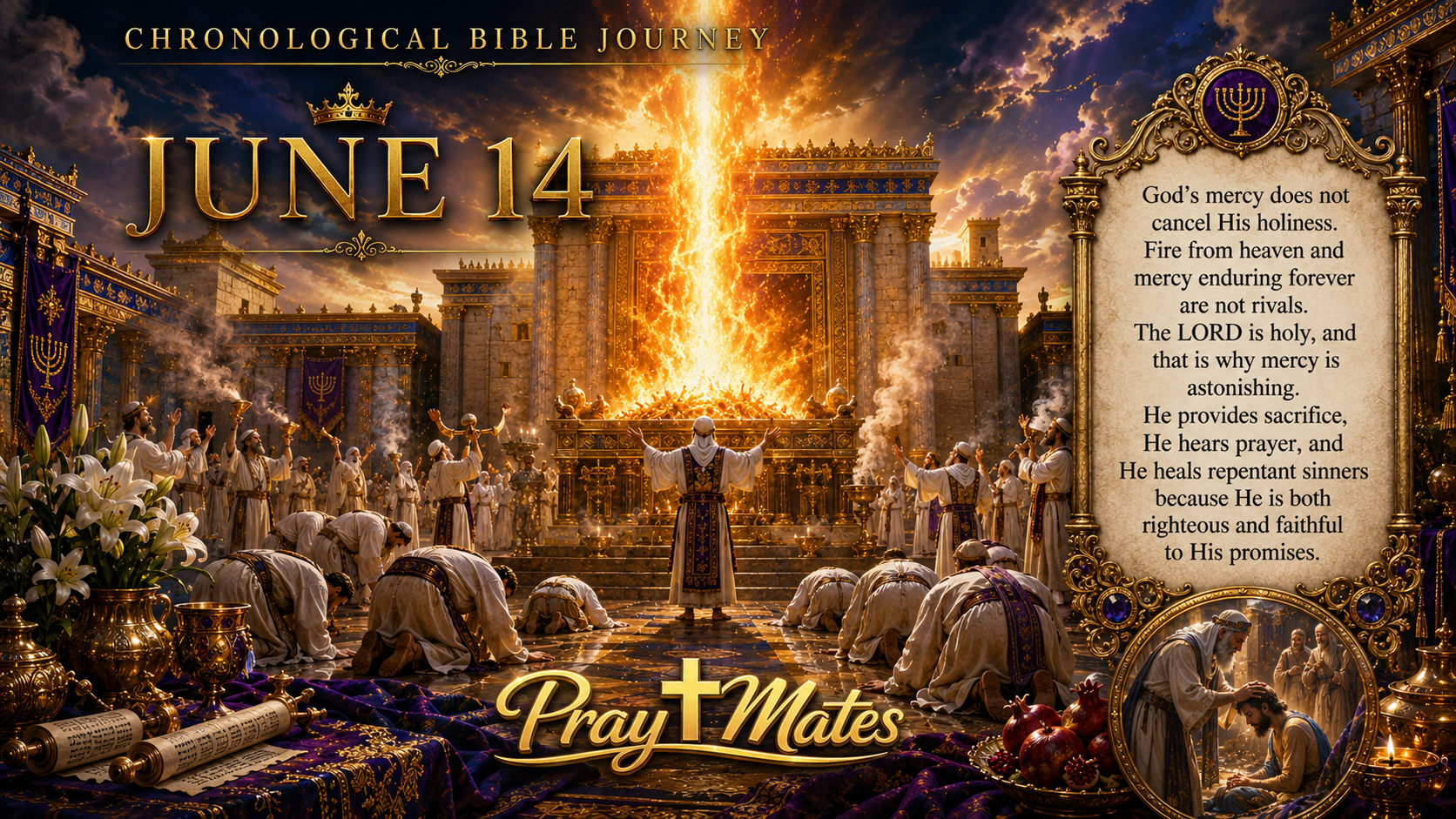
June 14 — Mercy That Answers with Fire
June 14 — Mercy That Answers with Fire
SCRIPTURE READING:
2 Chronicles 6-7; Psalm 136
SCRIPTURE:
Passage: 2 Chronicles 6
¹ Then said Solomon, The LORD hath said that he would dwell in the thick darkness.
² But I have built an house of habitation for thee, and a place for thy dwelling for ever.
³ And the king turned his face, and blessed the whole congregation of Israel: and all the congregation of Israel stood.
⁴ And he said, Blessed be the LORD God of Israel, who hath with his hands fulfilled that which he spake with his mouth to my father David, saying,
⁵ Since the day that I brought forth my people out of the land of Egypt I chose no city among all the tribes of Israel to build an house in, that my name might be there; neither chose I any man to be a ruler over my people Israel:
⁶ But I have chosen Jerusalem, that my name might be there; and have chosen David to be over my people Israel.
⁷ Now it was in the heart of David my father to build an house for the name of the LORD God of Israel.
⁸ But the LORD said to David my father, Forasmuch as it was in thine heart to build an house for my name, thou didst well in that it was in thine heart:
⁹ Notwithstanding thou shalt not build the house; but thy son which shall come forth out of thy loins, he shall build the house for my name.
¹⁰ The LORD therefore hath performed his word that he hath spoken: for I am risen up in the room of David my father, and am set on the throne of Israel, as the LORD promised, and have built the house for the name of the LORD God of Israel.
¹¹ And in it have I put the ark, wherein is the covenant of the LORD, that he made with the children of Israel.
¹² And he stood before the altar of the LORD in the presence of all the congregation of Israel, and spread forth his hands:
¹³ For Solomon had made a brasen scaffold of five cubits long, and five cubits broad, and three cubits high, and had set it in the midst of the court: and upon it he stood, and kneeled down upon his knees before all the congregation of Israel, and spread forth his hands toward heaven.
¹⁴ And said, O LORD God of Israel, there is no God like thee in the heaven, nor in the earth; which keepest covenant, and shewest mercy unto thy servants, that walk before thee with all their hearts:
¹⁵ Thou which hast kept with thy servant David my father that which thou hast promised him; and spakest with thy mouth, and hast fulfilled it with thine hand, as it is this day.
¹⁶ Now therefore, O LORD God of Israel, keep with thy servant David my father that which thou hast promised him, saying, There shall not fail thee a man in my sight to sit upon the throne of Israel; yet so that thy children take heed to their way to walk in my law, as thou hast walked before me.
¹⁷ Now then, O LORD God of Israel, let thy word be verified, which thou hast spoken unto thy servant David.
¹⁸ But will God in very deed dwell with men on the earth? behold, heaven and the heaven of heavens cannot contain thee; how much less this house which I have built!
¹⁹ Have respect therefore to the prayer of thy servant, and to his supplication, O LORD my God, to hearken unto the cry and the prayer which thy servant prayeth before thee:
²⁰ That thine eyes may be open upon this house day and night, upon the place whereof thou hast said that thou wouldest put thy name there; to hearken unto the prayer which thy servant prayeth toward this place.
²¹ Hearken therefore unto the supplications of thy servant, and of thy people Israel, which they shall make toward this place: hear thou from thy dwelling place, even from heaven; and when thou hearest, forgive.
²² If a man sin against his neighbour, and an oath be laid upon him to make him swear, and the oath come before thine altar in this house;
²³ Then hear thou from heaven, and do, and judge thy servants, by requiting the wicked, by recompensing his way upon his own head; and by justifying the righteous, by giving him according to his righteousness.
²⁴ And if thy people Israel be put to the worse before the enemy, because they have sinned against thee; and shall return and confess thy name, and pray and make supplication before thee in this house;
²⁵ Then hear thou from the heavens, and forgive the sin of thy people Israel, and bring them again unto the land which thou gavest to them and to their fathers.
²⁶ When the heaven is shut up, and there is no rain, because they have sinned against thee; yet if they pray toward this place, and confess thy name, and turn from their sin, when thou dost afflict them;
²⁷ Then hear thou from heaven, and forgive the sin of thy servants, and of thy people Israel, when thou hast taught them the good way, wherein they should walk; and send rain upon thy land, which thou hast given unto thy people for an inheritance.
²⁸ If there be dearth in the land, if there be pestilence, if there be blasting, or mildew, locusts, or caterpillers; if their enemies besiege them in the cities of their land; whatsoever sore or whatsoever sickness there be:
²⁹ Then what prayer or what supplication soever shall be made of any man, or of all thy people Israel, when every one shall know his own sore and his own grief, and shall spread forth his hands in this house:
³⁰ Then hear thou from heaven thy dwelling place, and forgive, and render unto every man according unto all his ways, whose heart thou knowest; (for thou only knowest the hearts of the children of men:)
³¹ That they may fear thee, to walk in thy ways, so long as they live in the land which thou gavest unto our fathers.
³² Moreover concerning the stranger, which is not of thy people Israel, but is come from a far country for thy great name's sake, and thy mighty hand, and thy stretched out arm; if they come and pray in this house;
³³ Then hear thou from the heavens, even from thy dwelling place, and do according to all that the stranger calleth to thee for; that all people of the earth may know thy name, and fear thee, as doth thy people Israel, and may know that this house which I have built is called by thy name.
³⁴ If thy people go out to war against their enemies by the way that thou shalt send them, and they pray unto thee toward this city which thou hast chosen, and the house which I have built for thy name;
³⁵ Then hear thou from the heavens their prayer and their supplication, and maintain their cause.
³⁶ If they sin against thee, (for there is no man which sinneth not,) and thou be angry with them, and deliver them over before their enemies, and they carry them away captives unto a land far off or near;
³⁷ Yet if they bethink themselves in the land whither they are carried captive, and turn and pray unto thee in the land of their captivity, saying, We have sinned, we have done amiss, and have dealt wickedly;
³⁸ If they return to thee with all their heart and with all their soul in the land of their captivity, whither they have carried them captives, and pray toward their land, which thou gavest unto their fathers, and toward the city which thou hast chosen, and toward the house which I have built for thy name:
³⁹ Then hear thou from the heavens, even from thy dwelling place, their prayer and their supplications, and maintain their cause, and forgive thy people which have sinned against thee.
⁴⁰ Now, my God, let, I beseech thee, thine eyes be open, and let thine ears be attent unto the prayer that is made in this place.
⁴¹ Now therefore arise, O LORD God, into thy resting place, thou, and the ark of thy strength: let thy priests, O LORD God, be clothed with salvation, and let thy saints rejoice in goodness.
⁴² O LORD God, turn not away the face of thine anointed: remember the mercies of David thy servant.
Passage: 2 Chronicles 7
¹ Now when Solomon had made an end of praying, the fire came down from heaven, and consumed the burnt offering and the sacrifices; and the glory of the LORD filled the house.
² And the priests could not enter into the house of the LORD, because the glory of the LORD had filled the LORD's house.
³ And when all the children of Israel saw how the fire came down, and the glory of the LORD upon the house, they bowed themselves with their faces to the ground upon the pavement, and worshipped, and praised the LORD, saying, For he is good; for his mercy endureth for ever.
⁴ Then the king and all the people offered sacrifices before the LORD.
⁵ And king Solomon offered a sacrifice of twenty and two thousand oxen, and an hundred and twenty thousand sheep: so the king and all the people dedicated the house of God.
⁶ And the priests waited on their offices: the Levites also with instruments of musick of the LORD, which David the king had made to praise the LORD, because his mercy endureth for ever, when David praised by their ministry; and the priests sounded trumpets before them, and all Israel stood.
⁷ Moreover Solomon hallowed the middle of the court that was before the house of the LORD: for there he offered burnt offerings, and the fat of the peace offerings, because the brasen altar which Solomon had made was not able to receive the burnt offerings, and the meat offerings, and the fat.
⁸ Also at the same time Solomon kept the feast seven days, and all Israel with him, a very great congregation, from the entering in of Hamath unto the river of Egypt.
⁹ And in the eighth day they made a solemn assembly: for they kept the dedication of the altar seven days, and the feast seven days.
¹⁰ And on the three and twentieth day of the seventh month he sent the people away into their tents, glad and merry in heart for the goodness that the LORD had shewed unto David, and to Solomon, and to Israel his people.
¹¹ Thus Solomon finished the house of the LORD, and the king's house: and all that came into Solomon's heart to make in the house of the LORD, and in his own house, he prosperously effected.
¹² And the LORD appeared to Solomon by night, and said unto him, I have heard thy prayer, and have chosen this place to myself for an house of sacrifice.
¹³ If I shut up heaven that there be no rain, or if I command the locusts to devour the land, or if I send pestilence among my people;
¹⁴ If my people, which are called by my name, shall humble themselves, and pray, and seek my face, and turn from their wicked ways; then will I hear from heaven, and will forgive their sin, and will heal their land.
¹⁵ Now mine eyes shall be open, and mine ears attent unto the prayer that is made in this place.
¹⁶ For now have I chosen and sanctified this house, that my name may be there for ever: and mine eyes and mine heart shall be there perpetually.
¹⁷ And as for thee, if thou wilt walk before me, as David thy father walked, and do according to all that I have commanded thee, and shalt observe my statutes and my judgments;
¹⁸ Then will I stablish the throne of thy kingdom, according as I have covenanted with David thy father, saying, There shall not fail thee a man to be ruler in Israel.
¹⁹ But if ye turn away, and forsake my statutes and my commandments, which I have set before you, and shall go and serve other gods, and worship them;
²⁰ Then will I pluck them up by the roots out of my land which I have given them; and this house, which I have sanctified for my name, will I cast out of my sight, and will make it to be a proverb and a byword among all nations.
²¹ And this house, which is high, shall be an astonishment to every one that passeth by it; so that he shall say, Why hath the LORD done thus unto this land, and unto this house?
²² And it shall be answered, Because they forsook the LORD God of their fathers, which brought them forth out of the land of Egypt, and laid hold on other gods, and worshipped them, and served them: therefore hath he brought all this evil upon them.
Passage: Psalm 136
¹ O give thanks unto the LORD; for he is good: for his mercy endureth for ever.
² O give thanks unto the God of gods: for his mercy endureth for ever.
³ O give thanks to the Lord of lords: for his mercy endureth for ever.
⁴ To him who alone doeth great wonders: for his mercy endureth for ever.
⁵ To him that by wisdom made the heavens: for his mercy endureth for ever.
⁶ To him that stretched out the earth above the waters: for his mercy endureth for ever.
⁷ To him that made great lights: for his mercy endureth for ever:
⁸ The sun to rule by day: for his mercy endureth for ever:
⁹ The moon and stars to rule by night: for his mercy endureth for ever.
¹⁰ To him that smote Egypt in their firstborn: for his mercy endureth for ever:
¹¹ And brought out Israel from among them: for his mercy endureth for ever:
¹² With a strong hand, and with a stretched out arm: for his mercy endureth for ever.
¹³ To him which divided the Red sea into parts: for his mercy endureth for ever:
¹⁴ And made Israel to pass through the midst of it: for his mercy endureth for ever:
¹⁵ But overthrew Pharaoh and his host in the Red sea: for his mercy endureth for ever.
¹⁶ To him which led his people through the wilderness: for his mercy endureth for ever.
¹⁷ To him which smote great kings: for his mercy endureth for ever:
¹⁸ And slew famous kings: for his mercy endureth for ever:
¹⁹ Sihon king of the Amorites: for his mercy endureth for ever:
²⁰ And Og the king of Bashan: for his mercy endureth for ever:
²¹ And gave their land for an heritage: for his mercy endureth for ever:
²² Even an heritage unto Israel his servant: for his mercy endureth for ever.
²³ Who remembered us in our low estate: for his mercy endureth for ever:
²⁴ And hath redeemed us from our enemies: for his mercy endureth for ever.
²⁵ Who giveth food to all flesh: for his mercy endureth for ever.
²⁶ O give thanks unto the God of heaven: for his mercy endureth for ever.
DEVOTIONAL:
2 Chronicles expands Solomon’s dedication prayer and then records a breathtaking answer. Solomon asks God to hear from heaven when His people sin, repent, and pray, and the LORD responds with fire from heaven and with glory filling the house. The sequence matters: prayer leads to God’s response, and God’s response leads to worship. Israel is taught that the LORD is not distant. He is the living God who hears and who acts according to His covenant mercy.
God’s words in 2 Chronicles 7 include both comfort and warning. The LORD chooses the house for sacrifice, and He promises to respond to humble repentance. Yet He also warns that turning from Him will bring judgment, and that the temple itself can become a proverb if hearts harden. The passage is often quoted, but it should not be flattened into a slogan. It is a covenantal call: humility, prayer, seeking God’s face, and turning from wicked ways are always fitting responses for God’s people when sin has spread.
Psalm 136 then teaches Israel how to remember: with a repeated refrain, “for his mercy endureth for ever.” The Psalm walks through creation, redemption, wilderness provision, and conquest, insisting that behind every act of God is steadfast love. The Hebrew idea behind mercy here is not sentimental softness; it is loyal love, the kind of covenant kindness that keeps working for the good of the people even when they deserve to be abandoned.
When we put these readings together, we learn that God’s mercy does not cancel His holiness. Fire from heaven and mercy enduring forever are not rivals. The LORD is holy, and that is why mercy is astonishing. He provides sacrifice, He hears prayer, and He heals repentant sinners because He is both righteous and faithful to His promises.
Jesus the Messiah is the clearest place where fire and mercy meet. At the cross, judgment falls, not on repentant sinners who trust Him, but on the spotless Son who stands in our place. The resurrection then declares that mercy truly endures, because death itself cannot extinguish the covenant love of God. In Christ, repentance is not groveling; it is coming home to the Father who has made a way.
In daily life, practice repentance as a normal part of discipleship. Do not wait until damage is large before you turn. Humble yourself quickly, pray honestly, seek God’s face through Scripture, and turn from what you know is wicked. In your church, cultivate worship that remembers God’s mercy with specificity, because gratitude is one of the strongest defenses against cynicism and bitterness.
In U.S. civic life, the virtue of humility is essential for renewal because pride refuses correction. Pray for churches to repent where they have compromised, and pray for our communities to experience true spiritual awakening rather than mere outrage. Christians should show up as people who repent publicly when needed, extend mercy to neighbors, and pursue holiness without self-righteousness.
DISCUSSION QUESTIONS:
What does God’s response with fire and glory teach you about His nearness and His holiness?
How do comfort and warning belong together in 2 Chronicles 7?
Why does Psalm 136 repeat the same refrain, and what does that repetition train in God’s people?
How does the cross of Christ deepen your understanding of mercy that “endureth for ever”?
PRAYER:
ADORATION:
LORD, You are holy and merciful, mighty in judgment and steadfast in love. Your covenant kindness endures, and Your glory fills what You choose.
CONFESSION:
I confess that I have treated repentance as a last resort and gratitude as optional. I have sinned, excused myself, and grown dull. Have mercy on me and turn my heart back.
THANKSGIVING:
Thank You that You hear from heaven and that You forgive repentant sinners. Thank You for the cross of Jesus, where Your mercy and righteousness meet without contradiction.
SUPPLICATION – GENERAL:
Humble me and teach me to seek Your face. Expose my hidden sin, give me strength to turn, and restore joy in Your salvation. Renew our church with worship that remembers Your mercy and obeys Your Word.
SUPPLICATION – U.S. / CIVIC:
Pour out repentance and renewal among Your people in our land. Heal divisions that come from pride, restrain violence, and guide leaders toward justice. Make the church a humble witness of mercy that is rooted in holiness.
SCRIPTURE: If my people, which are called by my name, shall humble themselves, and pray, and seek my face, and turn from their wicked ways; then will I hear from heaven, and will forgive their sin, and will heal their land. 2 Chronicles 7:14
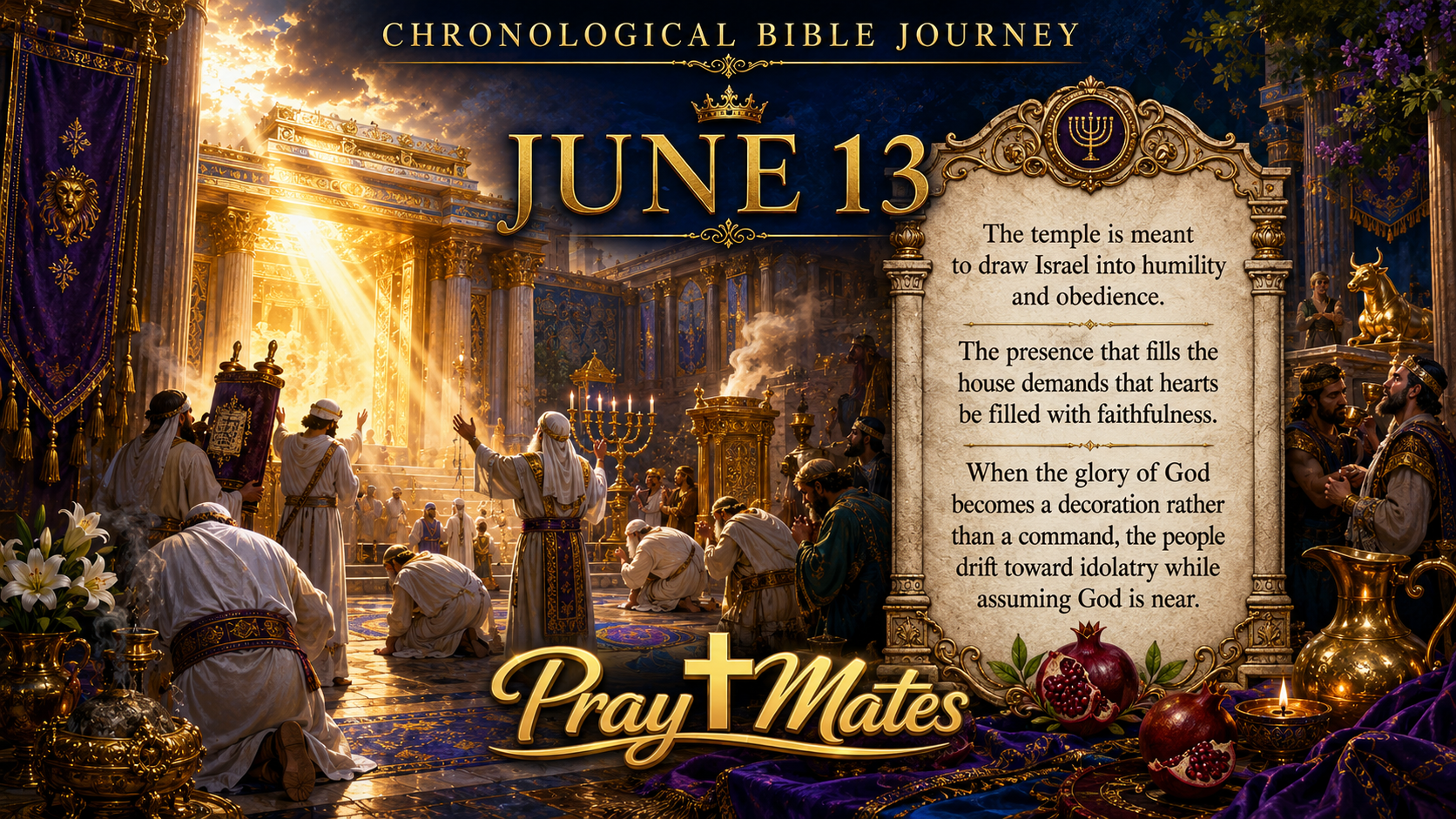
June 13 — When Glory Fills the House
June 13 — When Glory Fills the House
SCRIPTURE READING:
1 Kings 8; 2 Chronicles 5
SCRIPTURE:
Passage: 1 Kings 8
¹ Then Solomon assembled the elders of Israel, and all the heads of the tribes, the chief of the fathers of the children of Israel, unto king Solomon in Jerusalem, that they might bring up the ark of the covenant of the LORD out of the city of David, which is Zion.
² And all the men of Israel assembled themselves unto king Solomon at the feast in the month Ethanim, which is the seventh month.
³ And all the elders of Israel came, and the priests took up the ark.
⁴ And they brought up the ark of the LORD, and the tabernacle of the congregation, and all the holy vessels that were in the tabernacle, even those did the priests and the Levites bring up.
⁵ And king Solomon, and all the congregation of Israel, that were assembled unto him, were with him before the ark, sacrificing sheep and oxen, that could not be told nor numbered for multitude.
⁶ And the priests brought in the ark of the covenant of the LORD unto his place, into the oracle of the house, to the most holy place, even under the wings of the cherubims.
⁷ For the cherubims spread forth their two wings over the place of the ark, and the cherubims covered the ark and the staves thereof above.
⁸ And they drew out the staves, that the ends of the staves were seen out in the holy place before the oracle, and they were not seen without: and there they are unto this day.
⁹ There was nothing in the ark save the two tables of stone, which Moses put there at Horeb, when the LORD made a covenant with the children of Israel, when they came out of the land of Egypt.
¹⁰ And it came to pass, when the priests were come out of the holy place, that the cloud filled the house of the LORD,
¹¹ So that the priests could not stand to minister because of the cloud: for the glory of the LORD had filled the house of the LORD.
¹² Then spake Solomon, The LORD said that he would dwell in the thick darkness.
¹³ I have surely built thee an house to dwell in, a settled place for thee to abide in for ever.
¹⁴ And the king turned his face about, and blessed all the congregation of Israel: (and all the congregation of Israel stood;)
¹⁵ And he said, Blessed be the LORD God of Israel, which spake with his mouth unto David my father, and hath with his hand fulfilled it, saying,
¹⁶ Since the day that I brought forth my people Israel out of Egypt, I chose no city out of all the tribes of Israel to build an house, that my name might be therein; but I chose David to be over my people Israel.
¹⁷ And it was in the heart of David my father to build an house for the name of the LORD God of Israel.
¹⁸ And the LORD said unto David my father, Whereas it was in thine heart to build an house unto my name, thou didst well that it was in thine heart.
¹⁹ Nevertheless thou shalt not build the house; but thy son that shall come forth out of thy loins, he shall build the house unto my name.
²⁰ And the LORD hath performed his word that he spake, and I am risen up in the room of David my father, and sit on the throne of Israel, as the LORD promised, and have built an house for the name of the LORD God of Israel.
²¹ And I have set there a place for the ark, wherein is the covenant of the LORD, which he made with our fathers, when he brought them out of the land of Egypt.
²² And Solomon stood before the altar of the LORD in the presence of all the congregation of Israel, and spread forth his hands toward heaven:
²³ And he said, LORD God of Israel, there is no God like thee, in heaven above, or on earth beneath, who keepest covenant and mercy with thy servants that walk before thee with all their heart:
²⁴ Who hast kept with thy servant David my father that thou promisedst him: thou spakest also with thy mouth, and hast fulfilled it with thine hand, as it is this day.
²⁵ Therefore now, LORD God of Israel, keep with thy servant David my father that thou promisedst him, saying, There shall not fail thee a man in my sight to sit on the throne of Israel; so that thy children take heed to their way, that they walk before me as thou hast walked before me.
²⁶ And now, O God of Israel, let thy word, I pray thee, be verified, which thou spakest unto thy servant David my father.
²⁷ But will God indeed dwell on the earth? behold, the heaven and heaven of heavens cannot contain thee; how much less this house that I have builded?
²⁸ Yet have thou respect unto the prayer of thy servant, and to his supplication, O LORD my God, to hearken unto the cry and to the prayer, which thy servant prayeth before thee to day:
²⁹ That thine eyes may be open toward this house night and day, even toward the place of which thou hast said, My name shall be there: that thou mayest hearken unto the prayer which thy servant shall make toward this place.
³⁰ And hearken thou to the supplication of thy servant, and of thy people Israel, when they shall pray toward this place: and hear thou in heaven thy dwelling place: and when thou hearest, forgive.
³¹ If any man trespass against his neighbour, and an oath be laid upon him to cause him to swear, and the oath come before thine altar in this house:
³² Then hear thou in heaven, and do, and judge thy servants, condemning the wicked, to bring his way upon his head; and justifying the righteous, to give him according to his righteousness.
³³ When thy people Israel be smitten down before the enemy, because they have sinned against thee, and shall turn again to thee, and confess thy name, and pray, and make supplication unto thee in this house:
³⁴ Then hear thou in heaven, and forgive the sin of thy people Israel, and bring them again unto the land which thou gavest unto their fathers.
³⁵ When heaven is shut up, and there is no rain, because they have sinned against thee; if they pray toward this place, and confess thy name, and turn from their sin, when thou afflictest them:
³⁶ Then hear thou in heaven, and forgive the sin of thy servants, and of thy people Israel, that thou teach them the good way wherein they should walk, and give rain upon thy land, which thou hast given to thy people for an inheritance.
³⁷ If there be in the land famine, if there be pestilence, blasting, mildew, locust, or if there be caterpiller; if their enemy besiege them in the land of their cities; whatsoever plague, whatsoever sickness there be;
³⁸ What prayer and supplication soever be made by any man, or by all thy people Israel, which shall know every man the plague of his own heart, and spread forth his hands toward this house:
³⁹ Then hear thou in heaven thy dwelling place, and forgive, and do, and give to every man according to his ways, whose heart thou knowest; (for thou, even thou only, knowest the hearts of all the children of men;)
⁴⁰ That they may fear thee all the days that they live in the land which thou gavest unto our fathers.
⁴¹ Moreover concerning a stranger, that is not of thy people Israel, but cometh out of a far country for thy name's sake;
⁴² (For they shall hear of thy great name, and of thy strong hand, and of thy stretched out arm;) when he shall come and pray toward this house;
⁴³ Hear thou in heaven thy dwelling place, and do according to all that the stranger calleth to thee for: that all people of the earth may know thy name, to fear thee, as do thy people Israel; and that they may know that this house, which I have builded, is called by thy name.
⁴⁴ If thy people go out to battle against their enemy, whithersoever thou shalt send them, and shall pray unto the LORD toward the city which thou hast chosen, and toward the house that I have built for thy name:
⁴⁵ Then hear thou in heaven their prayer and their supplication, and maintain their cause.
⁴⁶ If they sin against thee, (for there is no man that sinneth not,) and thou be angry with them, and deliver them to the enemy, so that they carry them away captives unto the land of the enemy, far or near;
⁴⁷ Yet if they shall bethink themselves in the land whither they were carried captives, and repent, and make supplication unto thee in the land of them that carried them captives, saying, We have sinned, and have done perversely, we have committed wickedness;
⁴⁸ And so return unto thee with all their heart, and with all their soul, in the land of their enemies, which led them away captive, and pray unto thee toward their land, which thou gavest unto their fathers, the city which thou hast chosen, and the house which I have built for thy name:
⁴⁹ Then hear thou their prayer and their supplication in heaven thy dwelling place, and maintain their cause,
⁵⁰ And forgive thy people that have sinned against thee, and all their transgressions wherein they have transgressed against thee, and give them compassion before them who carried them captive, that they may have compassion on them:
⁵¹ For they be thy people, and thine inheritance, which thou broughtest forth out of Egypt, from the midst of the furnace of iron:
⁵² That thine eyes may be open unto the supplication of thy servant, and unto the supplication of thy people Israel, to hearken unto them in all that they call for unto thee.
⁵³ For thou didst separate them from among all the people of the earth, to be thine inheritance, as thou spakest by the hand of Moses thy servant, when thou broughtest our fathers out of Egypt, O LORD God.
⁵⁴ And it was so, that when Solomon had made an end of praying all this prayer and supplication unto the LORD, he arose from before the altar of the LORD, from kneeling on his knees with his hands spread up to heaven.
⁵⁵ And he stood, and blessed all the congregation of Israel with a loud voice, saying,
⁵⁶ Blessed be the LORD, that hath given rest unto his people Israel, according to all that he promised: there hath not failed one word of all his good promise, which he promised by the hand of Moses his servant.
⁵⁷ The LORD our God be with us, as he was with our fathers: let him not leave us, nor forsake us:
⁵⁸ That he may incline our hearts unto him, to walk in all his ways, and to keep his commandments, and his statutes, and his judgments, which he commanded our fathers.
⁵⁹ And let these my words, wherewith I have made supplication before the LORD, be nigh unto the LORD our God day and night, that he maintain the cause of his servant, and the cause of his people Israel at all times, as the matter shall require:
⁶⁰ That all the people of the earth may know that the LORD is God, and that there is none else.
⁶¹ Let your heart therefore be perfect with the LORD our God, to walk in his statutes, and to keep his commandments, as at this day.
⁶² And the king, and all Israel with him, offered sacrifice before the LORD.
⁶³ And Solomon offered a sacrifice of peace offerings, which he offered unto the LORD, two and twenty thousand oxen, and an hundred and twenty thousand sheep. So the king and all the children of Israel dedicated the house of the LORD.
⁶⁴ The same day did the king hallow the middle of the court that was before the house of the LORD: for there he offered burnt offerings, and meat offerings, and the fat of the peace offerings: because the brasen altar that was before the LORD was too little to receive the burnt offerings, and meat offerings, and the fat of the peace offerings.
⁶⁵ And at that time Solomon held a feast, and all Israel with him, a great congregation, from the entering in of Hamath unto the river of Egypt, before the LORD our God, seven days and seven days, even fourteen days.
⁶⁶ On the eighth day he sent the people away: and they blessed the king, and went unto their tents joyful and glad of heart for all the goodness that the LORD had done for David his servant, and for Israel his people.
Passage: 2 Chronicles 5
¹ Thus all the work that Solomon made for the house of the LORD was finished: and Solomon brought in all the things that David his father had dedicated; and the silver, and the gold, and all the instruments, put he among the treasures of the house of God.
² Then Solomon assembled the elders of Israel, and all the heads of the tribes, the chief of the fathers of the children of Israel, unto Jerusalem, to bring up the ark of the covenant of the LORD out of the city of David, which is Zion.
³ Wherefore all the men of Israel assembled themselves unto the king in the feast which was in the seventh month.
⁴ And all the elders of Israel came; and the Levites took up the ark.
⁵ And they brought up the ark, and the tabernacle of the congregation, and all the holy vessels that were in the tabernacle, these did the priests and the Levites bring up.
⁶ Also king Solomon, and all the congregation of Israel that were assembled unto him before the ark, sacrificed sheep and oxen, which could not be told nor numbered for multitude.
⁷ And the priests brought in the ark of the covenant of the LORD unto his place, to the oracle of the house, into the most holy place, even under the wings of the cherubims:
⁸ For the cherubims spread forth their wings over the place of the ark, and the cherubims covered the ark and the staves thereof above.
⁹ And they drew out the staves of the ark, that the ends of the staves were seen from the ark before the oracle; but they were not seen without. And there it is unto this day.
¹⁰ There was nothing in the ark save the two tables which Moses put therein at Horeb, when the LORD made a covenant with the children of Israel, when they came out of Egypt.
¹¹ And it came to pass, when the priests were come out of the holy place: (for all the priests that were present were sanctified, and did not then wait by course:
¹² Also the Levites which were the singers, all of them of Asaph, of Heman, of Jeduthun, with their sons and their brethren, being arrayed in white linen, having cymbals and psalteries and harps, stood at the east end of the altar, and with them an hundred and twenty priests sounding with trumpets:)
¹³ It came even to pass, as the trumpeters and singers were as one, to make one sound to be heard in praising and thanking the LORD; and when they lifted up their voice with the trumpets and cymbals and instruments of musick, and praised the LORD, saying, For he is good; for his mercy endureth for ever: that then the house was filled with a cloud, even the house of the LORD;
¹⁴ So that the priests could not stand to minister by reason of the cloud: for the glory of the LORD had filled the house of God.
DEVOTIONAL:
The moving of the ark into the temple is not merely a ceremony; it is the heart of Israel’s worship being brought to its appointed place. 2 Chronicles 5 describes the Levites carrying the ark, the sacrifices offered, and the singers and trumpeters praising the LORD “for he is good; for his mercy endureth for ever.” Then the cloud fills the house, and the priests cannot stand to minister. The presence of God overwhelms human activity, reminding Israel that worship is first about God’s initiative, not ours.
In 1 Kings 8, Solomon’s words are saturated with covenant memory. He blesses the LORD for keeping what He promised to David, and he confesses that God’s faithfulness is the foundation for Israel’s future. Yet Solomon also acknowledges the mystery: “Will God indeed dwell on the earth?” Heaven cannot contain Him. The temple is therefore a mercy, a place where God’s name rests so that prayer and forgiveness may be sought with confidence.
Solomon’s dedication prayer is strikingly realistic about sin. He anticipates failure, exile, drought, defeat, and judgment, and he pleads for God to hear when His people repent and pray toward this house. The temple is not built because Israel is strong, but because Israel is needy. God provides a place where His people can return, again and again, to mercy grounded in sacrifice.
These chapters also reveal that God’s glory is not given to inflate national pride. The cloud silences boasting. The temple is meant to draw Israel into humility and obedience. The presence that fills the house demands that hearts be filled with faithfulness. When the glory of God becomes a decoration rather than a command, the people drift toward idolatry while assuming God is near.
Jesus fulfills this story in a deeper way. He is the Word who tabernacled among us, and He is the Son who perfectly honors the Father. In His body, God’s presence comes near, and in His cross, forgiveness becomes certain. At Pentecost, the Spirit fills a new temple, not a building of stone but a people redeemed by Christ. God’s dwelling is no longer tied to a single location, yet it is always tied to holiness and truth.
In daily life, let Solomon’s prayer train you to bring everything to God: family burdens, hidden sins, fears about the future, and longings for mercy. Pray with covenant confidence, not because you are worthy, but because God is faithful. In your church, resist treating worship as a performance. Seek the God who fills, humbles, and forgives, and let His presence shape your obedience through the week.
In U.S. civic life, the virtue of reverence expressed through repentance is vital because a nation that never admits wrong becomes hardened. Pray for spiritual awakening, for churches to pursue holiness, and for leaders to have humility when they fail. Christians should show up as people of prayer who confess sin honestly, seek reconciliation, and demonstrate that mercy is stronger than pride.
DISCUSSION QUESTIONS:
What stands out to you about the way God’s presence interrupts the priests’ ability to minister?
Why does Solomon’s prayer include so many scenarios of sin, judgment, and repentance?
How can worship become a decoration rather than a command, and what safeguards help prevent that drift?
What does it mean that God now dwells with His people through Christ and by the Spirit?
PRAYER:
ADORATION:
LORD, You are faithful to Your promises and glorious in holiness. Your presence is weighty, Your mercy is real, and Your goodness does not fail.
CONFESSION:
I confess that I sometimes approach worship lightly and treat repentance as optional. I have sinned and then tried to cover it with religious activity. Forgive me and cleanse me.
THANKSGIVING:
Thank You for hearing prayer and for providing a way back through sacrifice. Thank You for Jesus, whose cross secures forgiveness and whose Spirit makes us Your dwelling place.
SUPPLICATION – GENERAL:
Teach me to pray with humility and confidence. Turn my heart from hidden idols, and make my worship sincere. Fill our church with Your Spirit so that our praise leads to obedience and love.
SUPPLICATION – U.S. / CIVIC:
Bring repentance and renewal to churches across our land. Give humility to leaders, restraint to those with power, and mercy to those harmed by sin. Make Your people known as intercessors who seek the peace of their communities.
SCRIPTURE: But will God indeed dwell on the earth? behold, the heaven and heaven of heavens cannot contain thee; how much less this house that I have builded? 1 Kings 8:27

June 12 — Beauty That Teaches
June 12 — Beauty That Teaches
SCRIPTURE READING:
1 Kings 7; 2 Chronicles 4
SCRIPTURE:
Passage: 1 Kings 7
¹ But Solomon was building his own house thirteen years, and he finished all his house.
² He built also the house of the forest of Lebanon; the length thereof was an hundred cubits, and the breadth thereof fifty cubits, and the height thereof thirty cubits, upon four rows of cedar pillars, with cedar beams upon the pillars.
³ And it was covered with cedar above upon the beams, that lay on forty five pillars, fifteen in a row.
⁴ And there were windows in three rows, and light was against light in three ranks.
⁵ And all the doors and posts were square, with the windows: and light was against light in three ranks.
⁶ And he made a porch of pillars; the length thereof was fifty cubits, and the breadth thereof thirty cubits: and the porch was before them: and the other pillars and the thick beam were before them.
⁷ Then he made a porch for the throne where he might judge, even the porch of judgment: and it was covered with cedar from one side of the floor to the other.
⁸ And his house where he dwelt had another court within the porch, which was of the like work. Solomon made also an house for Pharaoh's daughter, whom he had taken to wife, like unto this porch.
⁹ All these were of costly stones, according to the measures of hewed stones, sawed with saws, within and without, even from the foundation unto the coping, and so on the outside toward the great court.
¹⁰ And the foundation was of costly stones, even great stones, stones of ten cubits, and stones of eight cubits.
¹¹ And above were costly stones, after the measures of hewed stones, and cedars.
¹² And the great court round about was with three rows of hewed stones, and a row of cedar beams, both for the inner court of the house of the LORD, and for the porch of the house.
¹³ And king Solomon sent and fetched Hiram out of Tyre.
¹⁴ He was a widow's son of the tribe of Naphtali, and his father was a man of Tyre, a worker in brass: and he was filled with wisdom, and understanding, and cunning to work all works in brass. And he came to king Solomon, and wrought all his work.
¹⁵ For he cast two pillars of brass, of eighteen cubits high apiece: and a line of twelve cubits did compass either of them about.
¹⁶ And he made two chapiters of molten brass, to set upon the tops of the pillars: the height of the one chapiter was five cubits, and the height of the other chapiter was five cubits:
¹⁷ And nets of checker work, and wreaths of chain work, for the chapiters which were upon the top of the pillars; seven for the one chapiter, and seven for the other chapiter.
¹⁸ And he made the pillars, and two rows round about upon the one network, to cover the chapiters that were upon the top, with pomegranates: and so did he for the other chapiter.
¹⁹ And the chapiters that were upon the top of the pillars were of lily work in the porch, four cubits.
²⁰ And the chapiters upon the two pillars had pomegranates also above, over against the belly which was by the network: and the pomegranates were two hundred in rows round about upon the other chapiter.
²¹ And he set up the pillars in the porch of the temple: and he set up the right pillar, and called the name thereof Jachin: and he set up the left pillar, and called the name thereof Boaz.
²² And upon the top of the pillars was lily work: so was the work of the pillars finished.
²³ And he made a molten sea, ten cubits from the one brim to the other: it was round all about, and his height was five cubits: and a line of thirty cubits did compass it round about.
²⁴ And under the brim of it round about there were knops compassing it, ten in a cubit, compassing the sea round about: the knops were cast in two rows, when it was cast.
²⁵ It stood upon twelve oxen, three looking toward the north, and three looking toward the west, and three looking toward the south, and three looking toward the east: and the sea was set above upon them, and all their hinder parts were inward.
²⁶ And it was an hand breadth thick, and the brim thereof was wrought like the brim of a cup, with flowers of lilies: it contained two thousand baths.
²⁷ And he made ten bases of brass; four cubits was the length of one base, and four cubits the breadth thereof, and three cubits the height of it.
²⁸ And the work of the bases was on this manner: they had borders, and the borders were between the ledges:
²⁹ And on the borders that were between the ledges were lions, oxen, and cherubims: and upon the ledges there was a base above: and beneath the lions and oxen were certain additions made of thin work.
³⁰ And every base had four brasen wheels, and plates of brass: and the four corners thereof had undersetters: under the laver were undersetters molten, at the side of every addition.
³¹ And the mouth of it within the chapiter and above was a cubit: but the mouth thereof was round after the work of the base, a cubit and an half: and also upon the mouth of it were gravings with their borders, foursquare, not round.
³² And under the borders were four wheels; and the axletrees of the wheels were joined to the base: and the height of a wheel was a cubit and half a cubit.
³³ And the work of the wheels was like the work of a chariot wheel: their axletrees, and their naves, and their felloes, and their spokes, were all molten.
³⁴ And there were four undersetters to the four corners of one base: and the undersetters were of the very base itself.
³⁵ And in the top of the base was there a round compass of half a cubit high: and on the top of the base the ledges thereof and the borders thereof were of the same.
³⁶ For on the plates of the ledges thereof, and on the borders thereof, he graved cherubims, lions, and palm trees, according to the proportion of every one, and additions round about.
³⁷ After this manner he made the ten bases: all of them had one casting, one measure, and one size.
³⁸ Then made he ten lavers of brass: one laver contained forty baths: and every laver was four cubits: and upon every one of the ten bases one laver.
³⁹ And he put five bases on the right side of the house, and five on the left side of the house: and he set the sea on the right side of the house eastward over against the south.
⁴⁰ And Hiram made the lavers, and the shovels, and the basons. So Hiram made an end of doing all the work that he made king Solomon for the house of the LORD:
⁴¹ The two pillars, and the two bowls of the chapiters that were on the top of the two pillars; and the two networks, to cover the two bowls of the chapiters which were upon the top of the pillars;
⁴² And four hundred pomegranates for the two networks, even two rows of pomegranates for one network, to cover the two bowls of the chapiters that were upon the pillars;
⁴³ And the ten bases, and ten lavers on the bases;
⁴⁴ And one sea, and twelve oxen under the sea;
⁴⁵ And the pots, and the shovels, and the basons: and all these vessels, which Hiram made to king Solomon for the house of the LORD, were of bright brass.
⁴⁶ In the plain of Jordan did the king cast them, in the clay ground between Succoth and Zarthan.
⁴⁷ And Solomon left all the vessels unweighed, because they were exceeding many: neither was the weight of the brass found out.
⁴⁸ And Solomon made all the vessels that pertained unto the house of the LORD: the altar of gold, and the table of gold, whereupon the shewbread was,
⁴⁹ And the candlesticks of pure gold, five on the right side, and five on the left, before the oracle, with the flowers, and the lamps, and the tongs of gold,
⁵⁰ And the bowls, and the snuffers, and the basons, and the spoons, and the censers of pure gold; and the hinges of gold, both for the doors of the inner house, the most holy place, and for the doors of the house, to wit, of the temple.
⁵¹ So was ended all the work that king Solomon made for the house of the LORD. And Solomon brought in the things which David his father had dedicated; even the silver, and the gold, and the vessels, did he put among the treasures of the house of the LORD.
Passage: 2 Chronicles 4
¹ Moreover he made an altar of brass, twenty cubits the length thereof, and twenty cubits the breadth thereof, and ten cubits the height thereof.
² Also he made a molten sea of ten cubits from brim to brim, round in compass, and five cubits the height thereof; and a line of thirty cubits did compass it round about.
³ And under it was the similitude of oxen, which did compass it round about: ten in a cubit, compassing the sea round about. Two rows of oxen were cast, when it was cast.
⁴ It stood upon twelve oxen, three looking toward the north, and three looking toward the west, and three looking toward the south, and three looking toward the east: and the sea was set above upon them, and all their hinder parts were inward.
⁵ And the thickness of it was an handbreadth, and the brim of it like the work of the brim of a cup, with flowers of lilies; and it received and held three thousand baths.
⁶ He made also ten lavers, and put five on the right hand, and five on the left, to wash in them: such things as they offered for the burnt offering they washed in them; but the sea was for the priests to wash in.
⁷ And he made ten candlesticks of gold according to their form, and set them in the temple, five on the right hand, and five on the left.
⁸ He made also ten tables, and placed them in the temple, five on the right side, and five on the left. And he made an hundred basons of gold.
⁹ Furthermore he made the court of the priests, and the great court, and doors for the court, and overlaid the doors of them with brass.
¹⁰ And he set the sea on the right side of the east end, over against the south.
¹¹ And Huram made the pots, and the shovels, and the basons. And Huram finished the work that he was to make for king Solomon for the house of God;
¹² To wit, the two pillars, and the pommels, and the chapiters which were on the top of the two pillars, and the two wreaths to cover the two pommels of the chapiters which were on the top of the pillars;
¹³ And four hundred pomegranates on the two wreaths; two rows of pomegranates on each wreath, to cover the two pommels of the chapiters which were upon the pillars.
¹⁴ He made also bases, and lavers made he upon the bases;
¹⁵ One sea, and twelve oxen under it.
¹⁶ The pots also, and the shovels, and the fleshhooks, and all their instruments, did Huram his father make to king Solomon for the house of the LORD of bright brass.
¹⁷ In the plain of Jordan did the king cast them, in the clay ground between Succoth and Zeredathah.
¹⁸ Thus Solomon made all these vessels in great abundance: for the weight of the brass could not be found out.
¹⁹ And Solomon made all the vessels that were for the house of God, the golden altar also, and the tables whereon the shewbread was set;
²⁰ Moreover the candlesticks with their lamps, that they should burn after the manner before the oracle, of pure gold;
²¹ And the flowers, and the lamps, and the tongs, made he of gold, and that perfect gold;
²² And the snuffers, and the basons, and the spoons, and the censers, of pure gold: and the entry of the house, the inner doors thereof for the most holy place, and the doors of the house of the temple, were of gold.
DEVOTIONAL:
After the structure of the temple comes the furnishing of the temple. 1 Kings 7 and 2 Chronicles 4 linger over pillars, basins, lavers, bowls, and craftsmanship that most modern readers would skim. Scripture refuses to treat these details as clutter because worship is never only about what is said. The space itself is designed to teach: God is orderly, God is holy, and approaching Him is not casual.
The skilled worker Hiram is described as being filled with wisdom, understanding, and cunning to work. That language intentionally echoes the craftsmen of the tabernacle in Exodus. The covenant God who redeemed Israel also dignifies human skill. Hands that shape bronze and gold can be instruments of worship when their work is offered to the LORD. Beauty here is not luxury for vanity; it is a servant of reverence, helping the people sense the weight of holiness.
The pillars named Jachin and Boaz stand as reminders that worship rests on what God establishes and on the strength God provides. The great sea and the lavers speak of cleansing, a continual testimony that sinners do not stroll into God’s presence without purification. The temple furnishings preach grace and warning together: God invites, but God is not to be trifled with.
These passages also confront the modern habit of dividing life into “sacred” and “ordinary.” If craftsmanship is brought into worship, then worship must shape craftsmanship. The temple was meant to produce a people whose daily lives reflected the God they adored. When beauty becomes an idol, it collapses into self-display. When beauty serves worship, it becomes a quiet teacher that points away from itself.
Jesus fulfills the symbolism of cleansing and access. He is the One who washes His people, not with a bronze sea but with His own redeeming work, applying it by the Spirit. He also cleanses the temple in His day to show that God’s house exists for prayer, not for pride. In Christ, excellence and humility can finally live together, because worship is anchored in grace rather than in performance.
In daily life, treat your work as an offering to God. Pursue quality and honesty, whether you build, teach, repair, manage, or serve, because sloppiness is not a virtue. At the same time, resist turning excellence into ego. In the church, value both beauty and simplicity as tools for reverence, keeping the focus on the God who meets us rather than on the impressiveness of our output.
In U.S. civic life, the virtue of excellence joined with humility strengthens public trust because communities need workmanship that is reliable, not flashy deception. Pray for workers, artisans, engineers, and public servants who build and maintain what people depend on every day. Christians should show up as people whose craftsmanship and honesty make neighbors safer and whose humility keeps their work from becoming self-worship.
DISCUSSION QUESTIONS:
Why do you think Scripture spends time describing temple furnishings rather than only summarizing them?
How does the temple’s emphasis on cleansing shape your understanding of approaching God in worship?
Where do you struggle to balance excellence and humility in your work or service?
How does Jesus’ cleansing work change the way you think about purity and access to God?
PRAYER:
ADORATION:
God of holiness, You are beautiful in righteousness and perfect in wisdom. You are worthy of reverent worship, and nothing in Your presence is trivial.
CONFESSION:
I confess that I often treat worship casually and work carelessly, as if You were not watching. I also confess the pride that wants admiration more than faithfulness. Forgive me.
THANKSGIVING:
Thank You for the dignity You give to skill and service. Thank You for Jesus, who cleanses us and makes our offerings acceptable through His grace.
SUPPLICATION – GENERAL:
Teach me to work with integrity and to worship with awe. Purify my motives, train my hands for faithful service, and help our church honor You with both truth and reverence.
SUPPLICATION – U.S. / CIVIC:
Bless those who labor in trades, design, construction, and public infrastructure. Guard them from dishonesty and harm, and make our communities marked by trustworthy work and fair treatment of workers.
SCRIPTURE: He was a widow's son of the tribe of Naphtali, and his father was a man of Tyre, a worker in brass: and he was filled with wisdom, and understanding, and cunning to work all works in brass. 1 Kings 7:14
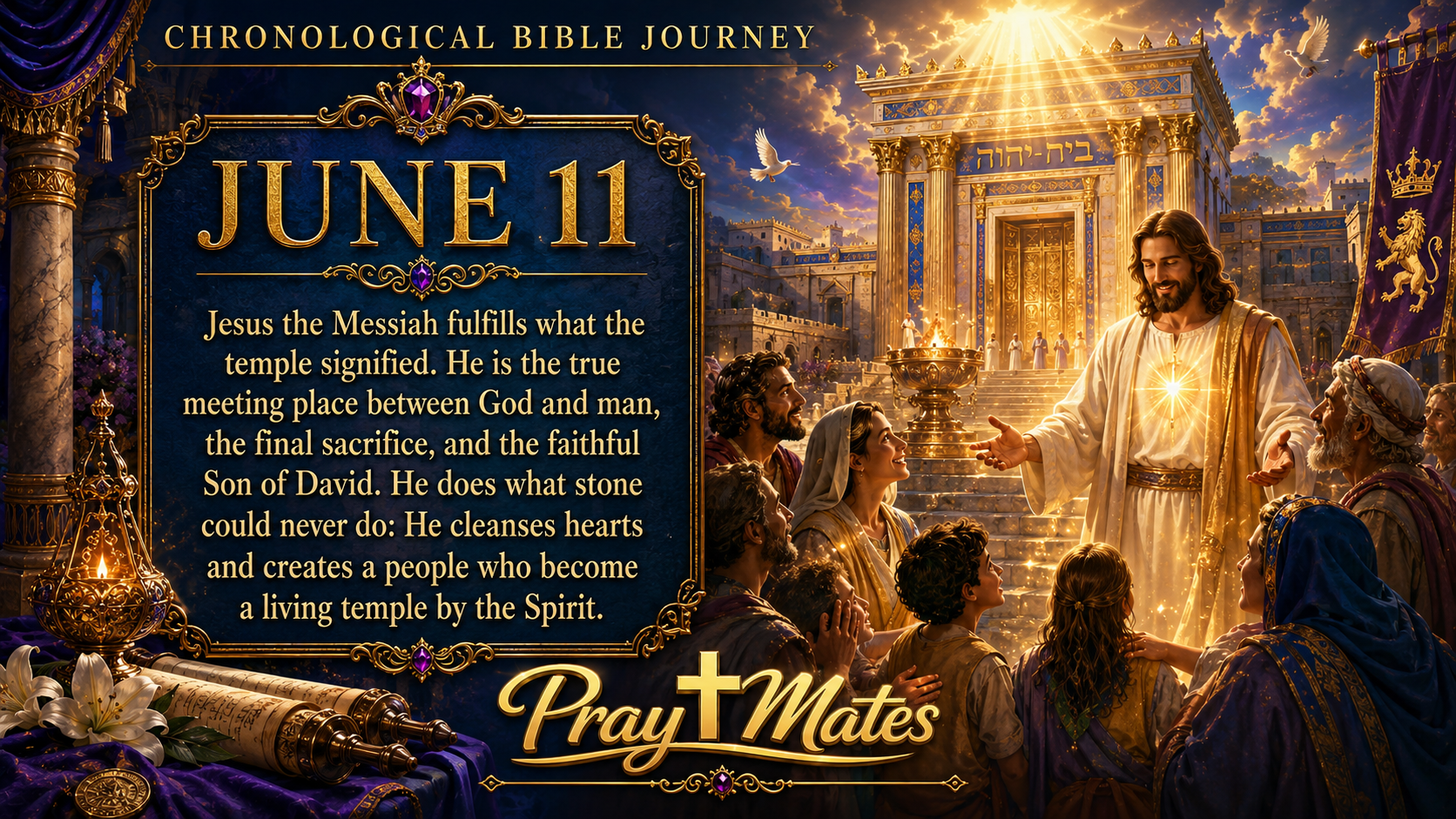
June 11 — A House for the Name
June 11 — A House for the Name
SCRIPTURE READING:
1 Kings 5-6; 2 Chronicles 2-3
SCRIPTURE:
Passage: 1 Kings 5
¹ And Hiram king of Tyre sent his servants unto Solomon; for he had heard that they had anointed him king in the room of his father: for Hiram was ever a lover of David.
² And Solomon sent to Hiram, saying,
³ Thou knowest how that David my father could not build an house unto the name of the LORD his God for the wars which were about him on every side, until the LORD put them under the soles of his feet.
⁴ But now the LORD my God hath given me rest on every side, so that there is neither adversary nor evil occurrent.
⁵ And, behold, I purpose to build an house unto the name of the LORD my God, as the LORD spake unto David my father, saying, Thy son, whom I will set upon thy throne in thy room, he shall build an house unto my name.
⁶ Now therefore command thou that they hew me cedar trees out of Lebanon; and my servants shall be with thy servants: and unto thee will I give hire for thy servants according to all that thou shalt appoint: for thou knowest that there is not among us any that can skill to hew timber like unto the Sidonians.
⁷ And it came to pass, when Hiram heard the words of Solomon, that he rejoiced greatly, and said, Blessed be the LORD this day, which hath given unto David a wise son over this great people.
⁸ And Hiram sent to Solomon, saying, I have considered the things which thou sentest to me for: and I will do all thy desire concerning timber of cedar, and concerning timber of fir.
⁹ My servants shall bring them down from Lebanon unto the sea: and I will convey them by sea in floats unto the place that thou shalt appoint me, and will cause them to be discharged there, and thou shalt receive them: and thou shalt accomplish my desire, in giving food for my household.
¹⁰ So Hiram gave Solomon cedar trees and fir trees according to all his desire.
¹¹ And Solomon gave Hiram twenty thousand measures of wheat for food to his household, and twenty measures of pure oil: thus gave Solomon to Hiram year by year.
¹² And the LORD gave Solomon wisdom, as he promised him: and there was peace between Hiram and Solomon; and they two made a league together.
¹³ And king Solomon raised a levy out of all Israel; and the levy was thirty thousand men.
¹⁴ And he sent them to Lebanon, ten thousand a month by courses: a month they were in Lebanon, and two months at home: and Adoniram was over the levy.
¹⁵ And Solomon had threescore and ten thousand that bare burdens, and fourscore thousand hewers in the mountains;
¹⁶ Beside the chief of Solomon's officers which were over the work, three thousand and three hundred, which ruled over the people that wrought in the work.
¹⁷ And the king commanded, and they brought great stones, costly stones, and hewed stones, to lay the foundation of the house.
¹⁸ And Solomon's builders and Hiram's builders did hew them, and the stonesquarers: so they prepared timber and stones to build the house.
Passage: 1 Kings 6
¹ And it came to pass in the four hundred and eightieth year after the children of Israel were come out of the land of Egypt, in the fourth year of Solomon's reign over Israel, in the month Zif, which is the second month, that he began to build the house of the LORD.
² And the house which king Solomon built for the LORD, the length thereof was threescore cubits, and the breadth thereof twenty cubits, and the height thereof thirty cubits.
³ And the porch before the temple of the house, twenty cubits was the length thereof, according to the breadth of the house; and ten cubits was the breadth thereof before the house.
⁴ And for the house he made windows of narrow lights.
⁵ And against the wall of the house he built chambers round about, against the walls of the house round about, both of the temple and of the oracle: and he made chambers round about:
⁶ The nethermost chamber was five cubits broad, and the middle was six cubits broad, and the third was seven cubits broad: for without in the wall of the house he made narrowed rests round about, that the beams should not be fastened in the walls of the house.
⁷ And the house, when it was in building, was built of stone made ready before it was brought thither: so that there was neither hammer nor axe nor any tool of iron heard in the house, while it was in building.
⁸ The door for the middle chamber was in the right side of the house: and they went up with winding stairs into the middle chamber, and out of the middle into the third.
⁹ So he built the house, and finished it; and covered the house with beams and boards of cedar.
¹⁰ And then he built chambers against all the house, five cubits high: and they rested on the house with timber of cedar.
¹¹ And the word of the LORD came to Solomon, saying,
¹² Concerning this house which thou art in building, if thou wilt walk in my statutes, and execute my judgments, and keep all my commandments to walk in them; then will I perform my word with thee, which I spake unto David thy father:
¹³ And I will dwell among the children of Israel, and will not forsake my people Israel.
¹⁴ So Solomon built the house, and finished it.
¹⁵ And he built the walls of the house within with boards of cedar, both the floor of the house, and the walls of the ceiling: and he covered them on the inside with wood, and covered the floor of the house with planks of fir.
¹⁶ And he built twenty cubits on the sides of the house, both the floor and the walls with boards of cedar: he even built them for it within, even for the oracle, even for the most holy place.
¹⁷ And the house, that is, the temple before it, was forty cubits long.
¹⁸ And the cedar of the house within was carved with knops and open flowers: all was cedar; there was no stone seen.
¹⁹ And the oracle he prepared in the house within, to set there the ark of the covenant of the LORD.
²⁰ And the oracle in the forepart was twenty cubits in length, and twenty cubits in breadth, and twenty cubits in the height thereof: and he overlaid it with pure gold; and so covered the altar which was of cedar.
²¹ So Solomon overlaid the house within with pure gold: and he made a partition by the chains of gold before the oracle; and he overlaid it with gold.
²² And the whole house he overlaid with gold, until he had finished all the house: also the whole altar that was by the oracle he overlaid with gold.
²³ And within the oracle he made two cherubims of olive tree, each ten cubits high.
²⁴ And five cubits was the one wing of the cherub, and five cubits the other wing of the cherub: from the uttermost part of the one wing unto the uttermost part of the other were ten cubits.
²⁵ And the other cherub was ten cubits: both the cherubims were of one measure and one size.
²⁶ The height of the one cherub was ten cubits, and so was it of the other cherub.
²⁷ And he set the cherubims within the inner house: and they stretched forth the wings of the cherubims, so that the wing of the one touched the one wall, and the wing of the other cherub touched the other wall; and their wings touched one another in the midst of the house.
²⁸ And he overlaid the cherubims with gold.
²⁹ And he carved all the walls of the house round about with carved figures of cherubims and palm trees and open flowers, within and without.
³⁰ And the floors of the house he overlaid with gold, within and without.
³¹ And for the entering of the oracle he made doors of olive tree: the lintel and side posts were a fifth part of the wall.
³² The two doors also were of olive tree; and he carved upon them carvings of cherubims and palm trees and open flowers, and overlaid them with gold, and spread gold upon the cherubims, and upon the palm trees.
³³ So also made he for the door of the temple posts of olive tree, a fourth part of the wall.
³⁴ And the two doors were of fir tree: the two leaves of the one door were folding, and the two leaves of the other door were folding.
³⁵ And he carved thereon cherubims and palm trees and open flowers: and covered them with gold fitted upon the carved work.
³⁶ And he built the inner court with three rows of hewed stone, and a row of cedar beams.
³⁷ In the fourth year was the foundation of the house of the LORD laid, in the month Zif:
³⁸ And in the eleventh year, in the month Bul, which is the eighth month, was the house finished throughout all the parts thereof, and according to all the fashion of it. So was he seven years in building it.
Passage: 2 Chronicles 2
¹ And Solomon determined to build an house for the name of the LORD, and an house for his kingdom.
² And Solomon told out threescore and ten thousand men to bear burdens, and fourscore thousand to hew in the mountain, and three thousand and six hundred to oversee them.
³ And Solomon sent to Huram the king of Tyre, saying, As thou didst deal with David my father, and didst send him cedars to build him an house to dwell therein, even so deal with me.
⁴ Behold, I build an house to the name of the LORD my God, to dedicate it to him, and to burn before him sweet incense, and for the continual shewbread, and for the burnt offerings morning and evening, on the sabbaths, and on the new moons, and on the solemn feasts of the LORD our God. This is an ordinance for ever to Israel.
⁵ And the house which I build is great: for great is our God above all gods.
⁶ But who is able to build him an house, seeing the heaven and heaven of heavens cannot contain him? who am I then, that I should build him an house, save only to burn sacrifice before him?
⁷ Send me now therefore a man cunning to work in gold, and in silver, and in brass, and in iron, and in purple, and crimson, and blue, and that can skill to grave with the cunning men that are with me in Judah and in Jerusalem, whom David my father did provide.
⁸ Send me also cedar trees, fir trees, and algum trees, out of Lebanon: for I know that thy servants can skill to cut timber in Lebanon; and, behold, my servants shall be with thy servants,
⁹ Even to prepare me timber in abundance: for the house which I am about to build shall be wonderful great.
¹⁰ And, behold, I will give to thy servants, the hewers that cut timber, twenty thousand measures of beaten wheat, and twenty thousand measures of barley, and twenty thousand baths of wine, and twenty thousand baths of oil.
¹¹ Then Huram the king of Tyre answered in writing, which he sent to Solomon, Because the LORD hath loved his people, he hath made thee king over them.
¹² Huram said moreover, Blessed be the LORD God of Israel, that made heaven and earth, who hath given to David the king a wise son, endued with prudence and understanding, that might build an house for the LORD, and an house for his kingdom.
¹³ And now I have sent a cunning man, endued with understanding, of Huram my father's,
¹⁴ The son of a woman of the daughters of Dan, and his father was a man of Tyre, skilful to work in gold, and in silver, in brass, in iron, in stone, and in timber, in purple, in blue, and in fine linen, and in crimson; also to grave any manner of graving, and to find out every device which shall be put to him, with thy cunning men, and with the cunning men of my lord David thy father.
¹⁵ Now therefore the wheat, and the barley, the oil, and the wine, which my lord hath spoken of, let him send unto his servants:
¹⁶ And we will cut wood out of Lebanon, as much as thou shalt need: and we will bring it to thee in floats by sea to Joppa; and thou shalt carry it up to Jerusalem.
¹⁷ And Solomon numbered all the strangers that were in the land of Israel, after the numbering wherewith David his father had numbered them; and they were found an hundred and fifty thousand and three thousand and six hundred.
¹⁸ And he set threescore and ten thousand of them to be bearers of burdens, and fourscore thousand to be hewers in the mountain, and three thousand and six hundred overseers to set the people a work.
Passage: 2 Chronicles 3
¹ Then Solomon began to build the house of the LORD at Jerusalem in mount Moriah, where the Lord appeared unto David his father, in the place that David had prepared in the threshingfloor of Ornan the Jebusite.
² And he began to build in the second day of the second month, in the fourth year of his reign.
³ Now these are the things wherein Solomon was instructed for the building of the house of God. The length by cubits after the first measure was threescore cubits, and the breadth twenty cubits.
⁴ And the porch that was in the front of the house, the length of it was according to the breadth of the house, twenty cubits, and the height was an hundred and twenty: and he overlaid it within with pure gold.
⁵ And the greater house he cieled with fir tree, which he overlaid with fine gold, and set thereon palm trees and chains.
⁶ And he garnished the house with precious stones for beauty: and the gold was gold of Parvaim.
⁷ He overlaid also the house, the beams, the posts, and the walls thereof, and the doors thereof, with gold; and graved cherubims on the walls.
⁸ And he made the most holy house, the length whereof was according to the breadth of the house, twenty cubits, and the breadth thereof twenty cubits: and he overlaid it with fine gold, amounting to six hundred talents.
⁹ And the weight of the nails was fifty shekels of gold. And he overlaid the upper chambers with gold.
¹⁰ And in the most holy house he made two cherubims of image work, and overlaid them with gold.
¹¹ And the wings of the cherubims were twenty cubits long: one wing of the one cherub was five cubits, reaching to the wall of the house: and the other wing was likewise five cubits, reaching to the wing of the other cherub.
¹² And one wing of the other cherub was five cubits, reaching to the wall of the house: and the other wing was five cubits also, joining to the wing of the other cherub.
¹³ The wings of these cherubims spread themselves forth twenty cubits: and they stood on their feet, and their faces were inward.
¹⁴ And he made the vail of blue, and purple, and crimson, and fine linen, and wrought cherubims thereon.
¹⁵ Also he made before the house two pillars of thirty and five cubits high, and the chapiter that was on the top of each of them was five cubits.
¹⁶ And he made chains, as in the oracle, and put them on the heads of the pillars; and made an hundred pomegranates, and put them on the chains.
¹⁷ And he reared up the pillars before the temple, one on the right hand, and the other on the left; and called the name of that on the right hand Jachin, and the name of that on the left Boaz.
DEVOTIONAL:
The temple does not begin with stone; it begins with desire to honor the LORD. In 1 Kings 5 and 2 Chronicles 2, Solomon gathers materials, workers, and agreements, including a partnership with Hiram of Tyre for cedar and skilled labor. The work is massive, organized, and costly. Yet the point is not national prestige. Solomon speaks of building “an house for the name of the LORD,” a place where God’s covenant presence will be publicly honored in Israel’s life.
Both accounts emphasize that God is not contained by buildings. Solomon confesses that “the heaven and heaven of heavens” cannot contain the LORD. The temple is therefore not a cage for God; it is a gracious sign of God’s nearness. In the covenant story, the LORD chooses to place His name among His people so that worship, sacrifice, prayer, and forgiveness have a defined center. The architecture preaches: holiness is real, access is costly, and God makes a way for sinners to draw near.
The details of 1 Kings 6 and 2 Chronicles 3 connect this temple to the tabernacle and to Eden-like imagery. Cherubim, gold, and carved trees echo the guarded garden where humanity once walked with God. The temple is a reminder that sin broke fellowship, but God is providing a mediated path back toward His presence. Even the measured dimensions teach that worship is not improvisation; it is response to God’s revealed will.
At the same time, the temple’s grandeur exposes a question: can a building substitute for obedience? Later Scripture will insist that it cannot. A holy house without holy hearts becomes an indictment. The temple is a gift, but it also becomes a test of whether Israel will love the LORD or merely love the benefits of His nearness.
Jesus the Messiah fulfills what the temple signified. He is the true meeting place between God and man, the final sacrifice, and the faithful Son of David. He does what stone could never do: He cleanses hearts and creates a people who become a living temple by the Spirit. The beauty and order of Solomon’s house point beyond themselves to the greater reality of God dwelling with His people through Christ.
In daily life, consider what kind of “house” your life is building. Let your work, planning, and craftsmanship be aimed at honoring God, not showcasing yourself. Pursue holiness in private, because public worship without private obedience is hollow. In the church, labor for reverence and unity, remembering that God’s presence is a gift that calls for awe, gratitude, and repentance.
In U.S. civic life, the virtue of reverence expressed through diligence strengthens communities because careless work and careless worship both train people to treat what matters as disposable. Pray for pastors, builders, and all who serve congregations, and pray for workers to be treated with fairness and dignity. Christians should show up as people who do excellent work without exploiting others and who keep God’s honor above image.
DISCUSSION QUESTIONS:
Why does Scripture emphasize building a house “for the name of the LORD” rather than for Solomon’s fame?
How do the temple’s details teach truths about holiness, access, and God’s presence?
Where might you be tempted to substitute religious activity for obedient love toward God?
How does Jesus fulfill the temple’s purpose in a way that changes how you think about worship and identity?
PRAYER:
ADORATION:
LORD God of Israel, You cannot be contained, yet You draw near with mercy. You are holy and glorious, and Your presence is a gift beyond measure.
CONFESSION:
I confess that I sometimes want the appearance of worship without the cost of obedience. I have treated Your holiness lightly and my own plans too seriously. Forgive me and renew my reverence.
THANKSGIVING:
Thank You for the way You placed Your name among Your people and for the promises You kept to David. Thank You for Jesus, the true Temple and the perfect Sacrifice, who brings us near.
SUPPLICATION – GENERAL:
Build holiness into my life as You build order into worship. Give me diligence in my work, integrity in my relationships, and devotion in my prayers. Help our church honor Your presence with unity and obedience.
SUPPLICATION – U.S. / CIVIC:
Grant fairness and wisdom in our labor practices, protect workers from exploitation, and bless those who build and maintain places of worship and service. Give our communities a renewed sense of reverence for what is true and good.
SCRIPTURE: But who is able to build him an house, seeing the heaven and heaven of heavens cannot contain him? who am I then, that I should build him an house, save only to burn sacrifice before him? 2 Chronicles 2:6
June 10 — Training, Treasure, and the Fear of the Lord
June 10 — Training, Treasure, and the Fear of the Lord
SCRIPTURE READING:
Proverbs 22-24
SCRIPTURE:
Passage: Proverbs 22
¹ A good name is rather to be chosen than great riches, and loving favour rather than silver and gold.
² The rich and poor meet together: the LORD is the maker of them all.
³ A prudent man foreseeth the evil, and hideth himself: but the simple pass on, and are punished.
⁴ By humility and the fear of the LORD are riches, and honour, and life.
⁵ Thorns and snares are in the way of the froward: he that doth keep his soul shall be far from them.
⁶ Train up a child in the way he should go: and when he is old, he will not depart from it.
⁷ The rich ruleth over the poor, and the borrower is servant to the lender.
⁸ He that soweth iniquity shall reap vanity: and the rod of his anger shall fail.
⁹ He that hath a bountiful eye shall be blessed; for he giveth of his bread to the poor.
¹⁰ Cast out the scorner, and contention shall go out; yea, strife and reproach shall cease.
¹¹ He that loveth pureness of heart, for the grace of his lips the king shall be his friend.
¹² The eyes of the LORD preserve knowledge, and he overthroweth the words of the transgressor.
¹³ The slothful man saith, There is a lion without, I shall be slain in the streets.
¹⁴ The mouth of strange women is a deep pit: he that is abhorred of the LORD shall fall therein.
¹⁵ Foolishness is bound in the heart of a child; but the rod of correction shall drive it far from him.
¹⁶ He that oppresseth the poor to increase his riches, and he that giveth to the rich, shall surely come to want.
¹⁷ Bow down thine ear, and hear the words of the wise, and apply thine heart unto my knowledge.
¹⁸ For it is a pleasant thing if thou keep them within thee; they shall withal be fitted in thy lips.
¹⁹ That thy trust may be in the LORD, I have made known to thee this day, even to thee.
²⁰ Have not I written to thee excellent things in counsels and knowledge,
²¹ That I might make thee know the certainty of the words of truth; that thou mightest answer the words of truth to them that send unto thee?
²² Rob not the poor, because he is poor: neither oppress the afflicted in the gate:
²³ For the LORD will plead their cause, and spoil the soul of those that spoiled them.
²⁴ Make no friendship with an angry man; and with a furious man thou shalt not go:
²⁵ Lest thou learn his ways, and get a snare to thy soul.
²⁶ Be not thou one of them that strike hands, or of them that are sureties for debts.
²⁷ If thou hast nothing to pay, why should he take away thy bed from under thee?
²⁸ Remove not the ancient landmark, which thy fathers have set.
²⁹ Seest thou a man diligent in his business? he shall stand before kings; he shall not stand before mean men.
Passage: Proverbs 23
¹ When thou sittest to eat with a ruler, consider diligently what is before thee:
² And put a knife to thy throat, if thou be a man given to appetite.
³ Be not desirous of his dainties: for they are deceitful meat.
⁴ Labour not to be rich: cease from thine own wisdom.
⁵ Wilt thou set thine eyes upon that which is not? for riches certainly make themselves wings; they fly away as an eagle toward heaven.
⁶ Eat thou not the bread of him that hath an evil eye, neither desire thou his dainty meats:
⁷ For as he thinketh in his heart, so is he: Eat and drink, saith he to thee; but his heart is not with thee.
⁸ The morsel which thou hast eaten shalt thou vomit up, and lose thy sweet words.
⁹ Speak not in the ears of a fool: for he will despise the wisdom of thy words.
¹⁰ Remove not the old landmark; and enter not into the fields of the fatherless:
¹¹ For their redeemer is mighty; he shall plead their cause with thee.
¹² Apply thine heart unto instruction, and thine ears to the words of knowledge.
¹³ Withhold not correction from the child: for if thou beatest him with the rod, he shall not die.
¹⁴ Thou shalt beat him with the rod, and shalt deliver his soul from hell.
¹⁵ My son, if thine heart be wise, my heart shall rejoice, even mine.
¹⁶ Yea, my reins shall rejoice, when thy lips speak right things.
¹⁷ Let not thine heart envy sinners: but be thou in the fear of the LORD all the day long.
¹⁸ For surely there is an end; and thine expectation shall not be cut off.
¹⁹ Hear thou, my son, and be wise, and guide thine heart in the way.
²⁰ Be not among winebibbers; among riotous eaters of flesh:
²¹ For the drunkard and the glutton shall come to poverty: and drowsiness shall clothe a man with rags.
²² Hearken unto thy father that begat thee, and despise not thy mother when she is old.
²³ Buy the truth, and sell it not; also wisdom, and instruction, and understanding.
²⁴ The father of the righteous shall greatly rejoice: and he that begetteth a wise child shall have joy of him.
²⁵ Thy father and thy mother shall be glad, and she that bare thee shall rejoice.
²⁶ My son, give me thine heart, and let thine eyes observe my ways.
²⁷ For a whore is a deep ditch; and a strange woman is a narrow pit.
²⁸ She also lieth in wait as for a prey, and increaseth the transgressors among men.
²⁹ Who hath woe? who hath sorrow? who hath contentions? who hath babbling? who hath wounds without cause? who hath redness of eyes?
³⁰ They that tarry long at the wine; they that go to seek mixed wine.
³¹ Look not thou upon the wine when it is red, when it giveth his colour in the cup, when it moveth itself aright.
³² At the last it biteth like a serpent, and stingeth like an adder.
³³ Thine eyes shall behold strange women, and thine heart shall utter perverse things.
³⁴ Yea, thou shalt be as he that lieth down in the midst of the sea, or as he that lieth upon the top of a mast.
³⁵ They have stricken me, shalt thou say, and I was not sick; they have beaten me, and I felt it not: when shall I awake? I will seek it yet again.
Passage: Proverbs 24
¹ Be not thou envious against evil men, neither desire to be with them.
² For their heart studieth destruction, and their lips talk of mischief.
³ Through wisdom is an house builded; and by understanding it is established:
⁴ And by knowledge shall the chambers be filled with all precious and pleasant riches.
⁵ A wise man is strong; yea, a man of knowledge increaseth strength.
⁶ For by wise counsel thou shalt make thy war: and in multitude of counsellors there is safety.
⁷ Wisdom is too high for a fool: he openeth not his mouth in the gate.
⁸ He that deviseth to do evil shall be called a mischievous person.
⁹ The thought of foolishness is sin: and the scorner is an abomination to men.
¹⁰ If thou faint in the day of adversity, thy strength is small.
¹¹ If thou forbear to deliver them that are drawn unto death, and those that are ready to be slain;
¹² If thou sayest, Behold, we knew it not; doth not he that pondereth the heart consider it? and he that keepeth thy soul, doth not he know it? and shall not he render to every man according to his works?
¹³ My son, eat thou honey, because it is good; and the honeycomb, which is sweet to thy taste:
¹⁴ So shall the knowledge of wisdom be unto thy soul: when thou hast found it, then there shall be a reward, and thy expectation shall not be cut off.
¹⁵ Lay not wait, O wicked man, against the dwelling of the righteous; spoil not his resting place:
¹⁶ For a just man falleth seven times, and riseth up again: but the wicked shall fall into mischief.
¹⁷ Rejoice not when thine enemy falleth, and let not thine heart be glad when he stumbleth:
¹⁸ Lest the LORD see it, and it displease him, and he turn away his wrath from him.
¹⁹ Fret not thyself because of evil men, neither be thou envious at the wicked:
²⁰ For there shall be no reward to the evil man; the candle of the wicked shall be put out.
²¹ My son, fear thou the LORD and the king: and meddle not with them that are given to change:
²² For their calamity shall rise suddenly; and who knoweth the ruin of them both?
²³ These things also belong to the wise. It is not good to have respect of persons in judgment.
²⁴ He that saith unto the wicked, Thou are righteous; him shall the people curse, nations shall abhor him:
²⁵ But to them that rebuke him shall be delight, and a good blessing shall come upon them.
²⁶ Every man shall kiss his lips that giveth a right answer.
²⁷ Prepare thy work without, and make it fit for thyself in the field; and afterwards build thine house.
²⁸ Be not a witness against thy neighbour without cause; and deceive not with thy lips.
²⁹ Say not, I will do so to him as he hath done to me: I will render to the man according to his work.
³⁰ I went by the field of the slothful, and by the vineyard of the man void of understanding;
³¹ And, lo, it was all grown over with thorns, and nettles had covered the face thereof, and the stone wall thereof was broken down.
³² Then I saw, and considered it well: I looked upon it, and received instruction.
³³ Yet a little sleep, a little slumber, a little folding of the hands to sleep:
³⁴ So shall thy poverty come as one that travelleth; and thy want as an armed man.
DEVOTIONAL:
Proverbs 22 begins with a quiet reversal of worldly values: a good name is better than great riches. Wisdom teaches us to measure life by character, not by accumulation. These chapters carry that theme into parenting, friendship, justice, and work, as if to say that true wealth is living under God’s smile with integrity that can be trusted.
The famous line about training up a child sits inside a larger context of instruction and warning. Proverbs is not offering a mechanical formula. It is calling parents and communities to intentional discipleship that aims at the heart. In Israel, teaching was not outsourced. God’s words were to be spoken at home, on the road, at bedtime, and at daybreak. Proverbs continues that covenant pattern, reminding us that formation happens whether we plan it or not.
Proverbs also warns against exploiting the poor and against making friends with an angry man. Those are not random rules; they are wisdom about how sin spreads. Injustice harms the victim, but it also corrupts the perpetrator by training the heart to love power. Angry companionship normalizes rage until it feels righteous. Wisdom protects the soul by choosing companions and habits that reinforce godliness rather than erosion.
These chapters repeatedly commend the fear of the LORD as the foundation for stability. They also counsel us not to envy evil men, because their apparent success is temporary. Scripture is preparing us to live with delayed gratification, to trust God’s timing, and to anchor our hope in the LORD rather than in the shifting outcomes of the moment.
Jesus is the faithful Teacher these chapters anticipate. He forms disciples through patient instruction, correcting not only actions but motives. He also welcomes children and warns adults who cause little ones to stumble. In Him, training becomes more than moral improvement; it becomes gospel formation. We are raised in the nurture and admonition of the Lord because we belong to the Lord who purchased us.
In daily life, pursue training that is relational and Scripture-saturated. Speak God’s Word in ordinary moments, and model repentance when you fail, because children learn humility by watching it. Choose friendships that make you more patient and more holy. In church life, honor older saints and invest in younger ones, treating discipleship as a shared calling rather than a private project.
In U.S. civic life, the virtue of responsibility matters because a society that neglects formation will reap confusion. Pray for parents, teachers, and those serving children in difficult situations to have wisdom and strength. Christians should show up as steady mentors and servants who protect children, honor truth, and practice fairness in everyday dealings.
DISCUSSION QUESTIONS:
Why does Proverbs place a good name above riches, and how does that challenge your current priorities?
How can you pursue “training” as a faith practice without treating it as a guarantee you can control?
What warnings in these chapters about anger, envy, or injustice apply most directly to you right now?
How does Jesus as Teacher change the way you think about discipleship in your home and church?
PRAYER:
ADORATION:
Lord, You are the faithful Teacher of Your people and the righteous Judge who loves truth. Your wisdom is steady, and Your ways are good.
CONFESSION:
I confess that I have sometimes chased recognition more than character and comfort more than faithfulness. I have also been careless in how I influence others. Forgive me and teach me Your ways.
THANKSGIVING:
Thank You for the gift of instruction and for the patience You show to slow learners. Thank You for Jesus, who welcomes children and forms disciples with grace and truth.
SUPPLICATION – GENERAL:
Give me wisdom to pursue integrity, to discipline my heart, and to invest in others faithfully. Strengthen parents, mentors, and church leaders as they teach and model godliness. Guard us from anger, envy, and injustice.
SUPPLICATION – U.S. / CIVIC:
Bless families, schools, and agencies that serve children. Protect the vulnerable, provide wise counselors, and restrain those who would exploit. Make Your people visible as trustworthy neighbors who invest in the next generation.
SCRIPTURE: Train up a child in the way he should go: and when he is old, he will not depart from it. Proverbs 22:6
June 9 — Justice That Does Not Forget the Poor
June 9 — Justice That Does Not Forget the Poor
SCRIPTURE READING:
Proverbs 19-21
SCRIPTURE:
Passage: Proverbs 19
¹ Better is the poor that walketh in his integrity, than he that is perverse in his lips, and is a fool.
² Also, that the soul be without knowledge, it is not good; and he that hasteth with his feet sinneth.
³ The foolishness of man perverteth his way: and his heart fretteth against the LORD.
⁴ Wealth maketh many friends; but the poor is separated from his neighbour.
⁵ A false witness shall not be unpunished, and he that speaketh lies shall not escape.
⁶ Many will intreat the favour of the prince: and every man is a friend to him that giveth gifts.
⁷ All the brethren of the poor do hate him: how much more do his friends go far from him? he pursueth them with words, yet they are wanting to him.
⁸ He that getteth wisdom loveth his own soul: he that keepeth understanding shall find good.
⁹ A false witness shall not be unpunished, and he that speaketh lies shall perish.
¹⁰ Delight is not seemly for a fool; much less for a servant to have rule over princes.
¹¹ The discretion of a man deferreth his anger; and it is his glory to pass over a transgression.
¹² The king's wrath is as the roaring of a lion; but his favour is as dew upon the grass.
¹³ A foolish son is the calamity of his father: and the contentions of a wife are a continual dropping.
¹⁴ House and riches are the inheritance of fathers: and a prudent wife is from the LORD.
¹⁵ Slothfulness casteth into a deep sleep; and an idle soul shall suffer hunger.
¹⁶ He that keepeth the commandment keepeth his own soul; but he that despiseth his ways shall die.
¹⁷ He that hath pity upon the poor lendeth unto the LORD; and that which he hath given will he pay him again.
¹⁸ Chasten thy son while there is hope, and let not thy soul spare for his crying.
¹⁹ A man of great wrath shall suffer punishment: for if thou deliver him, yet thou must do it again.
²⁰ Hear counsel, and receive instruction, that thou mayest be wise in thy latter end.
²¹ There are many devices in a man's heart; nevertheless the counsel of the LORD, that shall stand.
²² The desire of a man is his kindness: and a poor man is better than a liar.
²³ The fear of the LORD tendeth to life: and he that hath it shall abide satisfied; he shall not be visited with evil.
²⁴ A slothful man hideth his hand in his bosom, and will not so much as bring it to his mouth again.
²⁵ Smite a scorner, and the simple will beware: and reprove one that hath understanding, and he will understand knowledge.
²⁶ He that wasteth his father, and chaseth away his mother, is a son that causeth shame, and bringeth reproach.
²⁷ Cease, my son, to hear the instruction that causeth to err from the words of knowledge.
²⁸ An ungodly witness scorneth judgment: and the mouth of the wicked devoureth iniquity.
²⁹ Judgments are prepared for scorners, and stripes for the back of fools.
Passage: Proverbs 20
¹ Wine is a mocker, strong drink is raging: and whosoever is deceived thereby is not wise.
² The fear of a king is as the roaring of a lion: whoso provoketh him to anger sinneth against his own soul.
³ It is an honour for a man to cease from strife: but every fool will be meddling.
⁴ The sluggard will not plow by reason of the cold; therefore shall he beg in harvest, and have nothing.
⁵ Counsel in the heart of man is like deep water; but a man of understanding will draw it out.
⁶ Most men will proclaim every one his own goodness: but a faithful man who can find?
⁷ The just man walketh in his integrity: his children are blessed after him.
⁸ A king that sitteth in the throne of judgment scattereth away all evil with his eyes.
⁹ Who can say, I have made my heart clean, I am pure from my sin?
¹⁰ Divers weights, and divers measures, both of them are alike abomination to the LORD.
¹¹ Even a child is known by his doings, whether his work be pure, and whether it be right.
¹² The hearing ear, and the seeing eye, the LORD hath made even both of them.
¹³ Love not sleep, lest thou come to poverty; open thine eyes, and thou shalt be satisfied with bread.
¹⁴ It is naught, it is naught, saith the buyer: but when he is gone his way, then he boasteth.
¹⁵ There is gold, and a multitude of rubies: but the lips of knowledge are a precious jewel.
¹⁶ Take his garment that is surety for a stranger: and take a pledge of him for a strange woman.
¹⁷ Bread of deceit is sweet to a man; but afterwards his mouth shall be filled with gravel.
¹⁸ Every purpose is established by counsel: and with good advice make war.
¹⁹ He that goeth about as a talebearer revealeth secrets: therefore meddle not with him that flattereth with his lips.
²⁰ Whoso curseth his father or his mother, his lamp shall be put out in obscure darkness.
²¹ An inheritance may be gotten hastily at the beginning; but the end thereof shall not be blessed.
²² Say not thou, I will recompense evil; but wait on the LORD, and he shall save thee.
²³ Divers weights are an abomination unto the LORD; and a false balance is not good.
²⁴ Man's goings are of the LORD; how can a man then understand his own way?
²⁵ It is a snare to the man who devoureth that which is holy, and after vows to make enquiry.
²⁶ A wise king scattereth the wicked, and bringeth the wheel over them.
²⁷ The spirit of man is the candle of the LORD, searching all the inward parts of the belly.
²⁸ Mercy and truth preserve the king: and his throne is upholden by mercy.
²⁹ The glory of young men is their strength: and the beauty of old men is the grey head.
³⁰ The blueness of a wound cleanseth away evil: so do stripes the inward parts of the belly.
Passage: Proverbs 21
¹ The king's heart is in the hand of the LORD, as the rivers of water: he turneth it whithersoever he will.
² Every way of a man is right in his own eyes: but the LORD pondereth the hearts.
³ To do justice and judgment is more acceptable to the LORD than sacrifice.
⁴ An high look, and a proud heart, and the plowing of the wicked, is sin.
⁵ The thoughts of the diligent tend only to plenteousness; but of every one that is hasty only to want.
⁶ The getting of treasures by a lying tongue is a vanity tossed to and fro of them that seek death.
⁷ The robbery of the wicked shall destroy them; because they refuse to do judgment.
⁸ The way of man is froward and strange: but as for the pure, his work is right.
⁹ It is better to dwell in a corner of the housetop, than with a brawling woman in a wide house.
¹⁰ The soul of the wicked desireth evil: his neighbour findeth no favour in his eyes.
¹¹ When the scorner is punished, the simple is made wise: and when the wise is instructed, he receiveth knowledge.
¹² The righteous man wisely considereth the house of the wicked: but God overthroweth the wicked for their wickedness.
¹³ Whoso stoppeth his ears at the cry of the poor, he also shall cry himself, but shall not be heard.
¹⁴ A gift in secret pacifieth anger: and a reward in the bosom strong wrath.
¹⁵ It is joy to the just to do judgment: but destruction shall be to the workers of iniquity.
¹⁶ The man that wandereth out of the way of understanding shall remain in the congregation of the dead.
¹⁷ He that loveth pleasure shall be a poor man: he that loveth wine and oil shall not be rich.
¹⁸ The wicked shall be a ransom for the righteous, and the transgressor for the upright.
¹⁹ It is better to dwell in the wilderness, than with a contentious and an angry woman.
²⁰ There is treasure to be desired and oil in the dwelling of the wise; but a foolish man spendeth it up.
²¹ He that followeth after righteousness and mercy findeth life, righteousness, and honour.
²² A wise man scaleth the city of the mighty, and casteth down the strength of the confidence thereof.
²³ Whoso keepeth his mouth and his tongue keepeth his soul from troubles.
²⁴ Proud and haughty scorner is his name, who dealeth in proud wrath.
²⁵ The desire of the slothful killeth him; for his hands refuse to labour.
²⁶ He coveteth greedily all the day long: but the righteous giveth and spareth not.
²⁷ The sacrifice of the wicked is abomination: how much more, when he bringeth it with a wicked mind?
²⁸ A false witness shall perish: but the man that heareth speaketh constantly.
²⁹ A wicked man hardeneth his face: but as for the upright, he directeth his way.
³⁰ There is no wisdom nor understanding nor counsel against the LORD.
³¹ The horse is prepared against the day of battle: but safety is of the LORD.
DEVOTIONAL:
Proverbs 19 through 21 repeatedly turns our attention to the way wisdom treats people who cannot repay you. Compassion is not presented as an optional spiritual hobby; it is presented as part of righteousness. The chapters speak about the poor, the afflicted, and the vulnerable alongside warnings about laziness, deceit, and anger, showing that personal morality and social responsibility are not separate categories in God’s eyes.
In Israel’s covenant life, the LORD’s concern for the poor was embedded in the law: gleaning, fair weights, honest courts, and protection from exploitation. Proverbs assumes that kind of moral world. It warns that a person can gain money and still lose the soul. It also teaches that God sees how wealth is acquired and how it is used. Wisdom is learning to recognize that every neighbor bears God’s image, and that the LORD defends those the powerful can ignore.
One proverb says, “He that hath pity upon the poor lendeth unto the LORD.” That is a staggering claim. It means generosity is never wasted, even when the recipient cannot thank you properly. It means God Himself takes the loan as His own obligation. Proverbs is not promising that every act of mercy will lead to financial prosperity. It is promising something stronger: the LORD sees, and the LORD will repay in His time and way.
These chapters also emphasize the limits of human control. Many devices are in a man’s heart, but the counsel of the LORD stands. Wisdom therefore includes humility, because justice without humility becomes self-righteousness. We can advocate for what is right and still be blind to our own sins. Proverbs calls us to pursue justice as repentant people, not as superior people.
Jesus fulfills the righteousness Proverbs describes by becoming the poor One for us. He identifies with the needy, welcomes the overlooked, and gives Himself for sinners who had nothing to offer. In His kingdom, mercy and justice meet at the cross. The gospel creates a people who do not give to earn God’s favor, but who give because they have already received grace.
In daily life, ask God to widen your vision. Notice the person who is easy to walk past. Practice generosity that is thoughtful rather than performative, and pursue honesty in your work and finances. In the church, let compassion be organized and personal, combining prayer, hospitality, and wise assistance. Wisdom is love that is both tender and discerning.
In U.S. civic life, the virtue of justice with compassion reflects God’s heart for the vulnerable. Pray for courts, social workers, foster families, and those serving the poor to have wisdom and endurance. Christians should show up as people who serve locally, give generously, and speak for the powerless without turning mercy into a slogan.
DISCUSSION QUESTIONS:
What does Proverbs assume about the relationship between personal righteousness and care for the vulnerable?
How does the idea of “lending unto the LORD” challenge your view of generosity?
Where are you tempted to pursue justice without humility, and what might repentance look like there?
How does Jesus’ identification with the needy reshape the way you engage both charity and justice?
PRAYER:
ADORATION:
Righteous LORD, You judge without partiality and show mercy to the lowly. Your compassion is not sentimental; it is active and faithful.
CONFESSION:
I confess that I have sometimes ignored need because it felt inconvenient, and I have sometimes judged others harshly while excusing myself. Forgive my coldness and my hypocrisy.
THANKSGIVING:
Thank You for Your grace in Christ, who welcomed me when I had nothing to offer. Thank You for the privilege of serving others as an overflow of Your mercy.
SUPPLICATION – GENERAL:
Open my eyes to needs around me and give me wisdom to respond faithfully. Train me to be generous, honest, and patient. Help our church serve the vulnerable with both compassion and discernment.
SUPPLICATION – U.S. / CIVIC:
Strengthen those who labor for justice in our communities, especially in courts, shelters, foster care, and local ministries. Protect the poor from exploitation, and guide leaders toward policies and practices that reflect truth and mercy.
SCRIPTURE: He that hath pity upon the poor lendeth unto the LORD; and that which he hath given will he pay him again. Proverbs 19:17
June 8 — Plans, Pride, and the God Who Weighs Hearts
June 8 — Plans, Pride, and the God Who Weighs Hearts
SCRIPTURE READING:
Proverbs 16-18
SCRIPTURE:
Passage: Proverbs 16
¹ The preparations of the heart in man, and the answer of the tongue, is from the LORD.
² All the ways of a man are clean in his own eyes; but the LORD weigheth the spirits.
³ Commit thy works unto the LORD, and thy thoughts shall be established.
⁴ The LORD hath made all things for himself: yea, even the wicked for the day of evil.
⁵ Every one that is proud in heart is an abomination to the LORD: though hand join in hand, he shall not be unpunished.
⁶ By mercy and truth iniquity is purged: and by the fear of the LORD men depart from evil.
⁷ When a man's ways please the LORD, he maketh even his enemies to be at peace with him.
⁸ Better is a little with righteousness than great revenues without right.
⁹ A man's heart deviseth his way: but the LORD directeth his steps.
¹⁰ A divine sentence is in the lips of the king: his mouth transgresseth not in judgment.
¹¹ A just weight and balance are the LORD's: all the weights of the bag are his work.
¹² It is an abomination to kings to commit wickedness: for the throne is established by righteousness.
¹³ Righteous lips are the delight of kings; and they love him that speaketh right.
¹⁴ The wrath of a king is as messengers of death: but a wise man will pacify it.
¹⁵ In the light of the king's countenance is life; and his favour is as a cloud of the latter rain.
¹⁶ How much better is it to get wisdom than gold! and to get understanding rather to be chosen than silver!
¹⁷ The highway of the upright is to depart from evil: he that keepeth his way preserveth his soul.
¹⁸ Pride goeth before destruction, and an haughty spirit before a fall.
¹⁹ Better it is to be of an humble spirit with the lowly, than to divide the spoil with the proud.
²⁰ He that handleth a matter wisely shall find good: and whoso trusteth in the LORD, happy is he.
²¹ The wise in heart shall be called prudent: and the sweetness of the lips increaseth learning.
²² Understanding is a wellspring of life unto him that hath it: but the instruction of fools is folly.
²³ The heart of the wise teacheth his mouth, and addeth learning to his lips.
²⁴ Pleasant words are as an honeycomb, sweet to the soul, and health to the bones.
²⁵ There is a way that seemeth right unto a man, but the end thereof are the ways of death.
²⁶ He that laboureth laboureth for himself; for his mouth craveth it of him.
²⁷ An ungodly man diggeth up evil: and in his lips there is as a burning fire.
²⁸ A froward man soweth strife: and a whisperer separateth chief friends.
²⁹ A violent man enticeth his neighbour, and leadeth him into the way that is not good.
³⁰ He shutteth his eyes to devise froward things: moving his lips he bringeth evil to pass.
³¹ The hoary head is a crown of glory, if it be found in the way of righteousness.
³² He that is slow to anger is better than the mighty; and he that ruleth his spirit than he that taketh a city.
³³ The lot is cast into the lap; but the whole disposing thereof is of the LORD.
Passage: Proverbs 17
¹ Better is a dry morsel, and quietness therewith, than an house full of sacrifices with strife.
² A wise servant shall have rule over a son that causeth shame, and shall have part of the inheritance among the brethren.
³ The fining pot is for silver, and the furnace for gold: but the LORD trieth the hearts.
⁴ A wicked doer giveth heed to false lips; and a liar giveth ear to a naughty tongue.
⁵ Whoso mocketh the poor reproacheth his Maker: and he that is glad at calamities shall not be unpunished.
⁶ Children's children are the crown of old men; and the glory of children are their fathers.
⁷ Excellent speech becometh not a fool: much less do lying lips a prince.
⁸ A gift is as a precious stone in the eyes of him that hath it: whithersoever it turneth, it prospereth.
⁹ He that covereth a transgression seeketh love; but he that repeateth a matter separateth very friends.
¹⁰ A reproof entereth more into a wise man than an hundred stripes into a fool.
¹¹ An evil man seeketh only rebellion: therefore a cruel messenger shall be sent against him.
¹² Let a bear robbed of her whelps meet a man, rather than a fool in his folly.
¹³ Whoso rewardeth evil for good, evil shall not depart from his house.
¹⁴ The beginning of strife is as when one letteth out water: therefore leave off contention, before it be meddled with.
¹⁵ He that justifieth the wicked, and he that condemneth the just, even they both are abomination to the LORD.
¹⁶ Wherefore is there a price in the hand of a fool to get wisdom, seeing he hath no heart to it?
¹⁷ A friend loveth at all times, and a brother is born for adversity.
¹⁸ A man void of understanding striketh hands, and becometh surety in the presence of his friend.
¹⁹ He loveth transgression that loveth strife: and he that exalteth his gate seeketh destruction.
²⁰ He that hath a froward heart findeth no good: and he that hath a perverse tongue falleth into mischief.
²¹ He that begetteth a fool doeth it to his sorrow: and the father of a fool hath no joy.
²² A merry heart doeth good like a medicine: but a broken spirit drieth the bones.
²³ A wicked man taketh a gift out of the bosom to pervert the ways of judgment.
²⁴ Wisdom is before him that hath understanding; but the eyes of a fool are in the ends of the earth.
²⁵ A foolish son is a grief to his father, and bitterness to her that bare him.
²⁶ Also to punish the just is not good, nor to strike princes for equity.
²⁷ He that hath knowledge spareth his words: and a man of understanding is of an excellent spirit.
²⁸ Even a fool, when he holdeth his peace, is counted wise: and he that shutteth his lips is esteemed a man of understanding.
Passage: Proverbs 18
¹ Through desire a man, having separated himself, seeketh and intermeddleth with all wisdom.
² A fool hath no delight in understanding, but that his heart may discover itself.
³ When the wicked cometh, then cometh also contempt, and with ignominy reproach.
⁴ The words of a man's mouth are as deep waters, and the wellspring of wisdom as a flowing brook.
⁵ It is not good to accept the person of the wicked, to overthrow the righteous in judgment.
⁶ A fool's lips enter into contention, and his mouth calleth for strokes.
⁷ A fool's mouth is his destruction, and his lips are the snare of his soul.
⁸ The words of a talebearer are as wounds, and they go down into the innermost parts of the belly.
⁹ He also that is slothful in his work is brother to him that is a great waster.
¹⁰ The name of the LORD is a strong tower: the righteous runneth into it, and is safe.
¹¹ The rich man's wealth is his strong city, and as an high wall in his own conceit.
¹² Before destruction the heart of man is haughty, and before honour is humility.
¹³ He that answereth a matter before he heareth it, it is folly and shame unto him.
¹⁴ The spirit of a man will sustain his infirmity; but a wounded spirit who can bear?
¹⁵ The heart of the prudent getteth knowledge; and the ear of the wise seeketh knowledge.
¹⁶ A man's gift maketh room for him, and bringeth him before great men.
¹⁷ He that is first in his own cause seemeth just; but his neighbour cometh and searcheth him.
¹⁸ The lot causeth contentions to cease, and parteth between the mighty.
¹⁹ A brother offended is harder to be won than a strong city: and their contentions are like the bars of a castle.
²⁰ A man's belly shall be satisfied with the fruit of his mouth; and with the increase of his lips shall he be filled.
²¹ Death and life are in the power of the tongue: and they that love it shall eat the fruit thereof.
²² Whoso findeth a wife findeth a good thing, and obtaineth favour of the LORD.
²³ The poor useth intreaties; but the rich answereth roughly.
²⁴ A man that hath friends must shew himself friendly: and there is a friend that sticketh closer than a brother.
DEVOTIONAL:
Proverbs 16 opens the curtain on something we often forget: God is not merely watching our choices; He is weighing our motives. We love to evaluate ourselves by outcomes, but Proverbs evaluates by the heart. Plans, words, and intentions all come under the LORD’s gaze. That is both terrifying and relieving, because it means nothing is hidden, and it means nothing is finally out of His control.
These chapters repeatedly place human planning under divine sovereignty. We make our paths, but the LORD directs our steps. The point is not fatalism; the point is humility. You are responsible to plan, but you are not sovereign over results. That posture frees a believer from frantic control and from despair when plans collapse. It trains us to trust the God who can redirect without wasting our obedience.
Pride is treated like a ticking trap. Proverbs does not present pride as a mood; it presents pride as a moral danger that bends perception. A proud person cannot hear wisdom because pride turns correction into an insult. That is why these chapters keep commending humility, patience, and restraint. Wisdom is learning to live as a creature before the Creator, not as a self-made king in a world that belongs to God.
Proverbs 18 reminds us that words can either isolate or build. A man who isolates himself “seeketh and intermeddleth with all wisdom,” exposing how self-sufficiency is often disguised as independence. Friendship is portrayed as a gift that strengthens endurance, and a brother is said to be born for adversity. Covenant life was never meant to be solitary. God forms a people, not just a collection of spiritual freelancers.
Jesus models this humility perfectly. He planned with purpose, yet He submitted to the Father’s will at every turn. He rejected pride’s shortcuts and embraced obedience’s long road, even when it led to a cross. In Him, we find both wisdom for our choices and forgiveness for our pride. By His Spirit, we learn to hold plans loosely while holding God’s promises tightly.
In daily life, make plans in the light of God’s presence. Pray before you decide, and ask not only what is effective but what is faithful. Practice humility by welcoming counsel, especially from people who will not flatter you. In your family and church, cultivate relationships that can withstand adversity, because community is one of God’s main tools for shaping a wise heart.
In U.S. civic life, the virtue of humility is essential for healthy leadership because pride turns power into cruelty. Pray for public servants, business leaders, and influencers to receive correction and to pursue truth over image. Christians should show up as people who speak with measured words, refuse arrogance, and serve their communities with quiet steadiness.
DISCUSSION QUESTIONS:
How does the idea that God “weigheth the spirits” change the way you think about your motives?
Where do you most struggle to hold your plans loosely, and what fear sits underneath that struggle?
What forms of pride show up in the way you respond to correction or disagreement?
How could you strengthen friendships and church relationships so they can bear the weight of adversity?
PRAYER:
ADORATION:
Sovereign LORD, You direct steps, search hearts, and rule with perfect righteousness. Your wisdom is deeper than our plans, and Your mercy is greater than our pride.
CONFESSION:
I confess my craving to control outcomes and my tendency to defend my ego. I have trusted my own plans more than Your promises. Forgive me and teach me humility.
THANKSGIVING:
Thank You that You do not abandon us when our plans fail, and that You guide Your children with patient faithfulness. Thank You for Jesus, who obeyed perfectly and intercedes for us.
SUPPLICATION – GENERAL:
Direct my steps today. Give me a teachable spirit, wise friends, and restrained words. Keep me from pride that blinds, and form in me the humility that receives truth with joy.
SUPPLICATION – U.S. / CIVIC:
Give humility and integrity to leaders at every level, including those who shape culture and conversation. Restrain prideful power, protect the vulnerable, and make Your people known for steady service and truthful speech.
SCRIPTURE: Pride goeth before destruction, and an haughty spirit before a fall. Proverbs 16:18
June 7 — The Slow Work of Humility
June 7 — The Slow Work of Humility
SCRIPTURE READING:
Proverbs 13-15
SCRIPTURE:
Passage: Proverbs 13
¹ A wise son heareth his father's instruction: but a scorner heareth not rebuke.
² A man shall eat good by the fruit of his mouth: but the soul of the transgressors shall eat violence.
³ He that keepeth his mouth keepeth his life: but he that openeth wide his lips shall have destruction.
⁴ The soul of the sluggard desireth, and hath nothing: but the soul of the diligent shall be made fat.
⁵ A righteous man hateth lying: but a wicked man is loathsome, and cometh to shame.
⁶ Righteousness keepeth him that is upright in the way: but wickedness overthroweth the sinner.
⁷ There is that maketh himself rich, yet hath nothing: there is that maketh himself poor, yet hath great riches.
⁸ The ransom of a man's life are his riches: but the poor heareth not rebuke.
⁹ The light of the righteous rejoiceth: but the lamp of the wicked shall be put out.
¹⁰ Only by pride cometh contention: but with the well advised is wisdom.
¹¹ Wealth gotten by vanity shall be diminished: but he that gathereth by labour shall increase.
¹² Hope deferred maketh the heart sick: but when the desire cometh, it is a tree of life.
¹³ Whoso despiseth the word shall be destroyed: but he that feareth the commandment shall be rewarded.
¹⁴ The law of the wise is a fountain of life, to depart from the snares of death.
¹⁵ Good understanding giveth favour: but the way of transgressors is hard.
¹⁶ Every prudent man dealeth with knowledge: but a fool layeth open his folly.
¹⁷ A wicked messenger falleth into mischief: but a faithful ambassador is health.
¹⁸ Poverty and shame shall be to him that refuseth instruction: but he that regardeth reproof shall be honoured.
¹⁹ The desire accomplished is sweet to the soul: but it is abomination to fools to depart from evil.
²⁰ He that walketh with wise men shall be wise: but a companion of fools shall be destroyed.
²¹ Evil pursueth sinners: but to the righteous good shall be repayed.
²² A good man leaveth an inheritance to his children's children: and the wealth of the sinner is laid up for the just.
²³ Much food is in the tillage of the poor: but there is that is destroyed for want of judgment.
²⁴ He that spareth his rod hateth his son: but he that loveth him chasteneth him betimes.
²⁵ The righteous eateth to the satisfying of his soul: but the belly of the wicked shall want.
Passage: Proverbs 14
¹ Every wise woman buildeth her house: but the foolish plucketh it down with her hands.
² He that walketh in his uprightness feareth the LORD: but he that is perverse in his ways despiseth him.
³ In the mouth of the foolish is a rod of pride: but the lips of the wise shall preserve them.
⁴ Where no oxen are, the crib is clean: but much increase is by the strength of the ox.
⁵ A faithful witness will not lie: but a false witness will utter lies.
⁶ A scorner seeketh wisdom, and findeth it not: but knowledge is easy unto him that understandeth.
⁷ Go from the presence of a foolish man, when thou perceivest not in him the lips of knowledge.
⁸ The wisdom of the prudent is to understand his way: but the folly of fools is deceit.
⁹ Fools make a mock at sin: but among the righteous there is favour.
¹⁰ The heart knoweth his own bitterness; and a stranger doth not intermeddle with his joy.
¹¹ The house of the wicked shall be overthrown: but the tabernacle of the upright shall flourish.
¹² There is a way which seemeth right unto a man, but the end thereof are the ways of death.
¹³ Even in laughter the heart is sorrowful; and the end of that mirth is heaviness.
¹⁴ The backslider in heart shall be filled with his own ways: and a good man shall be satisfied from himself.
¹⁵ The simple believeth every word: but the prudent man looketh well to his going.
¹⁶ A wise man feareth, and departeth from evil: but the fool rageth, and is confident.
¹⁷ He that is soon angry dealeth foolishly: and a man of wicked devices is hated.
¹⁸ The simple inherit folly: but the prudent are crowned with knowledge.
¹⁹ The evil bow before the good; and the wicked at the gates of the righteous.
²⁰ The poor is hated even of his own neighbour: but the rich hath many friends.
²¹ He that despiseth his neighbour sinneth: but he that hath mercy on the poor, happy is he.
²² Do they not err that devise evil? but mercy and truth shall be to them that devise good.
²³ In all labour there is profit: but the talk of the lips tendeth only to penury.
²⁴ The crown of the wise is their riches: but the foolishness of fools is folly.
²⁵ A true witness delivereth souls: but a deceitful witness speaketh lies.
²⁶ In the fear of the LORD is strong confidence: and his children shall have a place of refuge.
²⁷ The fear of the LORD is a fountain of life, to depart from the snares of death.
²⁸ In the multitude of people is the king's honour: but in the want of people is the destruction of the prince.
²⁹ He that is slow to wrath is of great understanding: but he that is hasty of spirit exalteth folly.
³⁰ A sound heart is the life of the flesh: but envy the rottenness of the bones.
³¹ He that oppresseth the poor reproacheth his Maker: but he that honoureth him hath mercy on the poor.
³² The wicked is driven away in his wickedness: but the righteous hath hope in his death.
³³ Wisdom resteth in the heart of him that hath understanding: but that which is in the midst of fools is made known.
³⁴ Righteousness exalteth a nation: but sin is a reproach to any people.
³⁵ The king's favour is toward a wise servant: but his wrath is against him that causeth shame.
Passage: Proverbs 15
¹ A soft answer turneth away wrath: but grievous words stir up anger.
² The tongue of the wise useth knowledge aright: but the mouth of fools poureth out foolishness.
³ The eyes of the LORD are in every place, beholding the evil and the good.
⁴ A wholesome tongue is a tree of life: but perverseness therein is a breach in the spirit.
⁵ A fool despiseth his father's instruction: but he that regardeth reproof is prudent.
⁶ In the house of the righteous is much treasure: but in the revenues of the wicked is trouble.
⁷ The lips of the wise disperse knowledge: but the heart of the foolish doeth not so.
⁸ The sacrifice of the wicked is an abomination to the LORD: but the prayer of the upright is his delight.
⁹ The way of the wicked is an abomination unto the LORD: but he loveth him that followeth after righteousness.
¹⁰ Correction is grievous unto him that forsaketh the way: and he that hateth reproof shall die.
¹¹ Hell and destruction are before the LORD: how much more then the hearts of the children of men?
¹² A scorner loveth not one that reproveth him: neither will he go unto the wise.
¹³ A merry heart maketh a cheerful countenance: but by sorrow of the heart the spirit is broken.
¹⁴ The heart of him that hath understanding seeketh knowledge: but the mouth of fools feedeth on foolishness.
¹⁵ All the days of the afflicted are evil: but he that is of a merry heart hath a continual feast.
¹⁶ Better is little with the fear of the LORD than great treasure and trouble therewith.
¹⁷ Better is a dinner of herbs where love is, than a stalled ox and hatred therewith.
¹⁸ A wrathful man stirreth up strife: but he that is slow to anger appeaseth strife.
¹⁹ The way of the slothful man is as an hedge of thorns: but the way of the righteous is made plain.
²⁰ A wise son maketh a glad father: but a foolish man despiseth his mother.
²¹ Folly is joy to him that is destitute of wisdom: but a man of understanding walketh uprightly.
²² Without counsel purposes are disappointed: but in the multitude of counsellors they are established.
²³ A man hath joy by the answer of his mouth: and a word spoken in due season, how good is it!
²⁴ The way of life is above to the wise, that he may depart from hell beneath.
²⁵ The LORD will destroy the house of the proud: but he will establish the border of the widow.
²⁶ The thoughts of the wicked are an abomination to the LORD: but the words of the pure are pleasant words.
²⁷ He that is greedy of gain troubleth his own house; but he that hateth gifts shall live.
²⁸ The heart of the righteous studieth to answer: but the mouth of the wicked poureth out evil things.
²⁹ The LORD is far from the wicked: but he heareth the prayer of the righteous.
³⁰ The light of the eyes rejoiceth the heart: and a good report maketh the bones fat.
³¹ The ear that heareth the reproof of life abideth among the wise.
³² He that refuseth instruction despiseth his own soul: but he that heareth reproof getteth understanding.
³³ The fear of the LORD is the instruction of wisdom; and before honour is humility.
DEVOTIONAL:
Proverbs 13 through 15 feel like a workshop on becoming teachable. The repeated contrast is not only between the righteous and the wicked, but between the wise and the stubborn. Wisdom is presented as a willingness to receive correction, to delay gratification, and to prefer truth over ego. That is why these chapters keep returning to discipline, counsel, and the danger of a mouth that runs ahead of the heart.
One of the most searching realities here is that hope and desire shape behavior. “Hope deferred maketh the heart sick,” Proverbs 13 says, and we know that sickness: when we expect life to satisfy us quickly, we become fragile and angry. Scripture does not deny disappointment, but it redirects us. A desire fulfilled is sweet, yet wisdom teaches us to want what God approves, or else the sweetness becomes poison.
Proverbs 14 and 15 push hard on speech and anger. A soft answer turning away wrath is not mere politeness; it is strength under control. It takes humility to refuse the easy thrill of winning an argument. It takes faith to believe that God can defend you without you becoming cruel. The fear of the LORD produces a posture that can be corrected, because it recognizes that God is the One who finally sees and judges.
These chapters also tie household life to spiritual health. A disciplined child, a peaceful home, a truthful mouth, and a cheerful heart are not random lifestyle tips. They are the fruit of covenant living. Israel was called to teach God’s words diligently, to love neighbor, to pursue justice, and to walk in humility. Proverbs shows how that covenant calling lands in the kitchen, the commute, and the conversation.
Jesus displays the humility Proverbs commends. He did not retaliate, even when falsely accused. He welcomed correction from the Father, submitting His will in perfect obedience. Through His cross, He forgives our pride, and through His Spirit, He forms in us a gentleness that is not weakness but Christlike strength.
In daily life, practice humility as a daily rhythm rather than a personality trait. Receive correction without spinning, apologize without excuses, and learn to answer conflict with a soft word that refuses to inflame. Teach your children, and let your children sometimes teach you, by forcing you to slow down and be patient. In the church, pursue counsel and accountability, because isolation is a nursery for stubbornness.
In U.S. civic life, the virtue of civility rooted in truth can lower the temperature without surrendering convictions. Pray for neighborhoods, schools, and public meetings to be places where disagreements do not become contempt. Christians should show up as calm, honest people whose gentleness makes room for real conversation and whose firmness keeps them from compromise.
DISCUSSION QUESTIONS:
Where do you resist correction most, and what does that resistance reveal about your fears or pride?
How does Proverbs connect your inner desires with your outer behavior?
Why is a soft answer a form of strength rather than weakness?
What specific practice could help you cultivate humility in your home and in your church relationships?
PRAYER:
ADORATION:
LORD, You are gentle and lowly in heart, yet You are perfectly strong. Your wisdom is pure, peaceable, and full of mercy.
CONFESSION:
I confess that I often defend myself more quickly than I defend Your honor. I have nursed anger, resisted correction, and spoken harshly. Forgive me and soften my heart.
THANKSGIVING:
Thank You that You do not break bruised reeds and that You teach sinners patiently. Thank You for Jesus, whose humility saves and whose gentleness restores.
SUPPLICATION – GENERAL:
Train me to receive rebuke with gratitude and to give counsel with kindness. Guard my words in moments of stress. Make my home a place of peace, and give me courage to repent quickly when I am wrong.
SUPPLICATION – U.S. / CIVIC:
Grant peaceable wisdom to our communities where tension and anger are rising. Help leaders and citizens speak truth without cruelty. Make the church a faithful witness that models humility, patience, and sincere love of neighbor.
SCRIPTURE: A soft answer turneth away wrath: but grievous words stir up anger. Proverbs 15:1
June 6 — Words as Seeds
June 6 — Words as Seeds
SCRIPTURE READING:
Proverbs 10-12
SCRIPTURE:
Passage: Proverbs 10
¹ The proverbs of Solomon. A wise son maketh a glad father: but a foolish son is the heaviness of his mother.
² Treasures of wickedness profit nothing: but righteousness delivereth from death.
³ The LORD will not suffer the soul of the righteous to famish: but he casteth away the substance of the wicked.
⁴ He becometh poor that dealeth with a slack hand: but the hand of the diligent maketh rich.
⁵ He that gathereth in summer is a wise son: but he that sleepeth in harvest is a son that causeth shame.
⁶ Blessings are upon the head of the just: but violence covereth the mouth of the wicked.
⁷ The memory of the just is blessed: but the name of the wicked shall rot.
⁸ The wise in heart will receive commandments: but a prating fool shall fall.
⁹ He that walketh uprightly walketh surely: but he that perverteth his ways shall be known.
¹⁰ He that winketh with the eye causeth sorrow: but a prating fool shall fall.
¹¹ The mouth of a righteous man is a well of life: but violence covereth the mouth of the wicked.
¹² Hatred stirreth up strifes: but love covereth all sins.
¹³ In the lips of him that hath understanding wisdom is found: but a rod is for the back of him that is void of understanding.
¹⁴ Wise men lay up knowledge: but the mouth of the foolish is near destruction.
¹⁵ The rich man's wealth is his strong city: the destruction of the poor is their poverty.
¹⁶ The labour of the righteous tendeth to life: the fruit of the wicked to sin.
¹⁷ He is in the way of life that keepeth instruction: but he that refuseth reproof erreth.
¹⁸ He that hideth hatred with lying lips, and he that uttereth a slander, is a fool.
¹⁹ In the multitude of words there wanteth not sin: but he that refraineth his lips is wise.
²⁰ The tongue of the just is as choice silver: the heart of the wicked is little worth.
²¹ The lips of the righteous feed many: but fools die for want of wisdom.
²² The blessing of the LORD, it maketh rich, and he addeth no sorrow with it.
²³ It is as sport to a fool to do mischief: but a man of understanding hath wisdom.
²⁴ The fear of the wicked, it shall come upon him: but the desire of the righteous shall be granted.
²⁵ As the whirlwind passeth, so is the wicked no more: but the righteous is an everlasting foundation.
²⁶ As vinegar to the teeth, and as smoke to the eyes, so is the sluggard to them that send him.
²⁷ The fear of the LORD prolongeth days: but the years of the wicked shall be shortened.
²⁸ The hope of the righteous shall be gladness: but the expectation of the wicked shall perish.
²⁹ The way of the LORD is strength to the upright: but destruction shall be to the workers of iniquity.
³⁰ The righteous shall never be removed: but the wicked shall not inhabit the earth.
³¹ The mouth of the just bringeth forth wisdom: but the froward tongue shall be cut out.
³² The lips of the righteous know what is acceptable: but the mouth of the wicked speaketh frowardness.
Passage: Proverbs 11
¹ A false balance is abomination to the LORD: but a just weight is his delight.
² When pride cometh, then cometh shame: but with the lowly is wisdom.
³ The integrity of the upright shall guide them: but the perverseness of transgressors shall destroy them.
⁴ Riches profit not in the day of wrath: but righteousness delivereth from death.
⁵ The righteousness of the perfect shall direct his way: but the wicked shall fall by his own wickedness.
⁶ The righteousness of the upright shall deliver them: but transgressors shall be taken in their own naughtiness.
⁷ When a wicked man dieth, his expectation shall perish: and the hope of unjust men perisheth.
⁸ The righteous is delivered out of trouble, and the wicked cometh in his stead.
⁹ An hypocrite with his mouth destroyeth his neighbour: but through knowledge shall the just be delivered.
¹⁰ When it goeth well with the righteous, the city rejoiceth: and when the wicked perish, there is shouting.
¹¹ By the blessing of the upright the city is exalted: but it is overthrown by the mouth of the wicked.
¹² He that is void of wisdom despiseth his neighbour: but a man of understanding holdeth his peace.
¹³ A talebearer revealeth secrets: but he that is of a faithful spirit concealeth the matter.
¹⁴ Where no counsel is, the people fall: but in the multitude of counsellors there is safety.
¹⁵ He that is surety for a stranger shall smart for it: and he that hateth suretiship is sure.
¹⁶ A gracious woman retaineth honour: and strong men retain riches.
¹⁷ The merciful man doeth good to his own soul: but he that is cruel troubleth his own flesh.
¹⁸ The wicked worketh a deceitful work: but to him that soweth righteousness shall be a sure reward.
¹⁹ As righteousness tendeth to life: so he that pursueth evil pursueth it to his own death.
²⁰ They that are of a froward heart are abomination to the LORD: but such as are upright in their way are his delight.
²¹ Though hand join in hand, the wicked shall not be unpunished: but the seed of the righteous shall be delivered.
²² As a jewel of gold in a swine's snout, so is a fair woman which is without discretion.
²³ The desire of the righteous is only good: but the expectation of the wicked is wrath.
²⁴ There is that scattereth, and yet increaseth; and there is that withholdeth more than is meet, but it tendeth to poverty.
²⁵ The liberal soul shall be made fat: and he that watereth shall be watered also himself.
²⁶ He that withholdeth corn, the people shall curse him: but blessing shall be upon the head of him that selleth it.
²⁷ He that diligently seeketh good procureth favour: but he that seeketh mischief, it shall come unto him.
²⁸ He that trusteth in his riches shall fall; but the righteous shall flourish as a branch.
²⁹ He that troubleth his own house shall inherit the wind: and the fool shall be servant to the wise of heart.
³⁰ The fruit of the righteous is a tree of life; and he that winneth souls is wise.
³¹ Behold, the righteous shall be recompensed in the earth: much more the wicked and the sinner.
Passage: Proverbs 12
¹ Whoso loveth instruction loveth knowledge: but he that hateth reproof is brutish.
² A good man obtaineth favour of the LORD: but a man of wicked devices will he condemn.
³ A man shall not be established by wickedness: but the root of the righteous shall not be moved.
⁴ A virtuous woman is a crown to her husband: but she that maketh ashamed is as rottenness in his bones.
⁵ The thoughts of the righteous are right: but the counsels of the wicked are deceit.
⁶ The words of the wicked are to lie in wait for blood: but the mouth of the upright shall deliver them.
⁷ The wicked are overthrown, and are not: but the house of the righteous shall stand.
⁸ A man shall be commended according to his wisdom: but he that is of a perverse heart shall be despised.
⁹ He that is despised, and hath a servant, is better than he that honoureth himself, and lacketh bread.
¹⁰ A righteous man regardeth the life of his beast: but the tender mercies of the wicked are cruel.
¹¹ He that tilleth his land shall be satisfied with bread: but he that followeth vain persons is void of understanding.
¹² The wicked desireth the net of evil men: but the root of the righteous yieldeth fruit.
¹³ The wicked is snared by the transgression of his lips: but the just shall come out of trouble.
¹⁴ A man shall be satisfied with good by the fruit of his mouth: and the recompence of a man's hands shall be rendered unto him.
¹⁵ The way of a fool is right in his own eyes: but he that hearkeneth unto counsel is wise.
¹⁶ A fool's wrath is presently known: but a prudent man covereth shame.
¹⁷ He that speaketh truth sheweth forth righteousness: but a false witness deceit.
¹⁸ There is that speaketh like the piercings of a sword: but the tongue of the wise is health.
¹⁹ The lip of truth shall be established for ever: but a lying tongue is but for a moment.
²⁰ Deceit is in the heart of them that imagine evil: but to the counsellors of peace is joy.
²¹ There shall no evil happen to the just: but the wicked shall be filled with mischief.
²² Lying lips are abomination to the LORD: but they that deal truly are his delight.
²³ A prudent man concealeth knowledge: but the heart of fools proclaimeth foolishness.
²⁴ The hand of the diligent shall bear rule: but the slothful shall be under tribute.
²⁵ Heaviness in the heart of man maketh it stoop: but a good word maketh it glad.
²⁶ The righteous is more excellent than his neighbour: but the way of the wicked seduceth them.
²⁷ The slothful man roasteth not that which he took in hunting: but the substance of a diligent man is precious.
²⁸ In the way of righteousness is life: and in the pathway thereof there is no death.
DEVOTIONAL:
When Proverbs reaches chapter 10, the teaching shifts from long speeches to short, sharp sayings. It feels like wisdom training for real life, where decisions come quickly and speech comes even quicker. These proverbs are not random; they repeatedly press on the same nerve: righteousness has a texture, and wickedness has a trajectory. What you choose does not stay isolated. It multiplies.
A dominant theme in these chapters is speech. The mouth can be a fountain or a trap, a shelter or a weapon. Proverbs assumes that words do not float free from the heart; they are the overflow of what we treasure. That means the fight for godly speech is not won by mere etiquette. It is won by a heart being reshaped to love truth, to hate cruelty, and to value peace.
The proverbs also connect righteousness to diligence and deceit to collapse. Lazy hands shrink life; honest labor tends to steadiness. This is not a simplistic promise that the righteous never suffer. It is wisdom’s observation that God’s world is morally structured: persistent dishonesty corrodes trust, and persistent diligence usually builds stability. Covenant life is meant to be lived with integrity in the ordinary rhythms of earning, giving, and serving.
Proverbs 12 highlights how reckless words can pierce like a sword, while wise speech can heal. That line alone exposes much of modern life, where sarcasm is praised and outrage is treated as courage. Scripture calls that folly. God’s people are to be known for words that are true, timely, and restorative, because the LORD Himself speaks truth and brings life by His Word.
Jesus is the Word made flesh, and His speech is the perfect pattern for ours. He never used truth as a club, and He never used kindness as a cover for lies. At the cross He absorbed the harm of our sinful speech, and in His resurrection He gives a new mouth to those who trust Him. The Spirit forms us into people whose words match the gospel we claim to believe.
In daily life, take inventory of your words before you take inventory of other people’s faults. Ask God to make you slow to speak and quick to listen, especially at home where careless words land hardest. In your work, practice integrity when no one is applauding. In the church, choose speech that builds confidence in Christ rather than rumor, suspicion, or performative outrage.
In U.S. civic life, the virtue of truthful speech is desperately needed because public discourse is easily poisoned by slander and exaggeration. Pray for journalists, teachers, leaders, and everyday citizens to love truth more than victory. Christians should show up as people who refuse to spread falsehood, who correct with gentleness, and who speak as those who will give account to God.
DISCUSSION QUESTIONS:
Which proverb about speech in these chapters most confronts your current habits of talking or posting?
Why does Proverbs connect integrity in work with integrity in words?
How can reckless speech function like a sword in a family, workplace, or church?
What does Jesus teach you about holding truth and mercy together in the way you speak?
PRAYER:
ADORATION:
God of truth, Your Word is pure, and Your speech gives life. You are faithful in what You say, and You never use power to crush the weak.
CONFESSION:
I confess the careless ways I have spoken, the sharp words I have justified, and the truths I have avoided. Forgive me for using my tongue to serve myself instead of serving You.
THANKSGIVING:
Thank You for the gospel that covers sinful speech and for the Spirit who can train my mouth. Thank You for Jesus, whose words are always right and whose mercy is always real.
SUPPLICATION – GENERAL:
Set a guard over my lips. Teach me to speak truthfully, to apologize quickly, and to encourage sincerely. Help me work with diligence and honesty so that my life does not contradict my testimony.
SUPPLICATION – U.S. / CIVIC:
Heal our public conversations from bitterness and deception. Give courage to those who tell the truth, and humility to those who need correction. Make Your church a model of truthful, peaceable speech in a divided society.
SCRIPTURE: There is that speaketh like the piercings of a sword: but the tongue of the wise is health. Proverbs 12:18