Every event we host is designed with intention, from the atmosphere we create to the way each session flows.

July 16 — The Lord Who Rules the Nations
July 16 — The Lord Who Rules the Nations
SCRIPTURE READING:
Isaiah 13-17
SCRIPTURE:
Isaiah 13:¹ The burden of Babylon, which Isaiah the son of Amoz did see.
Isaiah 13:² Lift ye up a banner upon the high mountain, exalt the voice unto them, shake the hand, that they may go into the gates of the nobles.
Isaiah 13:³ I have commanded my sanctified ones, I have also called my mighty ones for mine anger, even them that rejoice in my highness.
Isaiah 13:⁴ The noise of a multitude in the mountains, like as of a great people; a tumultuous noise of the kingdoms of nations gathered together: the LORD of hosts mustereth the host of the battle.
Isaiah 13:⁵ They come from a far country, from the end of heaven, even the LORD, and the weapons of his indignation, to destroy the whole land.
Isaiah 13:⁶ Howl ye; for the day of the LORD is at hand; it shall come as a destruction from the Almighty.
Isaiah 13:⁷ Therefore shall all hands be faint, and every man’s heart shall melt:
Isaiah 13:⁸ And they shall be afraid: pangs and sorrows shall take hold of them; they shall be in pain as a woman that travaileth: they shall be amazed one at another; their faces shall be as flames.
Isaiah 13:⁹ Behold, the day of the LORD cometh, cruel both with wrath and fierce anger, to lay the land desolate: and he shall destroy the sinners thereof out of it.
Isaiah 13:¹⁰ For the stars of heaven and the constellations thereof shall not give their light: the sun shall be darkened in his going forth, and the moon shall not cause her light to shine.
Isaiah 13:¹¹ And I will punish the world for their evil, and the wicked for their iniquity; and I will cause the arrogancy of the proud to cease, and will lay low the haughtiness of the terrible.
Isaiah 13:¹² I will make a man more precious than fine gold; even a man than the golden wedge of Ophir.
Isaiah 13:¹³ Therefore I will shake the heavens, and the earth shall remove out of her place, in the wrath of the LORD of hosts, and in the day of his fierce anger.
Isaiah 13:¹⁴ And it shall be as the chased roe, and as a sheep that no man taketh up: they shall every man turn to his own people, and flee every one into his own land.
Isaiah 13:¹⁵ Every one that is found shall be thrust through; and every one that is joined unto them shall fall by the sword.
Isaiah 13:¹⁶ Their children also shall be dashed to pieces before their eyes; their houses shall be spoiled, and their wives ravished.
Isaiah 13:¹⁷ Behold, I will stir up the Medes against them, which shall not regard silver; and as for gold, they shall not delight in it.
Isaiah 13:¹⁸ Their bows also shall dash the young men to pieces; and they shall have no pity on the fruit of the womb; their eye shall not spare children.
Isaiah 13:¹⁹ And Babylon, the glory of kingdoms, the beauty of the Chaldees’ excellency, shall be as when God overthrew Sodom and Gomorrah.
Isaiah 13:²⁰ It shall never be inhabited, neither shall it be dwelt in from generation to generation: neither shall the Arabian pitch tent there; neither shall the shepherds make their fold there.
Isaiah 13:²¹ But wild beasts of the desert shall lie there; and their houses shall be full of doleful creatures; and owls shall dwell there, and satyrs shall dance there.
Isaiah 13:²² And the wild beasts of the islands shall cry in their desolate houses, and dragons in their pleasant palaces: and her time is near to come, and her days shall not be prolonged.
Isaiah 14:¹ For the LORD will have mercy on Jacob, and will yet choose Israel, and set them in their own land: and the strangers shall be joined with them, and they shall cleave to the house of Jacob.
Isaiah 14:² And the people shall take them, and bring them to their place: and the house of Israel shall possess them in the land of the LORD for servants and handmaids: and they shall take them captives, whose captives they were; and they shall rule over their oppressors.
Isaiah 14:³ And it shall come to pass in the day that the LORD shall give thee rest from thy sorrow, and from thy fear, and from the hard bondage wherein thou wast made to serve,
Isaiah 14:⁴ That thou shalt take up this proverb against the king of Babylon, and say, How hath the oppressor ceased! the golden city ceased!
Isaiah 14:⁵ The LORD hath broken the staff of the wicked, and the sceptre of the rulers.
Isaiah 14:⁶ He who smote the people in wrath with a continual stroke, he that ruled the nations in anger, is persecuted, and none hindereth.
Isaiah 14:⁷ The whole earth is at rest, and is quiet: they break forth into singing.
Isaiah 14:⁸ Yea, the fir trees rejoice at thee, and the cedars of Lebanon, saying, Since thou art laid down, no feller is come up against us.
Isaiah 14:⁹ Hell from beneath is moved for thee to meet thee at thy coming: it stirreth up the dead for thee, even all the chief ones of the earth; it hath raised up from their thrones all the kings of the nations.
Isaiah 14:¹⁰ All they shall speak and say unto thee, Art thou also become weak as we? art thou become like unto us?
Isaiah 14:¹¹ Thy pomp is brought down to the grave, and the noise of thy viols: the worm is spread under thee, and the worms cover thee.
Isaiah 14:¹² How art thou fallen from heaven, O Lucifer, son of the morning! how art thou cut down to the ground, which didst weaken the nations!
Isaiah 14:¹³ For thou hast said in thine heart, I will ascend into heaven, I will exalt my throne above the stars of God: I will sit also upon the mount of the congregation, in the sides of the north:
Isaiah 14:¹⁴ I will ascend above the heights of the clouds; I will be like the most High.
Isaiah 14:¹⁵ Yet thou shalt be brought down to hell, to the sides of the pit.
Isaiah 14:¹⁶ They that see thee shall narrowly look upon thee, and consider thee, saying, Is this the man that made the earth to tremble, that did shake kingdoms;
Isaiah 14:¹⁷ That made the world as a wilderness, and destroyed the cities thereof; that opened not the house of his prisoners?
Isaiah 14:¹⁸ All the kings of the nations, even all of them, lie in glory, every one in his own house.
Isaiah 14:¹⁹ But thou art cast out of thy grave like an abominable branch, and as the raiment of those that are slain, thrust through with a sword, that go down to the stones of the pit; as a carcase trodden under feet.
Isaiah 14:²⁰ Thou shalt not be joined with them in burial, because thou hast destroyed thy land, and slain thy people: the seed of evildoers shall never be renowned.
Isaiah 14:²¹ Prepare slaughter for his children for the iniquity of their fathers; that they do not rise, nor possess the land, nor fill the face of the world with cities.
Isaiah 14:²² For I will rise up against them, saith the LORD of hosts, and cut off from Babylon the name, and remnant, and son, and nephew, saith the LORD.
Isaiah 14:²³ I will also make it a possession for the bittern, and pools of water: and I will sweep it with the besom of destruction, saith the LORD of hosts.
Isaiah 14:²⁴ The LORD of hosts hath sworn, saying, Surely as I have thought, so shall it come to pass; and as I have purposed, so shall it stand:
Isaiah 14:²⁵ That I will break the Assyrian in my land, and upon my mountains tread him under foot: then shall his yoke depart from off them, and his burden depart from off their shoulders.
Isaiah 14:²⁶ This is the purpose that is purposed upon the whole earth: and this is the hand that is stretched out upon all the nations.
Isaiah 14:²⁷ For the LORD of hosts hath purposed, and who shall disannul it? and his hand is stretched out, and who shall turn it back?
Isaiah 14:²⁸ In the year that king Ahaz died was this burden.
Isaiah 14:²⁹ Rejoice not thou, whole Palestina, because the rod of him that smote thee is broken: for out of the serpent’s root shall come forth a cockatrice, and his fruit shall be a fiery flying serpent.
Isaiah 14:³⁰ And the firstborn of the poor shall feed, and the needy shall lie down in safety: and I will kill thy root with famine, and he shall slay thy remnant.
Isaiah 14:³¹ Howl, O gate; cry, O city; thou, whole Palestina, art dissolved: for there shall come from the north a smoke, and none shall be alone in his appointed times.
Isaiah 14:³² What shall one then answer the messengers of the nation? That the LORD hath founded Zion, and the poor of his people shall trust in it.
Isaiah 15:¹ The burden of Moab. Because in the night Ar of Moab is laid waste, and brought to silence; because in the night Kir of Moab is laid waste, and brought to silence;
Isaiah 15:² He is gone up to Bajith, and to Dibon, the high places, to weep: Moab shall howl over Nebo, and over Medeba: on all their heads shall be baldness, and every beard cut off.
Isaiah 15:³ In their streets they shall gird themselves with sackcloth: on the tops of their houses, and in their streets, every one shall howl, weeping abundantly.
Isaiah 15:⁴ And Heshbon shall cry, and Elealeh: their voice shall be heard even unto Jahaz: therefore the armed soldiers of Moab shall cry out; his life shall be grievous unto him.
Isaiah 15:⁵ My heart shall cry out for Moab; his fugitives shall flee unto Zoar, an heifer of three years old: for by the mounting up of Luhith with weeping shall they go it up; for in the way of Horonaim they shall raise up a cry of destruction.
Isaiah 15:⁶ For the waters of Nimrim shall be desolate: for the hay is withered away, the grass faileth, there is no green thing.
Isaiah 15:⁷ Therefore the abundance they have gotten, and that which they have laid up, shall they carry away to the brook of the willows.
Isaiah 15:⁸ For the cry is gone round about the borders of Moab; the howling thereof unto Eglaim, and the howling thereof unto Beer-elim.
Isaiah 15:⁹ For the waters of Dimon shall be full of blood: for I will bring more upon Dimon, lions upon him that escapeth of Moab, and upon the remnant of the land.
Isaiah 16:¹ Send ye the lamb to the ruler of the land from Sela to the wilderness, unto the mount of the daughter of Zion.
Isaiah 16:² For it shall be, that, as a wandering bird cast out of the nest, so the daughters of Moab shall be at the fords of Arnon.
Isaiah 16:³ Take counsel, execute judgment; make thy shadow as the night in the midst of the noonday; hide the outcasts; bewray not him that wandereth.
Isaiah 16:⁴ Let mine outcasts dwell with thee, Moab; be thou a covert to them from the face of the spoiler: for the extortioner is at an end, the spoiler ceaseth, the oppressors are consumed out of the land.
Isaiah 16:⁵ And in mercy shall the throne be established: and he shall sit upon it in truth in the tabernacle of David, judging, and seeking judgment, and hasting righteousness.
Isaiah 16:⁶ We have heard of the pride of Moab; he is very proud: even of his haughtiness, and his pride, and his wrath: but his lies shall not be so.
Isaiah 16:⁷ Therefore shall Moab howl for Moab, every one shall howl: for the foundations of Kir-hareseth shall ye mourn; surely they are stricken.
Isaiah 16:⁸ For the fields of Heshbon languish, and the vine of Sibmah: the lords of the heathen have broken down the principal plants thereof, they are come even unto Jazer, they wandered through the wilderness: her branches are stretched out, they are gone over the sea.
Isaiah 16:⁹ Therefore I will bewail with the weeping of Jazer the vine of Sibmah: I will water thee with my tears, O Heshbon, and Elealeh: for the shouting for thy summer fruits and for thy harvest is fallen.
Isaiah 16:¹⁰ And gladness is taken away, and joy out of the plentiful field; and in the vineyards there shall be no singing, neither shall there be shouting: the treaders shall tread out no wine in their presses; I have made their vintage shouting to cease.
Isaiah 16:¹¹ Wherefore my bowels shall sound like an harp for Moab, and mine inward parts for Kir-haresh.
Isaiah 16:¹² And it shall come to pass, when it is seen that Moab is weary on the high place, that he shall come to his sanctuary to pray; but he shall not prevail.
Isaiah 16:¹³ This is the word that the LORD hath spoken concerning Moab since that time.
Isaiah 16:¹⁴ But now the LORD hath spoken, saying, Within three years, as the years of an hireling, and the glory of Moab shall be contemned, with all that great multitude; and the remnant shall be very small and feeble.
Isaiah 17:¹ The burden of Damascus. Behold, Damascus is taken away from being a city, and it shall be a ruinous heap.
Isaiah 17:² The cities of Aroer are forsaken: they shall be for flocks, which shall lie down, and none shall make them afraid.
Isaiah 17:³ The fortress also shall cease from Ephraim, and the kingdom from Damascus, and the remnant of Syria: they shall be as the glory of the children of Israel, saith the LORD of hosts.
Isaiah 17:⁴ And in that day it shall come to pass, that the glory of Jacob shall be made thin, and the fatness of his flesh shall wax lean.
Isaiah 17:⁵ And it shall be as when the harvestman gathereth the corn, and reapeth the ears with his arm; and it shall be as he that gathereth ears in the valley of Rephaim.
Isaiah 17:⁶ Yet gleaning grapes shall be left in it, as the shaking of an olive tree, two or three berries in the top of the uppermost bough, four or five in the outmost fruitful branches thereof, saith the LORD God of Israel.
Isaiah 17:⁷ At that day shall a man look to his Maker, and his eyes shall have respect to the Holy One of Israel.
Isaiah 17:⁸ And he shall not look to the altars, the work of his hands, neither shall respect that which his fingers have made, either the groves, or the images.
Isaiah 17:⁹ In that day shall his strong cities be as a forsaken bough, and an uppermost branch, which they left because of the children of Israel: and there shall be desolation.
Isaiah 17:¹⁰ Because thou hast forgotten the God of thy salvation, and hast not been mindful of the rock of thy strength, therefore shalt thou plant pleasant plants, and shalt set it with strange slips:
Isaiah 17:¹¹ In the day shalt thou make thy plant to grow, and in the morning shalt thou make thy seed to flourish: but the harvest shall be a heap in the day of grief and of desperate sorrow.
Isaiah 17:¹² Woe to the multitude of many people, which make a noise like the noise of the seas; and to the rushing of nations, that make a rushing like the rushing of mighty waters!
Isaiah 17:¹³ The nations shall rush like the rushing of many waters: but God shall rebuke them, and they shall flee far off, and shall be chased as the chaff of the mountains before the wind, and like a rolling thing before the whirlwind.
Isaiah 17:¹⁴ And behold at eveningtide trouble; and before the morning he is not. This is the portion of them that spoil us, and the lot of them that rob us.
DEVOTIONAL:
Isaiah's oracles against the nations remind us that the Lord's holiness is not confined to Judah's borders. Babylon, Assyria, Philistia, Moab, Damascus, and Israel's northern cities all stand beneath His rule. The prophetic word sees empires before they rise to their fullest pride and announces that God will bring them down. This is not human resentment dressed in religious language. It is the revelation that history is morally governed. No nation becomes so great that it escapes accountability to the Maker of heaven and earth.
Babylon becomes more than a city in the biblical imagination. It represents proud human glory organized without submission to God. Isaiah 14 mocks the fallen oppressor whose ambition reached upward but whose end is humiliation. The passage has often been discussed in relation to spiritual pride beyond the human king, but the plain prophetic thrust is already clear: arrogance that seeks godlike elevation will be brought to the grave. Political and spiritual rebellion share the same root when the creature refuses creaturely limits.
Moab's lament is tender and severe. Isaiah does not gloat over judgment; he weeps over ruined cities and desperate refugees. This emotional texture matters. The prophets can announce judgment against nations while grieving human suffering. God's people are never invited to enjoy catastrophe. The Lord's sovereignty over nations should produce reverence, compassion, and repentance, not smug distance. The shaking of the nations is a summons to trust the Holy One, not to boast in our tribe.
Jesus the Messiah stands as the true King over the nations. He refuses the devil's offer of empire without the cross, and after His resurrection He receives all authority in heaven and earth from the Father. The gospel goes to the nations because judgment is real and mercy is available. In Christ, former enemies become worshipers. Babylon's pride falls, but redeemed people from every language will bring their glory into the holy city by grace.
In daily life, Isaiah teaches us to hold worldly power lightly. Families should not measure worth by status, workers should not imitate ruthless ambition, and churches should not confuse national strength with the kingdom of God. When we read of judgment on nations, we should pray for humility in our own hearts. The cross tells us that sin is worse than we admit and mercy is greater than we imagine.
In U.S. civic life, the civic virtue tied to this reading is national humility. A fitting current prayer focus is for foreign policy, military decisions, refugee care, and international relations to be shaped by wisdom, restraint, and regard for human life. Christians should show up as citizens who love their country without worshiping it, pray for all nations, and refuse pride that forgets God's rule.
DISCUSSION QUESTIONS:
What do Isaiah's oracles against the nations teach about the scope of God's rule?
How does Babylon represent the danger of proud human glory?
Why is it important that the prophets can announce judgment while grieving suffering?
How can you love your earthly nation without making it an idol?
PRAYER:
ADORATION: Sovereign Lord, nations rise and fall before You, and no empire can stand outside Your righteous government.
CONFESSION: We confess pride in human strength, selective grief over suffering, and the temptation to trust power more than Your kingdom.
THANKSGIVING: Thank You for Jesus, the true King of the nations, who conquers through the cross and gathers enemies into worship.
SUPPLICATION – GENERAL: Make us humble, compassionate, and faithful as we live amid powers that cannot save.
SUPPLICATION – U.S. / CIVIC: Give wisdom and restraint in foreign policy, military action, refugee care, and international decisions that affect vulnerable lives.
SCRIPTURE: "For the LORD of hosts hath purposed, and who shall disannul it?"

July 15 — When a Nation Forgets the Lord
July 15 — When a Nation Forgets the Lord
SCRIPTURE READING:
2 Chronicles 28; 2 Kings 16-17
SCRIPTURE:
Second Chronicles 28:¹ Ahaz was twenty years old when he began to reign, and he reigned sixteen years in Jerusalem: but he did not that which was right in the sight of the LORD, like David his father:
Second Chronicles 28:² For he walked in the ways of the kings of Israel, and made also molten images for Baalim.
Second Chronicles 28:³ Moreover he burnt incense in the valley of the son of Hinnom, and burnt his children in the fire, after the abominations of the heathen whom the LORD had cast out before the children of Israel.
Second Chronicles 28:⁴ He sacrificed also and burnt incense in the high places, and on the hills, and under every green tree.
Second Chronicles 28:⁵ Wherefore the LORD his God delivered him into the hand of the king of Syria; and they smote him, and carried away a great multitude of them captives, and brought them to Damascus. And he was also delivered into the hand of the king of Israel, who smote him with a great slaughter.
Second Chronicles 28:⁶ For Pekah the son of Remaliah slew in Judah an hundred and twenty thousand in one day, which were all valiant men; because they had forsaken the LORD God of their fathers.
Second Chronicles 28:⁷ And Zichri, a mighty man of Ephraim, slew Maaseiah the king’s son, and Azrikam the governor of the house, and Elkanah that was next to the king.
Second Chronicles 28:⁸ And the children of Israel carried away captive of their brethren two hundred thousand, women, sons, and daughters, and took also away much spoil from them, and brought the spoil to Samaria.
Second Chronicles 28:⁹ But a prophet of the LORD was there, whose name was Oded: and he went out before the host that came to Samaria, and said unto them, Behold, because the LORD God of your fathers was wroth with Judah, he hath delivered them into your hand, and ye have slain them in a rage that reacheth up unto heaven.
Second Chronicles 28:¹⁰ And now ye purpose to keep under the children of Judah and Jerusalem for bondmen and bondwomen unto you: but are there not with you, even with you, sins against the LORD your God?
Second Chronicles 28:¹¹ Now hear me therefore, and deliver the captives again, which ye have taken captive of your brethren: for the fierce wrath of the LORD is upon you.
Second Chronicles 28:¹² Then certain of the heads of the children of Ephraim, Azariah the son of Johanan, Berechiah the son of Meshillemoth, and Jehizkiah the son of Shallum, and Amasa the son of Hadlai, stood up against them that came from the war,
Second Chronicles 28:¹³ And said unto them, Ye shall not bring in the captives hither: for whereas we have offended against the LORD already, ye intend to add more to our sins and to our trespass: for our trespass is great, and there is fierce wrath against Israel.
Second Chronicles 28:¹⁴ So the armed men left the captives and the spoil before the princes and all the congregation.
Second Chronicles 28:¹⁵ And the men which were expressed by name rose up, and took the captives, and with the spoil clothed all that were naked among them, and arrayed them, and shod them, and gave them to eat and to drink, and anointed them, and carried all the feeble of them upon asses, and brought them to Jericho, the city of palm trees, to their brethren: then they returned to Samaria.
Second Chronicles 28:¹⁶ At that time did king Ahaz send unto the kings of Assyria to help him.
Second Chronicles 28:¹⁷ For again the Edomites had come and smitten Judah, and carried away captives.
Second Chronicles 28:¹⁸ The Philistines also had invaded the cities of the low country, and of the south of Judah, and had taken Beth-shemesh, and Ajalon, and Gederoth, and Shocho with the villages thereof, and Timnah with the villages thereof, Gimzo also and the villages thereof: and they dwelt there.
Second Chronicles 28:¹⁹ For the LORD brought Judah low because of Ahaz king of Israel; for he made Judah naked, and transgressed sore against the LORD.
Second Chronicles 28:²⁰ And Tilgath-pilneser king of Assyria came unto him, and distressed him, but strengthened him not.
Second Chronicles 28:²¹ For Ahaz took away a portion out of the house of the LORD, and out of the house of the king, and of the princes, and gave it unto the king of Assyria: but he helped him not.
Second Chronicles 28:²² And in the time of his distress did he trespass yet more against the LORD: this is that king Ahaz.
Second Chronicles 28:²³ For he sacrificed unto the gods of Damascus, which smote him: and he said, Because the gods of the kings of Syria help them, therefore will I sacrifice to them, that they may help me. But they were the ruin of him, and of all Israel.
Second Chronicles 28:²⁴ And Ahaz gathered together the vessels of the house of God, and cut in pieces the vessels of the house of God, and shut up the doors of the house of the LORD, and he made him altars in every corner of Jerusalem.
Second Chronicles 28:²⁵ And in every several city of Judah he made high places to burn incense unto other gods, and provoked to anger the LORD God of his fathers.
Second Chronicles 28:²⁶ Now the rest of his acts and of all his ways, first and last, behold, they are written in the book of the kings of Judah and Israel.
Second Chronicles 28:²⁷ And Ahaz slept with his fathers, and they buried him in the city, even in Jerusalem: but they brought him not into the sepulchres of the kings of Israel: and Hezekiah his son reigned in his stead.
Second Kings 16:¹ In the seventeenth year of Pekah the son of Remaliah Ahaz the son of Jotham king of Judah began to reign.
Second Kings 16:² Twenty years old was Ahaz when he began to reign, and reigned sixteen years in Jerusalem, and did not that which was right in the sight of the LORD his God, like David his father.
Second Kings 16:³ But he walked in the way of the kings of Israel, yea, and made his son to pass through the fire, according to the abominations of the heathen, whom the LORD cast out from before the children of Israel.
Second Kings 16:⁴ And he sacrificed and burnt incense in the high places, and on the hills, and under every green tree.
Second Kings 16:⁵ Then Rezin king of Syria and Pekah son of Remaliah king of Israel came up to Jerusalem to war: and they besieged Ahaz, but could not overcome him.
Second Kings 16:⁶ At that time Rezin king of Syria recovered Elath to Syria, and drave the Jews from Elath: and the Syrians came to Elath, and dwelt there unto this day.
Second Kings 16:⁷ So Ahaz sent messengers to Tiglath-pileser king of Assyria, saying, I am thy servant and thy son: come up, and save me out of the hand of the king of Syria, and out of the hand of the king of Israel, which rise up against me.
Second Kings 16:⁸ And Ahaz took the silver and gold that was found in the house of the LORD, and in the treasures of the king’s house, and sent it for a present to the king of Assyria.
Second Kings 16:⁹ And the king of Assyria hearkened unto him: for the king of Assyria went up against Damascus, and took it, and carried the people of it captive to Kir, and slew Rezin.
Second Kings 16:¹⁰ And king Ahaz went to Damascus to meet Tiglath-pileser king of Assyria, and saw an altar that was at Damascus: and king Ahaz sent to Urijah the priest the fashion of the altar, and the pattern of it, according to all the workmanship thereof.
Second Kings 16:¹¹ And Urijah the priest built an altar according to all that king Ahaz had sent from Damascus: so Urijah the priest made it against king Ahaz came from Damascus.
Second Kings 16:¹² And when the king was come from Damascus, the king saw the altar: and the king approached to the altar, and offered thereon.
Second Kings 16:¹³ And he burnt his burnt offering and his meat offering, and poured his drink offering, and sprinkled the blood of his peace offerings, upon the altar.
Second Kings 16:¹⁴ And he brought also the brasen altar, which was before the LORD, from the forefront of the house, from between the altar and the house of the LORD, and put it on the north side of the altar.
Second Kings 16:¹⁵ And king Ahaz commanded Urijah the priest, saying, Upon the great altar burn the morning burnt offering, and the evening meat offering, and the king’s burnt sacrifice, and his meat offering, with the burnt offering of all the people of the land, and their meat offering, and their drink offerings; and sprinkle upon it all the blood of the burnt offering, and all the blood of the sacrifice: and the brasen altar shall be for me to enquire by.
Second Kings 16:¹⁶ Thus did Urijah the priest, according to all that king Ahaz commanded.
Second Kings 16:¹⁷ And king Ahaz cut off the borders of the bases, and removed the laver from off them; and took down the sea from off the brasen oxen that were under it, and put it upon a pavement of stones.
Second Kings 16:¹⁸ And the covert for the sabbath that they had built in the house, and the king’s entry without, turned he from the house of the LORD for the king of Assyria.
Second Kings 16:¹⁹ Now the rest of the acts of Ahaz which he did, are they not written in the book of the chronicles of the kings of Judah?
Second Kings 16:²⁰ And Ahaz slept with his fathers, and was buried with his fathers in the city of David: and Hezekiah his son reigned in his stead.
Second Kings 17:¹ In the twelfth year of Ahaz king of Judah began Hoshea the son of Elah to reign in Samaria over Israel nine years.
Second Kings 17:² And he did that which was evil in the sight of the LORD, but not as the kings of Israel that were before him.
Second Kings 17:³ Against him came up Shalmaneser king of Assyria; and Hoshea became his servant, and gave him presents.
Second Kings 17:⁴ And the king of Assyria found conspiracy in Hoshea: for he had sent messengers to So king of Egypt, and brought no present to the king of Assyria, as he had done year by year: therefore the king of Assyria shut him up, and bound him in prison.
Second Kings 17:⁵ Then the king of Assyria came up throughout all the land, and went up to Samaria, and besieged it three years.
Second Kings 17:⁶ In the ninth year of Hoshea the king of Assyria took Samaria, and carried Israel away into Assyria, and placed them in Halah and in Habor by the river of Gozan, and in the cities of the Medes.
Second Kings 17:⁷ For so it was, that the children of Israel had sinned against the LORD their God, which had brought them up out of the land of Egypt, from under the hand of Pharaoh king of Egypt, and had feared other gods,
Second Kings 17:⁸ And walked in the statutes of the heathen, whom the LORD cast out from before the children of Israel, and of the kings of Israel, which they had made.
Second Kings 17:⁹ And the children of Israel did secretly those things that were not right against the LORD their God, and they built them high places in all their cities, from the tower of the watchmen to the fenced city.
Second Kings 17:¹⁰ And they set them up images and groves in every high hill, and under every green tree:
Second Kings 17:¹¹ And there they burnt incense in all the high places, as did the heathen whom the LORD carried away before them; and wrought wicked things to provoke the LORD to anger:
Second Kings 17:¹² For they served idols, whereof the LORD had said unto them, Ye shall not do this thing.
Second Kings 17:¹³ Yet the LORD testified against Israel, and against Judah, by all the prophets, and by all the seers, saying, Turn ye from your evil ways, and keep my commandments and my statutes, according to all the law which I commanded your fathers, and which I sent to you by my servants the prophets.
Second Kings 17:¹⁴ Notwithstanding they would not hear, but hardened their necks, like to the neck of their fathers, that did not believe in the LORD their God.
Second Kings 17:¹⁵ And they rejected his statutes, and his covenant that he made with their fathers, and his testimonies which he testified against them; and they followed vanity, and became vain, and went after the heathen that were round about them, concerning whom the LORD had charged them, that they should not do like them.
Second Kings 17:¹⁶ And they left all the commandments of the LORD their God, and made them molten images, even two calves, and made a grove, and worshipped all the host of heaven, and served Baal.
Second Kings 17:¹⁷ And they caused their sons and their daughters to pass through the fire, and used divination and enchantments, and sold themselves to do evil in the sight of the LORD, to provoke him to anger.
Second Kings 17:¹⁸ Therefore the LORD was very angry with Israel, and removed them out of his sight: there was none left but the tribe of Judah only.
Second Kings 17:¹⁹ Also Judah kept not the commandments of the LORD their God, but walked in the statutes of Israel which they made.
Second Kings 17:²⁰ And the LORD rejected all the seed of Israel, and afflicted them, and delivered them into the hand of spoilers, until he had cast them out of his sight.
Second Kings 17:²¹ For he rent Israel from the house of David; and they made Jeroboam the son of Nebat king: and Jeroboam drave Israel from following the LORD, and made them sin a great sin.
Second Kings 17:²² For the children of Israel walked in all the sins of Jeroboam which he did; they departed not from them;
Second Kings 17:²³ Until the LORD removed Israel out of his sight, as he had said by all his servants the prophets. So was Israel carried away out of their own land to Assyria unto this day.
Second Kings 17:²⁴ And the king of Assyria brought men from Babylon, and from Cuthah, and from Ava, and from Hamath, and from Sepharvaim, and placed them in the cities of Samaria instead of the children of Israel: and they possessed Samaria, and dwelt in the cities thereof.
Second Kings 17:²⁵ And so it was at the beginning of their dwelling there, that they feared not the LORD: therefore the LORD sent lions among them, which slew some of them.
Second Kings 17:²⁶ Wherefore they spake to the king of Assyria, saying, The nations which thou hast removed, and placed in the cities of Samaria, know not the manner of the God of the land: therefore he hath sent lions among them, and, behold, they slay them, because they know not the manner of the God of the land.
Second Kings 17:²⁷ Then the king of Assyria commanded, saying, Carry thither one of the priests whom ye brought from thence; and let them go and dwell there, and let him teach them the manner of the God of the land.
Second Kings 17:²⁸ Then one of the priests whom they had carried away from Samaria came and dwelt in Beth-el, and taught them how they should fear the LORD.
Second Kings 17:²⁹ Howbeit every nation made gods of their own, and put them in the houses of the high places which the Samaritans had made, every nation in their cities wherein they dwelt.
Second Kings 17:³⁰ And the men of Babylon made Succoth-benoth, and the men of Cuth made Nergal, and the men of Hamath made Ashima,
Second Kings 17:³¹ And the Avites made Nibhaz and Tartak, and the Sepharvites burnt their children in fire to Adrammelech and Anammelech, the gods of Sepharvaim.
Second Kings 17:³² So they feared the LORD, and made unto themselves of the lowest of them priests of the high places, which sacrificed for them in the houses of the high places.
Second Kings 17:³³ They feared the LORD, and served their own gods, after the manner of the nations whom they carried away from thence.
Second Kings 17:³⁴ Unto this day they do after the former manners: they fear not the LORD, neither do they after their statutes, or after their ordinances, or after the law and commandment which the LORD commanded the children of Jacob, whom he named Israel;
Second Kings 17:³⁵ With whom the LORD had made a covenant, and charged them, saying, Ye shall not fear other gods, nor bow yourselves to them, nor serve them, nor sacrifice to them:
Second Kings 17:³⁶ But the LORD, who brought you up out of the land of Egypt with great power and a stretched out arm, him shall ye fear, and him shall ye worship, and to him shall ye do sacrifice.
Second Kings 17:³⁷ And the statutes, and the ordinances, and the law, and the commandment, which he wrote for you, ye shall observe to do for evermore; and ye shall not fear other gods.
Second Kings 17:³⁸ And the covenant that I have made with you ye shall not forget; neither shall ye fear other gods.
Second Kings 17:³⁹ But the LORD your God ye shall fear; and he shall deliver you out of the hand of all your enemies.
Second Kings 17:⁴⁰ Howbeit they did not hearken, but they did after their former manner.
Second Kings 17:⁴¹ So these nations feared the LORD, and served their graven images, both their children, and their children’s children: as did their fathers, so do they unto this day.
DEVOTIONAL:
Ahaz's reign shows how fear can become a doorway to idolatry. Instead of trusting the Lord during political threat, he imitates the nations, sacrifices in forbidden ways, and looks to Assyria for rescue. Second Kings describes him copying an altar from Damascus and rearranging temple worship around it. This is not cultural appreciation; it is covenant treason. The king entrusted with David's throne treats the worship of the Lord as adjustable material for political survival.
Second Kings 17 then explains the fall of the northern kingdom. Israel is exiled not because the Lord forgot His promises, but because the people feared other gods, walked in the statutes of the nations, rejected the covenant, despised His statutes, and would not hear the prophets. The chapter is a theological interpretation of history. Assyria is the visible empire, but covenant rebellion is the deeper cause. God's patience had sent warning after warning, yet persistent unbelief hardened into judgment.
The resettlement of Samaria reveals the confusion that follows divided worship. People fear the Lord in one sense while serving their own gods in another. Syncretism may look tolerant, practical, or politically wise, but Scripture presents it as spiritual disorder. The God of Israel is not one power to be honored alongside others. The covenant begins, 'Thou shalt have no other gods before me.' Worship cannot be safely mixed without losing the Lord as Lord.
Jesus enters this fractured history as the faithful Son who refuses fear-driven compromise. He is tempted with the kingdoms of the world and will not bow. He speaks with a Samaritan woman about worship in spirit and truth, revealing that salvation is of the Jews and that the Father seeks true worshipers. At the cross He bears the curse of covenant breakers, and through His resurrection He gathers people from divided histories into one reconciled worshiping body by grace.
In daily life, this reading warns us that fear often asks for worship. Fear of losing status, security, approval, or control can make compromise seem necessary. Families should not reshape faith to avoid hard conversations, workers should not trade integrity for protection, and churches should not modify worship to flatter the age. Repentance begins when we name the false altar, tear it down, and return to the Lord who saves through Christ alone.
In U.S. civic life, the civic virtue tied to this reading is faithful courage under pressure. A fitting current prayer focus is for religious liberty, public integrity, and communities tempted to compromise truth for security or influence. Christians should show up as respectful, courageous citizens who refuse coercive idolatry, honor lawful authority, and keep worship belonging to God alone.
DISCUSSION QUESTIONS:
How did fear shape Ahaz's choices in worship and politics?
What reasons does Second Kings 17 give for the fall of Israel?
How does Jesus answer both syncretism and exile through true worship and reconciliation?
What false altar does fear most tempt you to build?
PRAYER:
ADORATION: Only Lord, You are not one god among many but the covenant God who alone saves, rules, and deserves worship.
CONFESSION: We confess fear-driven compromise, mixed loyalties, and attempts to secure ourselves by rearranging obedience around comfort.
THANKSGIVING: Thank You for Jesus, the faithful Son, who would not bow to false power and who reconciles exiles through His cross.
SUPPLICATION – GENERAL: Expose our false altars, restore pure worship, and give us courage to obey when compromise feels safer.
SUPPLICATION – U.S. / CIVIC: Protect religious liberty, preserve public integrity, and help believers honor authority without surrendering worship to any earthly power.
SCRIPTURE: "But the LORD your God ye shall fear; and he shall deliver you out of the hand of all your enemies."
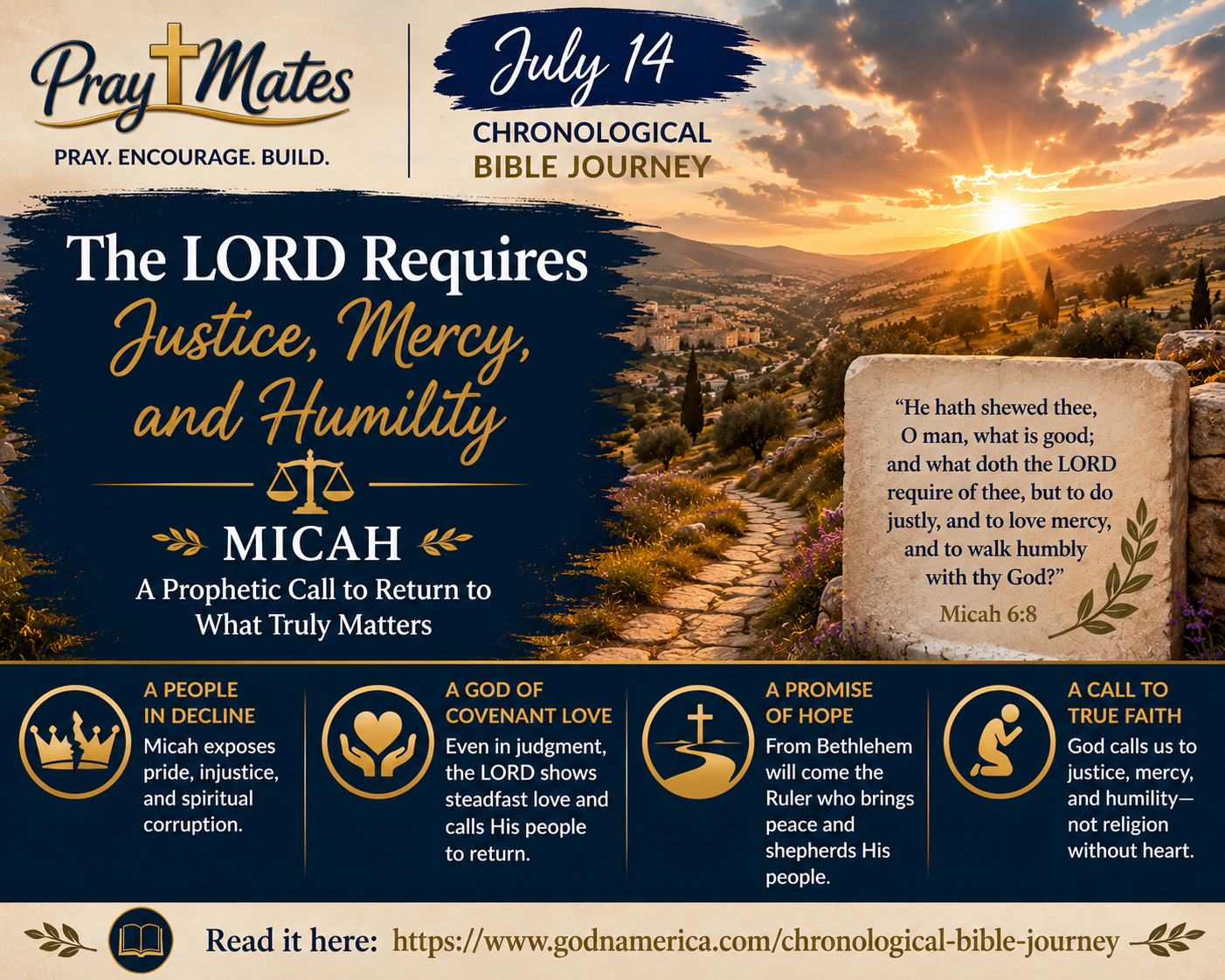
July 14 — What the Lord Requires
July 14 — What the Lord Requires
SCRIPTURE READING:
Micah
SCRIPTURE:
Micah 1:¹ The word of the LORD that came to Micah the Morasthite in the days of Jotham, Ahaz, and Hezekiah, kings of Judah, which he saw concerning Samaria and Jerusalem.
Micah 1:² Hear, all ye people; hearken, O earth, and all that therein is: and let the Lord GOD be witness against you, the Lord from his holy temple.
Micah 1:³ For, behold, the LORD cometh forth out of his place, and will come down, and tread upon the high places of the earth.
Micah 1:⁴ And the mountains shall be molten under him, and the valleys shall be cleft, as wax before the fire, and as the waters that are poured down a steep place.
Micah 1:⁵ For the transgression of Jacob is all this, and for the sins of the house of Israel. What is the transgression of Jacob? is it not Samaria? and what are the high places of Judah? are they not Jerusalem?
Micah 1:⁶ Therefore I will make Samaria as an heap of the field, and as plantings of a vineyard: and I will pour down the stones thereof into the valley, and I will discover the foundations thereof.
Micah 1:⁷ And all the graven images thereof shall be beaten to pieces, and all the hires thereof shall be burned with the fire, and all the idols thereof will I lay desolate: for she gathered it of the hire of an harlot, and they shall return to the hire of an harlot.
Micah 1:⁸ Therefore I will wail and howl, I will go stripped and naked: I will make a wailing like the dragons, and mourning as the owls.
Micah 1:⁹ For her wound is incurable; for it is come unto Judah; he is come unto the gate of my people, even to Jerusalem.
Micah 1:¹⁰ Declare ye it not at Gath, weep ye not at all: in the house of Aphrah roll thyself in the dust.
Micah 1:¹¹ Pass ye away, thou inhabitant of Saphir, having thy shame naked: the inhabitant of Zaanan came not forth in the mourning of Beth-ezel; he shall receive of you his standing.
Micah 1:¹² For the inhabitant of Maroth waited carefully for good: but evil came down from the LORD unto the gate of Jerusalem.
Micah 1:¹³ O thou inhabitant of Lachish, bind the chariot to the swift beast: she is the beginning of the sin to the daughter of Zion: for the transgressions of Israel were found in thee.
Micah 1:¹⁴ Therefore shalt thou give presents to Moresheth-gath: the houses of Achzib shall be a lie to the kings of Israel.
Micah 1:¹⁵ Yet will I bring an heir unto thee, O inhabitant of Mareshah: he shall come unto Adullam the glory of Israel.
Micah 1:¹⁶ Make thee bald, and poll thee for thy delicate children; enlarge thy baldness as the eagle; for they are gone into captivity from thee.
Micah 2:¹ Woe to them that devise iniquity, and work evil upon their beds! when the morning is light, they practise it, because it is in the power of their hand.
Micah 2:² And they covet fields, and take them by violence; and houses, and take them away: so they oppress a man and his house, even a man and his heritage.
Micah 2:³ Therefore thus saith the LORD; Behold, against this family do I devise an evil, from which ye shall not remove your necks; neither shall ye go haughtily: for this time is evil.
Micah 2:⁴ In that day shall one take up a parable against you, and lament with a doleful lamentation, and say, We be utterly spoiled: he hath changed the portion of my people: how hath he removed it from me! turning away he hath divided our fields.
Micah 2:⁵ Therefore thou shalt have none that shall cast a cord by lot in the congregation of the LORD.
Micah 2:⁶ Prophesy ye not, say they to them that prophesy: they shall not prophesy to them, that they shall not take shame.
Micah 2:⁷ O thou that art named the house of Jacob, is the spirit of the LORD straitened? are these his doings? do not my words do good to him that walketh uprightly?
Micah 2:⁸ Even of late my people is risen up as an enemy: ye pull off the robe with the garment from them that pass by securely as men averse from war.
Micah 2:⁹ The women of my people have ye cast out from their pleasant houses; from their children have ye taken away my glory for ever.
Micah 2:¹⁰ Arise ye, and depart; for this is not your rest: because it is polluted, it shall destroy you, even with a sore destruction.
Micah 2:¹¹ If a man walking in the spirit and falsehood do lie, saying, I will prophesy unto thee of wine and of strong drink; he shall even be the prophet of this people.
Micah 2:¹² I will surely assemble, O Jacob, all of thee; I will surely gather the remnant of Israel; I will put them together as the sheep of Bozrah, as the flock in the midst of their fold: they shall make great noise by reason of the multitude of men.
Micah 2:¹³ The breaker is come up before them: they have broken up, and have passed through the gate, and are gone out by it: and their king shall pass before them, and the LORD on the head of them.
Micah 3:¹ And I said, Hear, I pray you, O heads of Jacob, and ye princes of the house of Israel; Is it not for you to know judgment?
Micah 3:² Who hate the good, and love the evil; who pluck off their skin from off them, and their flesh from off their bones;
Micah 3:³ Who also eat the flesh of my people, and flay their skin from off them; and they break their bones, and chop them in pieces, as for the pot, and as flesh within the caldron.
Micah 3:⁴ Then shall they cry unto the LORD, but he will not hear them: he will even hide his face from them at that time, as they have behaved themselves ill in their doings.
Micah 3:⁵ Thus saith the LORD concerning the prophets that make my people err, that bite with their teeth, and cry, Peace; and he that putteth not into their mouths, they even prepare war against him.
Micah 3:⁶ Therefore night shall be unto you, that ye shall not have a vision; and it shall be dark unto you, that ye shall not divine; and the sun shall go down over the prophets, and the day shall be dark over them.
Micah 3:⁷ Then shall the seers be ashamed, and the diviners confounded: yea, they shall all cover their lips; for there is no answer of God.
Micah 3:⁸ But truly I am full of power by the spirit of the LORD, and of judgment, and of might, to declare unto Jacob his transgression, and to Israel his sin.
Micah 3:⁹ Hear this, I pray you, ye heads of the house of Jacob, and princes of the house of Israel, that abhor judgment, and pervert all equity.
Micah 3:¹⁰ They build up Zion with blood, and Jerusalem with iniquity.
Micah 3:¹¹ The heads thereof judge for reward, and the priests thereof teach for hire, and the prophets thereof divine for money: yet will they lean upon the LORD, and say, Is not the LORD among us? none evil can come upon us.
Micah 3:¹² Therefore shall Zion for your sake be plowed as a field, and Jerusalem shall become heaps, and the mountain of the house as the high places of the forest.
Micah 4:¹ But in the last days it shall come to pass, that the mountain of the house of the LORD shall be established in the top of the mountains, and it shall be exalted above the hills; and people shall flow unto it.
Micah 4:² And many nations shall come, and say, Come, and let us go up to the mountain of the LORD, and to the house of the God of Jacob; and he will teach us of his ways, and we will walk in his paths: for the law shall go forth of Zion, and the word of the LORD from Jerusalem.
Micah 4:³ And he shall judge among many people, and rebuke strong nations afar off; and they shall beat their swords into plowshares, and their spears into pruninghooks: nation shall not lift up a sword against nation, neither shall they learn war any more.
Micah 4:⁴ But they shall sit every man under his vine and under his fig tree; and none shall make them afraid: for the mouth of the LORD of hosts hath spoken it.
Micah 4:⁵ For all people will walk every one in the name of his god, and we will walk in the name of the LORD our God for ever and ever.
Micah 4:⁶ In that day, saith the LORD, will I assemble her that halteth, and I will gather her that is driven out, and her that I have afflicted;
Micah 4:⁷ And I will make her that halted a remnant, and her that was cast far off a strong nation: and the LORD shall reign over them in mount Zion from henceforth, even for ever.
Micah 4:⁸ And thou, O tower of the flock, the strong hold of the daughter of Zion, unto thee shall it come, even the first dominion; the kingdom shall come to the daughter of Jerusalem.
Micah 4:⁹ Now why dost thou cry out aloud? is there no king in thee? is thy counsellor perished? for pangs have taken thee as a woman in travail.
Micah 4:¹⁰ Be in pain, and labour to bring forth, O daughter of Zion, like a woman in travail: for now shalt thou go forth out of the city, and thou shalt dwell in the field, and thou shalt go even to Babylon; there shalt thou be delivered; there the LORD shall redeem thee from the hand of thine enemies.
Micah 4:¹¹ Now also many nations are gathered against thee, that say, Let her be defiled, and let our eye look upon Zion.
Micah 4:¹² But they know not the thoughts of the LORD, neither understand they his counsel: for he shall gather them as the sheaves into the floor.
Micah 4:¹³ Arise and thresh, O daughter of Zion: for I will make thine horn iron, and I will make thy hoofs brass: and thou shalt beat in pieces many people: and I will consecrate their gain unto the LORD, and their substance unto the Lord of the whole earth.
Micah 5:¹ Now gather thyself in troops, O daughter of troops: he hath laid siege against us: they shall smite the judge of Israel with a rod upon the cheek.
Micah 5:² But thou, Beth-lehem Ephratah, though thou be little among the thousands of Judah, yet out of thee shall he come forth unto me that is to be ruler in Israel; whose goings forth have been from of old, from everlasting.
Micah 5:³ Therefore will he give them up, until the time that she which travaileth hath brought forth: then the remnant of his brethren shall return unto the children of Israel.
Micah 5:⁴ And he shall stand and feed in the strength of the LORD, in the majesty of the name of the LORD his God; and they shall abide: for now shall he be great unto the ends of the earth.
Micah 5:⁵ And this man shall be the peace, when the Assyrian shall come into our land: and when he shall tread in our palaces, then shall we raise against him seven shepherds, and eight principal men.
Micah 5:⁶ And they shall waste the land of Assyria with the sword, and the land of Nimrod in the entrances thereof: thus shall he deliver us from the Assyrian, when he cometh into our land, and when he treadeth within our borders.
Micah 5:⁷ And the remnant of Jacob shall be in the midst of many people as a dew from the LORD, as the showers upon the grass, that tarrieth not for man, nor waiteth for the sons of men.
Micah 5:⁸ And the remnant of Jacob shall be among the Gentiles in the midst of many people as a lion among the beasts of the forest, as a young lion among the flocks of sheep: who, if he go through, both treadeth down, and teareth in pieces, and none can deliver.
Micah 5:⁹ Thine hand shall be lifted up upon thine adversaries, and all thine enemies shall be cut off.
Micah 5:¹⁰ And it shall come to pass in that day, saith the LORD, that I will cut off thy horses out of the midst of thee, and I will destroy thy chariots:
Micah 5:¹¹ And I will cut off the cities of thy land, and throw down all thy strong holds:
Micah 5:¹² And I will cut off witchcrafts out of thine hand; and thou shalt have no more soothsayers:
Micah 5:¹³ Thy graven images also will I cut off, and thy standing images out of the midst of thee; and thou shalt no more worship the work of thine hands.
Micah 5:¹⁴ And I will pluck up thy groves out of the midst of thee: so will I destroy thy cities.
Micah 5:¹⁵ And I will execute vengeance in anger and fury upon the heathen, such as they have not heard.
Micah 6:¹ Hear ye now what the LORD saith; Arise, contend thou before the mountains, and let the hills hear thy voice.
Micah 6:² Hear ye, O mountains, the LORD’s controversy, and ye strong foundations of the earth: for the LORD hath a controversy with his people, and he will plead with Israel.
Micah 6:³ O my people, what have I done unto thee? and wherein have I wearied thee? testify against me.
Micah 6:⁴ For I brought thee up out of the land of Egypt, and redeemed thee out of the house of servants; and I sent before thee Moses, Aaron, and Miriam.
Micah 6:⁵ O my people, remember now what Balak king of Moab consulted, and what Balaam the son of Beor answered him from Shittim unto Gilgal; that ye may know the righteousness of the LORD.
Micah 6:⁶ Wherewith shall I come before the LORD, and bow myself before the high God? shall I come before him with burnt offerings, with calves of a year old?
Micah 6:⁷ Will the LORD be pleased with thousands of rams, or with ten thousands of rivers of oil? shall I give my firstborn for my transgression, the fruit of my body for the sin of my soul?
Micah 6:⁸ He hath shewed thee, O man, what is good; and what doth the LORD require of thee, but to do justly, and to love mercy, and to walk humbly with thy God?
Micah 6:⁹ The LORD’s voice crieth unto the city, and the man of wisdom shall see thy name: hear ye the rod, and who hath appointed it.
Micah 6:¹⁰ Are there yet the treasures of wickedness in the house of the wicked, and the scant measure that is abominable?
Micah 6:¹¹ Shall I count them pure with the wicked balances, and with the bag of deceitful weights?
Micah 6:¹² For the rich men thereof are full of violence, and the inhabitants thereof have spoken lies, and their tongue is deceitful in their mouth.
Micah 6:¹³ Therefore also will I make thee sick in smiting thee, in making thee desolate because of thy sins.
Micah 6:¹⁴ Thou shalt eat, but not be satisfied; and thy casting down shall be in the midst of thee; and thou shalt take hold, but shalt not deliver; and that which thou deliverest will I give up to the sword.
Micah 6:¹⁵ Thou shalt sow, but thou shalt not reap; thou shalt tread the olives, but thou shalt not anoint thee with oil; and sweet wine, but shalt not drink wine.
Micah 6:¹⁶ For the statutes of Omri are kept, and all the works of the house of Ahab, and ye walk in their counsels; that I should make thee a desolation, and the inhabitants thereof an hissing: therefore ye shall bear the reproach of my people.
Micah 7:¹ Woe is me! for I am as when they have gathered the summer fruits, as the grapegleanings of the vintage: there is no cluster to eat: my soul desired the firstripe fruit.
Micah 7:² The good man is perished out of the earth: and there is none upright among men: they all lie in wait for blood; they hunt every man his brother with a net.
Micah 7:³ That they may do evil with both hands earnestly, the prince asketh, and the judge asketh for a reward; and the great man, he uttereth his mischievous desire: so they wrap it up.
Micah 7:⁴ The best of them is as a brier: the most upright is sharper than a thorn hedge: the day of thy watchmen and thy visitation cometh; now shall be their perplexity.
Micah 7:⁵ Trust ye not in a friend, put ye not confidence in a guide: keep the doors of thy mouth from her that lieth in thy bosom.
Micah 7:⁶ For the son dishonoureth the father, the daughter riseth up against her mother, the daughter in law against her mother in law; a man’s enemies are the men of his own house.
Micah 7:⁷ Therefore I will look unto the LORD; I will wait for the God of my salvation: my God will hear me.
Micah 7:⁸ Rejoice not against me, O mine enemy: when I fall, I shall arise; when I sit in darkness, the LORD shall be a light unto me.
Micah 7:⁹ I will bear the indignation of the LORD, because I have sinned against him, until he plead my cause, and execute judgment for me: he will bring me forth to the light, and I shall behold his righteousness.
Micah 7:¹⁰ Then she that is mine enemy shall see it, and shame shall cover her which said unto me, Where is the LORD thy God? mine eyes shall behold her: now shall she be trodden down as the mire of the streets.
Micah 7:¹¹ In the day that thy walls are to be built, in that day shall the decree be far removed.
Micah 7:¹² In that day also he shall come even to thee from Assyria, and from the fortified cities, and from the fortress even to the river, and from sea to sea, and from mountain to mountain.
Micah 7:¹³ Notwithstanding the land shall be desolate because of them that dwell therein, for the fruit of their doings.
Micah 7:¹⁴ Feed thy people with thy rod, the flock of thine heritage, which dwell solitarily in the wood, in the midst of Carmel: let them feed in Bashan and Gilead, as in the days of old.
Micah 7:¹⁵ According to the days of thy coming out of the land of Egypt will I shew unto him marvellous things.
Micah 7:¹⁶ The nations shall see and be confounded at all their might: they shall lay their hand upon their mouth, their ears shall be deaf.
Micah 7:¹⁷ They shall lick the dust like a serpent, they shall move out of their holes like worms of the earth: they shall be afraid of the LORD our God, and shall fear because of thee.
Micah 7:¹⁸ Who is a God like unto thee, that pardoneth iniquity, and passeth by the transgression of the remnant of his heritage? he retaineth not his anger for ever, because he delighteth in mercy.
Micah 7:¹⁹ He will turn again, he will have compassion upon us; he will subdue our iniquities; and thou wilt cast all their sins into the depths of the sea.
Micah 7:²⁰ Thou wilt perform the truth to Jacob, and the mercy to Abraham, which thou hast sworn unto our fathers from the days of old.
DEVOTIONAL:
Micah speaks to Samaria and Jerusalem with the grief of a prophet who sees covenant unfaithfulness in both worship and society. Idolatry, seized fields, corrupt rulers, false prophets, dishonest merchants, and violent leaders reveal a people whose public life contradicts their confession. Micah's message is not anti-institutional cynicism. He knows that rulers, priests, prophets, families, and courts can serve God's purposes. His burden is that those entrusted with responsibility have used power to devour rather than shepherd.
The book holds severe judgment together with astonishing promise. From Bethlehem Ephratah, small among the thousands of Judah, will come a ruler whose goings forth are from of old. Micah does not let present corruption cancel Davidic hope. The Messiah will shepherd in the strength of the Lord and bring peace. The nations will one day stream to the mountain of the Lord, beating swords into plowshares. God's answer to corrupt leadership is not anarchy, but His own righteous King.
Micah 6 brings the covenant lawsuit to a personal point. The Lord reminds His people of redemption from Egypt and faithful guidance through the wilderness. Then He asks what worship He desires. The answer is not lavish religious performance offered in place of obedience. The Lord requires doing justly, loving mercy, and walking humbly with God. These are not three disconnected virtues. Justice without mercy can become severe, mercy without justice can become sentimental, and both without humble fellowship with God lose their covenant root.
Jesus fulfills Micah with beautiful precision. He is born in Bethlehem, shepherds His flock, embodies justice and mercy, and walks in perfect humility before the Father. He also bears the judgment that dishonest, violent, and self-protective sinners deserve. Through faith in Him, believers receive forgiveness and the Spirit, so Micah 6:8 becomes fruit rather than a ladder for self-salvation. We do not earn grace by doing justice; grace trains us to become people who love what God loves.
In daily life, Micah brings discipleship down to ordinary integrity. Families can practice mercy in conflict, workers can reject dishonest measurements, churches can repent of platforming charisma without character, and neighbors can seek justice without losing humility. The Lord does not ask us to perform spirituality loudly while ignoring our closest responsibilities. He calls us to walk with Him, which means every step is taken under His mercy and authority.
In U.S. civic life, the civic virtue tied to Micah is humble justice. A fitting current prayer focus is for honest courts, fair business practices, trustworthy local government, and protection for those harmed by predatory power. Christians should show up as people who do justly, love mercy, and walk humbly with God in public without confusing prophetic faithfulness with partisan self-display.
DISCUSSION QUESTIONS:
How does Micah connect corrupt worship with injustice in public life?
Why is the promise of a ruler from Bethlehem such good news in a book filled with failed leadership?
How does Jesus make Micah 6:8 the fruit of grace rather than a way to earn salvation?
Which part of doing justly, loving mercy, and walking humbly needs renewed attention in your life?
PRAYER:
ADORATION: Shepherd King, You are righteous in judgment, rich in mercy, and humble enough to draw near to Your people.
CONFESSION: We confess religious performance that has not always become justice, mercy that has lacked truth, and public concern that has lacked humility.
THANKSGIVING: Thank You for Jesus, born in Bethlehem, who shepherds us in the strength of the Lord and forgives our crooked ways.
SUPPLICATION – GENERAL: Form in us honest dealings, tender mercy, and a steady walk with You in hidden and visible places.
SUPPLICATION – U.S. / CIVIC: Strengthen honest courts, fair commerce, and local leaders who protect people from predatory power.
SCRIPTURE: "to do justly, and to love mercy, and to walk humbly with thy God"

July 13 — A Child, a Son, a Righteous Reign
July 13 — A Child, a Son, a Righteous Reign
SCRIPTURE READING:
2 Chronicles 27; Isaiah 9-12
SCRIPTURE:
Second Chronicles 27:¹ Jotham was twenty and five years old when he began to reign, and he reigned sixteen years in Jerusalem. His mother’s name also was Jerushah, the daughter of Zadok.
Second Chronicles 27:² And he did that which was right in the sight of the LORD, according to all that his father Uzziah did: howbeit he entered not into the temple of the LORD. And the people did yet corruptly.
Second Chronicles 27:³ He built the high gate of the house of the LORD, and on the wall of Ophel he built much.
Second Chronicles 27:⁴ Moreover he built cities in the mountains of Judah, and in the forests he built castles and towers.
Second Chronicles 27:⁵ He fought also with the king of the Ammonites, and prevailed against them. And the children of Ammon gave him the same year an hundred talents of silver, and ten thousand measures of wheat, and ten thousand of barley. So much did the children of Ammon pay unto him, both the second year, and the third.
Second Chronicles 27:⁶ So Jotham became mighty, because he prepared his ways before the LORD his God.
Second Chronicles 27:⁷ Now the rest of the acts of Jotham, and all his wars, and his ways, lo, they are written in the book of the kings of Israel and Judah.
Second Chronicles 27:⁸ He was five and twenty years old when he began to reign, and reigned sixteen years in Jerusalem.
Second Chronicles 27:⁹ And Jotham slept with his fathers, and they buried him in the city of David: and Ahaz his son reigned in his stead.
Isaiah 9:¹ Nevertheless the dimness shall not be such as was in her vexation, when at the first he lightly afflicted the land of Zebulun and the land of Naphtali, and afterward did more grievously afflict her by the way of the sea, beyond Jordan, in Galilee of the nations.
Isaiah 9:² The people that walked in darkness have seen a great light: they that dwell in the land of the shadow of death, upon them hath the light shined.
Isaiah 9:³ Thou hast multiplied the nation, and not increased the joy: they joy before thee according to the joy in harvest, and as men rejoice when they divide the spoil.
Isaiah 9:⁴ For thou hast broken the yoke of his burden, and the staff of his shoulder, the rod of his oppressor, as in the day of Midian.
Isaiah 9:⁵ For every battle of the warrior is with confused noise, and garments rolled in blood; but this shall be with burning and fuel of fire.
Isaiah 9:⁶ For unto us a child is born, unto us a son is given: and the government shall be upon his shoulder: and his name shall be called Wonderful, Counsellor, The mighty God, The everlasting Father, The Prince of Peace.
Isaiah 9:⁷ Of the increase of his government and peace there shall be no end, upon the throne of David, and upon his kingdom, to order it, and to establish it with judgment and with justice from henceforth even for ever. The zeal of the LORD of hosts will perform this.
Isaiah 9:⁸ The Lord sent a word into Jacob, and it hath lighted upon Israel.
Isaiah 9:⁹ And all the people shall know, even Ephraim and the inhabitant of Samaria, that say in the pride and stoutness of heart,
Isaiah 9:¹⁰ The bricks are fallen down, but we will build with hewn stones: the sycomores are cut down, but we will change them into cedars.
Isaiah 9:¹¹ Therefore the LORD shall set up the adversaries of Rezin against him, and join his enemies together;
Isaiah 9:¹² The Syrians before, and the Philistines behind; and they shall devour Israel with open mouth. For all this his anger is not turned away, but his hand is stretched out still.
Isaiah 9:¹³ For the people turneth not unto him that smiteth them, neither do they seek the LORD of hosts.
Isaiah 9:¹⁴ Therefore the LORD will cut off from Israel head and tail, branch and rush, in one day.
Isaiah 9:¹⁵ The ancient and honourable, he is the head; and the prophet that teacheth lies, he is the tail.
Isaiah 9:¹⁶ For the leaders of this people cause them to err; and they that are led of them are destroyed.
Isaiah 9:¹⁷ Therefore the Lord shall have no joy in their young men, neither shall have mercy on their fatherless and widows: for every one is an hypocrite and an evildoer, and every mouth speaketh folly. For all this his anger is not turned away, but his hand is stretched out still.
Isaiah 9:¹⁸ For wickedness burneth as the fire: it shall devour the briers and thorns, and shall kindle in the thickets of the forest, and they shall mount up like the lifting up of smoke.
Isaiah 9:¹⁹ Through the wrath of the LORD of hosts is the land darkened, and the people shall be as the fuel of the fire: no man shall spare his brother.
Isaiah 9:²⁰ And he shall snatch on the right hand, and be hungry; and he shall eat on the left hand, and they shall not be satisfied: they shall eat every man the flesh of his own arm:
Isaiah 9:²¹ Manasseh, Ephraim; and Ephraim, Manasseh: and they together shall be against Judah. For all this his anger is not turned away, but his hand is stretched out still.
Isaiah 10:¹ Woe unto them that decree unrighteous decrees, and that write grievousness which they have prescribed;
Isaiah 10:² To turn aside the needy from judgment, and to take away the right from the poor of my people, that widows may be their prey, and that they may rob the fatherless!
Isaiah 10:³ And what will ye do in the day of visitation, and in the desolation which shall come from far? to whom will ye flee for help? and where will ye leave your glory?
Isaiah 10:⁴ Without me they shall bow down under the prisoners, and they shall fall under the slain. For all this his anger is not turned away, but his hand is stretched out still.
Isaiah 10:⁵ O Assyrian, the rod of mine anger, and the staff in their hand is mine indignation.
Isaiah 10:⁶ I will send him against an hypocritical nation, and against the people of my wrath will I give him a charge, to take the spoil, and to take the prey, and to tread them down like the mire of the streets.
Isaiah 10:⁷ Howbeit he meaneth not so, neither doth his heart think so; but it is in his heart to destroy and cut off nations not a few.
Isaiah 10:⁸ For he saith, Are not my princes altogether kings?
Isaiah 10:⁹ Is not Calno as Carchemish? is not Hamath as Arpad? is not Samaria as Damascus?
Isaiah 10:¹⁰ As my hand hath found the kingdoms of the idols, and whose graven images did excel them of Jerusalem and of Samaria;
Isaiah 10:¹¹ Shall I not, as I have done unto Samaria and her idols, so do to Jerusalem and her idols?
Isaiah 10:¹² Wherefore it shall come to pass, that when the Lord hath performed his whole work upon mount Zion and on Jerusalem, I will punish the fruit of the stout heart of the king of Assyria, and the glory of his high looks.
Isaiah 10:¹³ For he saith, By the strength of my hand I have done it, and by my wisdom; for I am prudent: and I have removed the bounds of the people, and have robbed their treasures, and I have put down the inhabitants like a valiant man:
Isaiah 10:¹⁴ And my hand hath found as a nest the riches of the people: and as one gathereth eggs that are left, have I gathered all the earth; and there was none that moved the wing, or opened the mouth, or peeped.
Isaiah 10:¹⁵ Shall the axe boast itself against him that heweth therewith? or shall the saw magnify itself against him that shaketh it? as if the rod should shake itself against them that lift it up, or as if the staff should lift up itself, as if it were no wood.
Isaiah 10:¹⁶ Therefore shall the Lord, the Lord of hosts, send among his fat ones leanness; and under his glory he shall kindle a burning like the burning of a fire.
Isaiah 10:¹⁷ And the light of Israel shall be for a fire, and his Holy One for a flame: and it shall burn and devour his thorns and his briers in one day;
Isaiah 10:¹⁸ And shall consume the glory of his forest, and of his fruitful field, both soul and body: and they shall be as when a standardbearer fainteth.
Isaiah 10:¹⁹ And the rest of the trees of his forest shall be few, that a child may write them.
Isaiah 10:²⁰ And it shall come to pass in that day, that the remnant of Israel, and such as are escaped of the house of Jacob, shall no more again stay upon him that smote them; but shall stay upon the LORD, the Holy One of Israel, in truth.
Isaiah 10:²¹ The remnant shall return, even the remnant of Jacob, unto the mighty God.
Isaiah 10:²² For though thy people Israel be as the sand of the sea, yet a remnant of them shall return: the consumption decreed shall overflow with righteousness.
Isaiah 10:²³ For the Lord GOD of hosts shall make a consumption, even determined, in the midst of all the land.
Isaiah 10:²⁴ Therefore thus saith the Lord GOD of hosts, O my people that dwellest in Zion, be not afraid of the Assyrian: he shall smite thee with a rod, and shall lift up his staff against thee, after the manner of Egypt.
Isaiah 10:²⁵ For yet a very little while, and the indignation shall cease, and mine anger in their destruction.
Isaiah 10:²⁶ And the LORD of hosts shall stir up a scourge for him according to the slaughter of Midian at the rock of Oreb: and as his rod was upon the sea, so shall he lift it up after the manner of Egypt.
Isaiah 10:²⁷ And it shall come to pass in that day, that his burden shall be taken away from off thy shoulder, and his yoke from off thy neck, and the yoke shall be destroyed because of the anointing.
Isaiah 10:²⁸ He is come to Aiath, he is passed to Migron; at Michmash he hath laid up his carriages:
Isaiah 10:²⁹ They are gone over the passage: they have taken up their lodging at Geba; Ramah is afraid; Gibeah of Saul is fled.
Isaiah 10:³⁰ Lift up thy voice, O daughter of Gallim: cause it to be heard unto Laish, O poor Anathoth.
Isaiah 10:³¹ Madmenah is removed; the inhabitants of Gebim gather themselves to flee.
Isaiah 10:³² As yet shall he remain at Nob that day: he shall shake his hand against the mount of the daughter of Zion, the hill of Jerusalem.
Isaiah 10:³³ Behold, the Lord, the LORD of hosts, shall lop the bough with terror: and the high ones of stature shall be hewn down, and the haughty shall be humbled.
Isaiah 10:³⁴ And he shall cut down the thickets of the forest with iron, and Lebanon shall fall by a mighty one.
Isaiah 11:¹ And there shall come forth a rod out of the stem of Jesse, and a Branch shall grow out of his roots:
Isaiah 11:² And the spirit of the LORD shall rest upon him, the spirit of wisdom and understanding, the spirit of counsel and might, the spirit of knowledge and of the fear of the LORD;
Isaiah 11:³ And shall make him of quick understanding in the fear of the LORD: and he shall not judge after the sight of his eyes, neither reprove after the hearing of his ears:
Isaiah 11:⁴ But with righteousness shall he judge the poor, and reprove with equity for the meek of the earth: and he shall smite the earth with the rod of his mouth, and with the breath of his lips shall he slay the wicked.
Isaiah 11:⁵ And righteousness shall be the girdle of his loins, and faithfulness the girdle of his reins.
Isaiah 11:⁶ The wolf also shall dwell with the lamb, and the leopard shall lie down with the kid; and the calf and the young lion and the fatling together; and a little child shall lead them.
Isaiah 11:⁷ And the cow and the bear shall feed; their young ones shall lie down together: and the lion shall eat straw like the ox.
Isaiah 11:⁸ And the sucking child shall play on the hole of the asp, and the weaned child shall put his hand on the cockatrice’ den.
Isaiah 11:⁹ They shall not hurt nor destroy in all my holy mountain: for the earth shall be full of the knowledge of the LORD, as the waters cover the sea.
Isaiah 11:¹⁰ And in that day there shall be a root of Jesse, which shall stand for an ensign of the people; to it shall the Gentiles seek: and his rest shall be glorious.
Isaiah 11:¹¹ And it shall come to pass in that day, that the Lord shall set his hand again the second time to recover the remnant of his people, which shall be left, from Assyria, and from Egypt, and from Pathros, and from Cush, and from Elam, and from Shinar, and from Hamath, and from the islands of the sea.
Isaiah 11:¹² And he shall set up an ensign for the nations, and shall assemble the outcasts of Israel, and gather together the dispersed of Judah from the four corners of the earth.
Isaiah 11:¹³ The envy also of Ephraim shall depart, and the adversaries of Judah shall be cut off: Ephraim shall not envy Judah, and Judah shall not vex Ephraim.
Isaiah 11:¹⁴ But they shall fly upon the shoulders of the Philistines toward the west; they shall spoil them of the east together: they shall lay their hand upon Edom and Moab; and the children of Ammon shall obey them.
Isaiah 11:¹⁵ And the LORD shall utterly destroy the tongue of the Egyptian sea; and with his mighty wind shall he shake his hand over the river, and shall smite it in the seven streams, and make men go over dryshod.
Isaiah 11:¹⁶ And there shall be an highway for the remnant of his people, which shall be left, from Assyria; like as it was to Israel in the day that he came up out of the land of Egypt.
Isaiah 12:¹ And in that day thou shalt say, O LORD, I will praise thee: though thou wast angry with me, thine anger is turned away, and thou comfortedst me.
Isaiah 12:² Behold, God is my salvation; I will trust, and not be afraid: for the LORD JEHOVAH is my strength and my song; he also is become my salvation.
Isaiah 12:³ Therefore with joy shall ye draw water out of the wells of salvation.
Isaiah 12:⁴ And in that day shall ye say, Praise the LORD, call upon his name, declare his doings among the people, make mention that his name is exalted.
Isaiah 12:⁵ Sing unto the LORD; for he hath done excellent things: this is known in all the earth.
Isaiah 12:⁶ Cry out and shout, thou inhabitant of Zion: for great is the Holy One of Israel in the midst of thee.
DEVOTIONAL:
Jotham's reign is described with restraint and clarity. He becomes mighty because he prepares his ways before the Lord, yet the people still do corruptly. The king's personal faithfulness does not automatically heal a nation's deeper spiritual disease. That sober note prepares us for Isaiah's sweeping vision. Darkness covers the land, oppression weighs down the people, and judgment has come because pride refuses to turn to the Lord. Human leadership is insufficient unless God gives the King His people truly need.
Isaiah 9 announces light in Galilee and joy like harvest after battle. The promised child bears royal names that no ordinary son of David can finally sustain: Wonderful, Counsellor, The mighty God, The everlasting Father, The Prince of Peace. His government and peace increase without end upon David's throne. This is covenant hope at its richest. The Lord does not abandon the Davidic promise; He intensifies it until it requires a King who is both truly human and more than merely human.
Chapters 10 and 11 hold judgment and hope together. Assyria is used as an instrument of judgment, yet Assyria's arrogance will also be judged. A remnant shall return, and from Jesse's seemingly cut-down line a Rod and Branch will come. The Spirit of the Lord rests upon Him, and His reign brings righteousness for the poor, equity for the meek, and peace pictured through creation itself. The Messiah's rule restores what sin has disordered, and the nations seek Him without Israel's covenant hope being erased.
The New Testament identifies Jesus as the light dawning in Galilee and the Son given for us. He teaches with wisdom, judges with righteousness, and brings peace first through the blood of His cross. The fullness of Isaiah's peace awaits His return, but its firstfruits appear wherever sinners bow to His reign. He gathers a remnant by grace, welcomes Gentiles into hope, and fills His people with the Spirit so they can live as signs of the kingdom that is coming.
In daily life, this reading invites us to prepare our ways before the Lord while placing ultimate hope in Christ, not in the best human leader. Families can seek peace without pretending they can create the kingdom by discipline alone, workers can practice fairness toward the meek, and churches can embody reconciled life across differences. Because the government rests on Messiah's shoulder, we can be faithful without despair and hopeful without naivety.
In U.S. civic life, the civic virtue tied to this reading is peaceable righteousness. A fitting current prayer focus is for leaders, courts, schools, and neighborhoods to protect the poor and make decisions with equity rather than favoritism. Christians should show up as hopeful citizens who seek peace, defend the meek, and remember that no earthly office can carry the weight that belongs only to Christ.
DISCUSSION QUESTIONS:
How does Jotham's reign show both the value and the limits of faithful human leadership?
Why do the titles in Isaiah 9 point beyond an ordinary Davidic king?
How does Jesus begin fulfilling Isaiah's promised light, peace, and righteous rule?
Where can you practice peaceable righteousness while trusting Christ with ultimate outcomes?
PRAYER:
ADORATION: Mighty God and Prince of Peace, Your throne is righteous, Your counsel is wonderful, and Your kingdom has no end.
CONFESSION: We confess that we place too much hope in human leadership and too little trust in the Son upon whose shoulder true government rests.
THANKSGIVING: Thank You for sending Jesus, the promised Son of David, who brings light to darkness and peace through His cross.
SUPPLICATION – GENERAL: Prepare our ways before You, make our homes and churches signs of Your peace, and teach us to defend the meek with righteousness.
SUPPLICATION – U.S. / CIVIC: Give our communities leaders who value equity for the poor, and keep Christians hopeful, honest, and peace-seeking in public life.
SCRIPTURE: "and his name shall be called Wonderful, Counsellor, The mighty God, The everlasting Father, The Prince of Peace"

July 12 — Hope Beyond the Fallen Booth
July 12 — Hope Beyond the Fallen Booth
SCRIPTURE READING:
Amos 6-9
SCRIPTURE:
Amos 6:¹ Woe to them that are at ease in Zion, and trust in the mountain of Samaria, which are named chief of the nations, to whom the house of Israel came!
Amos 6:² Pass ye unto Calneh, and see; and from thence go ye to Hamath the great: then go down to Gath of the Philistines: be they better than these kingdoms? or their border greater than your border?
Amos 6:³ Ye that put far away the evil day, and cause the seat of violence to come near;
Amos 6:⁴ That lie upon beds of ivory, and stretch themselves upon their couches, and eat the lambs out of the flock, and the calves out of the midst of the stall;
Amos 6:⁵ That chant to the sound of the viol, and invent to themselves instruments of musick, like David;
Amos 6:⁶ That drink wine in bowls, and anoint themselves with the chief ointments: but they are not grieved for the affliction of Joseph.
Amos 6:⁷ Therefore now shall they go captive with the first that go captive, and the banquet of them that stretched themselves shall be removed.
Amos 6:⁸ The Lord GOD hath sworn by himself, saith the LORD the God of hosts, I abhor the excellency of Jacob, and hate his palaces: therefore will I deliver up the city with all that is therein.
Amos 6:⁹ And it shall come to pass, if there remain ten men in one house, that they shall die.
Amos 6:¹⁰ And a man’s uncle shall take him up, and he that burneth him, to bring out the bones out of the house, and shall say unto him that is by the sides of the house, Is there yet any with thee? and he shall say, No. Then shall he say, Hold thy tongue: for we may not make mention of the name of the LORD.
Amos 6:¹¹ For, behold, the LORD commandeth, and he will smite the great house with breaches, and the little house with clefts.
Amos 6:¹² Shall horses run upon the rock? will one plow there with oxen? for ye have turned judgment into gall, and the fruit of righteousness into hemlock:
Amos 6:¹³ Ye which rejoice in a thing of nought, which say, Have we not taken to us horns by our own strength?
Amos 6:¹⁴ But, behold, I will raise up against you a nation, O house of Israel, saith the LORD the God of hosts; and they shall afflict you from the entering in of Hemath unto the river of the wilderness.
Amos 7:¹ Thus hath the Lord GOD shewed unto me; and, behold, he formed grasshoppers in the beginning of the shooting up of the latter growth; and, lo, it was the latter growth after the king’s mowings.
Amos 7:² And it came to pass, that when they had made an end of eating the grass of the land, then I said, O Lord GOD, forgive, I beseech thee: by whom shall Jacob arise? for he is small.
Amos 7:³ The LORD repented for this: It shall not be, saith the LORD.
Amos 7:⁴ Thus hath the Lord GOD shewed unto me: and, behold, the Lord GOD called to contend by fire, and it devoured the great deep, and did eat up a part.
Amos 7:⁵ Then said I, O Lord GOD, cease, I beseech thee: by whom shall Jacob arise? for he is small.
Amos 7:⁶ The LORD repented for this: This also shall not be, saith the Lord GOD.
Amos 7:⁷ Thus he shewed me: and, behold, the Lord stood upon a wall made by a plumbline, with a plumbline in his hand.
Amos 7:⁸ And the LORD said unto me, Amos, what seest thou? And I said, A plumbline. Then said the Lord, Behold, I will set a plumbline in the midst of my people Israel: I will not again pass by them any more:
Amos 7:⁹ And the high places of Isaac shall be desolate, and the sanctuaries of Israel shall be laid waste; and I will rise against the house of Jeroboam with the sword.
Amos 7:¹⁰ Then Amaziah the priest of Beth-el sent to Jeroboam king of Israel, saying, Amos hath conspired against thee in the midst of the house of Israel: the land is not able to bear all his words.
Amos 7:¹¹ For thus Amos saith, Jeroboam shall die by the sword, and Israel shall surely be led away captive out of their own land.
Amos 7:¹² Also Amaziah said unto Amos, O thou seer, go, flee thee away into the land of Judah, and there eat bread, and prophesy there:
Amos 7:¹³ But prophesy not again any more at Beth-el: for it is the king’s chapel, and it is the king’s court.
Amos 7:¹⁴ Then answered Amos, and said to Amaziah, I was no prophet, neither was I a prophet’s son; but I was an herdman, and a gatherer of sycomore fruit:
Amos 7:¹⁵ And the LORD took me as I followed the flock, and the LORD said unto me, Go, prophesy unto my people Israel.
Amos 7:¹⁶ Now therefore hear thou the word of the LORD: Thou sayest, Prophesy not against Israel, and drop not thy word against the house of Isaac.
Amos 7:¹⁷ Therefore thus saith the LORD; Thy wife shall be an harlot in the city, and thy sons and thy daughters shall fall by the sword, and thy land shall be divided by line; and thou shalt die in a polluted land: and Israel shall surely go into captivity forth of his land.
Amos 8:¹ Thus hath the Lord GOD shewed unto me: and behold a basket of summer fruit.
Amos 8:² And he said, Amos, what seest thou? And I said, A basket of summer fruit. Then said the LORD unto me, The end is come upon my people of Israel; I will not again pass by them any more.
Amos 8:³ And the songs of the temple shall be howlings in that day, saith the Lord GOD: there shall be many dead bodies in every place; they shall cast them forth with silence.
Amos 8:⁴ Hear this, O ye that swallow up the needy, even to make the poor of the land to fail,
Amos 8:⁵ Saying, When will the new moon be gone, that we may sell corn? and the sabbath, that we may set forth wheat, making the ephah small, and the shekel great, and falsifying the balances by deceit?
Amos 8:⁶ That we may buy the poor for silver, and the needy for a pair of shoes; yea, and sell the refuse of the wheat?
Amos 8:⁷ The LORD hath sworn by the excellency of Jacob, Surely I will never forget any of their works.
Amos 8:⁸ Shall not the land tremble for this, and every one mourn that dwelleth therein? and it shall rise up wholly as a flood; and it shall be cast out and drowned, as by the flood of Egypt.
Amos 8:⁹ And it shall come to pass in that day, saith the Lord GOD, that I will cause the sun to go down at noon, and I will darken the earth in the clear day:
Amos 8:¹⁰ And I will turn your feasts into mourning, and all your songs into lamentation; and I will bring up sackcloth upon all loins, and baldness upon every head; and I will make it as the mourning of an only son, and the end thereof as a bitter day.
Amos 8:¹¹ Behold, the days come, saith the Lord GOD, that I will send a famine in the land, not a famine of bread, nor a thirst for water, but of hearing the words of the LORD:
Amos 8:¹² And they shall wander from sea to sea, and from the north even to the east, they shall run to and fro to seek the word of the LORD, and shall not find it.
Amos 8:¹³ In that day shall the fair virgins and young men faint for thirst.
Amos 8:¹⁴ They that swear by the sin of Samaria, and say, Thy god, O Dan, liveth; and, The manner of Beer-sheba liveth; even they shall fall, and never rise up again.
Amos 9:¹ I saw the Lord standing upon the altar: and he said, Smite the lintel of the door, that the posts may shake: and cut them in the head, all of them; and I will slay the last of them with the sword: he that fleeth of them shall not flee away, and he that escapeth of them shall not be delivered.
Amos 9:² Though they dig into hell, thence shall mine hand take them; though they climb up to heaven, thence will I bring them down:
Amos 9:³ And though they hide themselves in the top of Carmel, I will search and take them out thence; and though they be hid from my sight in the bottom of the sea, thence will I command the serpent, and he shall bite them:
Amos 9:⁴ And though they go into captivity before their enemies, thence will I command the sword, and it shall slay them: and I will set mine eyes upon them for evil, and not for good.
Amos 9:⁵ And the Lord GOD of hosts is he that toucheth the land, and it shall melt, and all that dwell therein shall mourn: and it shall rise up wholly like a flood; and shall be drowned, as by the flood of Egypt.
Amos 9:⁶ It is he that buildeth his stories in the heaven, and hath founded his troop in the earth; he that calleth for the waters of the sea, and poureth them out upon the face of the earth: The LORD is his name.
Amos 9:⁷ Are ye not as children of the Ethiopians unto me, O children of Israel? saith the LORD. Have not I brought up Israel out of the land of Egypt? and the Philistines from Caphtor, and the Syrians from Kir?
Amos 9:⁸ Behold, the eyes of the Lord GOD are upon the sinful kingdom, and I will destroy it from off the face of the earth; saving that I will not utterly destroy the house of Jacob, saith the LORD.
Amos 9:⁹ For, lo, I will command, and I will sift the house of Israel among all nations, like as corn is sifted in a sieve, yet shall not the least grain fall upon the earth.
Amos 9:¹⁰ All the sinners of my people shall die by the sword, which say, The evil shall not overtake nor prevent us.
Amos 9:¹¹ In that day will I raise up the tabernacle of David that is fallen, and close up the breaches thereof; and I will raise up his ruins, and I will build it as in the days of old:
Amos 9:¹² That they may possess the remnant of Edom, and of all the heathen, which are called by my name, saith the LORD that doeth this.
Amos 9:¹³ Behold, the days come, saith the LORD, that the plowman shall overtake the reaper, and the treader of grapes him that soweth seed; and the mountains shall drop sweet wine, and all the hills shall melt.
Amos 9:¹⁴ And I will bring again the captivity of my people of Israel, and they shall build the waste cities, and inhabit them; and they shall plant vineyards, and drink the wine thereof; they shall also make gardens, and eat the fruit of them.
Amos 9:¹⁵ And I will plant them upon their land, and they shall no more be pulled up out of their land which I have given them, saith the LORD thy God.
DEVOTIONAL:
Amos 6 confronts ease without repentance. The people at ease in Zion and secure in Samaria enjoy luxury, music, wine, and comfort while they are not grieved for the affliction of Joseph. The problem is not beauty, food, or music in themselves. The sin is insulated pleasure while covenant life collapses. Amos exposes a spirituality that can decorate itself with culture while ignoring ruin. When comfort dulls grief over sin and suffering, it becomes a sedative against the fear of the Lord.
The visions in chapters 7 through 9 intensify the warning. Locusts, fire, the plumbline, summer fruit, and the struck altar reveal that judgment is measured, near, and unavoidable apart from God's mercy. Amaziah the priest of Bethel rejects Amos as a threat to national stability, but he cannot silence the Lord. The famine of hearing the words of the Lord is especially terrifying. A society can have markets, shrines, politics, and songs, yet starve because it no longer receives God's word.
Yet the book does not end in devastation. The Lord promises to raise up the tabernacle, or booth, of David that is fallen. The restoration of David's house will bring blessing so abundant that plowman and reaper overlap, and the people will be planted in their land. This promise preserves hope within judgment. God will sift His people, but He will not lose one grain that belongs to His saving purpose. The covenant line moves forward because the Lord is faithful to His promises.
The New Testament quotes Amos 9 at the Jerusalem council to show that the inclusion of Gentiles in Messiah is not a departure from the prophets. James sees the rebuilding of David's fallen tent fulfilled as Gentiles seek the Lord through Jesus. This is not replacement, but fulfillment through Israel's Davidic King. The risen Christ gathers Jews and Gentiles into one redeemed people by grace, proving that judgment is not God's final word for those who repent and trust Him.
In daily life, Amos teaches us to grieve rightly. We should not enjoy comfort in ways that make us numb to sin, lonely neighbors, broken families, or a church's spiritual drift. Parents can cultivate concern beyond their own household, workers can notice those harmed by dishonest systems, and congregations can value the word of God more than entertainment. Hope in Christ does not make us passive; it makes repentance possible and restoration believable.
In U.S. civic life, the civic virtue tied to this reading is sober responsibility amid prosperity. A fitting current prayer focus is for communities with wealth, influence, education, and cultural power to use their advantages for repair rather than self-protection. Christians should show up as awake and generous citizens who listen for God's word, grieve public harm, and work for renewal without trusting comfort to save.
DISCUSSION QUESTIONS:
What makes the ease condemned in Amos 6 spiritually dangerous?
Why is a famine of hearing God's word more serious than material scarcity?
How does Amos 9 point forward to the Messiah and the gathering of the nations?
Where might comfort be making you less responsive to God or less attentive to others?
PRAYER:
ADORATION: Covenant Lord, You tear down false security and raise up the fallen house of David according to Your faithful promise.
CONFESSION: We confess ease that has made us slow to grieve sin, slow to hear Your word, and slow to serve those who suffer.
THANKSGIVING: Thank You for Jesus, the Son of David, who gathers the nations by grace and gives hope beyond deserved judgment.
SUPPLICATION – GENERAL: Awaken us from spiritual numbness, restore hunger for Scripture, and plant us in works of mercy that reflect Your coming kingdom.
SUPPLICATION – U.S. / CIVIC: Turn communities of influence toward responsibility, generosity, and repair, and make churches faithful witnesses in prosperous places.
SCRIPTURE: "In that day will I raise up the tabernacle of David that is fallen"
July 11 — The Plumbline of the Lord
July 11 — The Plumbline of the Lord
SCRIPTURE READING:
Amos 1-5
SCRIPTURE:
Amos 1:¹ The words of Amos, who was among the herdmen of Tekoa, which he saw concerning Israel in the days of Uzziah king of Judah, and in the days of Jeroboam the son of Joash king of Israel, two years before the earthquake.
Amos 1:² And he said, The LORD will roar from Zion, and utter his voice from Jerusalem; and the habitations of the shepherds shall mourn, and the top of Carmel shall wither.
Amos 1:³ Thus saith the LORD; For three transgressions of Damascus, and for four, I will not turn away the punishment thereof; because they have threshed Gilead with threshing instruments of iron:
Amos 1:⁴ But I will send a fire into the house of Hazael, which shall devour the palaces of Ben-hadad.
Amos 1:⁵ I will break also the bar of Damascus, and cut off the inhabitant from the plain of Aven, and him that holdeth the sceptre from the house of Eden: and the people of Syria shall go into captivity unto Kir, saith the LORD.
Amos 1:⁶ Thus saith the LORD; For three transgressions of Gaza, and for four, I will not turn away the punishment thereof; because they carried away captive the whole captivity, to deliver them up to Edom:
Amos 1:⁷ But I will send a fire on the wall of Gaza, which shall devour the palaces thereof:
Amos 1:⁸ And I will cut off the inhabitant from Ashdod, and him that holdeth the sceptre from Ashkelon, and I will turn mine hand against Ekron: and the remnant of the Philistines shall perish, saith the Lord GOD.
Amos 1:⁹ Thus saith the LORD; For three transgressions of Tyrus, and for four, I will not turn away the punishment thereof; because they delivered up the whole captivity to Edom, and remembered not the brotherly covenant:
Amos 1:¹⁰ But I will send a fire on the wall of Tyrus, which shall devour the palaces thereof.
Amos 1:¹¹ Thus saith the LORD; For three transgressions of Edom, and for four, I will not turn away the punishment thereof; because he did pursue his brother with the sword, and did cast off all pity, and his anger did tear perpetually, and he kept his wrath for ever:
Amos 1:¹² But I will send a fire upon Teman, which shall devour the palaces of Bozrah.
Amos 1:¹³ Thus saith the LORD; For three transgressions of the children of Ammon, and for four, I will not turn away the punishment thereof; because they have ripped up the women with child of Gilead, that they might enlarge their border:
Amos 1:¹⁴ But I will kindle a fire in the wall of Rabbah, and it shall devour the palaces thereof, with shouting in the day of battle, with a tempest in the day of the whirlwind:
Amos 1:¹⁵ And their king shall go into captivity, he and his princes together, saith the LORD.
Amos 2:¹ Thus saith the LORD; For three transgressions of Moab, and for four, I will not turn away the punishment thereof; because he burned the bones of the king of Edom into lime:
Amos 2:² But I will send a fire upon Moab, and it shall devour the palaces of Kerioth: and Moab shall die with tumult, with shouting, and with the sound of the trumpet:
Amos 2:³ And I will cut off the judge from the midst thereof, and will slay all the princes thereof with him, saith the LORD.
Amos 2:⁴ Thus saith the LORD; For three transgressions of Judah, and for four, I will not turn away the punishment thereof; because they have despised the law of the LORD, and have not kept his commandments, and their lies caused them to err, after the which their fathers have walked:
Amos 2:⁵ But I will send a fire upon Judah, and it shall devour the palaces of Jerusalem.
Amos 2:⁶ Thus saith the LORD; For three transgressions of Israel, and for four, I will not turn away the punishment thereof; because they sold the righteous for silver, and the poor for a pair of shoes;
Amos 2:⁷ That pant after the dust of the earth on the head of the poor, and turn aside the way of the meek: and a man and his father will go in unto the same maid, to profane my holy name:
Amos 2:⁸ And they lay themselves down upon clothes laid to pledge by every altar, and they drink the wine of the condemned in the house of their god.
Amos 2:⁹ Yet destroyed I the Amorite before them, whose height was like the height of the cedars, and he was strong as the oaks; yet I destroyed his fruit from above, and his roots from beneath.
Amos 2:¹⁰ Also I brought you up from the land of Egypt, and led you forty years through the wilderness, to possess the land of the Amorite.
Amos 2:¹¹ And I raised up of your sons for prophets, and of your young men for Nazarites. Is it not even thus, O ye children of Israel? saith the LORD.
Amos 2:¹² But ye gave the Nazarites wine to drink; and commanded the prophets, saying, Prophesy not.
Amos 2:¹³ Behold, I am pressed under you, as a cart is pressed that is full of sheaves.
Amos 2:¹⁴ Therefore the flight shall perish from the swift, and the strong shall not strengthen his force, neither shall the mighty deliver himself:
Amos 2:¹⁵ Neither shall he stand that handleth the bow; and he that is swift of foot shall not deliver himself: neither shall he that rideth the horse deliver himself.
Amos 2:¹⁶ And he that is courageous among the mighty shall flee away naked in that day, saith the LORD.
Amos 3:¹ Hear this word that the LORD hath spoken against you, O children of Israel, against the whole family which I brought up from the land of Egypt, saying,
Amos 3:² You only have I known of all the families of the earth: therefore I will punish you for all your iniquities.
Amos 3:³ Can two walk together, except they be agreed?
Amos 3:⁴ Will a lion roar in the forest, when he hath no prey? will a young lion cry out of his den, if he have taken nothing?
Amos 3:⁵ Can a bird fall in a snare upon the earth, where no gin is for him? shall one take up a snare from the earth, and have taken nothing at all?
Amos 3:⁶ Shall a trumpet be blown in the city, and the people not be afraid? shall there be evil in a city, and the LORD hath not done it?
Amos 3:⁷ Surely the Lord GOD will do nothing, but he revealeth his secret unto his servants the prophets.
Amos 3:⁸ The lion hath roared, who will not fear? the Lord GOD hath spoken, who can but prophesy?
Amos 3:⁹ Publish in the palaces at Ashdod, and in the palaces in the land of Egypt, and say, Assemble yourselves upon the mountains of Samaria, and behold the great tumults in the midst thereof, and the oppressed in the midst thereof.
Amos 3:¹⁰ For they know not to do right, saith the LORD, who store up violence and robbery in their palaces.
Amos 3:¹¹ Therefore thus saith the Lord GOD; An adversary there shall be even round about the land; and he shall bring down thy strength from thee, and thy palaces shall be spoiled.
Amos 3:¹² Thus saith the LORD; As the shepherd taketh out of the mouth of the lion two legs, or a piece of an ear; so shall the children of Israel be taken out that dwell in Samaria in the corner of a bed, and in Damascus in a couch.
Amos 3:¹³ Hear ye, and testify in the house of Jacob, saith the Lord GOD, the God of hosts,
Amos 3:¹⁴ That in the day that I shall visit the transgressions of Israel upon him I will also visit the altars of Beth-el: and the horns of the altar shall be cut off, and fall to the ground.
Amos 3:¹⁵ And I will smite the winter house with the summer house; and the houses of ivory shall perish, and the great houses shall have an end, saith the LORD.
Amos 4:¹ Hear this word, ye kine of Bashan, that are in the mountain of Samaria, which oppress the poor, which crush the needy, which say to their masters, Bring, and let us drink.
Amos 4:² The Lord GOD hath sworn by his holiness, that, lo, the days shall come upon you, that he will take you away with hooks, and your posterity with fishhooks.
Amos 4:³ And ye shall go out at the breaches, every cow at that which is before her; and ye shall cast them into the palace, saith the LORD.
Amos 4:⁴ Come to Beth-el, and transgress; at Gilgal multiply transgression; and bring your sacrifices every morning, and your tithes after three years:
Amos 4:⁵ And offer a sacrifice of thanksgiving with leaven, and proclaim and publish the free offerings: for this liketh you, O ye children of Israel, saith the Lord GOD.
Amos 4:⁶ And I also have given you cleanness of teeth in all your cities, and want of bread in all your places: yet have ye not returned unto me, saith the LORD.
Amos 4:⁷ And also I have withholden the rain from you, when there were yet three months to the harvest: and I caused it to rain upon one city, and caused it not to rain upon another city: one piece was rained upon, and the piece whereupon it rained not withered.
Amos 4:⁸ So two or three cities wandered unto one city, to drink water; but they were not satisfied: yet have ye not returned unto me, saith the LORD.
Amos 4:⁹ I have smitten you with blasting and mildew: when your gardens and your vineyards and your fig trees and your olive trees increased, the palmerworm devoured them: yet have ye not returned unto me, saith the LORD.
Amos 4:¹⁰ I have sent among you the pestilence after the manner of Egypt: your young men have I slain with the sword, and have taken away your horses; and I have made the stink of your camps to come up unto your nostrils: yet have ye not returned unto me, saith the LORD.
Amos 4:¹¹ I have overthrown some of you, as God overthrew Sodom and Gomorrah, and ye were as a firebrand plucked out of the burning: yet have ye not returned unto me, saith the LORD.
Amos 4:¹² Therefore thus will I do unto thee, O Israel: and because I will do this unto thee, prepare to meet thy God, O Israel.
Amos 4:¹³ For, lo, he that formeth the mountains, and createth the wind, and declareth unto man what is his thought, that maketh the morning darkness, and treadeth upon the high places of the earth, The LORD, The God of hosts, is his name.
Amos 5:¹ Hear ye this word which I take up against you, even a lamentation, O house of Israel.
Amos 5:² The virgin of Israel is fallen; she shall no more rise: she is forsaken upon her land; there is none to raise her up.
Amos 5:³ For thus saith the Lord GOD; The city that went out by a thousand shall leave an hundred, and that which went forth by an hundred shall leave ten, to the house of Israel.
Amos 5:⁴ For thus saith the LORD unto the house of Israel, Seek ye me, and ye shall live:
Amos 5:⁵ But seek not Beth-el, nor enter into Gilgal, and pass not to Beer-sheba: for Gilgal shall surely go into captivity, and Beth-el shall come to nought.
Amos 5:⁶ Seek the LORD, and ye shall live; lest he break out like fire in the house of Joseph, and devour it, and there be none to quench it in Beth-el.
Amos 5:⁷ Ye who turn judgment to wormwood, and leave off righteousness in the earth,
Amos 5:⁸ Seek him that maketh the seven stars and Orion, and turneth the shadow of death into the morning, and maketh the day dark with night: that calleth for the waters of the sea, and poureth them out upon the face of the earth: The LORD is his name:
Amos 5:⁹ That strengtheneth the spoiled against the strong, so that the spoiled shall come against the fortress.
Amos 5:¹⁰ They hate him that rebuketh in the gate, and they abhor him that speaketh uprightly.
Amos 5:¹¹ Forasmuch therefore as your treading is upon the poor, and ye take from him burdens of wheat: ye have built houses of hewn stone, but ye shall not dwell in them; ye have planted pleasant vineyards, but ye shall not drink wine of them.
Amos 5:¹² For I know your manifold transgressions and your mighty sins: they afflict the just, they take a bribe, and they turn aside the poor in the gate from their right.
Amos 5:¹³ Therefore the prudent shall keep silence in that time; for it is an evil time.
Amos 5:¹⁴ Seek good, and not evil, that ye may live: and so the LORD, the God of hosts, shall be with you, as ye have spoken.
Amos 5:¹⁵ Hate the evil, and love the good, and establish judgment in the gate: it may be that the LORD God of hosts will be gracious unto the remnant of Joseph.
Amos 5:¹⁶ Therefore the LORD, the God of hosts, the Lord, saith thus; Wailing shall be in all streets; and they shall say in all the highways, Alas! alas! and they shall call the husbandman to mourning, and such as are skilful of lamentation to wailing.
Amos 5:¹⁷ And in all vineyards shall be wailing: for I will pass through thee, saith the LORD.
Amos 5:¹⁸ Woe unto you that desire the day of the LORD! to what end is it for you? the day of the LORD is darkness, and not light.
Amos 5:¹⁹ As if a man did flee from a lion, and a bear met him; or went into the house, and leaned his hand on the wall, and a serpent bit him.
Amos 5:²⁰ Shall not the day of the LORD be darkness, and not light? even very dark, and no brightness in it?
Amos 5:²¹ I hate, I despise your feast days, and I will not smell in your solemn assemblies.
Amos 5:²² Though ye offer me burnt offerings and your meat offerings, I will not accept them: neither will I regard the peace offerings of your fat beasts.
Amos 5:²³ Take thou away from me the noise of thy songs; for I will not hear the melody of thy viols.
Amos 5:²⁴ But let judgment run down as waters, and righteousness as a mighty stream.
Amos 5:²⁵ Have ye offered unto me sacrifices and offerings in the wilderness forty years, O house of Israel?
Amos 5:²⁶ But ye have borne the tabernacle of your Moloch and Chiun your images, the star of your god, which ye made to yourselves.
Amos 5:²⁷ Therefore will I cause you to go into captivity beyond Damascus, saith the LORD, whose name is The God of hosts.
DEVOTIONAL:
Amos comes from Tekoa, outside the circles of professional power, and speaks to a prosperous northern kingdom. His opening oracles move through surrounding nations before turning the force of God's word against Judah and Israel. That movement would have drawn listeners in. It is easy to agree that other nations deserve judgment for cruelty, slave trading, covenant betrayal, and violence. Then Amos shows that the covenant people are not exempt. They have received more light, and therefore their injustice is more accountable.
Israel's sins are concrete. The poor are sold for silver, the needy for shoes, sexual immorality profanes God's name, pledged garments are misused beside altars, and wine taken through fines is consumed in religious settings. Worship continues, but justice has been trampled. Amos reminds them that the Lord delivered them from Egypt, destroyed the Amorite, raised up prophets, and gave Nazarites. Their history is grace upon grace, which makes their rebellion a rejection of covenant mercy rather than a mere social malfunction.
The famous call in chapter 5 is often quoted, but its context is severe. God despises feasts and songs when they coexist with oppression. 'Let judgment run down as waters, and righteousness as a mighty stream' is not a slogan for vague moral enthusiasm. It is a summons to covenant repentance before the living God. Amos also says, 'Seek ye me, and ye shall live.' Justice without returning to God becomes ideology; worship without justice becomes hypocrisy. The Lord requires both because He is holy.
Jesus the Messiah fulfills this prophetic demand by embodying perfect righteousness and bearing judgment for the unrighteous. He announces good news to the poor, confronts religious hypocrisy, and gives His life as a ransom. In Him, justice and mercy are not competitors. The cross proves that God does not overlook evil, and the resurrection creates a people who can seek righteousness as the fruit of grace. Believers do not pursue justice to earn salvation; they pursue it because salvation has brought them under the righteous reign of Christ.
In daily life, Amos asks whether our habits make room for the people God names. Families should practice fairness toward the weak, employers should pay and speak honestly, consumers should consider whether convenience hides exploitation, and churches should sing in a way that leads to repentance and mercy. The Spirit uses the plumbline of God's word to straighten what prosperity can bend. Seeking the Lord must become visible in how we treat people with less power.
In U.S. civic life, the civic virtue tied to Amos is impartial justice for the poor. A fitting current prayer focus is for housing systems, labor practices, courts, debt burdens, and local services to protect dignity rather than reward exploitation. Christians should show up as neighbors who seek the Lord first, then advocate truthfully for fair treatment without surrendering the gospel to any party or ideology.
DISCUSSION QUESTIONS:
Why does Amos begin with judgments on surrounding nations before confronting Israel?
How does Israel's history of grace make its injustice more serious?
How does the cross show both God's justice and His mercy?
What would it look like for righteousness to flow more visibly through your daily responsibilities?
PRAYER:
ADORATION: Lord God of hosts, You measure nations and households by righteousness, and no song can hide injustice from Your sight.
CONFESSION: We confess comfort with systems that benefit us, worship that has not always led to mercy, and indifference toward those with little power.
THANKSGIVING: Thank You for Christ, who bore judgment for sinners and forms a people eager to walk in righteousness.
SUPPLICATION – GENERAL: Let repentance, fairness, and compassion run through our homes, work, giving, and church life like a mighty stream.
SUPPLICATION – U.S. / CIVIC: Protect the poor from exploitation, give wisdom to courts and local leaders, and keep Your church faithful to gospel-rooted justice.
SCRIPTURE: "But let judgment run down as waters, and righteousness as a mighty stream."

July 10 — Holy, Holy, Holy
July 10 — Holy, Holy, Holy
SCRIPTURE READING:
Isaiah 5-8
SCRIPTURE:
Isaiah 5:¹ Now will I sing to my wellbeloved a song of my beloved touching his vineyard. My wellbeloved hath a vineyard in a very fruitful hill:
Isaiah 5:² And he fenced it, and gathered out the stones thereof, and planted it with the choicest vine, and built a tower in the midst of it, and also made a winepress therein: and he looked that it should bring forth grapes, and it brought forth wild grapes.
Isaiah 5:³ And now, O inhabitants of Jerusalem, and men of Judah, judge, I pray you, betwixt me and my vineyard.
Isaiah 5:⁴ What could have been done more to my vineyard, that I have not done in it? wherefore, when I looked that it should bring forth grapes, brought it forth wild grapes?
Isaiah 5:⁵ And now go to; I will tell you what I will do to my vineyard: I will take away the hedge thereof, and it shall be eaten up; and break down the wall thereof, and it shall be trodden down:
Isaiah 5:⁶ And I will lay it waste: it shall not be pruned, nor digged; but there shall come up briers and thorns: I will also command the clouds that they rain no rain upon it.
Isaiah 5:⁷ For the vineyard of the LORD of hosts is the house of Israel, and the men of Judah his pleasant plant: and he looked for judgment, but behold oppression; for righteousness, but behold a cry.
Isaiah 5:⁸ Woe unto them that join house to house, that lay field to field, till there be no place, that they may be placed alone in the midst of the earth!
Isaiah 5:⁹ In mine ears said the LORD of hosts, Of a truth many houses shall be desolate, even great and fair, without inhabitant.
Isaiah 5:¹⁰ Yea, ten acres of vineyard shall yield one bath, and the seed of an homer shall yield an ephah.
Isaiah 5:¹¹ Woe unto them that rise up early in the morning, that they may follow strong drink; that continue until night, till wine inflame them!
Isaiah 5:¹² And the harp, and the viol, the tabret, and pipe, and wine, are in their feasts: but they regard not the work of the LORD, neither consider the operation of his hands.
Isaiah 5:¹³ Therefore my people are gone into captivity, because they have no knowledge: and their honourable men are famished, and their multitude dried up with thirst.
Isaiah 5:¹⁴ Therefore hell hath enlarged herself, and opened her mouth without measure: and their glory, and their multitude, and their pomp, and he that rejoiceth, shall descend into it.
Isaiah 5:¹⁵ And the mean man shall be brought down, and the mighty man shall be humbled, and the eyes of the lofty shall be humbled:
Isaiah 5:¹⁶ But the LORD of hosts shall be exalted in judgment, and God that is holy shall be sanctified in righteousness.
Isaiah 5:¹⁷ Then shall the lambs feed after their manner, and the waste places of the fat ones shall strangers eat.
Isaiah 5:¹⁸ Woe unto them that draw iniquity with cords of vanity, and sin as it were with a cart rope:
Isaiah 5:¹⁹ That say, Let him make speed, and hasten his work, that we may see it: and let the counsel of the Holy One of Israel draw nigh and come, that we may know it!
Isaiah 5:²⁰ Woe unto them that call evil good, and good evil; that put darkness for light, and light for darkness; that put bitter for sweet, and sweet for bitter!
Isaiah 5:²¹ Woe unto them that are wise in their own eyes, and prudent in their own sight!
Isaiah 5:²² Woe unto them that are mighty to drink wine, and men of strength to mingle strong drink:
Isaiah 5:²³ Which justify the wicked for reward, and take away the righteousness of the righteous from him!
Isaiah 5:²⁴ Therefore as the fire devoureth the stubble, and the flame consumeth the chaff, so their root shall be as rottenness, and their blossom shall go up as dust: because they have cast away the law of the LORD of hosts, and despised the word of the Holy One of Israel.
Isaiah 5:²⁵ Therefore is the anger of the LORD kindled against his people, and he hath stretched forth his hand against them, and hath smitten them: and the hills did tremble, and their carcases were torn in the midst of the streets. For all this his anger is not turned away, but his hand is stretched out still.
Isaiah 5:²⁶ And he will lift up an ensign to the nations from far, and will hiss unto them from the end of the earth: and, behold, they shall come with speed swiftly:
Isaiah 5:²⁷ None shall be weary nor stumble among them; none shall slumber nor sleep; neither shall the girdle of their loins be loosed, nor the latchet of their shoes be broken:
Isaiah 5:²⁸ Whose arrows are sharp, and all their bows bent, their horses’ hoofs shall be counted like flint, and their wheels like a whirlwind:
Isaiah 5:²⁹ Their roaring shall be like a lion, they shall roar like young lions: yea, they shall roar, and lay hold of the prey, and shall carry it away safe, and none shall deliver it.
Isaiah 5:³⁰ And in that day they shall roar against them like the roaring of the sea: and if one look unto the land, behold darkness and sorrow, and the light is darkened in the heavens thereof.
Isaiah 6:¹ In the year that king Uzziah died I saw also the Lord sitting upon a throne, high and lifted up, and his train filled the temple.
Isaiah 6:² Above it stood the seraphims: each one had six wings; with twain he covered his face, and with twain he covered his feet, and with twain he did fly.
Isaiah 6:³ And one cried unto another, and said, Holy, holy, holy, is the LORD of hosts: the whole earth is full of his glory.
Isaiah 6:⁴ And the posts of the door moved at the voice of him that cried, and the house was filled with smoke.
Isaiah 6:⁵ Then said I, Woe is me! for I am undone; because I am a man of unclean lips, and I dwell in the midst of a people of unclean lips: for mine eyes have seen the King, the LORD of hosts.
Isaiah 6:⁶ Then flew one of the seraphims unto me, having a live coal in his hand, which he had taken with the tongs from off the altar:
Isaiah 6:⁷ And he laid it upon my mouth, and said, Lo, this hath touched thy lips; and thine iniquity is taken away, and thy sin purged.
Isaiah 6:⁸ Also I heard the voice of the Lord, saying, Whom shall I send, and who will go for us? Then said I, Here am I; send me.
Isaiah 6:⁹ And he said, Go, and tell this people, Hear ye indeed, but understand not; and see ye indeed, but perceive not.
Isaiah 6:¹⁰ Make the heart of this people fat, and make their ears heavy, and shut their eyes; lest they see with their eyes, and hear with their ears, and understand with their heart, and convert, and be healed.
Isaiah 6:¹¹ Then said I, Lord, how long? And he answered, Until the cities be wasted without inhabitant, and the houses without man, and the land be utterly desolate,
Isaiah 6:¹² And the LORD have removed men far away, and there be a great forsaking in the midst of the land.
Isaiah 6:¹³ But yet in it shall be a tenth, and it shall return, and shall be eaten: as a teil tree, and as an oak, whose substance is in them, when they cast their leaves: so the holy seed shall be the substance thereof.
Isaiah 7:¹ And it came to pass in the days of Ahaz the son of Jotham, the son of Uzziah, king of Judah, that Rezin the king of Syria, and Pekah the son of Remaliah, king of Israel, went up toward Jerusalem to war against it, but could not prevail against it.
Isaiah 7:² And it was told the house of David, saying, Syria is confederate with Ephraim. And his heart was moved, and the heart of his people, as the trees of the wood are moved with the wind.
Isaiah 7:³ Then said the LORD unto Isaiah, Go forth now to meet Ahaz, thou, and Shear-jashub thy son, at the end of the conduit of the upper pool in the highway of the fuller’s field;
Isaiah 7:⁴ And say unto him, Take heed, and be quiet; fear not, neither be fainthearted for the two tails of these smoking firebrands, for the fierce anger of Rezin with Syria, and of the son of Remaliah.
Isaiah 7:⁵ Because Syria, Ephraim, and the son of Remaliah, have taken evil counsel against thee, saying,
Isaiah 7:⁶ Let us go up against Judah, and vex it, and let us make a breach therein for us, and set a king in the midst of it, even the son of Tabeal:
Isaiah 7:⁷ Thus saith the Lord GOD, It shall not stand, neither shall it come to pass.
Isaiah 7:⁸ For the head of Syria is Damascus, and the head of Damascus is Rezin; and within threescore and five years shall Ephraim be broken, that it be not a people.
Isaiah 7:⁹ And the head of Ephraim is Samaria, and the head of Samaria is Remaliah’s son. If ye will not believe, surely ye shall not be established.
Isaiah 7:¹⁰ Moreover the LORD spake again unto Ahaz, saying,
Isaiah 7:¹¹ Ask thee a sign of the LORD thy God; ask it either in the depth, or in the height above.
Isaiah 7:¹² But Ahaz said, I will not ask, neither will I tempt the LORD.
Isaiah 7:¹³ And he said, Hear ye now, O house of David; Is it a small thing for you to weary men, but will ye weary my God also?
Isaiah 7:¹⁴ Therefore the Lord himself shall give you a sign; Behold, a virgin shall conceive, and bear a son, and shall call his name Immanuel.
Isaiah 7:¹⁵ Butter and honey shall he eat, that he may know to refuse the evil, and choose the good.
Isaiah 7:¹⁶ For before the child shall know to refuse the evil, and choose the good, the land that thou abhorrest shall be forsaken of both her kings.
Isaiah 7:¹⁷ The LORD shall bring upon thee, and upon thy people, and upon thy father’s house, days that have not come, from the day that Ephraim departed from Judah; even the king of Assyria.
Isaiah 7:¹⁸ And it shall come to pass in that day, that the LORD shall hiss for the fly that is in the uttermost part of the rivers of Egypt, and for the bee that is in the land of Assyria.
Isaiah 7:¹⁹ And they shall come, and shall rest all of them in the desolate valleys, and in the holes of the rocks, and upon all thorns, and upon all bushes.
Isaiah 7:²⁰ In the same day shall the Lord shave with a razor that is hired, namely, by them beyond the river, by the king of Assyria, the head, and the hair of the feet: and it shall also consume the beard.
Isaiah 7:²¹ And it shall come to pass in that day, that a man shall nourish a young cow, and two sheep;
Isaiah 7:²² And it shall come to pass, for the abundance of milk that they shall give he shall eat butter: for butter and honey shall every one eat that is left in the land.
Isaiah 7:²³ And it shall come to pass in that day, that every place shall be, where there were a thousand vines at a thousand silverlings, it shall even be for briers and thorns.
Isaiah 7:²⁴ With arrows and with bows shall men come thither; because all the land shall become briers and thorns.
Isaiah 7:²⁵ And on all hills that shall be digged with the mattock, there shall not come thither the fear of briers and thorns: but it shall be for the sending forth of oxen, and for the treading of lesser cattle.
Isaiah 8:¹ Moreover the LORD said unto me, Take thee a great roll, and write in it with a man’s pen concerning Maher-shalal-hash-baz.
Isaiah 8:² And I took unto me faithful witnesses to record, Uriah the priest, and Zechariah the son of Jeberechiah.
Isaiah 8:³ And I went unto the prophetess; and she conceived, and bare a son. Then said the LORD to me, Call his name Maher-shalal-hash-baz.
Isaiah 8:⁴ For before the child shall have knowledge to cry, My father, and my mother, the riches of Damascus and the spoil of Samaria shall be taken away before the king of Assyria.
Isaiah 8:⁵ The LORD spake also unto me again, saying,
Isaiah 8:⁶ Forasmuch as this people refuseth the waters of Shiloah that go softly, and rejoice in Rezin and Remaliah’s son;
Isaiah 8:⁷ Now therefore, behold, the Lord bringeth up upon them the waters of the river, strong and many, even the king of Assyria, and all his glory: and he shall come up over all his channels, and go over all his banks:
Isaiah 8:⁸ And he shall pass through Judah; he shall overflow and go over, he shall reach even to the neck; and the stretching out of his wings shall fill the breadth of thy land, O Immanuel.
Isaiah 8:⁹ Associate yourselves, O ye people, and ye shall be broken in pieces; and give ear, all ye of far countries: gird yourselves, and ye shall be broken in pieces; gird yourselves, and ye shall be broken in pieces.
Isaiah 8:¹⁰ Take counsel together, and it shall come to nought; speak the word, and it shall not stand: for God is with us.
Isaiah 8:¹¹ For the LORD spake thus to me with a strong hand, and instructed me that I should not walk in the way of this people, saying,
Isaiah 8:¹² Say ye not, A confederacy, to all them to whom this people shall say, A confederacy; neither fear ye their fear, nor be afraid.
Isaiah 8:¹³ Sanctify the LORD of hosts himself; and let him be your fear, and let him be your dread.
Isaiah 8:¹⁴ And he shall be for a sanctuary; but for a stone of stumbling and for a rock of offence to both the houses of Israel, for a gin and for a snare to the inhabitants of Jerusalem.
Isaiah 8:¹⁵ And many among them shall stumble, and fall, and be broken, and be snared, and be taken.
Isaiah 8:¹⁶ Bind up the testimony, seal the law among my disciples.
Isaiah 8:¹⁷ And I will wait upon the LORD, that hideth his face from the house of Jacob, and I will look for him.
Isaiah 8:¹⁸ Behold, I and the children whom the LORD hath given me are for signs and for wonders in Israel from the LORD of hosts, which dwelleth in mount Zion.
Isaiah 8:¹⁹ And when they shall say unto you, Seek unto them that have familiar spirits, and unto wizards that peep, and that mutter: should not a people seek unto their God? for the living to the dead?
Isaiah 8:²⁰ To the law and to the testimony: if they speak not according to this word, it is because there is no light in them.
Isaiah 8:²¹ And they shall pass through it, hardly bestead and hungry: and it shall come to pass, that when they shall be hungry, they shall fret themselves, and curse their king and their God, and look upward.
Isaiah 8:²² And they shall look unto the earth; and behold trouble and darkness, dimness of anguish; and they shall be driven to darkness.
DEVOTIONAL:
Isaiah 5 sings of the Lord's vineyard. Israel and Judah are pictured as a carefully tended planting from which God expected judgment and righteousness, yet He found oppression and a cry. The wordplay in Hebrew intensifies the grief: the fruit resembles the opposite of what covenant grace cultivated. The woes that follow name social sins with precision: greed that devours houses and fields, drunkenness that dulls moral perception, defiant evil, moral inversion, prideful wisdom, and corrupted justice. The Lord is not vague about why the vineyard faces judgment.
Isaiah 6 then lifts the prophet from the vineyard to the throne room. The seraphim cry, 'Holy, holy, holy,' and Isaiah is undone. Before he can speak for God, he must see his own uncleanness. A coal from the altar touches his lips, and guilt is removed by God's provision. This order is essential. The messenger of judgment is first a recipient of mercy. Biblical ministry is never the work of people who stand above sinners; it is the calling of cleansed sinners sent by the Holy One.
Chapters 7 and 8 place that holiness into political crisis. Ahaz faces fear from Syria and Israel, but refuses faithful trust while pretending humility. The sign of Immanuel announces that God is with His people, yet the immediate context also warns that unbelief will bring Assyria like a flood. Isaiah calls the faithful remnant not to fear what the people fear, but to sanctify the Lord Himself. Covenant faithfulness is tested when public panic makes compromise seem practical.
Matthew sees the fullness of Immanuel in Jesus the Messiah, conceived by the Holy Ghost and born of the virgin Mary. He is God with us in a way Isaiah's generation could only partially glimpse. He is also the holy presence before whom sinners are exposed and cleansed. The altar coal points toward a deeper atonement: Christ's sacrifice purifies unclean lips, fearful hearts, and guilty lives. He becomes sanctuary for those who trust Him and a stone of stumbling to those who refuse Him.
In daily life, these chapters call us to let God's holiness reorder our fears and our speech. Families need confession instead of image management, workers need honesty when crowds redefine evil as good, and churches need worship that trembles before God rather than using Him to decorate personal agendas. The forgiven do not become casual about sin; they become courageous because mercy has touched the unclean place.
In U.S. civic life, the civic virtue tied to this reading is moral clarity under pressure. A fitting current prayer focus is for educators, journalists, judges, parents, pastors, and public officials to resist calling evil good or good evil when cultural pressure is strong. Christians should show up as calm, repentant witnesses who fear the Lord more than public panic and speak truth without cruelty.
DISCUSSION QUESTIONS:
What fruit did the Lord seek from His vineyard, and what did He find instead?
Why must Isaiah be cleansed before he is sent?
How does the promise of Immanuel find its fullest meaning in Jesus?
Which fear most tempts you to compromise moral clarity?
PRAYER:
ADORATION: Holy, holy, holy Lord, the whole earth is full of Your glory, and every human pride trembles before Your throne.
CONFESSION: We confess unclean lips, fearful compromises, and moments when we have allowed culture to rename good and evil for us.
THANKSGIVING: Thank You for Immanuel, Jesus Christ, who comes near in holiness and cleanses sinners by His atoning work.
SUPPLICATION – GENERAL: Cleanse our speech, steady our courage, and make our worship a training ground for truth-filled obedience.
SUPPLICATION – U.S. / CIVIC: Give moral clarity to those who teach, report, judge, govern, parent, and shepherd, especially when truth is costly.
SCRIPTURE: "Holy, holy, holy, is the LORD of hosts: the whole earth is full of his glory."

July 9 — Reasoning With a Sin-Sick People
July 9 — Reasoning With a Sin-Sick People
SCRIPTURE READING:
Isaiah 1-4
SCRIPTURE:
Isaiah 1:¹ The vision of Isaiah the son of Amoz, which he saw concerning Judah and Jerusalem in the days of Uzziah, Jotham, Ahaz, and Hezekiah, kings of Judah.
Isaiah 1:² Hear, O heavens, and give ear, O earth: for the LORD hath spoken, I have nourished and brought up children, and they have rebelled against me.
Isaiah 1:³ The ox knoweth his owner, and the ass his master’s crib: but Israel doth not know, my people doth not consider.
Isaiah 1:⁴ Ah sinful nation, a people laden with iniquity, a seed of evildoers, children that are corrupters: they have forsaken the LORD, they have provoked the Holy One of Israel unto anger, they are gone away backward.
Isaiah 1:⁵ Why should ye be stricken any more? ye will revolt more and more: the whole head is sick, and the whole heart faint.
Isaiah 1:⁶ From the sole of the foot even unto the head there is no soundness in it; but wounds, and bruises, and putrifying sores: they have not been closed, neither bound up, neither mollified with ointment.
Isaiah 1:⁷ Your country is desolate, your cities are burned with fire: your land, strangers devour it in your presence, and it is desolate, as overthrown by strangers.
Isaiah 1:⁸ And the daughter of Zion is left as a cottage in a vineyard, as a lodge in a garden of cucumbers, as a besieged city.
Isaiah 1:⁹ Except the LORD of hosts had left unto us a very small remnant, we should have been as Sodom, and we should have been like unto Gomorrah.
Isaiah 1:¹⁰ Hear the word of the LORD, ye rulers of Sodom; give ear unto the law of our God, ye people of Gomorrah.
Isaiah 1:¹¹ To what purpose is the multitude of your sacrifices unto me? saith the LORD: I am full of the burnt offerings of rams, and the fat of fed beasts; and I delight not in the blood of bullocks, or of lambs, or of he goats.
Isaiah 1:¹² When ye come to appear before me, who hath required this at your hand, to tread my courts?
Isaiah 1:¹³ Bring no more vain oblations; incense is an abomination unto me; the new moons and sabbaths, the calling of assemblies, I cannot away with; it is iniquity, even the solemn meeting.
Isaiah 1:¹⁴ Your new moons and your appointed feasts my soul hateth: they are a trouble unto me; I am weary to bear them.
Isaiah 1:¹⁵ And when ye spread forth your hands, I will hide mine eyes from you: yea, when ye make many prayers, I will not hear: your hands are full of blood.
Isaiah 1:¹⁶ Wash you, make you clean; put away the evil of your doings from before mine eyes; cease to do evil;
Isaiah 1:¹⁷ Learn to do well; seek judgment, relieve the oppressed, judge the fatherless, plead for the widow.
Isaiah 1:¹⁸ Come now, and let us reason together, saith the LORD: though your sins be as scarlet, they shall be as white as snow; though they be red like crimson, they shall be as wool.
Isaiah 1:¹⁹ If ye be willing and obedient, ye shall eat the good of the land:
Isaiah 1:²⁰ But if ye refuse and rebel, ye shall be devoured with the sword: for the mouth of the LORD hath spoken it.
Isaiah 1:²¹ How is the faithful city become an harlot! it was full of judgment; righteousness lodged in it; but now murderers.
Isaiah 1:²² Thy silver is become dross, thy wine mixed with water:
Isaiah 1:²³ Thy princes are rebellious, and companions of thieves: every one loveth gifts, and followeth after rewards: they judge not the fatherless, neither doth the cause of the widow come unto them.
Isaiah 1:²⁴ Therefore saith the Lord, the LORD of hosts, the mighty One of Israel, Ah, I will ease me of mine adversaries, and avenge me of mine enemies:
Isaiah 1:²⁵ And I will turn my hand upon thee, and purely purge away thy dross, and take away all thy tin:
Isaiah 1:²⁶ And I will restore thy judges as at the first, and thy counsellors as at the beginning: afterward thou shalt be called, The city of righteousness, the faithful city.
Isaiah 1:²⁷ Zion shall be redeemed with judgment, and her converts with righteousness.
Isaiah 1:²⁸ And the destruction of the transgressors and of the sinners shall be together, and they that forsake the LORD shall be consumed.
Isaiah 1:²⁹ For they shall be ashamed of the oaks which ye have desired, and ye shall be confounded for the gardens that ye have chosen.
Isaiah 1:³⁰ For ye shall be as an oak whose leaf fadeth, and as a garden that hath no water.
Isaiah 1:³¹ And the strong shall be as tow, and the maker of it as a spark, and they shall both burn together, and none shall quench them.
Isaiah 2:¹ The word that Isaiah the son of Amoz saw concerning Judah and Jerusalem.
Isaiah 2:² And it shall come to pass in the last days, that the mountain of the LORD’s house shall be established in the top of the mountains, and shall be exalted above the hills; and all nations shall flow unto it.
Isaiah 2:³ And many people shall go and say, Come ye, and let us go up to the mountain of the LORD, to the house of the God of Jacob; and he will teach us of his ways, and we will walk in his paths: for out of Zion shall go forth the law, and the word of the LORD from Jerusalem.
Isaiah 2:⁴ And he shall judge among the nations, and shall rebuke many people: and they shall beat their swords into plowshares, and their spears into pruninghooks: nation shall not lift up sword against nation, neither shall they learn war any more.
Isaiah 2:⁵ O house of Jacob, come ye, and let us walk in the light of the LORD.
Isaiah 2:⁶ Therefore thou hast forsaken thy people the house of Jacob, because they be replenished from the east, and are soothsayers like the Philistines, and they please themselves in the children of strangers.
Isaiah 2:⁷ Their land also is full of silver and gold, neither is there any end of their treasures; their land is also full of horses, neither is there any end of their chariots:
Isaiah 2:⁸ Their land also is full of idols; they worship the work of their own hands, that which their own fingers have made:
Isaiah 2:⁹ And the mean man boweth down, and the great man humbleth himself: therefore forgive them not.
Isaiah 2:¹⁰ Enter into the rock, and hide thee in the dust, for fear of the LORD, and for the glory of his majesty.
Isaiah 2:¹¹ The lofty looks of man shall be humbled, and the haughtiness of men shall be bowed down, and the LORD alone shall be exalted in that day.
Isaiah 2:¹² For the day of the LORD of hosts shall be upon every one that is proud and lofty, and upon every one that is lifted up; and he shall be brought low:
Isaiah 2:¹³ And upon all the cedars of Lebanon, that are high and lifted up, and upon all the oaks of Bashan,
Isaiah 2:¹⁴ And upon all the high mountains, and upon all the hills that are lifted up,
Isaiah 2:¹⁵ And upon every high tower, and upon every fenced wall,
Isaiah 2:¹⁶ And upon all the ships of Tarshish, and upon all pleasant pictures.
Isaiah 2:¹⁷ And the loftiness of man shall be bowed down, and the haughtiness of men shall be made low: and the LORD alone shall be exalted in that day.
Isaiah 2:¹⁸ And the idols he shall utterly abolish.
Isaiah 2:¹⁹ And they shall go into the holes of the rocks, and into the caves of the earth, for fear of the LORD, and for the glory of his majesty, when he ariseth to shake terribly the earth.
Isaiah 2:²⁰ In that day a man shall cast his idols of silver, and his idols of gold, which they made each one for himself to worship, to the moles and to the bats;
Isaiah 2:²¹ To go into the clefts of the rocks, and into the tops of the ragged rocks, for fear of the LORD, and for the glory of his majesty, when he ariseth to shake terribly the earth.
Isaiah 2:²² Cease ye from man, whose breath is in his nostrils: for wherein is he to be accounted of?
Isaiah 3:¹ For, behold, the Lord, the LORD of hosts, doth take away from Jerusalem and from Judah the stay and the staff, the whole stay of bread, and the whole stay of water,
Isaiah 3:² The mighty man, and the man of war, the judge, and the prophet, and the prudent, and the ancient,
Isaiah 3:³ The captain of fifty, and the honourable man, and the counsellor, and the cunning artificer, and the eloquent orator.
Isaiah 3:⁴ And I will give children to be their princes, and babes shall rule over them.
Isaiah 3:⁵ And the people shall be oppressed, every one by another, and every one by his neighbour: the child shall behave himself proudly against the ancient, and the base against the honourable.
Isaiah 3:⁶ When a man shall take hold of his brother of the house of his father, saying, Thou hast clothing, be thou our ruler, and let this ruin be under thy hand:
Isaiah 3:⁷ In that day shall he swear, saying, I will not be an healer; for in my house is neither bread nor clothing: make me not a ruler of the people.
Isaiah 3:⁸ For Jerusalem is ruined, and Judah is fallen: because their tongue and their doings are against the LORD, to provoke the eyes of his glory.
Isaiah 3:⁹ The shew of their countenance doth witness against them; and they declare their sin as Sodom, they hide it not. Woe unto their soul! for they have rewarded evil unto themselves.
Isaiah 3:¹⁰ Say ye to the righteous, that it shall be well with him: for they shall eat the fruit of their doings.
Isaiah 3:¹¹ Woe unto the wicked! it shall be ill with him: for the reward of his hands shall be given him.
Isaiah 3:¹² As for my people, children are their oppressors, and women rule over them. O my people, they which lead thee cause thee to err, and destroy the way of thy paths.
Isaiah 3:¹³ The LORD standeth up to plead, and standeth to judge the people.
Isaiah 3:¹⁴ The LORD will enter into judgment with the ancients of his people, and the princes thereof: for ye have eaten up the vineyard; the spoil of the poor is in your houses.
Isaiah 3:¹⁵ What mean ye that ye beat my people to pieces, and grind the faces of the poor? saith the Lord GOD of hosts.
Isaiah 3:¹⁶ Moreover the LORD saith, Because the daughters of Zion are haughty, and walk with stretched forth necks and wanton eyes, walking and mincing as they go, and making a tinkling with their feet:
Isaiah 3:¹⁷ Therefore the Lord will smite with a scab the crown of the head of the daughters of Zion, and the LORD will discover their secret parts.
Isaiah 3:¹⁸ In that day the Lord will take away the bravery of their tinkling ornaments about their feet, and their cauls, and their round tires like the moon,
Isaiah 3:¹⁹ The chains, and the bracelets, and the mufflers,
Isaiah 3:²⁰ The bonnets, and the ornaments of the legs, and the headbands, and the tablets, and the earrings,
Isaiah 3:²¹ The rings, and nose jewels,
Isaiah 3:²² The changeable suits of apparel, and the mantles, and the wimples, and the crisping pins,
Isaiah 3:²³ The glasses, and the fine linen, and the hoods, and the vails.
Isaiah 3:²⁴ And it shall come to pass, that instead of sweet smell there shall be stink; and instead of a girdle a rent; and instead of well set hair baldness; and instead of a stomacher a girding of sackcloth; and burning instead of beauty.
Isaiah 3:²⁵ Thy men shall fall by the sword, and thy mighty in the war.
Isaiah 3:²⁶ And her gates shall lament and mourn; and she being desolate shall sit upon the ground.
Isaiah 4:¹ And in that day seven women shall take hold of one man, saying, We will eat our own bread, and wear our own apparel: only let us be called by thy name, to take away our reproach.
Isaiah 4:² In that day shall the branch of the LORD be beautiful and glorious, and the fruit of the earth shall be excellent and comely for them that are escaped of Israel.
Isaiah 4:³ And it shall come to pass, that he that is left in Zion, and he that remaineth in Jerusalem, shall be called holy, even every one that is written among the living in Jerusalem:
Isaiah 4:⁴ When the Lord shall have washed away the filth of the daughters of Zion, and shall have purged the blood of Jerusalem from the midst thereof by the spirit of judgment, and by the spirit of burning.
Isaiah 4:⁵ And the LORD will create upon every dwelling place of mount Zion, and upon her assemblies, a cloud and smoke by day, and the shining of a flaming fire by night: for upon all the glory shall be a defence.
Isaiah 4:⁶ And there shall be a tabernacle for a shadow in the daytime from the heat, and for a place of refuge, and for a covert from storm and from rain.
DEVOTIONAL:
Isaiah begins with a covenant lawsuit. Heaven and earth are summoned as witnesses because Judah's rebellion is not merely personal failure; it is covenant treachery. The Lord had nourished and brought up children, yet they rebelled against Him. The ox and donkey recognize their masters, but God's people do not know. The prophet's language is painful because sin is irrational. It makes those who have received mercy live as though the Giver were irrelevant.
The Lord rejects worship that is separated from justice. Sacrifices, feasts, assemblies, and prayers become offensive when hands are full of blood. This does not mean God despised the worship He had commanded through Moses. It means that Torah worship was never meant to cover oppression. The call to wash, cease from evil, seek judgment, relieve the oppressed, judge the fatherless, and plead for the widow shows that holiness includes public righteousness. Covenant worship must produce covenant life.
Yet Isaiah 1 contains astonishing grace: 'Come now, and let us reason together.' The Lord does not lower His holiness, but He opens a path for scarlet sins to become white as snow. Chapters 2 through 4 widen the view. Zion will one day become a center of instruction for the nations, human pride will be brought low, corrupt leadership will be exposed, and the Branch of the Lord will be beautiful and glorious. Judgment purifies; grace restores. The future of God's people rests on His cleansing action, not their self-repair.
Christians see the promised cleansing and the hope of Zion fulfilled through Jesus the Messiah. He is the righteous Branch, the true Israelite, and the teacher whose word goes out to the nations. He condemns hypocritical religion, welcomes the repentant, and washes His people by His blood. The church does not replace Israel's story; rather, Gentiles are grafted into the saving mercy promised through Israel's Messiah. The nations stream to God's light because the crucified and risen King sends His gospel outward.
In daily life, Isaiah calls us to bring worship and obedience back together. Families cannot honor God on Sunday while practicing cruelty at home. Workers cannot sing truth while cheating customers, ignoring the weak, or hiding injustice. Churches cannot measure health only by attendance while neglecting repentance, mercy, and prayer. The gospel gives hope because the Lord who exposes scarlet sin also cleanses it, making obedience the fruit of forgiven hearts.
In U.S. civic life, the civic virtue tied to Isaiah's opening vision is moral seriousness joined to mercy. A fitting current prayer focus is for courts, schools, foster care systems, local charities, and churches to protect the oppressed, the fatherless, and the widow with wisdom and compassion. Christians should show up as worshipers whose public concern for justice grows from repentance, not from self-righteous performance.
DISCUSSION QUESTIONS:
Why does Isaiah describe Judah's sin as covenant rebellion rather than merely bad behavior?
How does Isaiah 1 connect acceptable worship with justice for the vulnerable?
How does Jesus provide the cleansing that scarlet sinners need?
Where does your worship need to become more visible in mercy, honesty, or repentance?
PRAYER:
ADORATION: Holy One of Israel, You are pure in judgment, generous in mercy, and faithful to cleanse those who return to You.
CONFESSION: We confess worship that has not always shaped our conduct, prayers that have not always softened our hearts, and comfort that has ignored the oppressed.
THANKSGIVING: Thank You for Jesus, whose blood makes scarlet sinners clean and whose reign draws the nations to Your instruction.
SUPPLICATION – GENERAL: Wash us, teach us to cease from evil, and make our churches faithful in both reverent worship and costly mercy.
SUPPLICATION – U.S. / CIVIC: Strengthen those who protect children, widows, and the oppressed, and make public justice more truthful, patient, and humane.
SCRIPTURE: "though your sins be as scarlet, they shall be as white as snow"

July 8 — Prosperity Under a Cracked Foundation
July 8 — Prosperity Under a Cracked Foundation
READING:
2 Kings 15; 2 Chronicles 26
SCRIPTURE:
Second Kings 15:¹ In the twenty and seventh year of Jeroboam king of Israel began Azariah son of Amaziah king of Judah to reign.
Second Kings 15:² Sixteen years old was he when he began to reign, and he reigned two and fifty years in Jerusalem. And his mother’s name was Jecholiah of Jerusalem.
Second Kings 15:³ And he did that which was right in the sight of the LORD, according to all that his father Amaziah had done;
Second Kings 15:⁴ Save that the high places were not removed: the people sacrificed and burnt incense still on the high places.
Second Kings 15:⁵ And the LORD smote the king, so that he was a leper unto the day of his death, and dwelt in a several house. And Jotham the king’s son was over the house, judging the people of the land.
Second Kings 15:⁶ And the rest of the acts of Azariah, and all that he did, are they not written in the book of the chronicles of the kings of Judah?
Second Kings 15:⁷ So Azariah slept with his fathers; and they buried him with his fathers in the city of David: and Jotham his son reigned in his stead.
Second Kings 15:⁸ In the thirty and eighth year of Azariah king of Judah did Zachariah the son of Jeroboam reign over Israel in Samaria six months.
Second Kings 15:⁹ And he did that which was evil in the sight of the LORD, as his fathers had done: he departed not from the sins of Jeroboam the son of Nebat, who made Israel to sin.
Second Kings 15:¹⁰ And Shallum the son of Jabesh conspired against him, and smote him before the people, and slew him, and reigned in his stead.
Second Kings 15:¹¹ And the rest of the acts of Zachariah, behold, they are written in the book of the chronicles of the kings of Israel.
Second Kings 15:¹² This was the word of the LORD which he spake unto Jehu, saying, Thy sons shall sit on the throne of Israel unto the fourth generation. And so it came to pass.
Second Kings 15:¹³ Shallum the son of Jabesh began to reign in the nine and thirtieth year of Uzziah king of Judah; and he reigned a full month in Samaria.
Second Kings 15:¹⁴ For Menahem the son of Gadi went up from Tirzah, and came to Samaria, and smote Shallum the son of Jabesh in Samaria, and slew him, and reigned in his stead.
Second Kings 15:¹⁵ And the rest of the acts of Shallum, and his conspiracy which he made, behold, they are written in the book of the chronicles of the kings of Israel.
Second Kings 15:¹⁶ Then Menahem smote Tiphsah, and all that were therein, and the coasts thereof from Tirzah: because they opened not to him, therefore he smote it; and all the women therein that were with child he ripped up.
Second Kings 15:¹⁷ In the nine and thirtieth year of Azariah king of Judah began Menahem the son of Gadi to reign over Israel, and reigned ten years in Samaria.
Second Kings 15:¹⁸ And he did that which was evil in the sight of the LORD: he departed not all his days from the sins of Jeroboam the son of Nebat, who made Israel to sin.
Second Kings 15:¹⁹ And Pul the king of Assyria came against the land: and Menahem gave Pul a thousand talents of silver, that his hand might be with him to confirm the kingdom in his hand.
Second Kings 15:²⁰ And Menahem exacted the money of Israel, even of all the mighty men of wealth, of each man fifty shekels of silver, to give to the king of Assyria. So the king of Assyria turned back, and stayed not there in the land.
Second Kings 15:²¹ And the rest of the acts of Menahem, and all that he did, are they not written in the book of the chronicles of the kings of Israel?
Second Kings 15:²² And Menahem slept with his fathers; and Pekahiah his son reigned in his stead.
Second Kings 15:²³ In the fiftieth year of Azariah king of Judah Pekahiah the son of Menahem began to reign over Israel in Samaria, and reigned two years.
Second Kings 15:²⁴ And he did that which was evil in the sight of the LORD: he departed not from the sins of Jeroboam the son of Nebat, who made Israel to sin.
Second Kings 15:²⁵ But Pekah the son of Remaliah, a captain of his, conspired against him, and smote him in Samaria, in the palace of the king’s house, with Argob and Arieh, and with him fifty men of the Gileadites: and he killed him, and reigned in his room.
Second Kings 15:²⁶ And the rest of the acts of Pekahiah, and all that he did, behold, they are written in the book of the chronicles of the kings of Israel.
Second Kings 15:²⁷ In the two and fiftieth year of Azariah king of Judah Pekah the son of Remaliah began to reign over Israel in Samaria, and reigned twenty years.
Second Kings 15:²⁸ And he did that which was evil in the sight of the LORD: he departed not from the sins of Jeroboam the son of Nebat, who made Israel to sin.
Second Kings 15:²⁹ In the days of Pekah king of Israel came Tiglath-pileser king of Assyria, and took Ijon, and Abel-beth-maachah, and Janoah, and Kedesh, and Hazor, and Gilead, and Galilee, all the land of Naphtali, and carried them captive to Assyria.
Second Kings 15:³⁰ And Hoshea the son of Elah made a conspiracy against Pekah the son of Remaliah, and smote him, and slew him, and reigned in his stead, in the twentieth year of Jotham the son of Uzziah.
Second Kings 15:³¹ And the rest of the acts of Pekah, and all that he did, behold, they are written in the book of the chronicles of the kings of Israel.
Second Kings 15:³² In the second year of Pekah the son of Remaliah king of Israel began Jotham the son of Uzziah king of Judah to reign.
Second Kings 15:³³ Five and twenty years old was he when he began to reign, and he reigned sixteen years in Jerusalem. And his mother’s name was Jerusha, the daughter of Zadok.
Second Kings 15:³⁴ And he did that which was right in the sight of the LORD: he did according to all that his father Uzziah had done.
Second Kings 15:³⁵ Howbeit the high places were not removed: the people sacrificed and burned incense still in the high places. He built the higher gate of the house of the LORD.
Second Kings 15:³⁶ Now the rest of the acts of Jotham, and all that he did, are they not written in the book of the chronicles of the kings of Judah?
Second Kings 15:³⁷ In those days the LORD began to send against Judah Rezin the king of Syria, and Pekah the son of Remaliah.
Second Kings 15:³⁸ And Jotham slept with his fathers, and was buried with his fathers in the city of David his father: and Ahaz his son reigned in his stead.
Second Chronicles 26:¹ Then all the people of Judah took Uzziah, who was sixteen years old, and made him king in the room of his father Amaziah.
Second Chronicles 26:² He built Eloth, and restored it to Judah, after that the king slept with his fathers.
Second Chronicles 26:³ Sixteen years old was Uzziah when he began to reign, and he reigned fifty and two years in Jerusalem. His mother’s name also was Jecoliah of Jerusalem.
Second Chronicles 26:⁴ And he did that which was right in the sight of the LORD, according to all that his father Amaziah did.
Second Chronicles 26:⁵ And he sought God in the days of Zechariah, who had understanding in the visions of God: and as long as he sought the LORD, God made him to prosper.
Second Chronicles 26:⁶ And he went forth and warred against the Philistines, and brake down the wall of Gath, and the wall of Jabneh, and the wall of Ashdod, and built cities about Ashdod, and among the Philistines.
Second Chronicles 26:⁷ And God helped him against the Philistines, and against the Arabians that dwelt in Gur-baal, and the Mehunims.
Second Chronicles 26:⁸ And the Ammonites gave gifts to Uzziah: and his name spread abroad even to the entering in of Egypt; for he strengthened himself exceedingly.
Second Chronicles 26:⁹ Moreover Uzziah built towers in Jerusalem at the corner gate, and at the valley gate, and at the turning of the wall, and fortified them.
Second Chronicles 26:¹⁰ Also he built towers in the desert, and digged many wells: for he had much cattle, both in the low country, and in the plains: husbandmen also, and vine dressers in the mountains, and in Carmel: for he loved husbandry.
Second Chronicles 26:¹¹ Moreover Uzziah had an host of fighting men, that went out to war by bands, according to the number of their account by the hand of Jeiel the scribe and Maaseiah the ruler, under the hand of Hananiah, one of the king’s captains.
Second Chronicles 26:¹² The whole number of the chief of the fathers of the mighty men of valour were two thousand and six hundred.
Second Chronicles 26:¹³ And under their hand was an army, three hundred thousand and seven thousand and five hundred, that made war with mighty power, to help the king against the enemy.
Second Chronicles 26:¹⁴ And Uzziah prepared for them throughout all the host shields, and spears, and helmets, and habergeons, and bows, and slings to cast stones.
Second Chronicles 26:¹⁵ And he made in Jerusalem engines, invented by cunning men, to be on the towers and upon the bulwarks, to shoot arrows and great stones withal. And his name spread far abroad; for he was marvellously helped, till he was strong.
Second Chronicles 26:¹⁶ But when he was strong, his heart was lifted up to his destruction: for he transgressed against the LORD his God, and went into the temple of the LORD to burn incense upon the altar of incense.
Second Chronicles 26:¹⁷ And Azariah the priest went in after him, and with him fourscore priests of the LORD, that were valiant men:
Second Chronicles 26:¹⁸ And they withstood Uzziah the king, and said unto him, It appertaineth not unto thee, Uzziah, to burn incense unto the LORD, but to the priests the sons of Aaron, that are consecrated to burn incense: go out of the sanctuary; for thou hast trespassed; neither shall it be for thine honour from the LORD God.
Second Chronicles 26:¹⁹ Then Uzziah was wroth, and had a censer in his hand to burn incense: and while he was wroth with the priests, the leprosy even rose up in his forehead before the priests in the house of the LORD, from beside the incense altar.
Second Chronicles 26:²⁰ And Azariah the chief priest, and all the priests, looked upon him, and, behold, he was leprous in his forehead, and they thrust him out from thence; yea, himself hasted also to go out, because the LORD had smitten him.
Second Chronicles 26:²¹ And Uzziah the king was a leper unto the day of his death, and dwelt in a several house, being a leper; for he was cut off from the house of the LORD: and Jotham his son was over the king’s house, judging the people of the land.
Second Chronicles 26:²² Now the rest of the acts of Uzziah, first and last, did Isaiah the prophet, the son of Amoz, write.
Second Chronicles 26:²³ So Uzziah slept with his fathers, and they buried him with his fathers in the field of the burial which belonged to the kings; for they said, He is a leper: and Jotham his son reigned in his stead.
DEVOTIONAL:
The reigns summarized in Second Kings 15 move quickly, and that speed is itself sobering. Kings rise and fall, conspiracies multiply, and Israel's northern kingdom staggers under political violence. Meanwhile Judah's Uzziah experiences long success. Second Chronicles describes his military strength, building projects, agricultural care, and fame. Yet the text places a theological center beneath those achievements: as long as he sought the Lord, God made him to prosper. His strength was never self-generated. It was a gift under covenant accountability.
Uzziah's downfall comes when his heart is lifted up. He enters the temple to burn incense, crossing a boundary God had given to the priests. This is not a minor ceremonial dispute. The king is acting as though success in one calling authorizes disobedience in another. Azariah and the priests withstand him, and their courage is a mercy. Boundaries in worship were meant to teach that access to God is holy and received, not seized. Uzziah's leprosy marks publicly what pride had already done inwardly.
The contrast between national instability in Israel and royal pride in Judah reveals two dangers. Chaos can destroy a people from the outside, but success can rot a leader from within. Scripture does not romanticize either poverty or prosperity. It teaches that every condition becomes spiritually dangerous when detached from the fear of the Lord. The covenant God cares about worship, justice, leadership, and the health of the whole people, not only private devotion.
Jesus fulfills the roles that Uzziah confused without violating the holiness of God. He is King and Priest not by presumption, but by divine appointment. He does not force His way into holy service; He offers Himself as the holy sacrifice and opens access to the Father through His blood. In Him, believers become a royal priesthood, not because we erase God's order, but because grace brings us near in the way God Himself has provided. Pride grasps; faith receives.
In daily life, this reading challenges us to honor limits as gifts. A parent, pastor, supervisor, artist, teacher, or business owner may be strong in one area and still accountable in every area. Families need humility when success increases, workers need boundaries that prevent role confusion, and churches need leaders who welcome correction before giftedness becomes entitlement. The Spirit forms maturity by teaching us that influence is stewardship, not permission to trespass.
In U.S. civic life, the civic virtue tied to this reading is constitutional humility, the willingness to accept rightful limits on power. A fitting current prayer focus is for leaders in every branch and level of government to respect lawful boundaries, institutional responsibilities, and the dignity of those they serve. Christians should show up as citizens who prize accountability, resist personality-driven politics, and practice humility in every sphere of influence.
DISCUSSION QUESTIONS:
What does Uzziah's success teach about the relationship between seeking the Lord and stewarding strength?
Why was it serious for Uzziah to cross the priestly boundary in the temple?
How does Jesus rightly unite kingship and priesthood without presumption?
Which boundary in your life should be received as God's protection rather than resented as a limitation?
PRAYER:
ADORATION: Holy God, You give strength, set boundaries, and invite Your people to draw near only through the way You provide.
CONFESSION: We confess that success can make us careless, and we have sometimes treated influence as though it excused disobedience.
THANKSGIVING: Thank You for Jesus, our rightful King and Priest, who opens access to You by sacrifice rather than pride.
SUPPLICATION – GENERAL: Keep us humble when we are fruitful, receptive when corrected, and faithful within the callings You have assigned.
SUPPLICATION – U.S. / CIVIC: Teach public leaders to honor lawful limits and make Your people examples of accountable, humble citizenship.
SCRIPTURE: "as long as he sought the LORD, God made him to prosper"

July 7 — Mercy Wider Than the Prophet
July 7 — Mercy Wider Than the Prophet
SCRIPTURE READING:
Jonah
SCRIPTURE:
Jonah 1:¹ Now the word of the LORD came unto Jonah the son of Amittai, saying,
Jonah 1:² Arise, go to Nineveh, that great city, and cry against it; for their wickedness is come up before me.
Jonah 1:³ But Jonah rose up to flee unto Tarshish from the presence of the LORD, and went down to Joppa; and he found a ship going to Tarshish: so he paid the fare thereof, and went down into it, to go with them unto Tarshish from the presence of the LORD.
Jonah 1:⁴ But the LORD sent out a great wind into the sea, and there was a mighty tempest in the sea, so that the ship was like to be broken.
Jonah 1:⁵ Then the mariners were afraid, and cried every man unto his god, and cast forth the wares that were in the ship into the sea, to lighten it of them. But Jonah was gone down into the sides of the ship; and he lay, and was fast asleep.
Jonah 1:⁶ So the shipmaster came to him, and said unto him, What meanest thou, O sleeper? arise, call upon thy God, if so be that God will think upon us, that we perish not.
Jonah 1:⁷ And they said every one to his fellow, Come, and let us cast lots, that we may know for whose cause this evil is upon us. So they cast lots, and the lot fell upon Jonah.
Jonah 1:⁸ Then said they unto him, Tell us, we pray thee, for whose cause this evil is upon us; What is thine occupation? and whence comest thou? what is thy country? and of what people art thou?
Jonah 1:⁹ And he said unto them, I am an Hebrew; and I fear the LORD, the God of heaven, which hath made the sea and the dry land.
Jonah 1:¹⁰ Then were the men exceedingly afraid, and said unto him, Why hast thou done this? For the men knew that he fled from the presence of the LORD, because he had told them.
Jonah 1:¹¹ Then said they unto him, What shall we do unto thee, that the sea may be calm unto us? for the sea wrought, and was tempestuous.
Jonah 1:¹² And he said unto them, Take me up, and cast me forth into the sea; so shall the sea be calm unto you: for I know that for my sake this great tempest is upon you.
Jonah 1:¹³ Nevertheless the men rowed hard to bring it to the land; but they could not: for the sea wrought, and was tempestuous against them.
Jonah 1:¹⁴ Wherefore they cried unto the LORD, and said, We beseech thee, O LORD, we beseech thee, let us not perish for this man’s life, and lay not upon us innocent blood: for thou, O LORD, hast done as it pleased thee.
Jonah 1:¹⁵ So they took up Jonah, and cast him forth into the sea: and the sea ceased from her raging.
Jonah 1:¹⁶ Then the men feared the LORD exceedingly, and offered a sacrifice unto the LORD, and made vows.
Jonah 1:¹⁷ Now the LORD had prepared a great fish to swallow up Jonah. And Jonah was in the belly of the fish three days and three nights.
Jonah 2:¹ Then Jonah prayed unto the LORD his God out of the fish’s belly,
Jonah 2:² And said, I cried by reason of mine affliction unto the LORD, and he heard me; out of the belly of hell cried I, and thou heardest my voice.
Jonah 2:³ For thou hadst cast me into the deep, in the midst of the seas; and the floods compassed me about: all thy billows and thy waves passed over me.
Jonah 2:⁴ Then I said, I am cast out of thy sight; yet I will look again toward thy holy temple.
Jonah 2:⁵ The waters compassed me about, even to the soul: the depth closed me round about, the weeds were wrapped about my head.
Jonah 2:⁶ I went down to the bottoms of the mountains; the earth with her bars was about me for ever: yet hast thou brought up my life from corruption, O LORD my God.
Jonah 2:⁷ When my soul fainted within me I remembered the LORD: and my prayer came in unto thee, into thine holy temple.
Jonah 2:⁸ They that observe lying vanities forsake their own mercy.
Jonah 2:⁹ But I will sacrifice unto thee with the voice of thanksgiving; I will pay that that I have vowed. Salvation is of the LORD.
Jonah 2:¹⁰ And the LORD spake unto the fish, and it vomited out Jonah upon the dry land.
Jonah 3:¹ And the word of the LORD came unto Jonah the second time, saying,
Jonah 3:² Arise, go unto Nineveh, that great city, and preach unto it the preaching that I bid thee.
Jonah 3:³ So Jonah arose, and went unto Nineveh, according to the word of the LORD. Now Nineveh was an exceeding great city of three days’ journey.
Jonah 3:⁴ And Jonah began to enter into the city a day’s journey, and he cried, and said, Yet forty days, and Nineveh shall be overthrown.
Jonah 3:⁵ So the people of Nineveh believed God, and proclaimed a fast, and put on sackcloth, from the greatest of them even to the least of them.
Jonah 3:⁶ For word came unto the king of Nineveh, and he arose from his throne, and he laid his robe from him, and covered him with sackcloth, and sat in ashes.
Jonah 3:⁷ And he caused it to be proclaimed and published through Nineveh by the decree of the king and his nobles, saying, Let neither man nor beast, herd nor flock, taste any thing: let them not feed, nor drink water:
Jonah 3:⁸ But let man and beast be covered with sackcloth, and cry mightily unto God: yea, let them turn every one from his evil way, and from the violence that is in their hands.
Jonah 3:⁹ Who can tell if God will turn and repent, and turn away from his fierce anger, that we perish not?
Jonah 3:¹⁰ And God saw their works, that they turned from their evil way; and God repented of the evil, that he had said that he would do unto them; and he did it not.
Jonah 4:¹ But it displeased Jonah exceedingly, and he was very angry.
Jonah 4:² And he prayed unto the LORD, and said, I pray thee, O LORD, was not this my saying, when I was yet in my country? Therefore I fled before unto Tarshish: for I knew that thou art a gracious God, and merciful, slow to anger, and of great kindness, and repentest thee of the evil.
Jonah 4:³ Therefore now, O LORD, take, I beseech thee, my life from me; for it is better for me to die than to live.
Jonah 4:⁴ Then said the LORD, Doest thou well to be angry?
Jonah 4:⁵ So Jonah went out of the city, and sat on the east side of the city, and there made him a booth, and sat under it in the shadow, till he might see what would become of the city.
Jonah 4:⁶ And the LORD God prepared a gourd, and made it to come up over Jonah, that it might be a shadow over his head, to deliver him from his grief. So Jonah was exceeding glad of the gourd.
Jonah 4:⁷ But God prepared a worm when the morning rose the next day, and it smote the gourd that it withered.
Jonah 4:⁸ And it came to pass, when the sun did arise, that God prepared a vehement east wind; and the sun beat upon the head of Jonah, that he fainted, and wished in himself to die, and said, It is better for me to die than to live.
Jonah 4:⁹ And God said to Jonah, Doest thou well to be angry for the gourd? And he said, I do well to be angry, even unto death.
Jonah 4:¹⁰ Then said the LORD, Thou hast had pity on the gourd, for the which thou hast not laboured, neither madest it grow; which came up in a night, and perished in a night:
Jonah 4:¹¹ And should not I spare Nineveh, that great city, wherein are more than sixscore thousand persons that cannot discern between their right hand and their left hand; and also much cattle?
DEVOTIONAL:
Jonah is not mainly a children's tale about a great fish. It is a searching book about the mercy of God and the resistance of a prophet who knows too much theology to misunderstand God's character. The Lord sends Jonah to Nineveh, the great city associated with Assyrian power, and Jonah flees in the opposite direction. His flight is not caused by ignorance. Later he confesses that he knew the Lord is gracious, merciful, slow to anger, of great kindness, and willing to turn from judgment. Jonah's problem is not that he doubts mercy; he resents mercy when it reaches enemies.
The sailors, the sea, the fish, the plant, the worm, and the wind all obey God more readily than the prophet does. The book's irony is deliberate. Pagan sailors pray, fear the Lord, and show reluctance to shed blood, while Jonah sleeps, withdraws, and asks to die. Nineveh responds to a brief warning with public repentance, while Jonah sits outside the city nursing anger. The Lord's question at the end leaves the reader exposed. If God pities a great city full of morally confused people, how can His servant cherish a narrower compassion?
Jonah's prayer from the fish echoes the Psalms and acknowledges that salvation is of the Lord. Yet even true words can outrun the speaker's willingness to embody them. That tension is pastorally important. We may sing grace, preach grace, and defend grace while withholding grace from those we consider undeserving. The Hebrew Scriptures already reveal God's concern for the nations, not as a denial of Israel's calling but as part of the promise that through Abraham's seed blessing would reach the families of the earth.
Jesus calls His death and resurrection the sign of Jonah. He is greater than Jonah because He does not run from the mission of mercy. He goes down into death, not because of His own rebellion, but to save rebels from every people. He rises to proclaim repentance and forgiveness in His name. The gospel therefore humbles both the openly wicked and the religiously offended. Nineveh needed repentance; Jonah needed repentance too. Christ is merciful enough to confront both.
In daily life, Jonah asks whether our hearts have kept a private map of who deserves compassion. Families need mercy that moves toward the difficult relative, churches need evangelistic love for communities they may be tempted to fear, and workers need patience with people whose failures are obvious. Obedience may require going toward the place we would rather avoid. Because Jesus came toward us while we were sinners, we cannot make resentment the boundary of our love.
In U.S. civic life, the civic virtue tied to Jonah is compassionate repentance. A fitting current prayer focus is for cities burdened by violence, addiction, loneliness, poverty, and mistrust to receive truthful mercy rather than neglect or hatred. Christians should show up in their communities as repentant witnesses who speak honestly about sin, offer practical compassion, and never confuse love of neighbor with approval of evil.
DISCUSSION QUESTIONS:
Why did Jonah flee if he already knew that God is gracious and merciful?
How does the book expose both obvious wickedness and religious resentment?
What does Jesus mean when He points to the sign of Jonah?
Who is hardest for you to imagine receiving God's mercy, and what does that reveal about your heart?
PRAYER:
ADORATION: Gracious Lord, You are merciful, slow to anger, and great in kindness, and Your compassion is wider than our fears.
CONFESSION: We confess that we have sometimes wanted mercy for ourselves and judgment for those we dislike, fear, or blame.
THANKSGIVING: Thank You for Jesus, greater than Jonah, who entered death and rose again so repentance and forgiveness could be preached to the nations.
SUPPLICATION – GENERAL: Send us where You will, soften our resentment, and make our words about grace truthful in the way we treat difficult people.
SUPPLICATION – U.S. / CIVIC: Have mercy on our cities, restrain evil, heal civic mistrust, and make churches present with both truth and compassion.
SCRIPTURE: "Salvation is of the LORD."