Every event we host is designed with intention, from the atmosphere we create to the way each session flows.
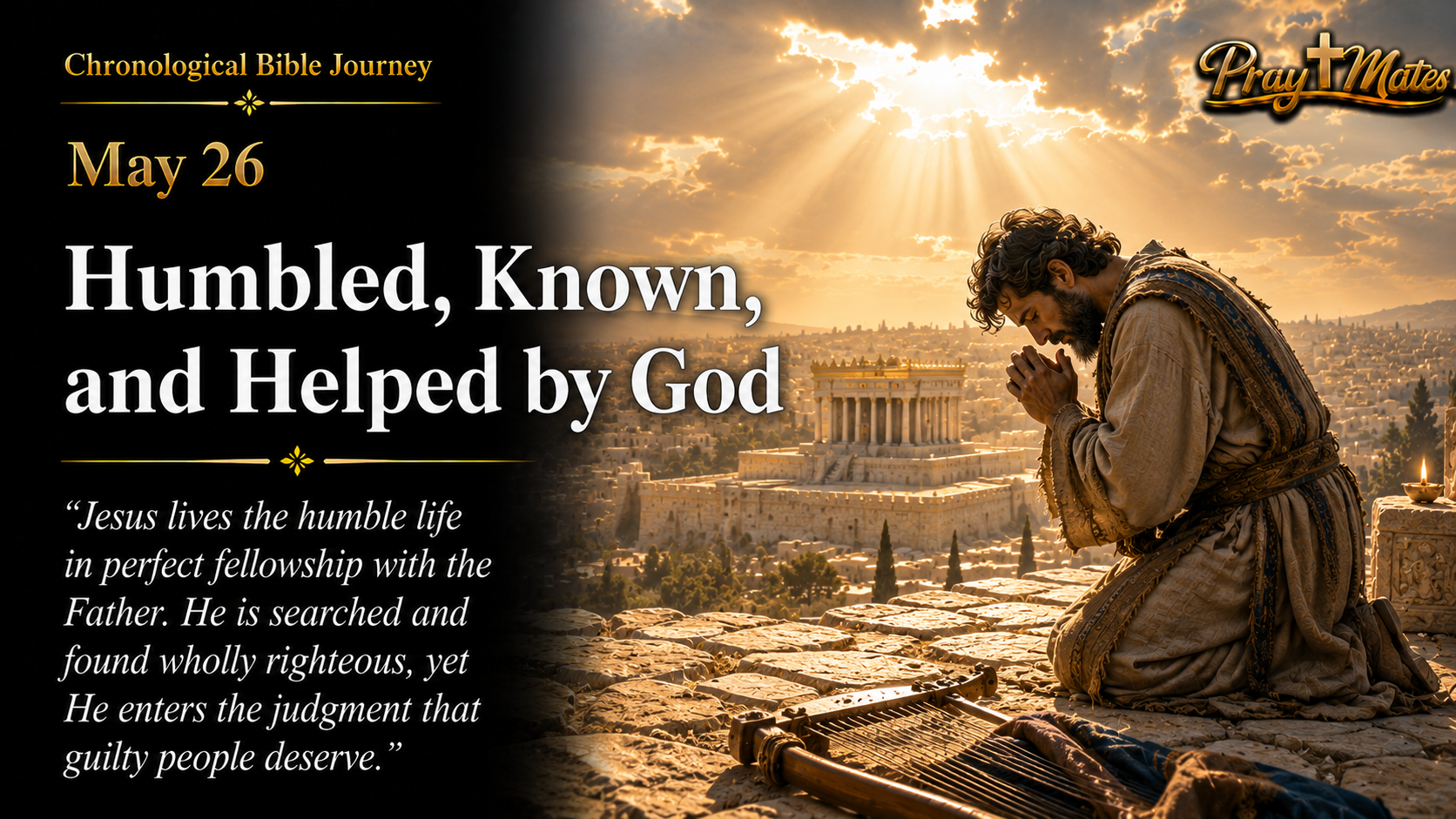
May 26 — Humbled, Known, and Helped by God
May 26 — Humbled, Known, and Helped by God
SCRIPTURE READING:
Psalms 131, 138-139, 143-145
SCRIPTURE:
Psalm 131
¹ A Song of degrees of David. LORD, my heart is not haughty, nor mine eyes lofty: neither do I exercise myself in great matters, or in things too high for me.
² Surely I have behaved and quieted myself, as a child that is weaned of his mother: my soul [is] even as a weaned child.
³ Let Israel hope in the LORD from henceforth and for ever.
Psalm 138
¹ [A Psalm] of David. I will praise thee with my whole heart: before the gods will I sing praise unto thee.
² I will worship toward thy holy temple, and praise thy name for thy lovingkindness and for thy truth: for thou hast magnified thy word above all thy name.
³ In the day when I cried thou answeredst me, [and] strengthenedst me [with] strength in my soul.
⁴ All the kings of the earth shall praise thee, O LORD, when they hear the words of thy mouth.
⁵ Yea, they shall sing in the ways of the LORD: for great [is] the glory of the LORD.
⁶ Though the LORD [be] high, yet hath he respect unto the lowly: but the proud he knoweth afar off.
⁷ Though I walk in the midst of trouble, thou wilt revive me: thou shalt stretch forth thine hand against the wrath of mine enemies, and thy right hand shall save me.
⁸ The LORD will perfect [that which] concerneth me: thy mercy, O LORD, [endureth] for ever: forsake not the works of thine own hands.
Psalm 139
¹ To the chief Musician, A Psalm of David. O LORD, thou hast searched me, and known [me].
² Thou knowest my downsitting and mine uprising, thou understandest my thought afar off.
³ Thou compassest my path and my lying down, and art acquainted [with] all my ways.
⁴ For [there is] not a word in my tongue, [but], lo, O LORD, thou knowest it altogether.
⁵ Thou hast beset me behind and before, and laid thine hand upon me.
⁶ [Such] knowledge [is] too wonderful for me; it is high, I cannot [attain] unto it.
⁷ Whither shall I go from thy spirit? or whither shall I flee from thy presence?
⁸ If I ascend up into heaven, thou [art] there: if I make my bed in hell, behold, thou [art there].
⁹ [If] I take the wings of the morning, [and] dwell in the uttermost parts of the sea;
¹⁰ Even there shall thy hand lead me, and thy right hand shall hold me.
¹¹ If I say, Surely the darkness shall cover me; even the night shall be light about me.
¹² Yea, the darkness hideth not from thee; but the night shineth as the day: the darkness and the light [are] both alike [to thee].
¹³ For thou hast possessed my reins: thou hast covered me in my mother’s womb.
¹⁴ I will praise thee; for I am fearfully [and] wonderfully made: marvellous [are] thy works; and [that] my soul knoweth right well.
¹⁵ My substance was not hid from thee, when I was made in secret, [and] curiously wrought in the lowest parts of the earth.
¹⁶ Thine eyes did see my substance, yet being unperfect; and in thy book all [my members] were written, [which] in continuance were fashioned, when [as yet there was] none of them.
¹⁷ How precious also are thy thoughts unto me, O God! how great is the sum of them!
¹⁸ [If] I should count them, they are more in number than the sand: when I awake, I am still with thee.
¹⁹ Surely thou wilt slay the wicked, O God: depart from me therefore, ye bloody men.
²⁰ For they speak against thee wickedly, [and] thine enemies take [thy name] in vain.
²¹ Do not I hate them, O LORD, that hate thee? and am not I grieved with those that rise up against thee?
²² I hate them with perfect hatred: I count them mine enemies.
²³ Search me, O God, and know my heart: try me, and know my thoughts:
²⁴ And see if [there be any] wicked way in me, and lead me in the way everlasting.
Psalm 143
¹ A Psalm of David. Hear my prayer, O LORD, give ear to my supplications: in thy faithfulness answer me, [and] in thy righteousness.
² And enter not into judgment with thy servant: for in thy sight shall no man living be justified.
³ For the enemy hath persecuted my soul; he hath smitten my life down to the ground; he hath made me to dwell in darkness, as those that have been long dead.
⁴ Therefore is my spirit overwhelmed within me; my heart within me is desolate.
⁵ I remember the days of old; I meditate on all thy works; I muse on the work of thy hands.
⁶ I stretch forth my hands unto thee: my soul [thirsteth] after thee, as a thirsty land. Selah.
⁷ Hear me speedily, O LORD: my spirit faileth: hide not thy face from me, lest I be like unto them that go down into the pit.
⁸ Cause me to hear thy lovingkindness in the morning; for in thee do I trust: cause me to know the way wherein I should walk; for I lift up my soul unto thee.
⁹ Deliver me, O LORD, from mine enemies: I flee unto thee to hide me.
¹⁰ Teach me to do thy will; for thou [art] my God: thy spirit [is] good; lead me into the land of uprightness.
¹¹ Quicken me, O LORD, for thy name’s sake: for thy righteousness’ sake bring my soul out of trouble.
¹² And of thy mercy cut off mine enemies, and destroy all them that afflict my soul: for I [am] thy servant.
Psalm 144
¹ [A Psalm] of David. Blessed [be] the LORD my strength, which teacheth my hands to war, [and] my fingers to fight:
² My goodness, and my fortress; my high tower, and my deliverer; my shield, and [he] in whom I trust; who subdueth my people under me.
³ LORD, what [is] man, that thou takest knowledge of him! [or] the son of man, that thou makest account of him!
⁴ Man is like to vanity: his days [are] as a shadow that passeth away.
⁵ Bow thy heavens, O LORD, and come down: touch the mountains, and they shall smoke.
⁶ Cast forth lightning, and scatter them: shoot out thine arrows, and destroy them.
⁷ Send thine hand from above; rid me, and deliver me out of great waters, from the hand of strange children;
⁸ Whose mouth speaketh vanity, and their right hand [is] a right hand of falsehood.
⁹ I will sing a new song unto thee, O God: upon a psaltery [and] an instrument of ten strings will I sing praises unto thee.
¹⁰ [It is he] that giveth salvation unto kings: who delivereth David his servant from the hurtful sword.
¹¹ Rid me, and deliver me from the hand of strange children, whose mouth speaketh vanity, and their right hand [is] a right hand of falsehood:
¹² That our sons [may be] as plants grown up in their youth; [that] our daughters [may be] as corner stones, polished [after] the similitude of a palace:
¹³ [That] our garners [may be] full, affording all manner of store: [that] our sheep may bring forth thousands and ten thousands in our streets:
¹⁴ [That] our oxen [may be] strong to labour; [that there be] no breaking in, nor going out; that [there be] no complaining in our streets.
¹⁵ Happy [is that] people, that is in such a case: [yea], happy [is that] people, whose God [is] the LORD.
Psalm 145
¹ David’s [Psalm] of praise. I will extol thee, my God, O king; and I will bless thy name for ever and ever. ב
² Every day will I bless thee; and I will praise thy name for ever and ever. ג
³ Great [is] the LORD, and greatly to be praised; and his greatness [is] unsearchable. ד
⁴ One generation shall praise thy works to another, and shall declare thy mighty acts. ה
⁵ I will speak of the glorious honour of thy majesty, and of thy wondrous works. ו
⁶ And [men] shall speak of the might of thy terrible acts: and I will declare thy greatness. ז
⁷ They shall abundantly utter the memory of thy great goodness, and shall sing of thy righteousness. ח
⁸ The LORD [is] gracious, and full of compassion; slow to anger, and of great mercy. ט
⁹ The LORD [is] good to all: and his tender mercies [are] over all his works. י
¹⁰ All thy works shall praise thee, O LORD; and thy saints shall bless thee. כ
¹¹ They shall speak of the glory of thy kingdom, and talk of thy power; ל
¹² To make known to the sons of men his mighty acts, and the glorious majesty of his kingdom. מ
¹³ Thy kingdom [is] an everlasting kingdom, and thy dominion [endureth] throughout all generations. ס
¹⁴ The LORD upholdeth all that fall, and raiseth up all [those that be] bowed down. ע
¹⁵ The eyes of all wait upon thee; and thou givest them their meat in due season. פ
¹⁶ Thou openest thine hand, and satisfiest the desire of every living thing. צ
¹⁷ The LORD [is] righteous in all his ways, and holy in all his works. ק
¹⁸ The LORD [is] nigh unto all them that call upon him, to all that call upon him in truth. ר
¹⁹ He will fulfil the desire of them that fear him: he also will hear their cry, and will save them. ש
²⁰ The LORD preserveth all them that love him: but all the wicked will he destroy. ת
²¹ My mouth shall speak the praise of the LORD: and let all flesh bless his holy name for ever and ever.
DEVOTIONAL:
These psalms move from the quiet humility of Psalm 131 to the vast wonder of being searched and known in Psalm 139, then into urgent pleas for help and expansive praise in Psalms 143-145. The movement is deeply human. The worshiper refuses proud ambition, gives thanks for God's regard, trembles before divine knowledge, asks to be taught, and praises the LORD whose kingdom endures through all generations.
In Jewish covenant prayer, humility is not self-hatred. It is the peace of a soul that stops trying to occupy God's place. Psalm 131 pictures a weaned child with its mother, a striking image of trust that has moved beyond grasping. Psalm 139 then shows why such humility is possible: the LORD knows completely, sees everywhere, forms life in the womb, and searches the heart. Nothing is hidden from Him.
Being known by God can expose and comfort at the same time. The psalmist does not ask God to search him because he believes he is flawless. He asks because the covenant God is both holy and merciful. The prayers for guidance in Psalm 143 and the praise of Psalm 145 show the proper response: teach me, lead me, deliver me, and let one generation praise Your works to another.
Jesus lives the humble life in perfect fellowship with the Father. He is searched and found wholly righteous, yet He enters the judgment that guilty people deserve. Through Him, being known by God becomes an invitation to repentance, trust, and holiness instead of terror for the forgiven. The Messiah also carries the praise of God's kingdom to every generation.
In daily life, this passage calls believers to obey God by quieting proud ambition and welcoming His searching gaze. Character grows when humility replaces self-promotion and when confession becomes safer than hiding. Families can teach children that God knows and loves truth, workers can labor without anxious vanity, and churches can become communities of honest prayer, generational praise, and humble confidence in Christ.
In U.S. civic life, the passage presses the virtue of humble self-knowledge into public life. It directs prayer toward people weighed down by anxiety, pride, loneliness, or the pressure to perform. Christians should show up by living honestly before God and treating others with compassion because every person is known by Him.
DISCUSSION QUESTIONS:
What part of this passage most clearly shows the LORD's character?
How does this reading strengthen your understanding of covenant faithfulness?
How does Jesus fulfill or complete the hope shown here?
Where do you need to practice humble self-knowledge in ordinary life?
PRAYER:
ADORATION:
Holy Father, You are faithful in covenant mercy and righteous in all Your ways.
CONFESSION:
Forgive me for trusting my own judgment more than Your word and for resisting the correction You give.
THANKSGIVING:
Thank You for revealing Your faithfulness through Scripture and for giving us Jesus, the promised Messiah.
SUPPLICATION – GENERAL:
Strengthen me to walk in humble self-knowledge, to receive Your word with humility, and to serve others faithfully.
SUPPLICATION – U.S. / CIVIC:
Teach Your people in our nation to practice humble self-knowledge, and bring mercy, wisdom, and healing to people weighed down by anxiety, pride, loneliness, or the pressure to perform.
SCRIPTURE:
²³ Search me, O God, and know my heart: try me, and know my thoughts:
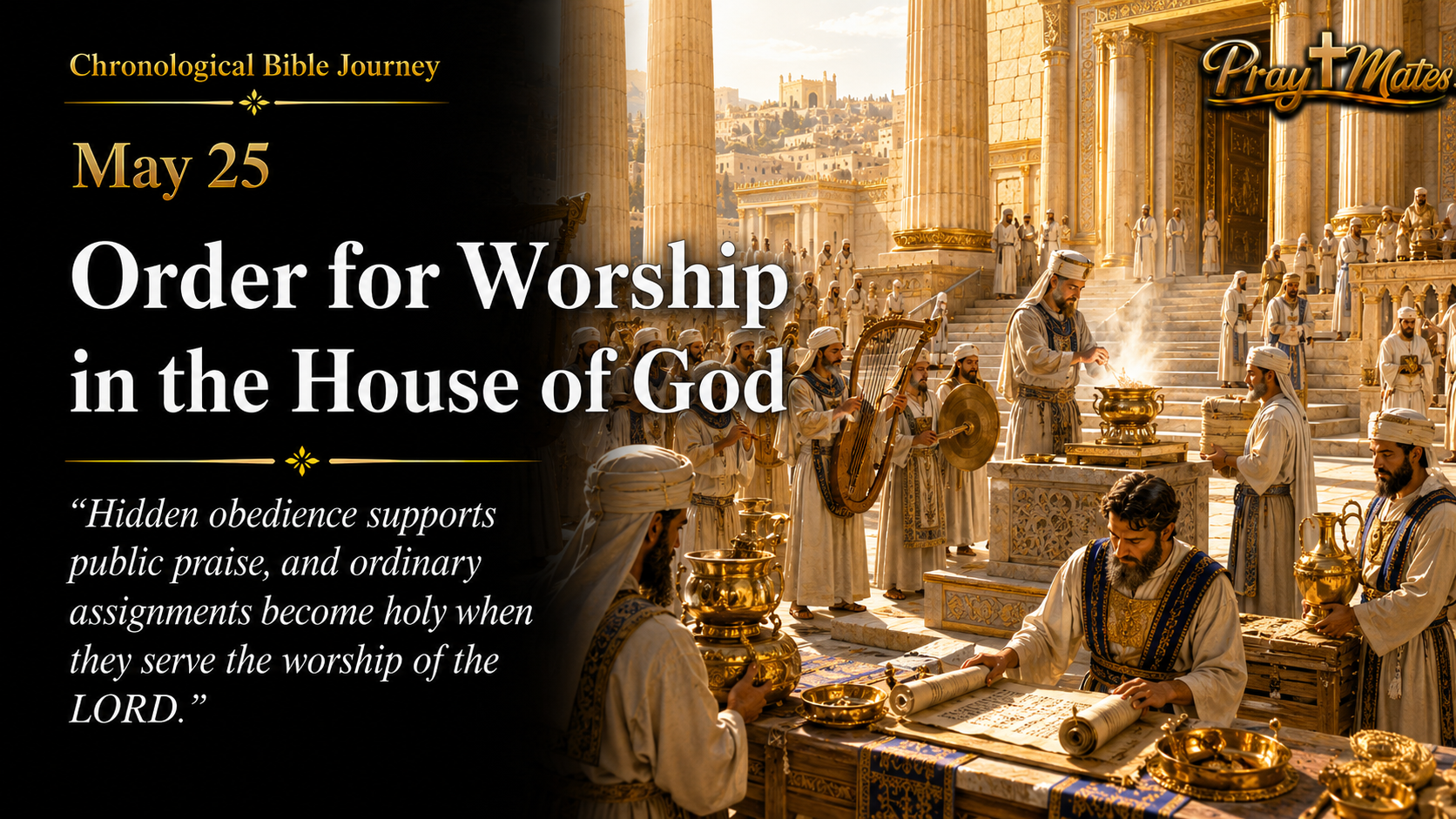
May 25 — Order for Worship in the House of God
May 25 — Order for Worship in the House of God
SCRIPTURE READING:
1 Chronicles 23-25
SCRIPTURE:
First Chronicles 23
¹ So when David was old and full of days, he made Solomon his son king over Israel.
² And he gathered together all the princes of Israel, with the priests and the Levites.
³ Now the Levites were numbered from the age of thirty years and upward: and their number by their polls, man by man, was thirty and eight thousand.
⁴ Of which, twenty and four thousand [were] to set forward the work of the house of the LORD; and six thousand [were] officers and judges:
⁵ Moreover four thousand [were] porters; and four thousand praised the LORD with the instruments which I made, [said David], to praise [therewith].
⁶ And David divided them into courses among the sons of Levi, [namely], Gershon, Kohath, and Merari.
⁷ Of the Gershonites [were], Laadan, and Shimei.
⁸ The sons of Laadan; the chief [was] Jehiel, and Zetham, and Joel, three.
⁹ The sons of Shimei; Shelomith, and Haziel, and Haran, three. These [were] the chief of the fathers of Laadan.
¹⁰ And the sons of Shimei [were], Jahath, Zina, and Jeush, and Beriah. These four [were] the sons of Shimei.
¹¹ And Jahath was the chief, and Zizah the second: but Jeush and Beriah had not many sons; therefore they were in one reckoning, according to [their] father’s house.
¹² The sons of Kohath; Amram, Izhar, Hebron, and Uzziel, four.
¹³ The sons of Amram; Aaron and Moses: and Aaron was separated, that he should sanctify the most holy things, he and his sons for ever, to burn incense before the LORD, to minister unto him, and to bless in his name for ever.
¹⁴ Now [concerning] Moses the man of God, his sons were named of the tribe of Levi.
¹⁵ The sons of Moses [were], Gershom, and Eliezer.
¹⁶ Of the sons of Gershom, Shebuel [was] the chief.
¹⁷ And the sons of Eliezer [were], Rehabiah the chief. And Eliezer had none other sons; but the sons of Rehabiah were very many.
¹⁸ Of the sons of Izhar; Shelomith the chief.
¹⁹ Of the sons of Hebron; Jeriah the first, Amariah the second, Jahaziel the third, and Jekameam the fourth.
²⁰ Of the sons of Uzziel; Michah the first, and Jesiah the second.
²¹ The sons of Merari; Mahli, and Mushi. The sons of Mahli; Eleazar, and Kish.
²² And Eleazar died, and had no sons, but daughters: and their brethren the sons of Kish took them.
²³ The sons of Mushi; Mahli, and Eder, and Jeremoth, three.
²⁴ These [were] the sons of Levi after the house of their fathers; [even] the chief of the fathers, as they were counted by number of names by their polls, that did the work for the service of the house of the LORD, from the age of twenty years and upward.
²⁵ For David said, The LORD God of Israel hath given rest unto his people, that they may dwell in Jerusalem for ever:
²⁶ And also unto the Levites; they shall no [more] carry the tabernacle, nor any vessels of it for the service thereof.
²⁷ For by the last words of David the Levites [were] numbered from twenty years old and above:
²⁸ Because their office [was] to wait on the sons of Aaron for the service of the house of the LORD, in the courts, and in the chambers, and in the purifying of all holy things, and the work of the service of the house of God;
²⁹ Both for the shewbread, and for the fine flour for meat offering, and for the unleavened cakes, and for [that which is baked in] the pan, and for that which is fried, and for all manner of measure and size;
³⁰ And to stand every morning to thank and praise the LORD, and likewise at even;
³¹ And to offer all burnt sacrifices unto the LORD in the sabbaths, in the new moons, and on the set feasts, by number, according to the order commanded unto them, continually before the LORD:
³² And that they should keep the charge of the tabernacle of the congregation, and the charge of the holy [place], and the charge of the sons of Aaron their brethren, in the service of the house of the LORD.
First Chronicles 24
¹ Now [these are] the divisions of the sons of Aaron. The sons of Aaron; Nadab, and Abihu, Eleazar, and Ithamar.
² But Nadab and Abihu died before their father, and had no children: therefore Eleazar and Ithamar executed the priest’s office.
³ And David distributed them, both Zadok of the sons of Eleazar, and Ahimelech of the sons of Ithamar, according to their offices in their service.
⁴ And there were more chief men found of the sons of Eleazar than of the sons of Ithamar; and [thus] were they divided. Among the sons of Eleazar [there were] sixteen chief men of the house of [their] fathers, and eight among the sons of Ithamar according to the house of their fathers.
⁵ Thus were they divided by lot, one sort with another; for the governors of the sanctuary, and governors [of the house] of God, were of the sons of Eleazar, and of the sons of Ithamar.
⁶ And Shemaiah the son of Nethaneel the scribe, [one] of the Levites, wrote them before the king, and the princes, and Zadok the priest, and Ahimelech the son of Abiathar, and [before] the chief of the fathers of the priests and Levites: one principal household being taken for Eleazar, and [one] taken for Ithamar.
⁷ Now the first lot came forth to Jehoiarib, the second to Jedaiah,
⁸ The third to Harim, the fourth to Seorim,
⁹ The fifth to Malchijah, the sixth to Mijamin,
¹⁰ The seventh to Hakkoz, the eighth to Abijah,
¹¹ The ninth to Jeshua, the tenth to Shecaniah,
¹² The eleventh to Eliashib, the twelfth to Jakim,
¹³ The thirteenth to Huppah, the fourteenth to Jeshebeab,
¹⁴ The fifteenth to Bilgah, the sixteenth to Immer,
¹⁵ The seventeenth to Hezir, the eighteenth to Aphses,
¹⁶ The nineteenth to Pethahiah, the twentieth to Jehezekel,
¹⁷ The one and twentieth to Jachin, the two and twentieth to Gamul,
¹⁸ The three and twentieth to Delaiah, the four and twentieth to Maaziah.
¹⁹ These [were] the orderings of them in their service to come into the house of the LORD, according to their manner, under Aaron their father, as the LORD God of Israel had commanded him.
²⁰ And the rest of the sons of Levi [were these]: Of the sons of Amram; Shubael: of the sons of Shubael; Jehdeiah.
²¹ Concerning Rehabiah: of the sons of Rehabiah, the first [was] Isshiah.
²² Of the Izharites; Shelomoth: of the sons of Shelomoth; Jahath.
²³ And the sons [of Hebron]; Jeriah [the first], Amariah the second, Jahaziel the third, Jekameam the fourth.
²⁴ [Of] the sons of Uzziel; Michah: of the sons of Michah; Shamir.
²⁵ The brother of Michah [was] Isshiah: of the sons of Isshiah; Zechariah.
²⁶ The sons of Merari [were] Mahli and Mushi: the sons of Jaaziah; Beno.
²⁷ The sons of Merari by Jaaziah; Beno, and Shoham, and Zaccur, and Ibri.
²⁸ Of Mahli [came] Eleazar, who had no sons.
²⁹ Concerning Kish: the son of Kish [was] Jerahmeel.
³⁰ The sons also of Mushi; Mahli, and Eder, and Jerimoth. These [were] the sons of the Levites after the house of their fathers.
³¹ These likewise cast lots over against their brethren the sons of Aaron in the presence of David the king, and Zadok, and Ahimelech, and the chief of the fathers of the priests and Levites, even the principal fathers over against their younger brethren.
First Chronicles 25
¹ Moreover David and the captains of the host separated to the service of the sons of Asaph, and of Heman, and of Jeduthun, who should prophesy with harps, with psalteries, and with cymbals: and the number of the workmen according to their service was:
² Of the sons of Asaph; Zaccur, and Joseph, and Nethaniah, and Asarelah, the sons of Asaph under the hands of Asaph, which prophesied according to the order of the king.
³ Of Jeduthun: the sons of Jeduthun; Gedaliah, and Zeri, and Jeshaiah, Hashabiah, and Mattithiah, six, under the hands of their father Jeduthun, who prophesied with a harp, to give thanks and to praise the LORD.
⁴ Of Heman: the sons of Heman; Bukkiah, Mattaniah, Uzziel, Shebuel, and Jerimoth, Hananiah, Hanani, Eliathah, Giddalti, and Romamtiezer, Joshbekashah, Mallothi, Hothir, [and] Mahazioth:
⁵ All these [were] the sons of Heman the king’s seer in the words of God, to lift up the horn. And God gave to Heman fourteen sons and three daughters.
⁶ All these [were] under the hands of their father for song [in] the house of the LORD, with cymbals, psalteries, and harps, for the service of the house of God, according to the king’s order to Asaph, Jeduthun, and Heman.
⁷ So the number of them, with their brethren that were instructed in the songs of the LORD, [even] all that were cunning, was two hundred fourscore and eight.
⁸ And they cast lots, ward against [ward], as well the small as the great, the teacher as the scholar.
⁹ Now the first lot came forth for Asaph to Joseph: the second to Gedaliah, who with his brethren and sons [were] twelve:
¹⁰ The third to Zaccur, [he], his sons, and his brethren, [were] twelve:
¹¹ The fourth to Izri, [he], his sons, and his brethren, [were] twelve:
¹² The fifth to Nethaniah, [he], his sons, and his brethren, [were] twelve:
¹³ The sixth to Bukkiah, [he], his sons, and his brethren, [were] twelve:
¹⁴ The seventh to Jesharelah, [he], his sons, and his brethren, [were] twelve:
¹⁵ The eighth to Jeshaiah, [he], his sons, and his brethren, [were] twelve:
¹⁶ The ninth to Mattaniah, [he], his sons, and his brethren, [were] twelve:
¹⁷ The tenth to Shimei, [he], his sons, and his brethren, [were] twelve:
¹⁸ The eleventh to Azareel, [he], his sons, and his brethren, [were] twelve:
¹⁹ The twelfth to Hashabiah, [he], his sons, and his brethren, [were] twelve:
²⁰ The thirteenth to Shubael, [he], his sons, and his brethren, [were] twelve:
²¹ The fourteenth to Mattithiah, [he], his sons, and his brethren, [were] twelve:
²² The fifteenth to Jeremoth, [he], his sons, and his brethren, [were] twelve:
²³ The sixteenth to Hananiah, [he], his sons, and his brethren, [were] twelve:
²⁴ The seventeenth to Joshbekashah, [he], his sons, and his brethren, [were] twelve:
²⁵ The eighteenth to Hanani, [he], his sons, and his brethren, [were] twelve:
²⁶ The nineteenth to Mallothi, [he], his sons, and his brethren, [were] twelve:
²⁷ The twentieth to Eliathah, [he], his sons, and his brethren, [were] twelve:
²⁸ The one and twentieth to Hothir, [he], his sons, and his brethren, [were] twelve:
²⁹ The two and twentieth to Giddalti, [he], his sons, and his brethren, [were] twelve:
³⁰ The three and twentieth to Mahazioth, [he], his sons, and his brethren, [were] twelve:
³¹ The four and twentieth to Romamtiezer, [he], his sons, and his brethren, [were] twelve.
DEVOTIONAL:
The lists of Levites, priests, musicians, gatekeepers, and temple servants may feel distant from ordinary devotional reading, but they reveal a vital truth: worship requires faithful ordering. David prepares the service of the house of the LORD so that praise, sacrifice, music, guarding, and administration will continue after him. The details show that the worship of God is worth careful planning, skilled labor, and generational stewardship.
In Israel's covenant life, the Levites were set apart for holy service. Their work was not glamorous in every assignment, but it mattered because it supported the worship of the whole people. Musicians prophesied with harps, psalteries, and cymbals. Gatekeepers guarded sacred space. Priests carried out duties that pointed to God's holiness and mercy. The passage dignifies ordered service as an act of devotion.
This background corrects the assumption that only spontaneous feeling is spiritually sincere. Israel's worship included structure, training, appointed roles, and accountability. The LORD is worthy of excellence, but excellence here is not performance for applause. It is faithfulness before God. Hidden obedience supports public praise, and ordinary assignments become holy when they serve the worship of the LORD.
Jesus fulfills the temple as the true meeting place between God and humanity. Through Him, believers become a priestly people who offer spiritual sacrifices. The church no longer repeats the Levitical order, but it still learns from its seriousness. Christ gives gifts to His body, and every member has work that can serve worship, mercy, teaching, order, and mission.
In daily life, this passage calls believers to obey God in assignments that may seem repetitive or unseen. Character is formed by reliability, preparation, and joy in serving without needing attention. Families can teach children that worship includes readiness and responsibility, workplaces can honor support roles that make shared labor possible, and churches can value musicians, teachers, administrators, caregivers, cleaners, and quiet servants as gifts under Christ.
In U.S. civic life, this reading commends the virtue of faithful service. It turns prayer toward teachers, volunteers, administrators, musicians, and unnoticed workers who sustain community life. Christians should show up by serving consistently without needing attention and treating order as a form of love.
DISCUSSION QUESTIONS:
What does this reading reveal about God's work in the original setting?
How does the covenant background deepen the meaning of this passage?
Where does this Scripture point you toward Jesus the Messiah?
How should the virtue of faithful service shape your obedience this week?
PRAYER:
ADORATION:
Righteous Father, You see truly, judge rightly, and show mercy to the humble.
CONFESSION:
Forgive me for neglecting prayer, gratitude, and obedience when life feels pressured.
THANKSGIVING:
Thank You for the hope, cleansing, wisdom, and refuge You provide through Christ.
SUPPLICATION – GENERAL:
Lead me in faithful service, and make my home, work, and church life more faithful to Your will.
SUPPLICATION – U.S. / CIVIC:
Make Your people witnesses of faithful service, and bring righteous care to teachers, volunteers, administrators, musicians, and unnoticed workers who sustain community life.
SCRIPTURE:
³⁰ And to stand every morning to thank and praise the LORD, and likewise at even;
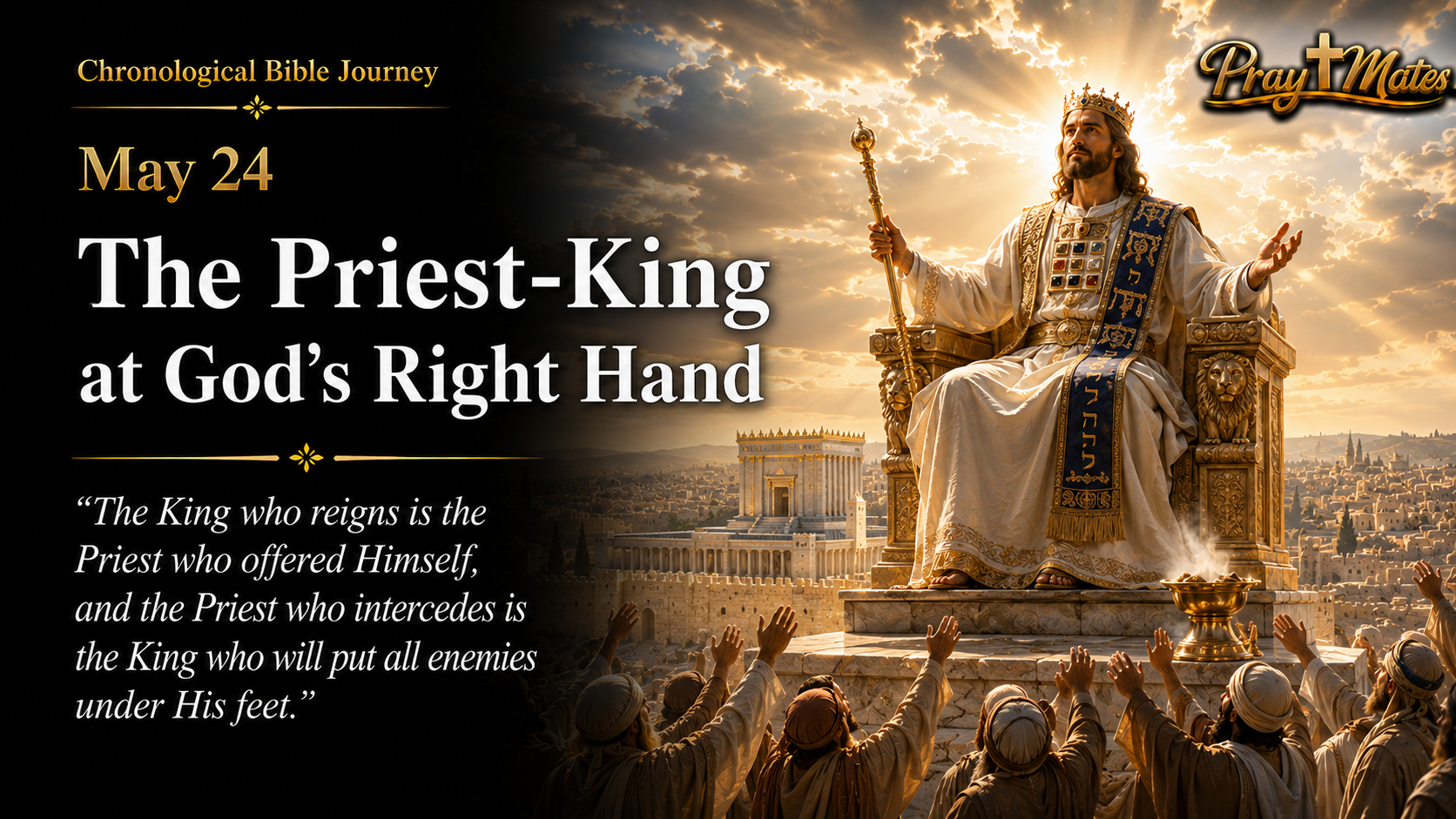
May 24 — The Priest-King at God's Right Hand
May 24 — The Priest-King at God's Right Hand
SCRIPTURE READING:
Psalms 108-110
SCRIPTURE:
Psalm 108
¹ A Song [or] Psalm of David. O God, my heart is fixed; I will sing and give praise, even with my glory.
² Awake, psaltery and harp: I [myself] will awake early.
³ I will praise thee, O LORD, among the people: and I will sing praises unto thee among the nations.
⁴ For thy mercy [is] great above the heavens: and thy truth [reacheth] unto the clouds.
⁵ Be thou exalted, O God, above the heavens: and thy glory above all the earth;
⁶ That thy beloved may be delivered: save [with] thy right hand, and answer me.
⁷ God hath spoken in his holiness; I will rejoice, I will divide Shechem, and mete out the valley of Succoth.
⁸ Gilead [is] mine; Manasseh [is] mine; Ephraim also [is] the strength of mine head; Judah [is] my lawgiver;
⁹ Moab [is] my washpot; over Edom will I cast out my shoe; over Philistia will I triumph.
¹⁰ Who will bring me into the strong city? who will lead me into Edom?
¹¹ [Wilt] not [thou], O God, [who] hast cast us off? and wilt not thou, O God, go forth with our hosts?
¹² Give us help from trouble: for vain [is] the help of man.
¹³ Through God we shall do valiantly: for he [it is that] shall tread down our enemies.
Psalm 109
¹ To the chief Musician, A Psalm of David. Hold not thy peace, O God of my praise;
² For the mouth of the wicked and the mouth of the deceitful are opened against me: they have spoken against me with a lying tongue.
³ They compassed me about also with words of hatred; and fought against me without a cause.
⁴ For my love they are my adversaries: but I [give myself unto] prayer.
⁵ And they have rewarded me evil for good, and hatred for my love.
⁶ Set thou a wicked man over him: and let Satan stand at his right hand.
⁷ When he shall be judged, let him be condemned: and let his prayer become sin.
⁸ Let his days be few; [and] let another take his office.
⁹ Let his children be fatherless, and his wife a widow.
¹⁰ Let his children be continually vagabonds, and beg: let them seek [their bread] also out of their desolate places.
¹¹ Let the extortioner catch all that he hath; and let the strangers spoil his labour.
¹² Let there be none to extend mercy unto him: neither let there be any to favour his fatherless children.
¹³ Let his posterity be cut off; [and] in the generation following let their name be blotted out.
¹⁴ Let the iniquity of his fathers be remembered with the LORD; and let not the sin of his mother be blotted out.
¹⁵ Let them be before the LORD continually, that he may cut off the memory of them from the earth.
¹⁶ Because that he remembered not to shew mercy, but persecuted the poor and needy man, that he might even slay the broken in heart.
¹⁷ As he loved cursing, so let it come unto him: as he delighted not in blessing, so let it be far from him.
¹⁸ As he clothed himself with cursing like as with his garment, so let it come into his bowels like water, and like oil into his bones.
¹⁹ Let it be unto him as the garment [which] covereth him, and for a girdle wherewith he is girded continually.
²⁰ [Let] this [be] the reward of mine adversaries from the LORD, and of them that speak evil against my soul.
²¹ But do thou for me, O GOD the Lord, for thy name’s sake: because thy mercy [is] good, deliver thou me.
²² For I [am] poor and needy, and my heart is wounded within me.
²³ I am gone like the shadow when it declineth: I am tossed up and down as the locust.
²⁴ My knees are weak through fasting; and my flesh faileth of fatness.
²⁵ I became also a reproach unto them: [when] they looked upon me they shaked their heads.
²⁶ Help me, O LORD my God: O save me according to thy mercy:
²⁷ That they may know that this [is] thy hand; [that] thou, LORD, hast done it.
²⁸ Let them curse, but bless thou: when they arise, let them be ashamed; but let thy servant rejoice.
²⁹ Let mine adversaries be clothed with shame, and let them cover themselves with their own confusion, as with a mantle.
³⁰ I will greatly praise the LORD with my mouth; yea, I will praise him among the multitude.
³¹ For he shall stand at the right hand of the poor, to save [him] from those that condemn his soul.
Psalm 110
¹ A Psalm of David. The LORD said unto my Lord, Sit thou at my right hand, until I make thine enemies thy footstool.
² The LORD shall send the rod of thy strength out of Zion: rule thou in the midst of thine enemies.
³ Thy people [shall be] willing in the day of thy power, in the beauties of holiness from the womb of the morning: thou hast the dew of thy youth.
⁴ The LORD hath sworn, and will not repent, Thou [art] a priest for ever after the order of Melchizedek.
⁵ The Lord at thy right hand shall strike through kings in the day of his wrath.
⁶ He shall judge among the heathen, he shall fill [the places] with the dead bodies; he shall wound the heads over many countries.
⁷ He shall drink of the brook in the way: therefore shall he lift up the head.
DEVOTIONAL:
Psalms 108-110 combine confidence, petition, and royal prophecy. The worshiper praises God among the nations, asks for help against enemies, and then hears the LORD speak to a figure seated at His right hand. Psalm 110 rises above ordinary royal language because this king is also a priest for ever after the order of Melchizedek. The result is a vision of rule, holiness, victory, and priestly mediation.
In Israel's covenant hope, kingship and priesthood normally had distinct roles. The king ruled from David's line, while priests served from Aaron's line. Psalm 110 therefore creates expectation for someone greater than the ordinary patterns of Israel's institutions. The LORD Himself appoints this priest-king, gives Him victory, and establishes His place at the right hand. The passage is both royal and deeply worshipful.
The psalms also hold confidence and dependence together. "Through God we shall do valiantly" does not mean human arrogance dressed in religious language. It means that courage comes from knowing the LORD's promise and seeking His help. Israel's enemies may be strong, but salvation does not rest in the cleverness of the people. It rests in the Lord who speaks, sends help, and rules.
The New Testament repeatedly identifies Jesus with Psalm 110. He is David's Son and David's Lord, the exalted Messiah seated at God's right hand. He is also the eternal priest who intercedes for His people. In Him, victory and mediation meet. The King who reigns is the Priest who offered Himself, and the Priest who intercedes is the King who will put all enemies under His feet.
In daily life, this reading calls believers to obey God with confidence shaped by Christ's reign rather than by fear or self-assertion. Character grows when prayer comes before action and hope is anchored in the exalted Messiah. Families can worship Jesus as both King and intercessor, workers can face opposition without panic, and churches can proclaim a Savior whose authority and mercy belong together.
In U.S. civic life, this reading teaches confident hope as a public good. It calls for prayer over people facing opposition, injustice, or spiritual discouragement who need courage anchored in Christ's reign. Christians should show up by standing firm with prayerful hope rather than panic, contempt, or despair.
DISCUSSION QUESTIONS:
What does this reading teach about the difference between human strength and God's purpose?
Which covenant theme in this passage should shape your worship?
How does this Scripture prepare your heart to see Jesus more clearly?
What faithful action would grow from confident hope today?
PRAYER:
ADORATION:
King of heaven, Your purposes stand, and Your word never fails.
CONFESSION:
Forgive me for hiding sin, excusing selfishness, or using Your gifts for my own name.
THANKSGIVING:
Thank You for hearing prayer and for making Your grace known in the Son of David.
SUPPLICATION – GENERAL:
Give me courage to live out confident hope in hidden places as well as visible responsibilities.
SUPPLICATION – U.S. / CIVIC:
Form Your church in confident hope, and let our prayers and service bless people facing opposition, injustice, or spiritual discouragement who need courage anchored in Christ's reign.
SCRIPTURE:
¹ A Psalm of David. The LORD said unto my Lord, Sit thou at my right hand, until I make thine enemies thy footstool.
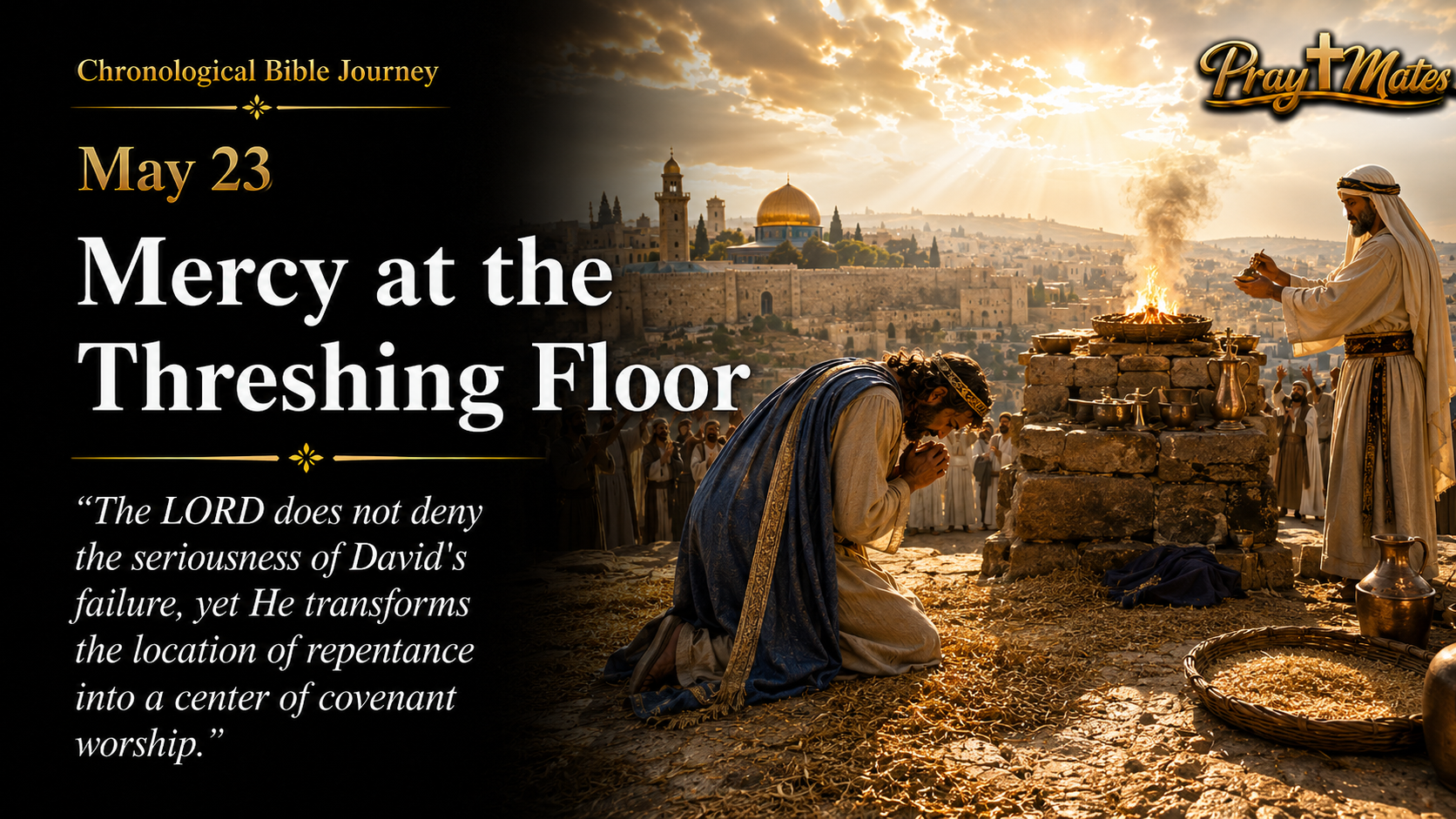
May 23 — Mercy at the Threshing Floor
May 23 — Mercy at the Threshing Floor
SCRIPTURE READING:
2 Samuel 24; 1 Chronicles 21-22; Psalm 30
SCRIPTURE:
Second Samuel 24
¹ And again the anger of the LORD was kindled against Israel, and he moved David against them to say, Go, number Israel and Judah.
² For the king said to Joab the captain of the host, which [was] with him, Go now through all the tribes of Israel, from Dan even to Beersheba, and number ye the people, that I may know the number of the people.
³ And Joab said unto the king, Now the LORD thy God add unto the people, how many soever they be, an hundredfold, and that the eyes of my lord the king may see [it]: but why doth my lord the king delight in this thing?
⁴ Notwithstanding the king’s word prevailed against Joab, and against the captains of the host. And Joab and the captains of the host went out from the presence of the king, to number the people of Israel.
⁵ And they passed over Jordan, and pitched in Aroer, on the right side of the city that [lieth] in the midst of the river of Gad, and toward Jazer:
⁶ Then they came to Gilead, and to the land of Tahtimhodshi; and they came to Danjaan, and about to Zidon,
⁷ And came to the strong hold of Tyre, and to all the cities of the Hivites, and of the Canaanites: and they went out to the south of Judah, [even] to Beersheba.
⁸ So when they had gone through all the land, they came to Jerusalem at the end of nine months and twenty days.
⁹ And Joab gave up the sum of the number of the people unto the king: and there were in Israel eight hundred thousand valiant men that drew the sword; and the men of Judah [were] five hundred thousand men.
¹⁰ And David’s heart smote him after that he had numbered the people. And David said unto the LORD, I have sinned greatly in that I have done: and now, I beseech thee, O LORD, take away the iniquity of thy servant; for I have done very foolishly.
¹¹ For when David was up in the morning, the word of the LORD came unto the prophet Gad, David’s seer, saying,
¹² Go and say unto David, Thus saith the LORD, I offer thee three [things]; choose thee one of them, that I may [do it] unto thee.
¹³ So Gad came to David, and told him, and said unto him, Shall seven years of famine come unto thee in thy land? or wilt thou flee three months before thine enemies, while they pursue thee? or that there be three days’ pestilence in thy land? now advise, and see what answer I shall return to him that sent me.
¹⁴ And David said unto Gad, I am in a great strait: let us fall now into the hand of the LORD; for his mercies [are] great: and let me not fall into the hand of man.
¹⁵ So the LORD sent a pestilence upon Israel from the morning even to the time appointed: and there died of the people from Dan even to Beersheba seventy thousand men.
¹⁶ And when the angel stretched out his hand upon Jerusalem to destroy it, the LORD repented him of the evil, and said to the angel that destroyed the people, It is enough: stay now thine hand. And the angel of the LORD was by the threshingplace of Araunah the Jebusite.
¹⁷ And David spake unto the LORD when he saw the angel that smote the people, and said, Lo, I have sinned, and I have done wickedly: but these sheep, what have they done? let thine hand, I pray thee, be against me, and against my father’s house.
¹⁸ And Gad came that day to David, and said unto him, Go up, rear an altar unto the LORD in the threshingfloor of Araunah the Jebusite.
¹⁹ And David, according to the saying of Gad, went up as the LORD commanded.
²⁰ And Araunah looked, and saw the king and his servants coming on toward him: and Araunah went out, and bowed himself before the king on his face upon the ground.
²¹ And Araunah said, Wherefore is my lord the king come to his servant? And David said, To buy the threshingfloor of thee, to build an altar unto the LORD, that the plague may be stayed from the people.
²² And Araunah said unto David, Let my lord the king take and offer up what [seemeth] good unto him: behold, [here be] oxen for burnt sacrifice, and threshing instruments and [other] instruments of the oxen for wood.
²³ All these [things] did Araunah, [as] a king, give unto the king. And Araunah said unto the king, The LORD thy God accept thee.
²⁴ And the king said unto Araunah, Nay; but I will surely buy [it] of thee at a price: neither will I offer burnt offerings unto the LORD my God of that which doth cost me nothing. So David bought the threshingfloor and the oxen for fifty shekels of silver.
²⁵ And David built there an altar unto the LORD, and offered burnt offerings and peace offerings. So the LORD was intreated for the land, and the plague was stayed from Israel.
First Chronicles 21
¹ And Satan stood up against Israel, and provoked David to number Israel.
² And David said to Joab and to the rulers of the people, Go, number Israel from Beersheba even to Dan; and bring the number of them to me, that I may know [it].
³ And Joab answered, The LORD make his people an hundred times so many more as they [be]: but, my lord the king, [are] they not all my lord’s servants? why then doth my lord require this thing? why will he be a cause of trespass to Israel?
⁴ Nevertheless the king’s word prevailed against Joab. Wherefore Joab departed, and went throughout all Israel, and came to Jerusalem.
⁵ And Joab gave the sum of the number of the people unto David. And all [they of] Israel were a thousand thousand and an hundred thousand men that drew sword: and Judah [was] four hundred threescore and ten thousand men that drew sword.
⁶ But Levi and Benjamin counted he not among them: for the king’s word was abominable to Joab.
⁷ And God was displeased with this thing; therefore he smote Israel.
⁸ And David said unto God, I have sinned greatly, because I have done this thing: but now, I beseech thee, do away the iniquity of thy servant; for I have done very foolishly.
⁹ And the LORD spake unto Gad, David’s seer, saying,
¹⁰ Go and tell David, saying, Thus saith the LORD, I offer thee three [things]: choose thee one of them, that I may do [it] unto thee.
¹¹ So Gad came to David, and said unto him, Thus saith the LORD, Choose thee
¹² Either three years’ famine; or three months to be destroyed before thy foes, while that the sword of thine enemies overtaketh [thee]; or else three days the sword of the LORD, even the pestilence, in the land, and the angel of the LORD destroying throughout all the coasts of Israel. Now therefore advise thyself what word I shall bring again to him that sent me.
¹³ And David said unto Gad, I am in a great strait: let me fall now into the hand of the LORD; for very great [are] his mercies: but let me not fall into the hand of man.
¹⁴ So the LORD sent pestilence upon Israel: and there fell of Israel seventy thousand men.
¹⁵ And God sent an angel unto Jerusalem to destroy it: and as he was destroying, the LORD beheld, and he repented him of the evil, and said to the angel that destroyed, It is enough, stay now thine hand. And the angel of the LORD stood by the threshingfloor of Ornan the Jebusite.
¹⁶ And David lifted up his eyes, and saw the angel of the LORD stand between the earth and the heaven, having a drawn sword in his hand stretched out over Jerusalem. Then David and the elders [of Israel, who were] clothed in sackcloth, fell upon their faces.
¹⁷ And David said unto God, [Is it] not I [that] commanded the people to be numbered? even I it is that have sinned and done evil indeed; but [as for] these sheep, what have they done? let thine hand, I pray thee, O LORD my God, be on me, and on my father’s house; but not on thy people, that they should be plagued.
¹⁸ Then the angel of the LORD commanded Gad to say to David, that David should go up, and set up an altar unto the LORD in the threshingfloor of Ornan the Jebusite.
¹⁹ And David went up at the saying of Gad, which he spake in the name of the LORD.
²⁰ And Ornan turned back, and saw the angel; and his four sons with him hid themselves. Now Ornan was threshing wheat.
²¹ And as David came to Ornan, Ornan looked and saw David, and went out of the threshingfloor, and bowed himself to David with [his] face to the ground.
²² Then David said to Ornan, Grant me the place of [this] threshingfloor, that I may build an altar therein unto the LORD: thou shalt grant it me for the full price: that the plague may be stayed from the people.
²³ And Ornan said unto David, Take [it] to thee, and let my lord the king do [that which is] good in his eyes: lo, I give [thee] the oxen [also] for burnt offerings, and the threshing instruments for wood, and the wheat for the meat offering; I give it all.
²⁴ And king David said to Ornan, Nay; but I will verily buy it for the full price: for I will not take [that] which [is] thine for the LORD, nor offer burnt offerings without cost.
²⁵ So David gave to Ornan for the place six hundred shekels of gold by weight.
²⁶ And David built there an altar unto the LORD, and offered burnt offerings and peace offerings, and called upon the LORD; and he answered him from heaven by fire upon the altar of burnt offering.
²⁷ And the LORD commanded the angel; and he put up his sword again into the sheath thereof.
²⁸ At that time when David saw that the LORD had answered him in the threshingfloor of Ornan the Jebusite, then he sacrificed there.
²⁹ For the tabernacle of the LORD, which Moses made in the wilderness, and the altar of the burnt offering, [were] at that season in the high place at Gibeon.
³⁰ But David could not go before it to inquire of God: for he was afraid because of the sword of the angel of the LORD.
First Chronicles 22
¹ Then David said, This [is] the house of the LORD God, and this [is] the altar of the burnt offering for Israel.
² And David commanded to gather together the strangers that [were] in the land of Israel; and he set masons to hew wrought stones to build the house of God.
³ And David prepared iron in abundance for the nails for the doors of the gates, and for the joinings; and brass in abundance without weight;
⁴ Also cedar trees in abundance: for the Zidonians and they of Tyre brought much cedar wood to David.
⁵ And David said, Solomon my son [is] young and tender, and the house [that is] to be builded for the LORD [must be] exceeding magnifical, of fame and of glory throughout all countries: I will [therefore] now make preparation for it. So David prepared abundantly before his death.
⁶ Then he called for Solomon his son, and charged him to build an house for the LORD God of Israel.
⁷ And David said to Solomon, My son, as for me, it was in my mind to build an house unto the name of the LORD my God:
⁸ But the word of the LORD came to me, saying, Thou hast shed blood abundantly, and hast made great wars: thou shalt not build an house unto my name, because thou hast shed much blood upon the earth in my sight.
⁹ Behold, a son shall be born to thee, who shall be a man of rest; and I will give him rest from all his enemies round about: for his name shall be Solomon, and I will give peace and quietness unto Israel in his days.
¹⁰ He shall build an house for my name; and he shall be my son, and I [will be] his father; and I will establish the throne of his kingdom over Israel for ever.
¹¹ Now, my son, the LORD be with thee; and prosper thou, and build the house of the LORD thy God, as he hath said of thee.
¹² Only the LORD give thee wisdom and understanding, and give thee charge concerning Israel, that thou mayest keep the law of the LORD thy God.
¹³ Then shalt thou prosper, if thou takest heed to fulfil the statutes and judgments which the LORD charged Moses with concerning Israel: be strong, and of good courage; dread not, nor be dismayed.
¹⁴ Now, behold, in my trouble I have prepared for the house of the LORD an hundred thousand talents of gold, and a thousand thousand talents of silver; and of brass and iron without weight; for it is in abundance: timber also and stone have I prepared; and thou mayest add thereto.
¹⁵ Moreover [there are] workmen with thee in abundance, hewers and workers of stone and timber, and all manner of cunning men for every manner of work.
¹⁶ Of the gold, the silver, and the brass, and the iron, [there is] no number. Arise [therefore], and be doing, and the LORD be with thee.
¹⁷ David also commanded all the princes of Israel to help Solomon his son, [saying],
¹⁸ [Is] not the LORD your God with you? and hath he [not] given you rest on every side? for he hath given the inhabitants of the land into mine hand; and the land is subdued before the LORD, and before his people.
¹⁹ Now set your heart and your soul to seek the LORD your God; arise therefore, and build ye the sanctuary of the LORD God, to bring the ark of the covenant of the LORD, and the holy vessels of God, into the house that is to be built to the name of the LORD.
Psalm 30
¹ A Psalm [and] Song [at] the dedication of the house of David. I will extol thee, O LORD; for thou hast lifted me up, and hast not made my foes to rejoice over me.
² O LORD my God, I cried unto thee, and thou hast healed me.
³ O LORD, thou hast brought up my soul from the grave: thou hast kept me alive, that I should not go down to the pit.
⁴ Sing unto the LORD, O ye saints of his, and give thanks at the remembrance of his holiness.
⁵ For his anger [endureth but] a moment; in his favour [is] life: weeping may endure for a night, but joy [cometh] in the morning.
⁶ And in my prosperity I said, I shall never be moved.
⁷ LORD, by thy favour thou hast made my mountain to stand strong: thou didst hide thy face, [and] I was troubled.
⁸ I cried to thee, O LORD; and unto the LORD I made supplication.
⁹ What profit [is there] in my blood, when I go down to the pit? Shall the dust praise thee? shall it declare thy truth?
¹⁰ Hear, O LORD, and have mercy upon me: LORD, be thou my helper.
¹¹ Thou hast turned for me my mourning into dancing: thou hast put off my sackcloth, and girded me with gladness;
¹² To the end that [my] glory may sing praise to thee, and not be silent. O LORD my God, I will give thanks unto thee for ever.
DEVOTIONAL:
David's census is a warning about the spiritual danger of measuring strength in a way that forgets dependence on the LORD. Counting is not always sinful in Scripture, but here the act exposes pride, control, and misplaced confidence. The king's decision brings suffering on the people, and David must face the weight of leadership sin. He confesses, chooses to fall into the hand of the LORD, and meets mercy at the threshing floor.
The covenant setting makes the altar central. Judgment stops where sacrifice is offered, and the site becomes bound to the future temple. David refuses Araunah's gift because worship that costs nothing cannot express the repentance required. The plague halts not because David has managed the crisis, but because the LORD is merciful and receives sacrifice at the place He appoints.
First Chronicles 22 then turns the site of judgment and mercy toward preparation for Solomon's temple. This is a remarkable movement in the biblical story. A place marked by sin and plague becomes a place of worship and future hope. The LORD does not deny the seriousness of David's failure, yet He transforms the location of repentance into a center of covenant worship.
Jesus is the final sacrifice and true temple. At the cross, judgment and mercy meet not through an animal offering purchased by a king, but through the Son who gives Himself. He bears the plague of sin, opens the way to God's presence, and makes repentance fruitful with hope. Every altar in this story points toward the costly mercy of Christ.
In daily life, this passage calls believers to obey God by rejecting prideful dependence on numbers, image, money, or influence. Character is formed through costly repentance, not symbolic regret. Families can teach that confession must include changed action, workplaces can resist measuring people only by metrics, and churches can worship through Christ's sacrifice rather than boasting in size, resources, or visible success.
In U.S. civic life, this passage forms the virtue of repentant humility. It turns our prayers toward leaders and institutions tempted to trust metrics, image, wealth, or control more than God. Christians should show up by confessing pride quickly and choosing costly obedience over impressive appearances.
DISCUSSION QUESTIONS:
What warning or encouragement would the first hearers have received from this passage?
How does Israel's covenant story help you read this text with greater care?
What does this passage teach you to treasure about Christ?
How can your family, work, or church life reflect repentant humility?
PRAYER:
ADORATION:
Merciful LORD, You are near to Your people and mighty to save.
CONFESSION:
Forgive me for treating Your mercy lightly and for failing to love others with covenant faithfulness.
THANKSGIVING:
Thank You for guiding, correcting, and sustaining Your people through every generation.
SUPPLICATION – GENERAL:
Shape my life with repentant humility, so that my choices, words, and relationships honor Jesus.
SUPPLICATION – U.S. / CIVIC:
Guide believers across the United States to show repentant humility, and answer the needs of leaders and institutions tempted to trust metrics, image, wealth, or control more than God.
SCRIPTURE:
⁵ For his anger [endureth but] a moment; in his favour [is] life: weeping may endure for a night, but joy [cometh] in the morning.
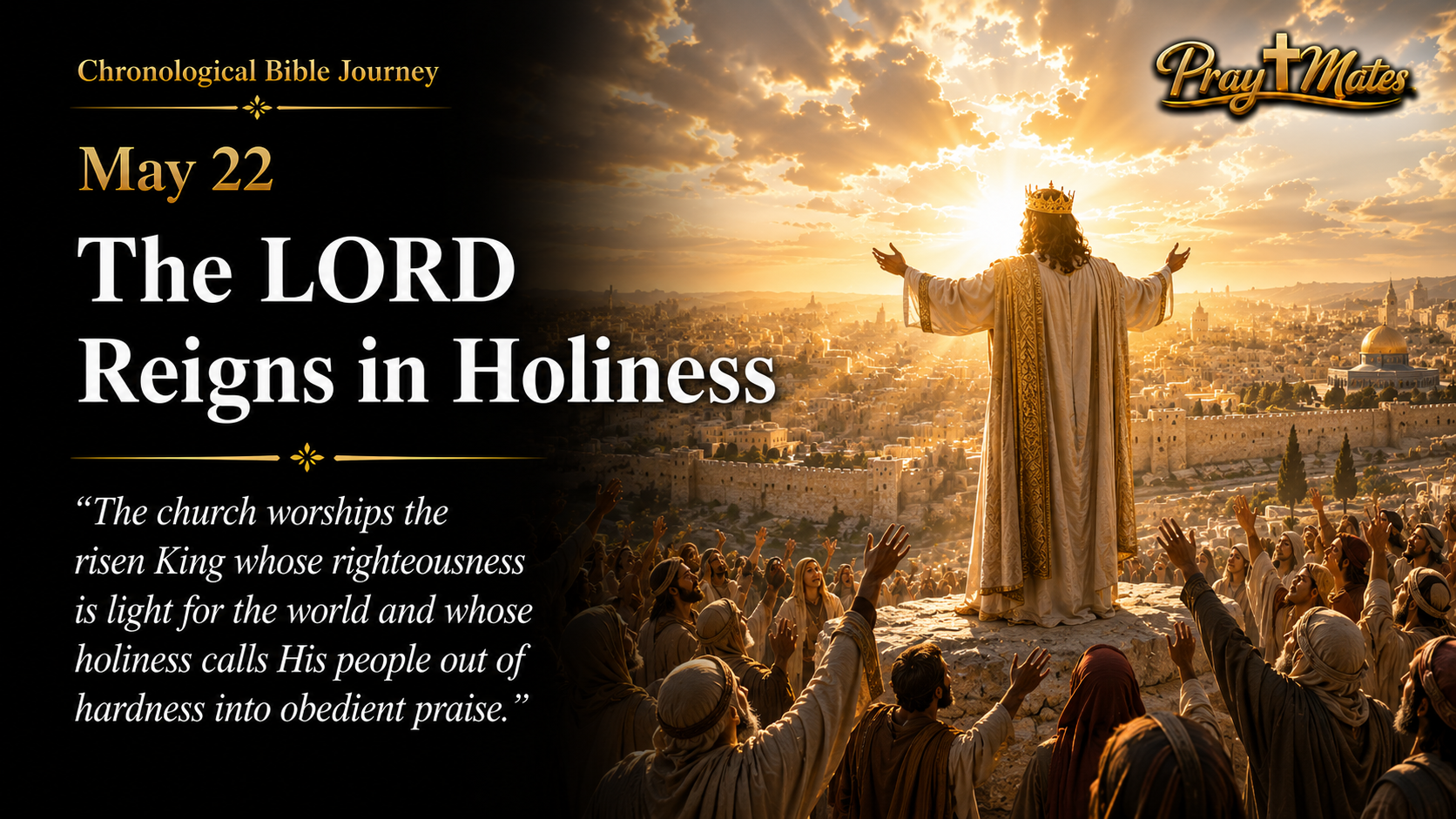
May 22 — The LORD Reigns in Holiness
May 22 — The LORD Reigns in Holiness
SCRIPTURE READING:
Psalms 95, 97-99
SCRIPTURE:
Psalm 95
¹ O come, let us sing unto the LORD: let us make a joyful noise to the rock of our salvation.
² Let us come before his presence with thanksgiving, and make a joyful noise unto him with psalms.
³ For the LORD [is] a great God, and a great King above all gods.
⁴ In his hand [are] the deep places of the earth: the strength of the hills [is] his also.
⁵ The sea [is] his, and he made it: and his hands formed the dry [land].
⁶ O come, let us worship and bow down: let us kneel before the LORD our maker.
⁷ For he [is] our God; and we [are] the people of his pasture, and the sheep of his hand. To day if ye will hear his voice,
⁸ Harden not your heart, as in the provocation, [and] as [in] the day of temptation in the wilderness:
⁹ When your fathers tempted me, proved me, and saw my work.
¹⁰ Forty years long was I grieved with [this] generation, and said, It [is] a people that do err in their heart, and they have not known my ways:
¹¹ Unto whom I sware in my wrath that they should not enter into my rest.
Psalm 97
¹ The LORD reigneth; let the earth rejoice; let the multitude of isles be glad [thereof].
² Clouds and darkness [are] round about him: righteousness and judgment [are] the habitation of his throne.
³ A fire goeth before him, and burneth up his enemies round about.
⁴ His lightnings enlightened the world: the earth saw, and trembled.
⁵ The hills melted like wax at the presence of the LORD, at the presence of the Lord of the whole earth.
⁶ The heavens declare his righteousness, and all the people see his glory.
⁷ Confounded be all they that serve graven images, that boast themselves of idols: worship him, all [ye] gods.
⁸ Zion heard, and was glad; and the daughters of Judah rejoiced because of thy judgments, O LORD.
⁹ For thou, LORD, [art] high above all the earth: thou art exalted far above all gods.
¹⁰ Ye that love the LORD, hate evil: he preserveth the souls of his saints; he delivereth them out of the hand of the wicked.
¹¹ Light is sown for the righteous, and gladness for the upright in heart.
¹² Rejoice in the LORD, ye righteous; and give thanks at the remembrance of his holiness.
Psalm 98
¹ A Psalm. O sing unto the LORD a new song; for he hath done marvellous things: his right hand, and his holy arm, hath gotten him the victory.
² The LORD hath made known his salvation: his righteousness hath he openly shewed in the sight of the heathen.
³ He hath remembered his mercy and his truth toward the house of Israel: all the ends of the earth have seen the salvation of our God.
⁴ Make a joyful noise unto the LORD, all the earth: make a loud noise, and rejoice, and sing praise.
⁵ Sing unto the LORD with the harp; with the harp, and the voice of a psalm.
⁶ With trumpets and sound of cornet make a joyful noise before the LORD, the King.
⁷ Let the sea roar, and the fulness thereof; the world, and they that dwell therein.
⁸ Let the floods clap [their] hands: let the hills be joyful together
⁹ Before the LORD; for he cometh to judge the earth: with righteousness shall he judge the world, and the people with equity.
Psalm 99
¹ The LORD reigneth; let the people tremble: he sitteth [between] the cherubims; let the earth be moved.
² The LORD [is] great in Zion; and he [is] high above all the people.
³ Let them praise thy great and terrible name; [for] it [is] holy.
⁴ The king’s strength also loveth judgment; thou dost establish equity, thou executest judgment and righteousness in Jacob.
⁵ Exalt ye the LORD our God, and worship at his footstool; [for] he [is] holy.
⁶ Moses and Aaron among his priests, and Samuel among them that call upon his name; they called upon the LORD, and he answered them.
⁷ He spake unto them in the cloudy pillar: they kept his testimonies, and the ordinance [that] he gave them.
⁸ Thou answeredst them, O LORD our God: thou wast a God that forgavest them, though thou tookest vengeance of their inventions.
⁹ Exalt the LORD our God, and worship at his holy hill; for the LORD our God [is] holy.
DEVOTIONAL:
Psalms 95 and 97-99 summon the people into worship because the LORD reigns. The call is joyful and weighty at the same time: sing, give thanks, bow down, tremble, rejoice, and exalt. The LORD is not a tribal deity competing for attention. He is the great King above all gods, the maker of sea and dry land, the holy ruler whose righteousness and judgment fill the world.
In Israel's covenant worship, praise was never meant to be detached from obedience. Psalm 95 remembers the warning of hardened hearts in the wilderness. The same people who sing are told not to resist the voice of God. Worship that does not listen becomes dangerous. The covenant people must rejoice before the King and also yield to Him, because His reign is holy.
The holiness of God in these psalms is beautiful, not merely severe. He loves judgment, establishes equity, answers His servants, and forgives while taking vengeance on their inventions. Israel's memory of Moses, Aaron, and Samuel teaches that the holy God is near enough to answer prayer and pure enough to correct His people. Holiness and mercy meet in His reign.
Jesus brings the reign of God near. He announces the kingdom, reveals the holiness of the Father, and gathers the nations into worship. In Him, reverence does not cancel joy, and joy does not weaken reverence. The church worships the risen King whose righteousness is light for the world and whose holiness calls His people out of hardness into obedient praise.
In daily life, this reading calls believers to obey God by listening to the voice they praise. Character grows when joy is rooted in holiness instead of entertainment, and when reverence shapes speech, choices, and desires. Families can practice worship that includes both singing and obedience, workers can act with moral seriousness, and churches can display glad reverence before the Lord who reigns.
In U.S. civic life, the civic virtue rising from this reading is reverent joy. It leads us to pray for communities shaped by fear, cynicism, entertainment without holiness, or anger without worship. Christians should show up by living as joyful worshipers whose public conduct reflects the holiness of the Lord.
DISCUSSION QUESTIONS:
What part of this passage most clearly shows the LORD's character?
How does this reading strengthen your understanding of covenant faithfulness?
How does Jesus fulfill or complete the hope shown here?
Where do you need to practice reverent joy in ordinary life?
PRAYER:
ADORATION:
Lord God, You reign with holiness, wisdom, and steadfast love.
CONFESSION:
Forgive me for the pride, fear, or impatience that keeps me from walking in Your ways.
THANKSGIVING:
Thank You for mercy that reaches sinners and for a kingdom that is secure in Christ.
SUPPLICATION – GENERAL:
Teach me to practice reverent joy with a steady heart and to obey You when obedience is costly.
SUPPLICATION – U.S. / CIVIC:
Raise up Christians who carry reverent joy into public life, and give help to communities shaped by fear, cynicism, entertainment without holiness, or anger without worship.
SCRIPTURE:
⁹ Exalt the LORD our God, and worship at his holy hill; for the LORD our God [is] holy.
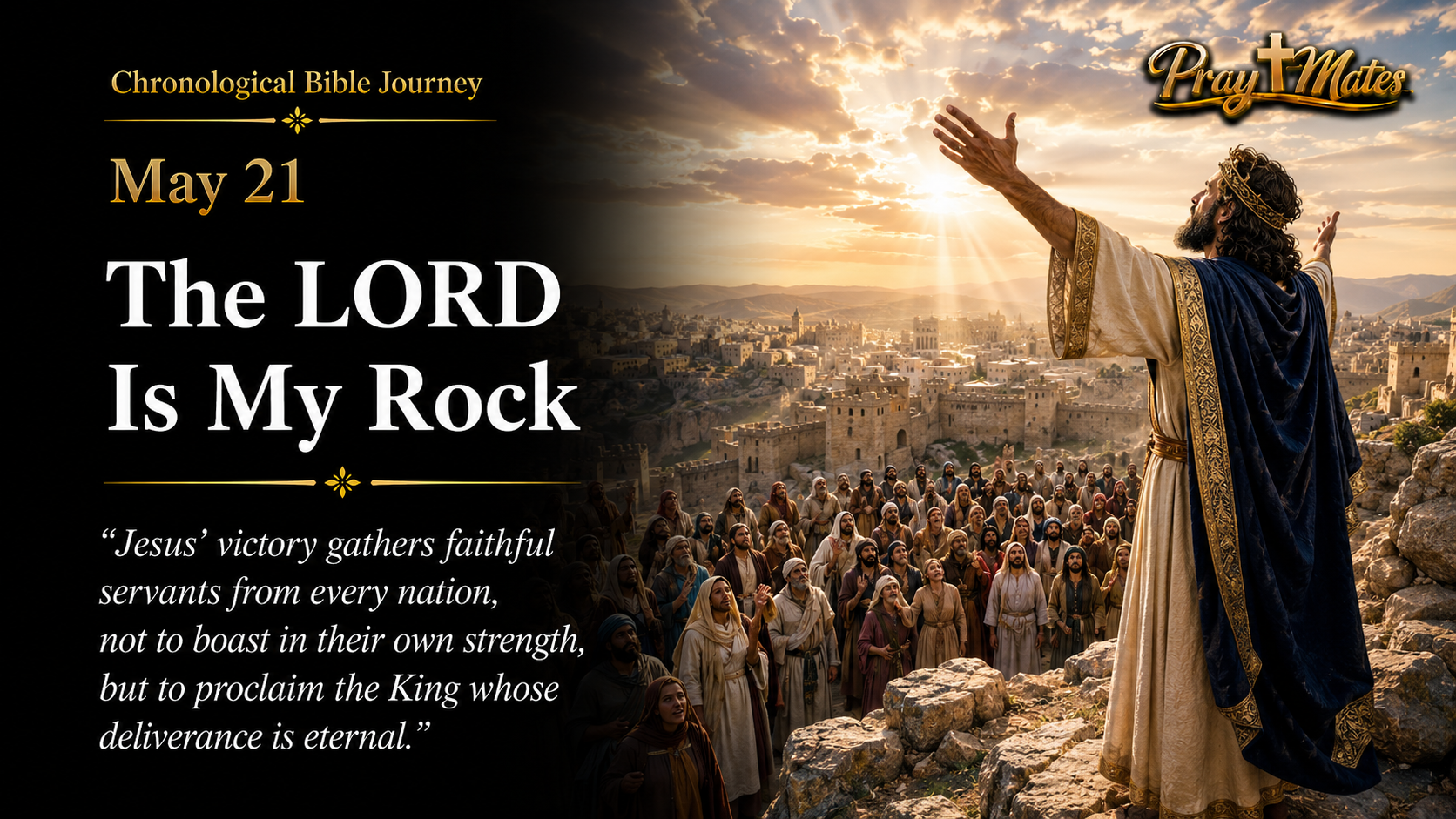
May 21 — The LORD Is My Rock
May 21 — The LORD Is My Rock
SCRIPTURE READING:
2 Samuel 22-23; Psalm 57
SCRIPTURE:
Second Samuel 22
¹ And David spake unto the LORD the words of this song in the day [that] the LORD had delivered him out of the hand of all his enemies, and out of the hand of Saul:
² And he said, The LORD [is] my rock, and my fortress, and my deliverer;
³ The God of my rock; in him will I trust: [he is] my shield, and the horn of my salvation, my high tower, and my refuge, my saviour; thou savest me from violence.
⁴ I will call on the LORD, [who is] worthy to be praised: so shall I be saved from mine enemies.
⁵ When the waves of death compassed me, the floods of ungodly men made me afraid;
⁶ The sorrows of hell compassed me about; the snares of death prevented me;
⁷ In my distress I called upon the LORD, and cried to my God: and he did hear my voice out of his temple, and my cry [did enter] into his ears.
⁸ Then the earth shook and trembled; the foundations of heaven moved and shook, because he was wroth.
⁹ There went up a smoke out of his nostrils, and fire out of his mouth devoured: coals were kindled by it.
¹⁰ He bowed the heavens also, and came down; and darkness [was] under his feet.
¹¹ And he rode upon a cherub, and did fly: and he was seen upon the wings of the wind.
¹² And he made darkness pavilions round about him, dark waters, [and] thick clouds of the skies.
¹³ Through the brightness before him were coals of fire kindled.
¹⁴ The LORD thundered from heaven, and the most High uttered his voice.
¹⁵ And he sent out arrows, and scattered them; lightning, and discomfited them.
¹⁶ And the channels of the sea appeared, the foundations of the world were discovered, at the rebuking of the LORD, at the blast of the breath of his nostrils.
¹⁷ He sent from above, he took me; he drew me out of many waters;
¹⁸ He delivered me from my strong enemy, [and] from them that hated me: for they were too strong for me.
¹⁹ They prevented me in the day of my calamity: but the LORD was my stay.
²⁰ He brought me forth also into a large place: he delivered me, because he delighted in me.
²¹ The LORD rewarded me according to my righteousness: according to the cleanness of my hands hath he recompensed me.
²² For I have kept the ways of the LORD, and have not wickedly departed from my God.
²³ For all his judgments [were] before me: and [as for] his statutes, I did not depart from them.
²⁴ I was also upright before him, and have kept myself from mine iniquity.
²⁵ Therefore the LORD hath recompensed me according to my righteousness; according to my cleanness in his eye sight.
²⁶ With the merciful thou wilt shew thyself merciful, [and] with the upright man thou wilt shew thyself upright.
²⁷ With the pure thou wilt shew thyself pure; and with the froward thou wilt shew thyself unsavoury.
²⁸ And the afflicted people thou wilt save: but thine eyes [are] upon the haughty, [that] thou mayest bring [them] down.
²⁹ For thou [art] my lamp, O LORD: and the LORD will lighten my darkness.
³⁰ For by thee I have run through a troop: by my God have I leaped over a wall.
³¹ [As for] God, his way [is] perfect; the word of the LORD [is] tried: he [is] a buckler to all them that trust in him.
³² For who [is] God, save the LORD? and who [is] a rock, save our God?
³³ God [is] my strength [and] power: and he maketh my way perfect.
³⁴ He maketh my feet like hinds’ [feet]: and setteth me upon my high places.
³⁵ He teacheth my hands to war; so that a bow of steel is broken by mine arms.
³⁶ Thou hast also given me the shield of thy salvation: and thy gentleness hath made me great.
³⁷ Thou hast enlarged my steps under me; so that my feet did not slip.
³⁸ I have pursued mine enemies, and destroyed them; and turned not again until I had consumed them.
³⁹ And I have consumed them, and wounded them, that they could not arise: yea, they are fallen under my feet.
⁴⁰ For thou hast girded me with strength to battle: them that rose up against me hast thou subdued under me.
⁴¹ Thou hast also given me the necks of mine enemies, that I might destroy them that hate me.
⁴² They looked, but [there was] none to save; [even] unto the LORD, but he answered them not.
⁴³ Then did I beat them as small as the dust of the earth, I did stamp them as the mire of the street, [and] did spread them abroad.
⁴⁴ Thou also hast delivered me from the strivings of my people, thou hast kept me [to be] head of the heathen: a people [which] I knew not shall serve me.
⁴⁵ Strangers shall submit themselves unto me: as soon as they hear, they shall be obedient unto me.
⁴⁶ Strangers shall fade away, and they shall be afraid out of their close places.
⁴⁷ The LORD liveth; and blessed [be] my rock; and exalted be the God of the rock of my salvation.
⁴⁸ It [is] God that avengeth me, and that bringeth down the people under me,
⁴⁹ And that bringeth me forth from mine enemies: thou also hast lifted me up on high above them that rose up against me: thou hast delivered me from the violent man.
⁵⁰ Therefore I will give thanks unto thee, O LORD, among the heathen, and I will sing praises unto thy name.
⁵¹ [He is] the tower of salvation for his king: and sheweth mercy to his anointed, unto David, and to his seed for evermore.
Second Samuel 23
¹ Now these [be] the last words of David. David the son of Jesse said, and the man [who was] raised up on high, the anointed of the God of Jacob, and the sweet psalmist of Israel, said,
² The Spirit of the LORD spake by me, and his word [was] in my tongue.
³ The God of Israel said, the Rock of Israel spake to me, He that ruleth over men [must be] just, ruling in the fear of God.
⁴ And [he shall be] as the light of the morning, [when] the sun riseth, [even] a morning without clouds; [as] the tender grass [springing] out of the earth by clear shining after rain.
⁵ Although my house [be] not so with God; yet he hath made with me an everlasting covenant, ordered in all [things], and sure: for [this is] all my salvation, and all [my] desire, although he make [it] not to grow.
⁶ But [the sons] of Belial [shall be] all of them as thorns thrust away, because they cannot be taken with hands:
⁷ But the man [that] shall touch them must be fenced with iron and the staff of a spear; and they shall be utterly burned with fire in the [same] place.
⁸ These [be] the names of the mighty men whom David had: The Tachmonite that sat in the seat, chief among the captains; the same [was] Adino the Eznite: [he lift up his spear] against eight hundred, whom he slew at one time.
⁹ And after him [was] Eleazar the son of Dodo the Ahohite, [one] of the three mighty men with David, when they defied the Philistines [that] were there gathered together to battle, and the men of Israel were gone away:
¹⁰ He arose, and smote the Philistines until his hand was weary, and his hand clave unto the sword: and the LORD wrought a great victory that day; and the people returned after him only to spoil.
¹¹ And after him [was] Shammah the son of Agee the Hararite. And the Philistines were gathered together into a troop, where was a piece of ground full of lentiles: and the people fled from the Philistines.
¹² But he stood in the midst of the ground, and defended it, and slew the Philistines: and the LORD wrought a great victory.
¹³ And three of the thirty chief went down, and came to David in the harvest time unto the cave of Adullam: and the troop of the Philistines pitched in the valley of Rephaim.
¹⁴ And David [was] then in an hold, and the garrison of the Philistines [was] then [in] Bethlehem.
¹⁵ And David longed, and said, Oh that one would give me drink of the water of the well of Bethlehem, which [is] by the gate!
¹⁶ And the three mighty men brake through the host of the Philistines, and drew water out of the well of Bethlehem, that [was] by the gate, and took [it], and brought [it] to David: nevertheless he would not drink thereof, but poured it out unto the LORD.
¹⁷ And he said, Be it far from me, O LORD, that I should do this: [is not this] the blood of the men that went in jeopardy of their lives? therefore he would not drink it. These things did these three mighty men.
¹⁸ And Abishai, the brother of Joab, the son of Zeruiah, was chief among three. And he lifted up his spear against three hundred, [and] slew [them], and had the name among three.
¹⁹ Was he not most honourable of three? therefore he was their captain: howbeit he attained not unto the [first] three.
²⁰ And Benaiah the son of Jehoiada, the son of a valiant man, of Kabzeel, who had done many acts, he slew two lionlike men of Moab: he went down also and slew a lion in the midst of a pit in time of snow:
²¹ And he slew an Egyptian, a goodly man: and the Egyptian had a spear in his hand; but he went down to him with a staff, and plucked the spear out of the Egyptian’s hand, and slew him with his own spear.
²² These [things] did Benaiah the son of Jehoiada, and had the name among three mighty men.
²³ He was more honourable than the thirty, but he attained not to the [first] three. And David set him over his guard.
²⁴ Asahel the brother of Joab [was] one of the thirty; Elhanan the son of Dodo of Bethlehem,
²⁵ Shammah the Harodite, Elika the Harodite,
²⁶ Helez the Paltite, Ira the son of Ikkesh the Tekoite,
²⁷ Abiezer the Anethothite, Mebunnai the Hushathite,
²⁸ Zalmon the Ahohite, Maharai the Netophathite,
²⁹ Heleb the son of Baanah, a Netophathite, Ittai the son of Ribai out of Gibeah of the children of Benjamin,
³⁰ Benaiah the Pirathonite, Hiddai of the brooks of Gaash,
³¹ Abialbon the Arbathite, Azmaveth the Barhumite,
³² Eliahba the Shaalbonite, of the sons of Jashen, Jonathan,
³³ Shammah the Hararite, Ahiam the son of Sharar the Hararite,
³⁴ Eliphelet the son of Ahasbai, the son of the Maachathite, Eliam the son of Ahithophel the Gilonite,
³⁵ Hezrai the Carmelite, Paarai the Arbite,
³⁶ Igal the son of Nathan of Zobah, Bani the Gadite,
³⁷ Zelek the Ammonite, Naharai the Beerothite, armourbearer to Joab the son of Zeruiah,
³⁸ Ira an Ithrite, Gareb an Ithrite,
³⁹ Uriah the Hittite: thirty and seven in all.
Psalm 57
¹ To the chief Musician, Altaschith, Michtam of David, when he fled from Saul in the cave. Be merciful unto me, O God, be merciful unto me: for my soul trusteth in thee: yea, in the shadow of thy wings will I make my refuge, until [these] calamities be overpast.
² I will cry unto God most high; unto God that performeth [all things] for me.
³ He shall send from heaven, and save me [from] the reproach of him that would swallow me up. Selah. God shall send forth his mercy and his truth.
⁴ My soul [is] among lions: [and] I lie [even among] them that are set on fire, [even] the sons of men, whose teeth [are] spears and arrows, and their tongue a sharp sword.
⁵ Be thou exalted, O God, above the heavens; [let] thy glory [be] above all the earth.
⁶ They have prepared a net for my steps; my soul is bowed down: they have digged a pit before me, into the midst whereof they are fallen [themselves]. Selah.
⁷ My heart is fixed, O God, my heart is fixed: I will sing and give praise.
⁸ Awake up, my glory; awake, psaltery and harp: I [myself] will awake early.
⁹ I will praise thee, O Lord, among the people: I will sing unto thee among the nations.
¹⁰ For thy mercy [is] great unto the heavens, and thy truth unto the clouds.
¹¹ Be thou exalted, O God, above the heavens: [let] thy glory [be] above all the earth.
DEVOTIONAL:
David's song of deliverance is full of images that stack strength upon strength: rock, fortress, deliverer, shield, horn of salvation, high tower, and refuge. He looks back over danger and does not credit survival to himself. The LORD heard, thundered, rescued, and brought him into a large place. The song teaches that David's victories are not detached achievements but testimonies to the God who saves.
The covenant dimension is especially clear because David is the anointed king. His deliverance is personal, but it is not private. When the LORD preserves the king, He preserves His purposes for the people. David's last words look toward righteous rule like morning light, and the mighty men demonstrate loyalty that costs them dearly. The kingdom is sustained by God's faithfulness and by servants who live courageously under that faithfulness.
Yet the passage also contains reminders of human limitation. David's mighty men are honored, but they are not the hope of Israel. Their courage belongs within a story where the LORD is the true rock. Even the best servants are gifts, and the greatest exploits are not ultimate. The covenant kingdom needs a ruler more righteous than David and a deliverance deeper than escape from military enemies.
Jesus is the righteous ruler whose dawn brings true life. He is both David's Son and David's Lord, the King who wins salvation through suffering and rises as the refuge for all who trust Him. His victory gathers faithful servants from every nation, not to boast in their own strength, but to proclaim the King whose deliverance is eternal.
In daily life, this reading calls believers to obey God from gratitude rather than self-reliance. Character is formed when we remember rescue accurately and give the Lord credit for what pride would claim. Families can retell stories of God's help, workers can serve faithfully in roles that may never be celebrated, and churches can honor costly service while keeping Christ, not human heroism, at the center.
In U.S. civic life, this Scripture calls for grateful courage. It gives us a current prayer focus in veterans, first responders, caregivers, and unseen servants who carry costly responsibilities. Christians should show up by giving God the glory for deliverance and serving bravely without seeking personal praise.
DISCUSSION QUESTIONS:
What does this reading reveal about God's work in the original setting?
How does the covenant background deepen the meaning of this passage?
Where does this Scripture point you toward Jesus the Messiah?
How should the virtue of grateful courage shape your obedience this week?
PRAYER:
ADORATION:
Holy Father, You are faithful in covenant mercy and righteous in all Your ways.
CONFESSION:
Forgive me for trusting my own judgment more than Your word and for resisting the correction You give.
THANKSGIVING:
Thank You for revealing Your faithfulness through Scripture and for giving us Jesus, the promised Messiah.
SUPPLICATION – GENERAL:
Strengthen me to walk in grateful courage, to receive Your word with humility, and to serve others faithfully.
SUPPLICATION – U.S. / CIVIC:
Teach Your people in our nation to practice grateful courage, and bring mercy, wisdom, and healing to veterans, first responders, caregivers, and unseen servants who carry costly responsibilities.
SCRIPTURE:
² And he said, The LORD [is] my rock, and my fortress, and my deliverer;
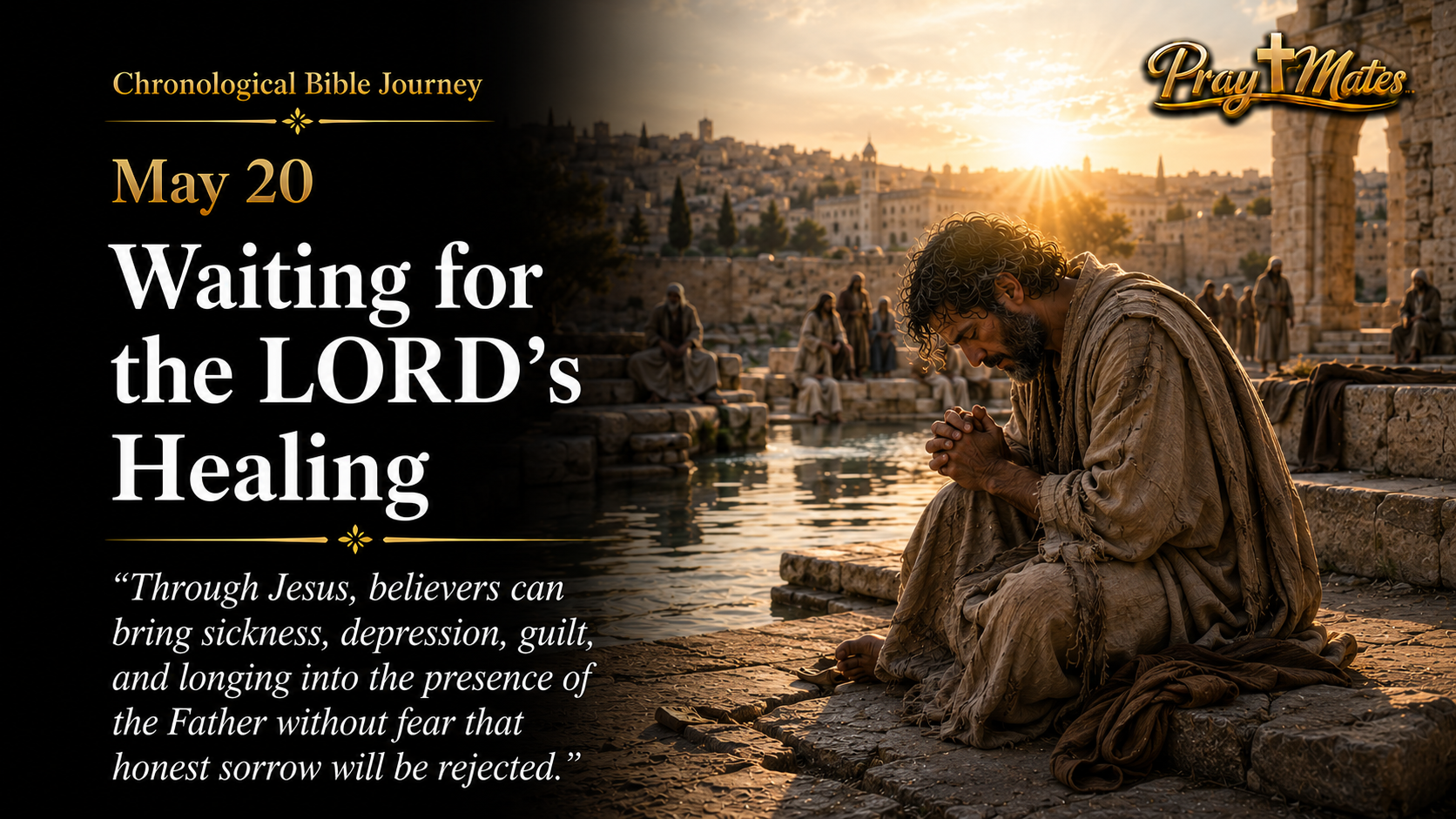
May 20 — Waiting for the LORD's Healing
May 20 — Waiting for the LORD's Healing
SCRIPTURE READING:
Psalms 5, 38, 41-42
SCRIPTURE:
Psalm 5
¹ To the chief Musician upon Nehiloth, A Psalm of David. Give ear to my words, O LORD, consider my meditation.
² Hearken unto the voice of my cry, my King, and my God: for unto thee will I pray.
³ My voice shalt thou hear in the morning, O LORD; in the morning will I direct [my prayer] unto thee, and will look up.
⁴ For thou [art] not a God that hath pleasure in wickedness: neither shall evil dwell with thee.
⁵ The foolish shall not stand in thy sight: thou hatest all workers of iniquity.
⁶ Thou shalt destroy them that speak leasing: the LORD will abhor the bloody and deceitful man.
⁷ But as for me, I will come [into] thy house in the multitude of thy mercy: [and] in thy fear will I worship toward thy holy temple.
⁸ Lead me, O LORD, in thy righteousness because of mine enemies; make thy way straight before my face.
⁹ For [there is] no faithfulness in their mouth; their inward part [is] very wickedness; their throat [is] an open sepulchre; they flatter with their tongue.
¹⁰ Destroy thou them, O God; let them fall by their own counsels; cast them out in the multitude of their transgressions; for they have rebelled against thee.
¹¹ But let all those that put their trust in thee rejoice: let them ever shout for joy, because thou defendest them: let them also that love thy name be joyful in thee.
¹² For thou, LORD, wilt bless the righteous; with favour wilt thou compass him as [with] a shield.
Psalm 38
¹ A Psalm of David, to bring to remembrance. O LORD, rebuke me not in thy wrath: neither chasten me in thy hot displeasure.
² For thine arrows stick fast in me, and thy hand presseth me sore.
³ [There is] no soundness in my flesh because of thine anger; neither [is there any] rest in my bones because of my sin.
⁴ For mine iniquities are gone over mine head: as an heavy burden they are too heavy for me.
⁵ My wounds stink [and] are corrupt because of my foolishness.
⁶ I am troubled; I am bowed down greatly; I go mourning all the day long.
⁷ For my loins are filled with a loathsome [disease]: and [there is] no soundness in my flesh.
⁸ I am feeble and sore broken: I have roared by reason of the disquietness of my heart.
⁹ Lord, all my desire [is] before thee; and my groaning is not hid from thee.
¹⁰ My heart panteth, my strength faileth me: as for the light of mine eyes, it also is gone from me.
¹¹ My lovers and my friends stand aloof from my sore; and my kinsmen stand afar off.
¹² They also that seek after my life lay snares [for me]: and they that seek my hurt speak mischievous things, and imagine deceits all the day long.
¹³ But I, as a deaf [man], heard not; and [I was] as a dumb man [that] openeth not his mouth.
¹⁴ Thus I was as a man that heareth not, and in whose mouth [are] no reproofs.
¹⁵ For in thee, O LORD, do I hope: thou wilt hear, O Lord my God.
¹⁶ For I said, [Hear me], lest [otherwise] they should rejoice over me: when my foot slippeth, they magnify [themselves] against me.
¹⁷ For I [am] ready to halt, and my sorrow [is] continually before me.
¹⁸ For I will declare mine iniquity; I will be sorry for my sin.
¹⁹ But mine enemies [are] lively, [and] they are strong: and they that hate me wrongfully are multiplied.
²⁰ They also that render evil for good are mine adversaries; because I follow [the thing that] good [is].
²¹ Forsake me not, O LORD: O my God, be not far from me.
²² Make haste to help me, O Lord my salvation.
Psalm 41
¹ To the chief Musician, A Psalm of David. Blessed [is] he that considereth the poor: the LORD will deliver him in time of trouble.
² The LORD will preserve him, and keep him alive; [and] he shall be blessed upon the earth: and thou wilt not deliver him unto the will of his enemies.
³ The LORD will strengthen him upon the bed of languishing: thou wilt make all his bed in his sickness.
⁴ I said, LORD, be merciful unto me: heal my soul; for I have sinned against thee.
⁵ Mine enemies speak evil of me, When shall he die, and his name perish?
⁶ And if he come to see [me], he speaketh vanity: his heart gathereth iniquity to itself; [when] he goeth abroad, he telleth [it].
⁷ All that hate me whisper together against me: against me do they devise my hurt.
⁸ An evil disease, [say they], cleaveth fast unto him: and [now] that he lieth he shall rise up no more.
⁹ Yea, mine own familiar friend, in whom I trusted, which did eat of my bread, hath lifted up [his] heel against me.
¹⁰ But thou, O LORD, be merciful unto me, and raise me up, that I may requite them.
¹¹ By this I know that thou favourest me, because mine enemy doth not triumph over me.
¹² And as for me, thou upholdest me in mine integrity, and settest me before thy face for ever.
¹³ Blessed [be] the LORD God of Israel from everlasting, and to everlasting. Amen, and Amen.
Psalm 42
¹ To the chief Musician, Maschil, for the sons of Korah. As the hart panteth after the water brooks, so panteth my soul after thee, O God.
² My soul thirsteth for God, for the living God: when shall I come and appear before God?
³ My tears have been my meat day and night, while they continually say unto me, Where [is] thy God?
⁴ When I remember these [things], I pour out my soul in me: for I had gone with the multitude, I went with them to the house of God, with the voice of joy and praise, with a multitude that kept holyday.
⁵ Why art thou cast down, O my soul? and [why] art thou disquieted in me? hope thou in God: for I shall yet praise him [for] the help of his countenance.
⁶ O my God, my soul is cast down within me: therefore will I remember thee from the land of Jordan, and of the Hermonites, from the hill Mizar.
⁷ Deep calleth unto deep at the noise of thy waterspouts: all thy waves and thy billows are gone over me.
⁸ [Yet] the LORD will command his lovingkindness in the daytime, and in the night his song [shall be] with me, [and] my prayer unto the God of my life.
⁹ I will say unto God my rock, Why hast thou forgotten me? why go I mourning because of the oppression of the enemy?
¹⁰ [As] with a sword in my bones, mine enemies reproach me; while they say daily unto me, Where [is] thy God?
¹¹ Why art thou cast down, O my soul? and why art thou disquieted within me? hope thou in God: for I shall yet praise him, [who is] the health of my countenance, and my God.
DEVOTIONAL:
Psalms 5, 38, 41, and 42 carry morning prayer, bodily weakness, guilt, betrayal, longing, and hope. The worshiper asks the LORD to hear his voice in the morning, groans under pain, confesses iniquity, suffers from enemies and friends, and speaks to his own cast-down soul. These psalms are for believers who need God in both conscience and body, in both memory and tears.
Israel's prayer life did not divide spiritual health from physical suffering. The covenant worshiper could speak of bones, wounds, tears, enemies, and longing for the sanctuary all in the same breath. This honesty is part of biblical faith. The person who thirsts for God does not stop being faithful because the soul is cast down. Faith learns to ask, "Why art thou cast down?" and then commands hope toward the LORD.
The Jewish background of these songs reminds us that worship was tied to place, memory, and community. The psalmist remembers going with the multitude to the house of God, and that memory deepens the ache of absence. Spiritual discouragement often hurts because we remember joy. Yet even that memory can become prayer, turning grief into longing for restored communion with God.
Jesus enters weakness, betrayal, and thirst. He is the faithful sufferer whose enemies misread pain and whose friends fail Him. He also becomes the living water for souls that pant after God. Through Him, believers can bring sickness, depression, guilt, and longing into the presence of the Father without fear that honest sorrow will be rejected.
In daily life, this passage calls believers to obey God in seasons when strength is low and hope must be spoken deliberately. Character grows when honesty before God replaces performance before others. Families can learn to pray through sadness without shame, workers can show compassion to the depleted, and churches can make room for lament, healing prayer, and steady hope in Christ rather than demanding constant cheerfulness.
In U.S. civic life, the passage presses the virtue of hopeful endurance into public life. It directs prayer toward those facing illness, depression, grief, burnout, and spiritual dryness. Christians should show up by walking with sufferers patiently and speaking hope without dismissing pain.
DISCUSSION QUESTIONS:
What does this reading teach about the difference between human strength and God's purpose?
Which covenant theme in this passage should shape your worship?
How does this Scripture prepare your heart to see Jesus more clearly?
What faithful action would grow from hopeful endurance today?
PRAYER:
ADORATION:
Righteous Father, You see truly, judge rightly, and show mercy to the humble.
CONFESSION:
Forgive me for neglecting prayer, gratitude, and obedience when life feels pressured.
THANKSGIVING:
Thank You for the hope, cleansing, wisdom, and refuge You provide through Christ.
SUPPLICATION – GENERAL:
Lead me in hopeful endurance, and make my home, work, and church life more faithful to Your will.
SUPPLICATION – U.S. / CIVIC:
Make Your people witnesses of hopeful endurance, and bring righteous care to those facing illness, depression, grief, burnout, and spiritual dryness.
SCRIPTURE:
¹ To the chief Musician, Maschil, for the sons of Korah. As the hart panteth after the water brooks, so panteth my soul after thee, O God.
May 19 — Mercy, Justice, and the Cost of Broken Covenant
May 19 — Mercy, Justice, and the Cost of Broken Covenant
SCRIPTURE READING:
2 Samuel 19-21
SCRIPTURE:
Second Samuel 19
¹ And it was told Joab, Behold, the king weepeth and mourneth for Absalom.
² And the victory that day was [turned] into mourning unto all the people: for the people heard say that day how the king was grieved for his son.
³ And the people gat them by stealth that day into the city, as people being ashamed steal away when they flee in battle.
⁴ But the king covered his face, and the king cried with a loud voice, O my son Absalom, O Absalom, my son, my son!
⁵ And Joab came into the house to the king, and said, Thou hast shamed this day the faces of all thy servants, which this day have saved thy life, and the lives of thy sons and of thy daughters, and the lives of thy wives, and the lives of thy concubines;
⁶ In that thou lovest thine enemies, and hatest thy friends. For thou hast declared this day, that thou regardest neither princes nor servants: for this day I perceive, that if Absalom had lived, and all we had died this day, then it had pleased thee well.
⁷ Now therefore arise, go forth, and speak comfortably unto thy servants: for I swear by the LORD, if thou go not forth, there will not tarry one with thee this night: and that will be worse unto thee than all the evil that befell thee from thy youth until now.
⁸ Then the king arose, and sat in the gate. And they told unto all the people, saying, Behold, the king doth sit in the gate. And all the people came before the king: for Israel had fled every man to his tent.
⁹ And all the people were at strife throughout all the tribes of Israel, saying, The king saved us out of the hand of our enemies, and he delivered us out of the hand of the Philistines; and now he is fled out of the land for Absalom.
¹⁰ And Absalom, whom we anointed over us, is dead in battle. Now therefore why speak ye not a word of bringing the king back?
¹¹ And king David sent to Zadok and to Abiathar the priests, saying, Speak unto the elders of Judah, saying, Why are ye the last to bring the king back to his house? seeing the speech of all Israel is come to the king, [even] to his house.
¹² Ye [are] my brethren, ye [are] my bones and my flesh: wherefore then are ye the last to bring back the king?
¹³ And say ye to Amasa, [Art] thou not of my bone, and of my flesh? God do so to me, and more also, if thou be not captain of the host before me continually in the room of Joab.
¹⁴ And he bowed the heart of all the men of Judah, even as [the heart of] one man; so that they sent [this word] unto the king, Return thou, and all thy servants.
¹⁵ So the king returned, and came to Jordan. And Judah came to Gilgal, to go to meet the king, to conduct the king over Jordan.
¹⁶ And Shimei the son of Gera, a Benjamite, which [was] of Bahurim, hasted and came down with the men of Judah to meet king David.
¹⁷ And [there were] a thousand men of Benjamin with him, and Ziba the servant of the house of Saul, and his fifteen sons and his twenty servants with him; and they went over Jordan before the king.
¹⁸ And there went over a ferry boat to carry over the king’s household, and to do what he thought good. And Shimei the son of Gera fell down before the king, as he was come over Jordan;
¹⁹ And said unto the king, Let not my lord impute iniquity unto me, neither do thou remember that which thy servant did perversely the day that my lord the king went out of Jerusalem, that the king should take it to his heart.
²⁰ For thy servant doth know that I have sinned: therefore, behold, I am come the first this day of all the house of Joseph to go down to meet my lord the king.
²¹ But Abishai the son of Zeruiah answered and said, Shall not Shimei be put to death for this, because he cursed the LORD’S anointed?
²² And David said, What have I to do with you, ye sons of Zeruiah, that ye should this day be adversaries unto me? shall there any man be put to death this day in Israel? for do not I know that I [am] this day king over Israel?
²³ Therefore the king said unto Shimei, Thou shalt not die. And the king sware unto him.
²⁴ And Mephibosheth the son of Saul came down to meet the king, and had neither dressed his feet, nor trimmed his beard, nor washed his clothes, from the day the king departed until the day he came [again] in peace.
²⁵ And it came to pass, when he was come to Jerusalem to meet the king, that the king said unto him, Wherefore wentest not thou with me, Mephibosheth?
²⁶ And he answered, My lord, O king, my servant deceived me: for thy servant said, I will saddle me an ass, that I may ride thereon, and go to the king; because thy servant [is] lame.
²⁷ And he hath slandered thy servant unto my lord the king; but my lord the king [is] as an angel of God: do therefore [what is] good in thine eyes.
²⁸ For all [of] my father’s house were but dead men before my lord the king: yet didst thou set thy servant among them that did eat at thine own table. What right therefore have I yet to cry any more unto the king?
²⁹ And the king said unto him, Why speakest thou any more of thy matters? I have said, Thou and Ziba divide the land.
³⁰ And Mephibosheth said unto the king, Yea, let him take all, forasmuch as my lord the king is come again in peace unto his own house.
³¹ And Barzillai the Gileadite came down from Rogelim, and went over Jordan with the king, to conduct him over Jordan.
³² Now Barzillai was a very aged man, [even] fourscore years old: and he had provided the king of sustenance while he lay at Mahanaim; for he [was] a very great man.
³³ And the king said unto Barzillai, Come thou over with me, and I will feed thee with me in Jerusalem.
³⁴ And Barzillai said unto the king, How long have I to live, that I should go up with the king unto Jerusalem?
³⁵ I [am] this day fourscore years old: [and] can I discern between good and evil? can thy servant taste what I eat or what I drink? can I hear any more the voice of singing men and singing women? wherefore then should thy servant be yet a burden unto my lord the king?
³⁶ Thy servant will go a little way over Jordan with the king: and why should the king recompense it me with such a reward?
³⁷ Let thy servant, I pray thee, turn back again, that I may die in mine own city, [and be buried] by the grave of my father and of my mother. But behold thy servant Chimham; let him go over with my lord the king; and do to him what shall seem good unto thee.
³⁸ And the king answered, Chimham shall go over with me, and I will do to him that which shall seem good unto thee: and whatsoever thou shalt require of me, [that] will I do for thee.
³⁹ And all the people went over Jordan. And when the king was come over, the king kissed Barzillai, and blessed him; and he returned unto his own place.
⁴⁰ Then the king went on to Gilgal, and Chimham went on with him: and all the people of Judah conducted the king, and also half the people of Israel.
⁴¹ And, behold, all the men of Israel came to the king, and said unto the king, Why have our brethren the men of Judah stolen thee away, and have brought the king, and his household, and all David’s men with him, over Jordan?
⁴² And all the men of Judah answered the men of Israel, Because the king [is] near of kin to us: wherefore then be ye angry for this matter? have we eaten at all of the king’s [cost]? or hath he given us any gift?
⁴³ And the men of Israel answered the men of Judah, and said, We have ten parts in the king, and we have also more [right] in David than ye: why then did ye despise us, that our advice should not be first had in bringing back our king? And the words of the men of Judah were fiercer than the words of the men of Israel.
Second Samuel 20
¹ And there happened to be there a man of Belial, whose name [was] Sheba, the son of Bichri, a Benjamite: and he blew a trumpet, and said, We have no part in David, neither have we inheritance in the son of Jesse: every man to his tents, O Israel.
² So every man of Israel went up from after David, [and] followed Sheba the son of Bichri: but the men of Judah clave unto their king, from Jordan even to Jerusalem.
³ And David came to his house at Jerusalem; and the king took the ten women [his] concubines, whom he had left to keep the house, and put them in ward, and fed them, but went not in unto them. So they were shut up unto the day of their death, living in widowhood.
⁴ Then said the king to Amasa, Assemble me the men of Judah within three days, and be thou here present.
⁵ So Amasa went to assemble [the men of] Judah: but he tarried longer than the set time which he had appointed him.
⁶ And David said to Abishai, Now shall Sheba the son of Bichri do us more harm than [did] Absalom: take thou thy lord’s servants, and pursue after him, lest he get him fenced cities, and escape us.
⁷ And there went out after him Joab’s men, and the Cherethites, and the Pelethites, and all the mighty men: and they went out of Jerusalem, to pursue after Sheba the son of Bichri.
⁸ When they [were] at the great stone which [is] in Gibeon, Amasa went before them. And Joab’s garment that he had put on was girded unto him, and upon it a girdle [with] a sword fastened upon his loins in the sheath thereof; and as he went forth it fell out.
⁹ And Joab said to Amasa, [Art] thou in health, my brother? And Joab took Amasa by the beard with the right hand to kiss him.
¹⁰ But Amasa took no heed to the sword that [was] in Joab’s hand: so he smote him therewith in the fifth [rib], and shed out his bowels to the ground, and struck him not again; and he died. So Joab and Abishai his brother pursued after Sheba the son of Bichri.
¹¹ And one of Joab’s men stood by him, and said, He that favoureth Joab, and he that [is] for David, [let him go] after Joab.
¹² And Amasa wallowed in blood in the midst of the highway. And when the man saw that all the people stood still, he removed Amasa out of the highway into the field, and cast a cloth upon him, when he saw that every one that came by him stood still.
¹³ When he was removed out of the highway, all the people went on after Joab, to pursue after Sheba the son of Bichri.
¹⁴ And he went through all the tribes of Israel unto Abel, and to Bethmaachah, and all the Berites: and they were gathered together, and went also after him.
¹⁵ And they came and besieged him in Abel of Bethmaachah, and they cast up a bank against the city, and it stood in the trench: and all the people that [were] with Joab battered the wall, to throw it down.
¹⁶ Then cried a wise woman out of the city, Hear, hear; say, I pray you, unto Joab, Come near hither, that I may speak with thee.
¹⁷ And when he was come near unto her, the woman said, [Art] thou Joab? And he answered, I [am he]. Then she said unto him, Hear the words of thine handmaid. And he answered, I do hear.
¹⁸ Then she spake, saying, They were wont to speak in old time, saying, They shall surely ask [counsel] at Abel: and so they ended [the matter].
¹⁹ I [am one of them that are] peaceable [and] faithful in Israel: thou seekest to destroy a city and a mother in Israel: why wilt thou swallow up the inheritance of the LORD?
²⁰ And Joab answered and said, Far be it, far be it from me, that I should swallow up or destroy.
²¹ The matter [is] not so: but a man of mount Ephraim, Sheba the son of Bichri by name, hath lifted up his hand against the king, [even] against David: deliver him only, and I will depart from the city. And the woman said unto Joab, Behold, his head shall be thrown to thee over the wall.
²² Then the woman went unto all the people in her wisdom. And they cut off the head of Sheba the son of Bichri, and cast [it] out to Joab. And he blew a trumpet, and they retired from the city, every man to his tent. And Joab returned to Jerusalem unto the king.
²³ Now Joab [was] over all the host of Israel: and Benaiah the son of Jehoiada [was] over the Cherethites and over the Pelethites:
²⁴ And Adoram [was] over the tribute: and Jehoshaphat the son of Ahilud [was] recorder:
²⁵ And Sheva [was] scribe: and Zadok and Abiathar [were] the priests:
²⁶ And Ira also the Jairite was a chief ruler about David.
Second Samuel 21
¹ Then there was a famine in the days of David three years, year after year; and David inquired of the LORD. And the LORD answered, [It is] for Saul, and for [his] bloody house, because he slew the Gibeonites.
² And the king called the Gibeonites, and said unto them; (now the Gibeonites [were] not of the children of Israel, but of the remnant of the Amorites; and the children of Israel had sworn unto them: and Saul sought to slay them in his zeal to the children of Israel and Judah.)
³ Wherefore David said unto the Gibeonites, What shall I do for you? and wherewith shall I make the atonement, that ye may bless the inheritance of the LORD?
⁴ And the Gibeonites said unto him, We will have no silver nor gold of Saul, nor of his house; neither for us shalt thou kill any man in Israel. And he said, What ye shall say, [that] will I do for you.
⁵ And they answered the king, The man that consumed us, and that devised against us [that] we should be destroyed from remaining in any of the coasts of Israel,
⁶ Let seven men of his sons be delivered unto us, and we will hang them up unto the LORD in Gibeah of Saul, [whom] the LORD did choose. And the king said, I will give [them].
⁷ But the king spared Mephibosheth, the son of Jonathan the son of Saul, because of the LORD’S oath that [was] between them, between David and Jonathan the son of Saul.
⁸ But the king took the two sons of Rizpah the daughter of Aiah, whom she bare unto Saul, Armoni and Mephibosheth; and the five sons of Michal the daughter of Saul, whom she brought up for Adriel the son of Barzillai the Meholathite:
⁹ And he delivered them into the hands of the Gibeonites, and they hanged them in the hill before the LORD: and they fell [all] seven together, and were put to death in the days of harvest, in the first [days], in the beginning of barley harvest.
¹⁰ And Rizpah the daughter of Aiah took sackcloth, and spread it for her upon the rock, from the beginning of harvest until water dropped upon them out of heaven, and suffered neither the birds of the air to rest on them by day, nor the beasts of the field by night.
¹¹ And it was told David what Rizpah the daughter of Aiah, the concubine of Saul, had done.
¹² And David went and took the bones of Saul and the bones of Jonathan his son from the men of Jabeshgilead, which had stolen them from the street of Bethshan, where the Philistines had hanged them, when the Philistines had slain Saul in Gilboa:
¹³ And he brought up from thence the bones of Saul and the bones of Jonathan his son; and they gathered the bones of them that were hanged.
¹⁴ And the bones of Saul and Jonathan his son buried they in the country of Benjamin in Zelah, in the sepulchre of Kish his father: and they performed all that the king commanded. And after that God was intreated for the land.
¹⁵ Moreover the Philistines had yet war again with Israel; and David went down, and his servants with him, and fought against the Philistines: and David waxed faint.
¹⁶ And Ishbibenob, which [was] of the sons of the giant, the weight of whose spear [weighed] three hundred [shekels] of brass in weight, he being girded with a new [sword], thought to have slain David.
¹⁷ But Abishai the son of Zeruiah succoured him, and smote the Philistine, and killed him. Then the men of David sware unto him, saying, Thou shalt go no more out with us to battle, that thou quench not the light of Israel.
¹⁸ And it came to pass after this, that there was again a battle with the Philistines at Gob: then Sibbechai the Hushathite slew Saph, which [was] of the sons of the giant.
¹⁹ And there was again a battle in Gob with the Philistines, where Elhanan the son of Jaareoregim, a Bethlehemite, slew [the brother of] Goliath the Gittite, the staff of whose spear [was] like a weaver’s beam.
²⁰ And there was yet a battle in Gath, where was a man of [great] stature, that had on every hand six fingers, and on every foot six toes, four and twenty in number; and he also was born to the giant.
²¹ And when he defied Israel, Jonathan the son of Shimea the brother of David slew him.
²² These four were born to the giant in Gath, and fell by the hand of David, and by the hand of his servants.
DEVOTIONAL:
David's return to the kingdom is complicated by grief, politics, old offenses, divided loyalties, and unfinished covenant obligations. Shimei seeks mercy, Mephibosheth's story requires discernment, Barzillai's loyalty is honored, Judah and Israel argue, Sheba rebels, and the Gibeonite wrong must be addressed. Restoration after rebellion is not smooth or simple. The land needs more than a change of location for the king; it needs truth, mercy, and wise judgment.
The covenant background is especially important in the matter of the Gibeonites. Israel's earlier oath had continuing moral weight, and Saul's violence against them left bloodguilt in the land. The passage reminds readers that covenant promises cannot be discarded when they become inconvenient. A nation cannot heal by forgetting injustice that God remembers. Peace requires reckoning with wrong, not merely moving past discomfort.
At the same time, the chapters show mercy at work. David spares Shimei for the moment, honors Barzillai, and preserves Mephibosheth. Yet mercy must be joined to discernment because not every claim is simple and not every division heals quickly. The returning king must navigate justice without cruelty and mercy without naivety. This is the hard labor of restoration in a wounded kingdom.
Jesus is the King who reconciles with perfect justice and mercy. He bears covenant curse, makes peace by His blood, and gathers a divided people into one body. He does not heal by pretending sin is harmless. He heals by facing sin at the cross and creating a people who can speak truth, forgive, repair, and pursue unity without tribal pride.
In daily life, this reading calls believers to obey God in the slow work of repair. Character is shaped by patience, truthfulness, and the courage to deal with old wounds instead of disguising them. Families can practice reconciliation that names harm honestly, workplaces can pursue fair repair when trust has been broken, and churches can model unity grounded in Christ rather than in avoidance, favoritism, or fear of conflict.
In U.S. civic life, this reading commends the virtue of reconciling justice. It turns prayer toward divided neighborhoods, fractured churches, grieving families, and public leaders handling old wounds. Christians should show up by pursuing peace that tells the truth, honors justice, and refuses revenge.
DISCUSSION QUESTIONS:
What warning or encouragement would the first hearers have received from this passage?
How does Israel's covenant story help you read this text with greater care?
What does this passage teach you to treasure about Christ?
How can your family, work, or church life reflect reconciling justice?
PRAYER:
ADORATION:
King of heaven, Your purposes stand, and Your word never fails.
CONFESSION:
Forgive me for hiding sin, excusing selfishness, or using Your gifts for my own name.
THANKSGIVING:
Thank You for hearing prayer and for making Your grace known in the Son of David.
SUPPLICATION – GENERAL:
Give me courage to live out reconciling justice in hidden places as well as visible responsibilities.
SUPPLICATION – U.S. / CIVIC:
Form Your church in reconciling justice, and let our prayers and service bless divided neighborhoods, fractured churches, grieving families, and public leaders handling old wounds.
SCRIPTURE:
¹⁴ And the bones of Saul and Jonathan his son buried they in the country of Benjamin in Zelah, in the sepulchre of Kish his father: and they performed all that the king commanded. And after that God was intreated for the land.
May 18 — Refuge Under the Wings of God
May 18 — Refuge Under the Wings of God
SCRIPTURE READING:
Psalms 26, 40, 58, 61-62, 64
SCRIPTURE:
Psalm 26
¹ [A Psalm] of David. Judge me, O LORD; for I have walked in mine integrity: I have trusted also in the LORD; [therefore] I shall not slide.
² Examine me, O LORD, and prove me; try my reins and my heart.
³ For thy lovingkindness [is] before mine eyes: and I have walked in thy truth.
⁴ I have not sat with vain persons, neither will I go in with dissemblers.
⁵ I have hated the congregation of evil doers; and will not sit with the wicked.
⁶ I will wash mine hands in innocency: so will I compass thine altar, O LORD:
⁷ That I may publish with the voice of thanksgiving, and tell of all thy wondrous works.
⁸ LORD, I have loved the habitation of thy house, and the place where thine honour dwelleth.
⁹ Gather not my soul with sinners, nor my life with bloody men:
¹⁰ In whose hands [is] mischief, and their right hand is full of bribes.
¹¹ But as for me, I will walk in mine integrity: redeem me, and be merciful unto me.
¹² My foot standeth in an even place: in the congregations will I bless the LORD.
Psalm 40
¹ To the chief Musician, A Psalm of David. I waited patiently for the LORD; and he inclined unto me, and heard my cry.
² He brought me up also out of an horrible pit, out of the miry clay, and set my feet upon a rock, [and] established my goings.
³ And he hath put a new song in my mouth, [even] praise unto our God: many shall see [it], and fear, and shall trust in the LORD.
⁴ Blessed [is] that man that maketh the LORD his trust, and respecteth not the proud, nor such as turn aside to lies.
⁵ Many, O LORD my God, [are] thy wonderful works [which] thou hast done, and thy thoughts [which are] to us-ward: they cannot be reckoned up in order unto thee: [if] I would declare and speak [of them], they are more than can be numbered.
⁶ Sacrifice and offering thou didst not desire; mine ears hast thou opened: burnt offering and sin offering hast thou not required.
⁷ Then said I, Lo, I come: in the volume of the book [it is] written of me,
⁸ I delight to do thy will, O my God: yea, thy law [is] within my heart.
⁹ I have preached righteousness in the great congregation: lo, I have not refrained my lips, O LORD, thou knowest.
¹⁰ I have not hid thy righteousness within my heart; I have declared thy faithfulness and thy salvation: I have not concealed thy lovingkindness and thy truth from the great congregation.
¹¹ Withhold not thou thy tender mercies from me, O LORD: let thy lovingkindness and thy truth continually preserve me.
¹² For innumerable evils have compassed me about: mine iniquities have taken hold upon me, so that I am not able to look up; they are more than the hairs of mine head: therefore my heart faileth me.
¹³ Be pleased, O LORD, to deliver me: O LORD, make haste to help me.
¹⁴ Let them be ashamed and confounded together that seek after my soul to destroy it; let them be driven backward and put to shame that wish me evil.
¹⁵ Let them be desolate for a reward of their shame that say unto me, Aha, aha.
¹⁶ Let all those that seek thee rejoice and be glad in thee: let such as love thy salvation say continually, The LORD be magnified.
¹⁷ But I [am] poor and needy; [yet] the Lord thinketh upon me: thou [art] my help and my deliverer; make no tarrying, O my God.
Psalm 58
¹ To the chief Musician, Altaschith, Michtam of David. Do ye indeed speak righteousness, O congregation? do ye judge uprightly, O ye sons of men?
² Yea, in heart ye work wickedness; ye weigh the violence of your hands in the earth.
³ The wicked are estranged from the womb: they go astray as soon as they be born, speaking lies.
⁴ Their poison [is] like the poison of a serpent: [they are] like the deaf adder [that] stoppeth her ear;
⁵ Which will not hearken to the voice of charmers, charming never so wisely.
⁶ Break their teeth, O God, in their mouth: break out the great teeth of the young lions, O LORD.
⁷ Let them melt away as waters [which] run continually: [when] he bendeth [his bow to shoot] his arrows, let them be as cut in pieces.
⁸ As a snail [which] melteth, let [every one of them] pass away: [like] the untimely birth of a woman, [that] they may not see the sun.
⁹ Before your pots can feel the thorns, he shall take them away as with a whirlwind, both living, and in [his] wrath.
¹⁰ The righteous shall rejoice when he seeth the vengeance: he shall wash his feet in the blood of the wicked.
¹¹ So that a man shall say, Verily [there is] a reward for the righteous: verily he is a God that judgeth in the earth.
Psalm 61
¹ To the chief Musician upon Neginah, [A Psalm] of David. Hear my cry, O God; attend unto my prayer.
² From the end of the earth will I cry unto thee, when my heart is overwhelmed: lead me to the rock [that] is higher than I.
³ For thou hast been a shelter for me, [and] a strong tower from the enemy.
⁴ I will abide in thy tabernacle for ever: I will trust in the covert of thy wings. Selah.
⁵ For thou, O God, hast heard my vows: thou hast given [me] the heritage of those that fear thy name.
⁶ Thou wilt prolong the king’s life: [and] his years as many generations.
⁷ He shall abide before God for ever: O prepare mercy and truth, [which] may preserve him.
⁸ So will I sing praise unto thy name for ever, that I may daily perform my vows.
Psalm 62
¹ To the chief Musician, to Jeduthun, A Psalm of David. Truly my soul waiteth upon God: from him [cometh] my salvation.
² He only [is] my rock and my salvation; [he is] my defence; I shall not be greatly moved.
³ How long will ye imagine mischief against a man? ye shall be slain all of you: as a bowing wall [shall ye be, and as] a tottering fence.
⁴ They only consult to cast [him] down from his excellency: they delight in lies: they bless with their mouth, but they curse inwardly. Selah.
⁵ My soul, wait thou only upon God; for my expectation [is] from him.
⁶ He only [is] my rock and my salvation: [he is] my defence; I shall not be moved.
⁷ In God [is] my salvation and my glory: the rock of my strength, [and] my refuge, [is] in God.
⁸ Trust in him at all times; ye people, pour out your heart before him: God [is] a refuge for us. Selah.
⁹ Surely men of low degree [are] vanity, [and] men of high degree [are] a lie: to be laid in the balance, they [are] altogether [lighter] than vanity.
¹⁰ Trust not in oppression, and become not vain in robbery: if riches increase, set not your heart [upon them].
¹¹ God hath spoken once; twice have I heard this; that power [belongeth] unto God.
¹² Also unto thee, O Lord, [belongeth] mercy: for thou renderest to every man according to his work.
Psalm 64
¹ To the chief Musician, A Psalm of David. Hear my voice, O God, in my prayer: preserve my life from fear of the enemy.
² Hide me from the secret counsel of the wicked; from the insurrection of the workers of iniquity:
³ Who whet their tongue like a sword, [and] bend [their bows to shoot] their arrows, [even] bitter words:
⁴ That they may shoot in secret at the perfect: suddenly do they shoot at him, and fear not.
⁵ They encourage themselves [in] an evil matter: they commune of laying snares privily; they say, Who shall see them?
⁶ They search out iniquities; they accomplish a diligent search: both the inward [thought] of every one [of them], and the heart, [is] deep.
⁷ But God shall shoot at them [with] an arrow; suddenly shall they be wounded.
⁸ So they shall make their own tongue to fall upon themselves: all that see them shall flee away.
⁹ And all men shall fear, and shall declare the work of God; for they shall wisely consider of his doing.
¹⁰ The righteous shall be glad in the LORD, and shall trust in him; and all the upright in heart shall glory.
DEVOTIONAL:
These psalms give the faithful a vocabulary for integrity, rescue, judgment, refuge, and quiet confidence. The worshiper asks to be examined, waits patiently for the LORD, cries against injustice, seeks a rock higher than himself, and finds rest in God alone. The enemies in these prayers may be loud or hidden, violent or deceitful, but the answer is consistently the same: the LORD is the refuge of His people.
In Israel's covenant life, integrity was not self-righteous boasting. To ask God to examine the heart is to stand under His searching gaze while clinging to His mercy. The righteous desire vindication, but they also know they need steadfast love. The psalms hold together moral seriousness and dependence, teaching the covenant people to seek justice without pretending they are their own saviors.
The repeated language of rock, refuge, wings, and salvation shows that trust is not merely an idea. It is shelter. Israel learned to pray from danger into the presence of the LORD, from agitation into quiet waiting. This kind of trust does not deny evil. It refuses to let evil become the loudest truth. God alone is the rock, and His mercy is stronger than the schemes of men.
Jesus is the righteous sufferer whose integrity is complete. He is falsely accused, surrounded by schemers, and yet entrusts Himself to the Father. Through His death and resurrection, He becomes the refuge sinners need and the judge before whom hidden evil cannot finally stand. In Him, believers are invited to pray for justice while resting in grace.
In daily life, this passage calls believers to obey God with integrity when motives are tested and accusations feel heavy. Character grows through patient waiting, truthful speech, and refusal to join hidden schemes. Families can teach children to seek refuge in prayer instead of fear, workers can practice honesty when shortcuts are tempting, and churches can become safe shelters where weary souls learn to rest in Christ.
In U.S. civic life, this reading teaches patient integrity as a public good. It calls for prayer over courts, workplaces, families, and civic institutions where hidden manipulation needs truth and accountability. Christians should show up by living transparently and waiting on God instead of using fear as an excuse for compromise.
DISCUSSION QUESTIONS:
What part of this passage most clearly shows the LORD's character?
How does this reading strengthen your understanding of covenant faithfulness?
How does Jesus fulfill or complete the hope shown here?
Where do you need to practice patient integrity in ordinary life?
PRAYER:
ADORATION:
Merciful LORD, You are near to Your people and mighty to save.
CONFESSION:
Forgive me for treating Your mercy lightly and for failing to love others with covenant faithfulness.
THANKSGIVING:
Thank You for guiding, correcting, and sustaining Your people through every generation.
SUPPLICATION – GENERAL:
Shape my life with patient integrity, so that my choices, words, and relationships honor Jesus.
SUPPLICATION – U.S. / CIVIC:
Guide believers across the United States to show patient integrity, and answer the needs of courts, workplaces, families, and civic institutions where hidden manipulation needs truth and accountability.
SCRIPTURE:
¹ To the chief Musician, to Jeduthun, A Psalm of David. Truly my soul waiteth upon God: from him [cometh] my salvation.
May 17 — The King Weeps for His Son
May 17 — The King Weeps for His Son
SCRIPTURE READING:
2 Samuel 16-18
SCRIPTURE:
Second Samuel 16
¹ And when David was a little past the top [of the hill], behold, Ziba the servant of Mephibosheth met him, with a couple of asses saddled, and upon them two hundred [loaves] of bread, and an hundred bunches of raisins, and an hundred of summer fruits, and a bottle of wine.
² And the king said unto Ziba, What meanest thou by these? And Ziba said, The asses [be] for the king’s household to ride on; and the bread and summer fruit for the young men to eat; and the wine, that such as be faint in the wilderness may drink.
³ And the king said, And where [is] thy master’s son? And Ziba said unto the king, Behold, he abideth at Jerusalem: for he said, To day shall the house of Israel restore me the kingdom of my father.
⁴ Then said the king to Ziba, Behold, thine [are] all that [pertained] unto Mephibosheth. And Ziba said, I humbly beseech thee [that] I may find grace in thy sight, my lord, O king.
⁵ And when king David came to Bahurim, behold, thence came out a man of the family of the house of Saul, whose name [was] Shimei, the son of Gera: he came forth, and cursed still as he came.
⁶ And he cast stones at David, and at all the servants of king David: and all the people and all the mighty men [were] on his right hand and on his left.
⁷ And thus said Shimei when he cursed, Come out, come out, thou bloody man, and thou man of Belial:
⁸ The LORD hath returned upon thee all the blood of the house of Saul, in whose stead thou hast reigned; and the LORD hath delivered the kingdom into the hand of Absalom thy son: and, behold, thou [art taken] in thy mischief, because thou [art] a bloody man.
⁹ Then said Abishai the son of Zeruiah unto the king, Why should this dead dog curse my lord the king? let me go over, I pray thee, and take off his head.
¹⁰ And the king said, What have I to do with you, ye sons of Zeruiah? so let him curse, because the LORD hath said unto him, Curse David. Who shall then say, Wherefore hast thou done so?
¹¹ And David said to Abishai, and to all his servants, Behold, my son, which came forth of my bowels, seeketh my life: how much more now [may this] Benjamite [do it]? let him alone, and let him curse; for the LORD hath bidden him.
¹² It may be that the LORD will look on mine affliction, and that the LORD will requite me good for his cursing this day.
¹³ And as David and his men went by the way, Shimei went along on the hill’s side over against him, and cursed as he went, and threw stones at him, and cast dust.
¹⁴ And the king, and all the people that [were] with him, came weary, and refreshed themselves there.
¹⁵ And Absalom, and all the people the men of Israel, came to Jerusalem, and Ahithophel with him.
¹⁶ And it came to pass, when Hushai the Archite, David’s friend, was come unto Absalom, that Hushai said unto Absalom, God save the king, God save the king.
¹⁷ And Absalom said to Hushai, [Is] this thy kindness to thy friend? why wentest thou not with thy friend?
¹⁸ And Hushai said unto Absalom, Nay; but whom the LORD, and this people, and all the men of Israel, choose, his will I be, and with him will I abide.
¹⁹ And again, whom should I serve? [should I] not [serve] in the presence of his son? as I have served in thy father’s presence, so will I be in thy presence.
²⁰ Then said Absalom to Ahithophel, Give counsel among you what we shall do.
²¹ And Ahithophel said unto Absalom, Go in unto thy father’s concubines, which he hath left to keep the house; and all Israel shall hear that thou art abhorred of thy father: then shall the hands of all that [are] with thee be strong.
²² So they spread Absalom a tent upon the top of the house; and Absalom went in unto his father’s concubines in the sight of all Israel.
²³ And the counsel of Ahithophel, which he counselled in those days, [was] as if a man had inquired at the oracle of God: so [was] all the counsel of Ahithophel both with David and with Absalom.
Second Samuel 17
¹ Moreover Ahithophel said unto Absalom, Let me now choose out twelve thousand men, and I will arise and pursue after David this night:
² And I will come upon him while he [is] weary and weak handed, and will make him afraid: and all the people that [are] with him shall flee; and I will smite the king only:
³ And I will bring back all the people unto thee: the man whom thou seekest [is] as if all returned: [so] all the people shall be in peace.
⁴ And the saying pleased Absalom well, and all the elders of Israel.
⁵ Then said Absalom, Call now Hushai the Archite also, and let us hear likewise what he saith.
⁶ And when Hushai was come to Absalom, Absalom spake unto him, saying, Ahithophel hath spoken after this manner: shall we do [after] his saying? if not; speak thou.
⁷ And Hushai said unto Absalom, The counsel that Ahithophel hath given [is] not good at this time.
⁸ For, said Hushai, thou knowest thy father and his men, that they [be] mighty men, and they [be] chafed in their minds, as a bear robbed of her whelps in the field: and thy father [is] a man of war, and will not lodge with the people.
⁹ Behold, he is hid now in some pit, or in some [other] place: and it will come to pass, when some of them be overthrown at the first, that whosoever heareth it will say, There is a slaughter among the people that follow Absalom.
¹⁰ And he also [that is] valiant, whose heart [is] as the heart of a lion, shall utterly melt: for all Israel knoweth that thy father [is] a mighty man, and [they] which [be] with him [are] valiant men.
¹¹ Therefore I counsel that all Israel be generally gathered unto thee, from Dan even to Beersheba, as the sand that [is] by the sea for multitude; and that thou go to battle in thine own person.
¹² So shall we come upon him in some place where he shall be found, and we will light upon him as the dew falleth on the ground: and of him and of all the men that [are] with him there shall not be left so much as one.
¹³ Moreover, if he be gotten into a city, then shall all Israel bring ropes to that city, and we will draw it into the river, until there be not one small stone found there.
¹⁴ And Absalom and all the men of Israel said, The counsel of Hushai the Archite [is] better than the counsel of Ahithophel. For the LORD had appointed to defeat the good counsel of Ahithophel, to the intent that the LORD might bring evil upon Absalom.
¹⁵ Then said Hushai unto Zadok and to Abiathar the priests, Thus and thus did Ahithophel counsel Absalom and the elders of Israel; and thus and thus have I counselled.
¹⁶ Now therefore send quickly, and tell David, saying, Lodge not this night in the plains of the wilderness, but speedily pass over; lest the king be swallowed up, and all the people that [are] with him.
¹⁷ Now Jonathan and Ahimaaz stayed by Enrogel; for they might not be seen to come into the city: and a wench went and told them; and they went and told king David.
¹⁸ Nevertheless a lad saw them, and told Absalom: but they went both of them away quickly, and came to a man’s house in Bahurim, which had a well in his court; whither they went down.
¹⁹ And the woman took and spread a covering over the well’s mouth, and spread ground corn thereon; and the thing was not known.
²⁰ And when Absalom’s servants came to the woman to the house, they said, Where [is] Ahimaaz and Jonathan? And the woman said unto them, They be gone over the brook of water. And when they had sought and could not find [them], they returned to Jerusalem.
²¹ And it came to pass, after they were departed, that they came up out of the well, and went and told king David, and said unto David, Arise, and pass quickly over the water: for thus hath Ahithophel counselled against you.
²² Then David arose, and all the people that [were] with him, and they passed over Jordan: by the morning light there lacked not one of them that was not gone over Jordan.
²³ And when Ahithophel saw that his counsel was not followed, he saddled [his] ass, and arose, and gat him home to his house, to his city, and put his household in order, and hanged himself, and died, and was buried in the sepulchre of his father.
²⁴ Then David came to Mahanaim. And Absalom passed over Jordan, he and all the men of Israel with him.
²⁵ And Absalom made Amasa captain of the host instead of Joab: which Amasa [was] a man’s son, whose name [was] Ithra an Israelite, that went in to Abigail the daughter of Nahash, sister to Zeruiah Joab’s mother.
²⁶ So Israel and Absalom pitched in the land of Gilead.
²⁷ And it came to pass, when David was come to Mahanaim, that Shobi the son of Nahash of Rabbah of the children of Ammon, and Machir the son of Ammiel of Lodebar, and Barzillai the Gileadite of Rogelim,
²⁸ Brought beds, and basons, and earthen vessels, and wheat, and barley, and flour, and parched [corn], and beans, and lentiles, and parched [pulse],
²⁹ And honey, and butter, and sheep, and cheese of kine, for David, and for the people that [were] with him, to eat: for they said, The people [is] hungry, and weary, and thirsty, in the wilderness.
Second Samuel 18
¹ And David numbered the people that [were] with him, and set captains of thousands and captains of hundreds over them.
² And David sent forth a third part of the people under the hand of Joab, and a third part under the hand of Abishai the son of Zeruiah, Joab’s brother, and a third part under the hand of Ittai the Gittite. And the king said unto the people, I will surely go forth with you myself also.
³ But the people answered, Thou shalt not go forth: for if we flee away, they will not care for us; neither if half of us die, will they care for us: but now [thou art] worth ten thousand of us: therefore now [it is] better that thou succour us out of the city.
⁴ And the king said unto them, What seemeth you best I will do. And the king stood by the gate side, and all the people came out by hundreds and by thousands.
⁵ And the king commanded Joab and Abishai and Ittai, saying, [Deal] gently for my sake with the young man, [even] with Absalom. And all the people heard when the king gave all the captains charge concerning Absalom.
⁶ So the people went out into the field against Israel: and the battle was in the wood of Ephraim;
⁷ Where the people of Israel were slain before the servants of David, and there was there a great slaughter that day of twenty thousand [men].
⁸ For the battle was there scattered over the face of all the country: and the wood devoured more people that day than the sword devoured.
⁹ And Absalom met the servants of David. And Absalom rode upon a mule, and the mule went under the thick boughs of a great oak, and his head caught hold of the oak, and he was taken up between the heaven and the earth; and the mule that [was] under him went away.
¹⁰ And a certain man saw [it], and told Joab, and said, Behold, I saw Absalom hanged in an oak.
¹¹ And Joab said unto the man that told him, And, behold, thou sawest [him], and why didst thou not smite him there to the ground? and I would have given thee ten [shekels] of silver, and a girdle.
¹² And the man said unto Joab, Though I should receive a thousand [shekels] of silver in mine hand, [yet] would I not put forth mine hand against the king’s son: for in our hearing the king charged thee and Abishai and Ittai, saying, Beware that none [touch] the young man Absalom.
¹³ Otherwise I should have wrought falsehood against mine own life: for there is no matter hid from the king, and thou thyself wouldest have set thyself against [me].
¹⁴ Then said Joab, I may not tarry thus with thee. And he took three darts in his hand, and thrust them through the heart of Absalom, while he [was] yet alive in the midst of the oak.
¹⁵ And ten young men that bare Joab’s armour compassed about and smote Absalom, and slew him.
¹⁶ And Joab blew the trumpet, and the people returned from pursuing after Israel: for Joab held back the people.
¹⁷ And they took Absalom, and cast him into a great pit in the wood, and laid a very great heap of stones upon him: and all Israel fled every one to his tent.
¹⁸ Now Absalom in his lifetime had taken and reared up for himself a pillar, which [is] in the king’s dale: for he said, I have no son to keep my name in remembrance: and he called the pillar after his own name: and it is called unto this day, Absalom’s place.
¹⁹ Then said Ahimaaz the son of Zadok, Let me now run, and bear the king tidings, how that the LORD hath avenged him of his enemies.
²⁰ And Joab said unto him, Thou shalt not bear tidings this day, but thou shalt bear tidings another day: but this day thou shalt bear no tidings, because the king’s son is dead.
²¹ Then said Joab to Cushi, Go tell the king what thou hast seen. And Cushi bowed himself unto Joab, and ran.
²² Then said Ahimaaz the son of Zadok yet again to Joab, But howsoever, let me, I pray thee, also run after Cushi. And Joab said, Wherefore wilt thou run, my son, seeing that thou hast no tidings ready?
²³ But howsoever, [said he], let me run. And he said unto him, Run. Then Ahimaaz ran by the way of the plain, and overran Cushi.
²⁴ And David sat between the two gates: and the watchman went up to the roof over the gate unto the wall, and lifted up his eyes, and looked, and behold a man running alone.
²⁵ And the watchman cried, and told the king. And the king said, If he [be] alone, [there is] tidings in his mouth. And he came apace, and drew near.
²⁶ And the watchman saw another man running: and the watchman called unto the porter, and said, Behold [another] man running alone. And the king said, He also bringeth tidings.
²⁷ And the watchman said, Me thinketh the running of the foremost is like the running of Ahimaaz the son of Zadok. And the king said, He [is] a good man, and cometh with good tidings.
²⁸ And Ahimaaz called, and said unto the king, All is well. And he fell down to the earth upon his face before the king, and said, Blessed [be] the LORD thy God, which hath delivered up the men that lifted up their hand against my lord the king.
²⁹ And the king said, [Is] the young man Absalom safe? And Ahimaaz answered, When Joab sent the king’s servant, and [me] thy servant, I saw a great tumult, but I knew not what [it was].
³⁰ And the king said [unto him], Turn aside, [and] stand here. And he turned aside, and stood still.
³¹ And, behold, Cushi came; and Cushi said, Tidings, my lord the king: for the LORD hath avenged thee this day of all them that rose up against thee.
³² And the king said unto Cushi, [Is] the young man Absalom safe? And Cushi answered, The enemies of my lord the king, and all that rise against thee to do [thee] hurt, be as [that] young man [is].
³³ And the king was much moved, and went up to the chamber over the gate, and wept: and as he went, thus he said, O my son Absalom, my son, my son Absalom! would God I had died for thee, O Absalom, my son, my son!
DEVOTIONAL:
David's flight continues through insult, divided counsel, espionage, battle, and devastating news. Shimei curses him, Absalom receives counsel, Hushai's words overturn Ahithophel's strategy, and David is preserved. Yet the outcome is not simple triumph. Absalom dies, and the king's grief fills the victory with sorrow. The passage forces readers to feel both the justice of rebellion's defeat and the heartbreak of a father's loss.
In covenant perspective, the LORD's providence is active even when the kingdom looks chaotic. Counsel is frustrated, loyal servants risk themselves, and David survives the uprising. Yet the consequences of David's earlier sin continue to unfold. Scripture refuses to make providence sentimental. God is ruling, but His rule does not make sin painless or rebellion harmless. Victory can still carry tears when sin has shattered a family.
David's cry, "O Absalom, my son," reveals the ache of a king who cannot save the rebel he loves. That grief points forward, not because David is flawless, but because the story leaves us longing for a King who can do more than mourn. Israel needs a ruler who can bear rebellion, defeat evil, and restore sons and daughters without compromising justice.
Jesus is that greater King. He is rejected by His own, mocked, driven outside the city, and lifted up in death. Yet unlike David, He willingly dies for rebels so that enemies may become children of God. The cross answers the grief of this passage with a mercy strong enough to bring the lost home and a justice holy enough to defeat rebellion at its root.
In daily life, this reading calls believers to obey God when wronged, insulted, or misunderstood. Character is formed when grief does not become bitterness and restraint does not become passivity. Families must teach that rebellion has costs while still grieving tenderly over the wayward, workplaces need people who seek peace without deceit, and churches must learn to mourn sin, pursue restoration, and trust God's providence in complicated sorrows.
In U.S. civic life, this passage forms the virtue of merciful restraint. It turns our prayers toward families divided by rebellion, leaders under attack, and communities trying to heal after conflict. Christians should show up by refusing vengeance, grieving honestly, and seeking peace through righteousness rather than denial.
DISCUSSION QUESTIONS:
What does this reading reveal about God's work in the original setting?
How does the covenant background deepen the meaning of this passage?
Where does this Scripture point you toward Jesus the Messiah?
How should the virtue of merciful restraint shape your obedience this week?
PRAYER:
ADORATION:
Lord God, You reign with holiness, wisdom, and steadfast love.
CONFESSION:
Forgive me for the pride, fear, or impatience that keeps me from walking in Your ways.
THANKSGIVING:
Thank You for mercy that reaches sinners and for a kingdom that is secure in Christ.
SUPPLICATION – GENERAL:
Teach me to practice merciful restraint with a steady heart and to obey You when obedience is costly.
SUPPLICATION – U.S. / CIVIC:
Raise up Christians who carry merciful restraint into public life, and give help to families divided by rebellion, leaders under attack, and communities trying to heal after conflict.
SCRIPTURE:
¹⁴ And Absalom and all the men of Israel said, The counsel of Hushai the Archite [is] better than the counsel of Ahithophel. For the LORD had appointed to defeat the good counsel of Ahithophel, to the intent that the LORD might bring evil upon Absalom.