Every event we host is designed with intention, from the atmosphere we create to the way each session flows.
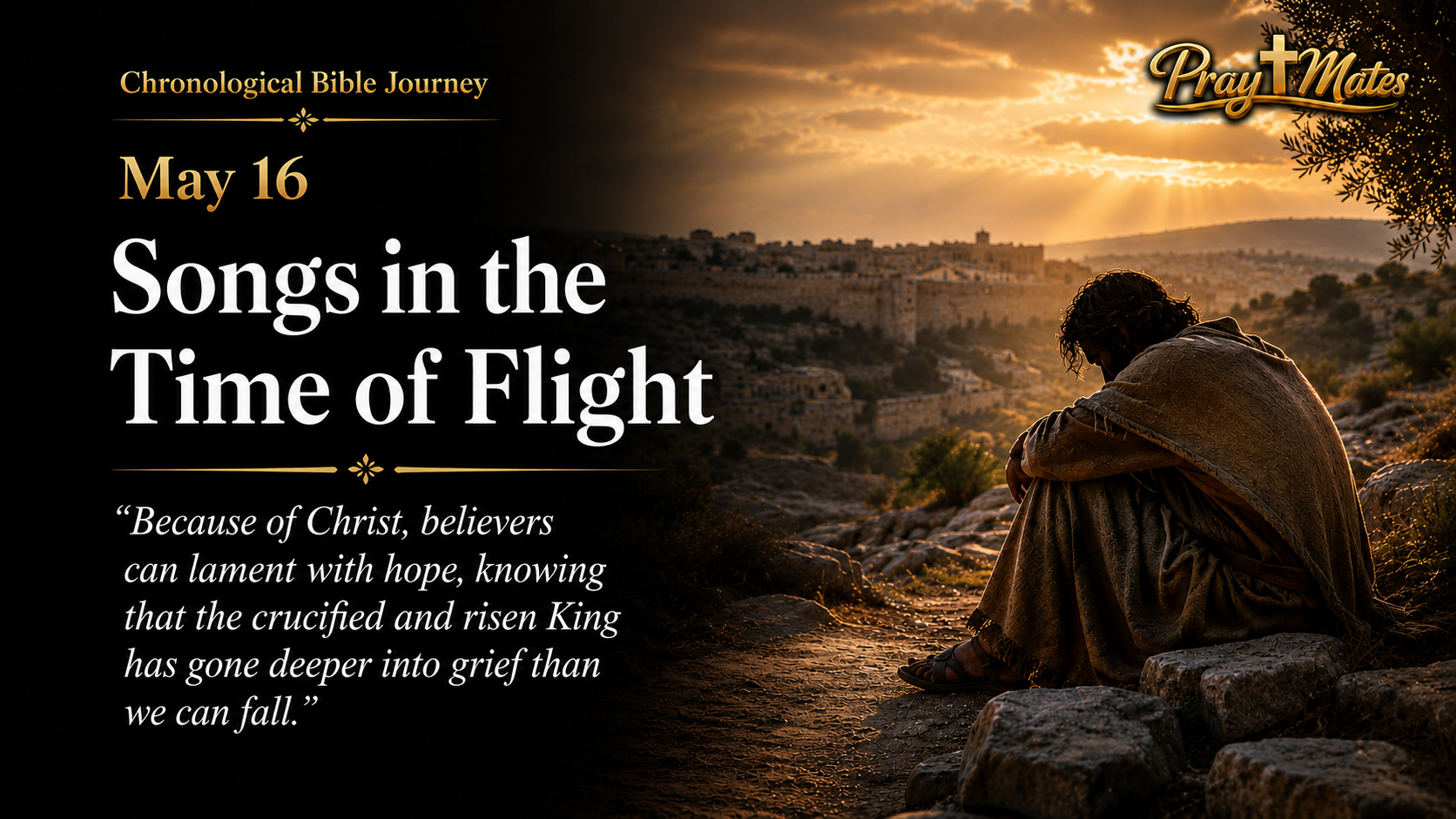
May 16 — Songs in the Time of Flight
May 16 — Songs in the Time of Flight
SCRIPTURE READING:
Psalms 3-4, 12-13, 28, 55
SCRIPTURE:
Psalm 3
¹ A Psalm of David, when he fled from Absalom his son. LORD, how are they increased that trouble me! many [are] they that rise up against me.
² Many [there be] which say of my soul, [There is] no help for him in God. Selah.
³ But thou, O LORD, [art] a shield for me; my glory, and the lifter up of mine head.
⁴ I cried unto the LORD with my voice, and he heard me out of his holy hill. Selah.
⁵ I laid me down and slept; I awaked; for the LORD sustained me.
⁶ I will not be afraid of ten thousands of people, that have set [themselves] against me round about.
⁷ Arise, O LORD; save me, O my God: for thou hast smitten all mine enemies [upon] the cheek bone; thou hast broken the teeth of the ungodly.
⁸ Salvation [belongeth] unto the LORD: thy blessing [is] upon thy people. Selah.
Psalm 4
¹ To the chief Musician on Neginoth, A Psalm of David. Hear me when I call, O God of my righteousness: thou hast enlarged me [when I was] in distress; have mercy upon me, and hear my prayer.
² O ye sons of men, how long [will ye turn] my glory into shame? [how long] will ye love vanity, [and] seek after leasing? Selah.
³ But know that the LORD hath set apart him that is godly for himself: the LORD will hear when I call unto him.
⁴ Stand in awe, and sin not: commune with your own heart upon your bed, and be still. Selah.
⁵ Offer the sacrifices of righteousness, and put your trust in the LORD.
⁶ [There be] many that say, Who will shew us [any] good? LORD, lift thou up the light of thy countenance upon us.
⁷ Thou hast put gladness in my heart, more than in the time [that] their corn and their wine increased.
⁸ I will both lay me down in peace, and sleep: for thou, LORD, only makest me dwell in safety.
Psalm 12
¹ To the chief Musician upon Sheminith, A Psalm of David. Help, LORD; for the godly man ceaseth; for the faithful fail from among the children of men.
² They speak vanity every one with his neighbour: [with] flattering lips [and] with a double heart do they speak.
³ The LORD shall cut off all flattering lips, [and] the tongue that speaketh proud things:
⁴ Who have said, With our tongue will we prevail; our lips [are] our own: who [is] lord over us?
⁵ For the oppression of the poor, for the sighing of the needy, now will I arise, saith the LORD; I will set [him] in safety [from him that] puffeth at him.
⁶ The words of the LORD [are] pure words: [as] silver tried in a furnace of earth, purified seven times.
⁷ Thou shalt keep them, O LORD, thou shalt preserve them from this generation for ever.
⁸ The wicked walk on every side, when the vilest men are exalted.
Psalm 13
¹ To the chief Musician, A Psalm of David. How long wilt thou forget me, O LORD? for ever? how long wilt thou hide thy face from me?
² How long shall I take counsel in my soul, [having] sorrow in my heart daily? how long shall mine enemy be exalted over me?
³ Consider [and] hear me, O LORD my God: lighten mine eyes, lest I sleep the [sleep of] death;
⁴ Lest mine enemy say, I have prevailed against him; [and] those that trouble me rejoice when I am moved.
⁵ But I have trusted in thy mercy; my heart shall rejoice in thy salvation.
⁶ I will sing unto the LORD, because he hath dealt bountifully with me.
Psalm 28
¹ [A Psalm] of David. Unto thee will I cry, O LORD my rock; be not silent to me: lest, [if] thou be silent to me, I become like them that go down into the pit.
² Hear the voice of my supplications, when I cry unto thee, when I lift up my hands toward thy holy oracle.
³ Draw me not away with the wicked, and with the workers of iniquity, which speak peace to their neighbours, but mischief [is] in their hearts.
⁴ Give them according to their deeds, and according to the wickedness of their endeavours: give them after the work of their hands; render to them their desert.
⁵ Because they regard not the works of the LORD, nor the operation of his hands, he shall destroy them, and not build them up.
⁶ Blessed [be] the LORD, because he hath heard the voice of my supplications.
⁷ The LORD [is] my strength and my shield; my heart trusted in him, and I am helped: therefore my heart greatly rejoiceth; and with my song will I praise him.
⁸ The LORD [is] their strength, and he [is] the saving strength of his anointed.
⁹ Save thy people, and bless thine inheritance: feed them also, and lift them up for ever.
Psalm 55
¹ To the chief Musician on Neginoth, Maschil, [A Psalm] of David. Give ear to my prayer, O God; and hide not thyself from my supplication.
² Attend unto me, and hear me: I mourn in my complaint, and make a noise;
³ Because of the voice of the enemy, because of the oppression of the wicked: for they cast iniquity upon me, and in wrath they hate me.
⁴ My heart is sore pained within me: and the terrors of death are fallen upon me.
⁵ Fearfulness and trembling are come upon me, and horror hath overwhelmed me.
⁶ And I said, Oh that I had wings like a dove! [for then] would I fly away, and be at rest.
⁷ Lo, [then] would I wander far off, [and] remain in the wilderness. Selah.
⁸ I would hasten my escape from the windy storm [and] tempest.
⁹ Destroy, O Lord, [and] divide their tongues: for I have seen violence and strife in the city.
¹⁰ Day and night they go about it upon the walls thereof: mischief also and sorrow [are] in the midst of it.
¹¹ Wickedness [is] in the midst thereof: deceit and guile depart not from her streets.
¹² For [it was] not an enemy [that] reproached me; then I could have borne [it]: neither [was it] he that hated me [that] did magnify [himself] against me; then I would have hid myself from him:
¹³ But [it was] thou, a man mine equal, my guide, and mine acquaintance.
¹⁴ We took sweet counsel together, [and] walked unto the house of God in company.
¹⁵ Let death seize upon them, [and] let them go down quick into hell: for wickedness [is] in their dwellings, [and] among them.
¹⁶ As for me, I will call upon God; and the LORD shall save me.
¹⁷ Evening, and morning, and at noon, will I pray, and cry aloud: and he shall hear my voice.
¹⁸ He hath delivered my soul in peace from the battle [that was] against me: for there were many with me.
¹⁹ God shall hear, and afflict them, even he that abideth of old. Selah. Because they have no changes, therefore they fear not God.
²⁰ He hath put forth his hands against such as be at peace with him: he hath broken his covenant.
²¹ [The words] of his mouth were smoother than butter, but war [was] in his heart: his words were softer than oil, yet [were] they drawn swords.
²² Cast thy burden upon the LORD, and he shall sustain thee: he shall never suffer the righteous to be moved.
²³ But thou, O God, shalt bring them down into the pit of destruction: bloody and deceitful men shall not live out half their days; but I will trust in thee.
DEVOTIONAL:
The psalms assigned to this day sound like prayers spoken while danger is still moving. David asks the LORD to arise, pleads for mercy in the night, laments flattering lips, wonders how long sorrow will last, asks for help, and grieves betrayal from a companion. These are not tidy reflections after everything has improved. They are songs from within pressure, teaching the faithful how to pray before relief has arrived.
Israel's covenant worship included lament because covenant trust includes the whole person. God's people did not have to pretend that betrayal, anxiety, or exhaustion were spiritually irrelevant. False words, sleeplessness, fear, and confusion all belong before the LORD. The psalms train the heart to bring pain into God's presence rather than letting pain become unbelief, revenge, or isolation.
The Jewish background of these prayers also honors communal worship. When Israel sang these psalms, individual anguish became part of the prayer language of the people. A suffering person did not need to invent faithful words from nothing. The covenant community carried prayers that could be borrowed in the hour of fear. That is one of the mercies of Scripture: God gives speech to those whose hearts are overwhelmed.
Jesus fulfills the righteous sufferer's cry. He knows betrayal by a friend, false accusations, lonely distress, and prayer in the night. Yet He entrusts Himself fully to the Father and brings salvation through suffering rather than escape from it. Because of Him, believers can lament with hope, knowing that the crucified and risen King has gone deeper into grief than we can fall.
In daily life, this passage calls believers to obey God when emotions are raw and circumstances remain unresolved. Character grows when prayer replaces retaliation and honest lament resists despair. Families can learn to speak sorrow without contempt, workers can refuse to return betrayal for betrayal, and churches can carry the anxious, the sleepless, and the wounded before the Lord with patience rather than shallow answers.
In U.S. civic life, the civic virtue rising from this reading is steadfast trust. It leads us to pray for people facing betrayal, anxiety, loneliness, and discouragement in homes, schools, workplaces, and churches. Christians should show up by responding to distress with prayer, patience, and faithful speech rather than revenge.
DISCUSSION QUESTIONS:
What does this reading teach about the difference between human strength and God's purpose?
Which covenant theme in this passage should shape your worship?
How does this Scripture prepare your heart to see Jesus more clearly?
What faithful action would grow from steadfast trust today?
PRAYER:
ADORATION:
Holy Father, You are faithful in covenant mercy and righteous in all Your ways.
CONFESSION:
Forgive me for trusting my own judgment more than Your word and for resisting the correction You give.
THANKSGIVING:
Thank You for revealing Your faithfulness through Scripture and for giving us Jesus, the promised Messiah.
SUPPLICATION – GENERAL:
Strengthen me to walk in steadfast trust, to receive Your word with humility, and to serve others faithfully.
SUPPLICATION – U.S. / CIVIC:
Teach Your people in our nation to practice steadfast trust, and bring mercy, wisdom, and healing to people facing betrayal, anxiety, loneliness, and discouragement in homes, schools, workplaces, and churches.
SCRIPTURE:
³ But thou, O LORD, [art] a shield for me; my glory, and the lifter up of mine head.
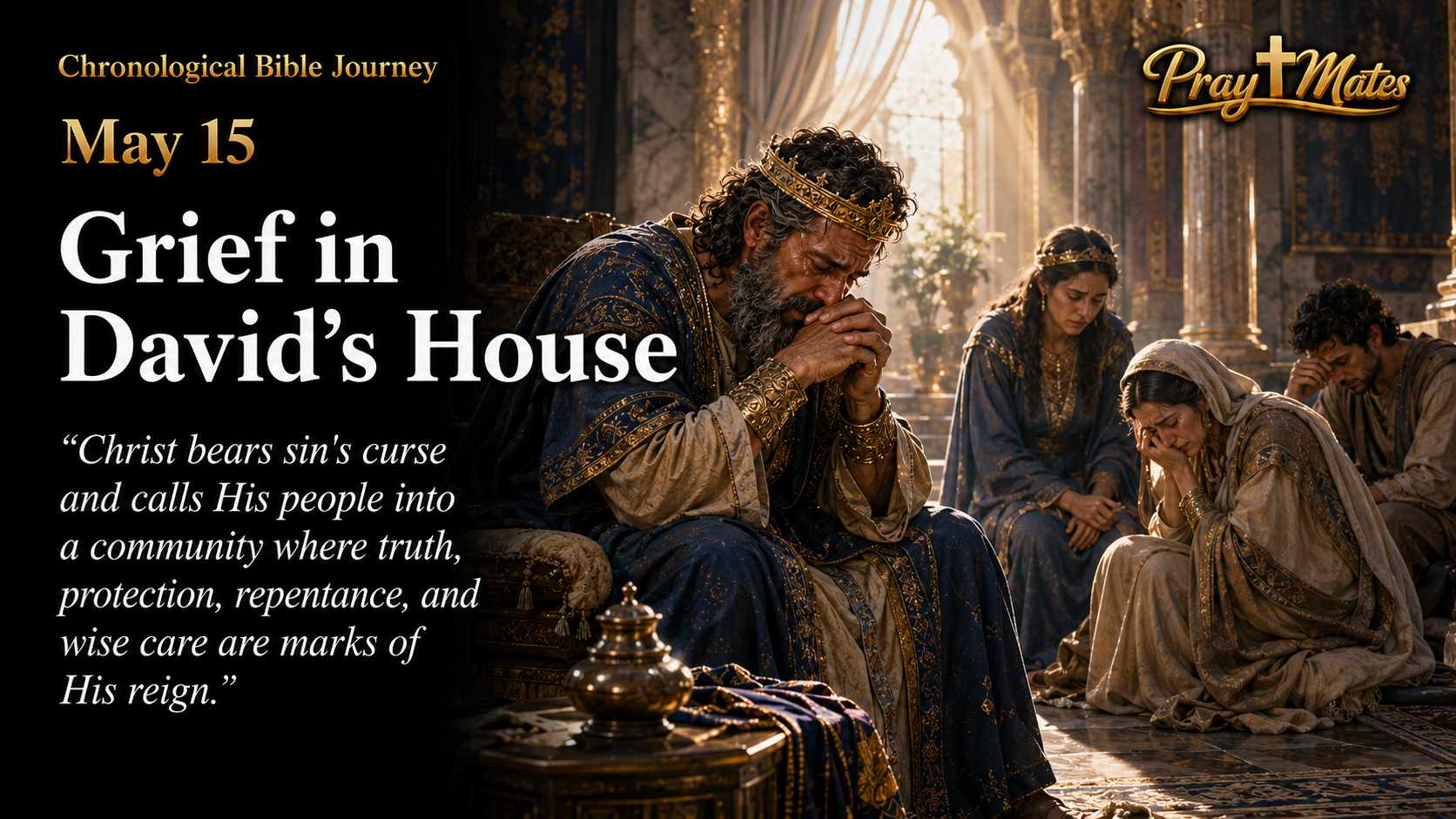
May 15 — Grief in David's House
May 15 — Grief in David's House
SCRIPTURE READING:
2 Samuel 13-15
SCRIPTURE:
Second Samuel 13
¹ And it came to pass after this, that Absalom the son of David had a fair sister, whose name [was] Tamar; and Amnon the son of David loved her.
² And Amnon was so vexed, that he fell sick for his sister Tamar; for she [was] a virgin; and Amnon thought it hard for him to do any thing to her.
³ But Amnon had a friend, whose name [was] Jonadab, the son of Shimeah David’s brother: and Jonadab [was] a very subtil man.
⁴ And he said unto him, Why [art] thou, [being] the king’s son, lean from day to day? wilt thou not tell me? And Amnon said unto him, I love Tamar, my brother Absalom’s sister.
⁵ And Jonadab said unto him, Lay thee down on thy bed, and make thyself sick: and when thy father cometh to see thee, say unto him, I pray thee, let my sister Tamar come, and give me meat, and dress the meat in my sight, that I may see [it], and eat [it] at her hand.
⁶ So Amnon lay down, and made himself sick: and when the king was come to see him, Amnon said unto the king, I pray thee, let Tamar my sister come, and make me a couple of cakes in my sight, that I may eat at her hand.
⁷ Then David sent home to Tamar, saying, Go now to thy brother Amnon’s house, and dress him meat.
⁸ So Tamar went to her brother Amnon’s house; and he was laid down. And she took flour, and kneaded [it], and made cakes in his sight, and did bake the cakes.
⁹ And she took a pan, and poured [them] out before him; but he refused to eat. And Amnon said, Have out all men from me. And they went out every man from him.
¹⁰ And Amnon said unto Tamar, Bring the meat into the chamber, that I may eat of thine hand. And Tamar took the cakes which she had made, and brought [them] into the chamber to Amnon her brother.
¹¹ And when she had brought [them] unto him to eat, he took hold of her, and said unto her, Come lie with me, my sister.
¹² And she answered him, Nay, my brother, do not force me; for no such thing ought to be done in Israel: do not thou this folly.
¹³ And I, whither shall I cause my shame to go? and as for thee, thou shalt be as one of the fools in Israel. Now therefore, I pray thee, speak unto the king; for he will not withhold me from thee.
¹⁴ Howbeit he would not hearken unto her voice: but, being stronger than she, forced her, and lay with her.
¹⁵ Then Amnon hated her exceedingly; so that the hatred wherewith he hated her [was] greater than the love wherewith he had loved her. And Amnon said unto her, Arise, be gone.
¹⁶ And she said unto him, [There is] no cause: this evil in sending me away [is] greater than the other that thou didst unto me. But he would not hearken unto her.
¹⁷ Then he called his servant that ministered unto him, and said, Put now this [woman] out from me, and bolt the door after her.
¹⁸ And [she had] a garment of divers colours upon her: for with such robes were the king’s daughters [that were] virgins apparelled. Then his servant brought her out, and bolted the door after her.
¹⁹ And Tamar put ashes on her head, and rent her garment of divers colours that [was] on her, and laid her hand on her head, and went on crying.
²⁰ And Absalom her brother said unto her, Hath Amnon thy brother been with thee? but hold now thy peace, my sister: he [is] thy brother; regard not this thing. So Tamar remained desolate in her brother Absalom’s house.
²¹ But when king David heard of all these things, he was very wroth.
²² And Absalom spake unto his brother Amnon neither good nor bad: for Absalom hated Amnon, because he had forced his sister Tamar.
²³ And it came to pass after two full years, that Absalom had sheepshearers in Baalhazor, which [is] beside Ephraim: and Absalom invited all the king’s sons.
²⁴ And Absalom came to the king, and said, Behold now, thy servant hath sheepshearers; let the king, I beseech thee, and his servants go with thy servant.
²⁵ And the king said to Absalom, Nay, my son, let us not all now go, lest we be chargeable unto thee. And he pressed him: howbeit he would not go, but blessed him.
²⁶ Then said Absalom, If not, I pray thee, let my brother Amnon go with us. And the king said unto him, Why should he go with thee?
²⁷ But Absalom pressed him, that he let Amnon and all the king’s sons go with him.
²⁸ Now Absalom had commanded his servants, saying, Mark ye now when Amnon’s heart is merry with wine, and when I say unto you, Smite Amnon; then kill him, fear not: have not I commanded you? be courageous, and be valiant.
²⁹ And the servants of Absalom did unto Amnon as Absalom had commanded. Then all the king’s sons arose, and every man gat him up upon his mule, and fled.
³⁰ And it came to pass, while they were in the way, that tidings came to David, saying, Absalom hath slain all the king’s sons, and there is not one of them left.
³¹ Then the king arose, and tare his garments, and lay on the earth; and all his servants stood by with their clothes rent.
³² And Jonadab, the son of Shimeah David’s brother, answered and said, Let not my lord suppose [that] they have slain all the young men the king’s sons; for Amnon only is dead: for by the appointment of Absalom this hath been determined from the day that he forced his sister Tamar.
³³ Now therefore let not my lord the king take the thing to his heart, to think that all the king’s sons are dead: for Amnon only is dead.
³⁴ But Absalom fled. And the young man that kept the watch lifted up his eyes, and looked, and, behold, there came much people by the way of the hill side behind him.
³⁵ And Jonadab said unto the king, Behold, the king’s sons come: as thy servant said, so it is.
³⁶ And it came to pass, as soon as he had made an end of speaking, that, behold, the king’s sons came, and lifted up their voice and wept: and the king also and all his servants wept very sore.
³⁷ But Absalom fled, and went to Talmai, the son of Ammihud, king of Geshur. And [David] mourned for his son every day.
³⁸ So Absalom fled, and went to Geshur, and was there three years.
³⁹ And [the soul of] king David longed to go forth unto Absalom: for he was comforted concerning Amnon, seeing he was dead.
Second Samuel 14
¹ Now Joab the son of Zeruiah perceived that the king’s heart [was] toward Absalom.
² And Joab sent to Tekoah, and fetched thence a wise woman, and said unto her, I pray thee, feign thyself to be a mourner, and put on now mourning apparel, and anoint not thyself with oil, but be as a woman that had a long time mourned for the dead:
³ And come to the king, and speak on this manner unto him. So Joab put the words in her mouth.
⁴ And when the woman of Tekoah spake to the king, she fell on her face to the ground, and did obeisance, and said, Help, O king.
⁵ And the king said unto her, What aileth thee? And she answered, I [am] indeed a widow woman, and mine husband is dead.
⁶ And thy handmaid had two sons, and they two strove together in the field, and [there was] none to part them, but the one smote the other, and slew him.
⁷ And, behold, the whole family is risen against thine handmaid, and they said, Deliver him that smote his brother, that we may kill him, for the life of his brother whom he slew; and we will destroy the heir also: and so they shall quench my coal which is left, and shall not leave to my husband [neither] name nor remainder upon the earth.
⁸ And the king said unto the woman, Go to thine house, and I will give charge concerning thee.
⁹ And the woman of Tekoah said unto the king, My lord, O king, the iniquity [be] on me, and on my father’s house: and the king and his throne [be] guiltless.
¹⁰ And the king said, Whosoever saith [ought] unto thee, bring him to me, and he shall not touch thee any more.
¹¹ Then said she, I pray thee, let the king remember the LORD thy God, that thou wouldest not suffer the revengers of blood to destroy any more, lest they destroy my son. And he said, [As] the LORD liveth, there shall not one hair of thy son fall to the earth.
¹² Then the woman said, Let thine handmaid, I pray thee, speak [one] word unto my lord the king. And he said, Say on.
¹³ And the woman said, Wherefore then hast thou thought such a thing against the people of God? for the king doth speak this thing as one which is faulty, in that the king doth not fetch home again his banished.
¹⁴ For we must needs die, and [are] as water spilt on the ground, which cannot be gathered up again; neither doth God respect [any] person: yet doth he devise means, that his banished be not expelled from him.
¹⁵ Now therefore that I am come to speak of this thing unto my lord the king, [it is] because the people have made me afraid: and thy handmaid said, I will now speak unto the king; it may be that the king will perform the request of his handmaid.
¹⁶ For the king will hear, to deliver his handmaid out of the hand of the man [that would] destroy me and my son together out of the inheritance of God.
¹⁷ Then thine handmaid said, The word of my lord the king shall now be comfortable: for as an angel of God, so [is] my lord the king to discern good and bad: therefore the LORD thy God will be with thee.
¹⁸ Then the king answered and said unto the woman, Hide not from me, I pray thee, the thing that I shall ask thee. And the woman said, Let my lord the king now speak.
¹⁹ And the king said, [Is not] the hand of Joab with thee in all this? And the woman answered and said, [As] thy soul liveth, my lord the king, none can turn to the right hand or to the left from ought that my lord the king hath spoken: for thy servant Joab, he bade me, and he put all these words in the mouth of thine handmaid:
²⁰ To fetch about this form of speech hath thy servant Joab done this thing: and my lord [is] wise, according to the wisdom of an angel of God, to know all [things] that [are] in the earth.
²¹ And the king said unto Joab, Behold now, I have done this thing: go therefore, bring the young man Absalom again.
²² And Joab fell to the ground on his face, and bowed himself, and thanked the king: and Joab said, To day thy servant knoweth that I have found grace in thy sight, my lord, O king, in that the king hath fulfilled the request of his servant.
²³ So Joab arose and went to Geshur, and brought Absalom to Jerusalem.
²⁴ And the king said, Let him turn to his own house, and let him not see my face. So Absalom returned to his own house, and saw not the king’s face.
²⁵ But in all Israel there was none to be so much praised as Absalom for his beauty: from the sole of his foot even to the crown of his head there was no blemish in him.
²⁶ And when he polled his head, (for it was at every year’s end that he polled [it]: because [the hair] was heavy on him, therefore he polled it:) he weighed the hair of his head at two hundred shekels after the king’s weight.
²⁷ And unto Absalom there were born three sons, and one daughter, whose name [was] Tamar: she was a woman of a fair countenance.
²⁸ So Absalom dwelt two full years in Jerusalem, and saw not the king’s face.
²⁹ Therefore Absalom sent for Joab, to have sent him to the king; but he would not come to him: and when he sent again the second time, he would not come.
³⁰ Therefore he said unto his servants, See, Joab’s field is near mine, and he hath barley there; go and set it on fire. And Absalom’s servants set the field on fire.
³¹ Then Joab arose, and came to Absalom unto [his] house, and said unto him, Wherefore have thy servants set my field on fire?
³² And Absalom answered Joab, Behold, I sent unto thee, saying, Come hither, that I may send thee to the king, to say, Wherefore am I come from Geshur? [it had been] good for me [to have been] there still: now therefore let me see the king’s face; and if there be [any] iniquity in me, let him kill me.
³³ So Joab came to the king, and told him: and when he had called for Absalom, he came to the king, and bowed himself on his face to the ground before the king: and the king kissed Absalom.
Second Samuel 15
¹ And it came to pass after this, that Absalom prepared him chariots and horses, and fifty men to run before him.
² And Absalom rose up early, and stood beside the way of the gate: and it was [so], that when any man that had a controversy came to the king for judgment, then Absalom called unto him, and said, Of what city [art] thou? And he said, Thy servant [is] of one of the tribes of Israel.
³ And Absalom said unto him, See, thy matters [are] good and right; but [there is] no man [deputed] of the king to hear thee.
⁴ Absalom said moreover, Oh that I were made judge in the land, that every man which hath any suit or cause might come unto me, and I would do him justice!
⁵ And it was [so], that when any man came nigh [to him] to do him obeisance, he put forth his hand, and took him, and kissed him.
⁶ And on this manner did Absalom to all Israel that came to the king for judgment: so Absalom stole the hearts of the men of Israel.
⁷ And it came to pass after forty years, that Absalom said unto the king, I pray thee, let me go and pay my vow, which I have vowed unto the LORD, in Hebron.
⁸ For thy servant vowed a vow while I abode at Geshur in Syria, saying, If the LORD shall bring me again indeed to Jerusalem, then I will serve the LORD.
⁹ And the king said unto him, Go in peace. So he arose, and went to Hebron.
¹⁰ But Absalom sent spies throughout all the tribes of Israel, saying, As soon as ye hear the sound of the trumpet, then ye shall say, Absalom reigneth in Hebron.
¹¹ And with Absalom went two hundred men out of Jerusalem, [that were] called; and they went in their simplicity, and they knew not any thing.
¹² And Absalom sent for Ahithophel the Gilonite, David’s counseller, from his city, [even] from Giloh, while he offered sacrifices. And the conspiracy was strong; for the people increased continually with Absalom.
¹³ And there came a messenger to David, saying, The hearts of the men of Israel are after Absalom.
¹⁴ And David said unto all his servants that [were] with him at Jerusalem, Arise, and let us flee; for we shall not [else] escape from Absalom: make speed to depart, lest he overtake us suddenly, and bring evil upon us, and smite the city with the edge of the sword.
¹⁵ And the king’s servants said unto the king, Behold, thy servants [are ready to do] whatsoever my lord the king shall appoint.
¹⁶ And the king went forth, and all his household after him. And the king left ten women, [which were] concubines, to keep the house.
¹⁷ And the king went forth, and all the people after him, and tarried in a place that was far off.
¹⁸ And all his servants passed on beside him; and all the Cherethites, and all the Pelethites, and all the Gittites, six hundred men which came after him from Gath, passed on before the king.
¹⁹ Then said the king to Ittai the Gittite, Wherefore goest thou also with us? return to thy place, and abide with the king: for thou [art] a stranger, and also an exile.
²⁰ Whereas thou camest [but] yesterday, should I this day make thee go up and down with us? seeing I go whither I may, return thou, and take back thy brethren: mercy and truth [be] with thee.
²¹ And Ittai answered the king, and said, [As] the LORD liveth, and [as] my lord the king liveth, surely in what place my lord the king shall be, whether in death or life, even there also will thy servant be.
²² And David said to Ittai, Go and pass over. And Ittai the Gittite passed over, and all his men, and all the little ones that [were] with him.
²³ And all the country wept with a loud voice, and all the people passed over: the king also himself passed over the brook Kidron, and all the people passed over, toward the way of the wilderness.
²⁴ And lo Zadok also, and all the Levites [were] with him, bearing the ark of the covenant of God: and they set down the ark of God; and Abiathar went up, until all the people had done passing out of the city.
²⁵ And the king said unto Zadok, Carry back the ark of God into the city: if I shall find favour in the eyes of the LORD, he will bring me again, and shew me [both] it, and his habitation:
²⁶ But if he thus say, I have no delight in thee; behold, [here am] I, let him do to me as seemeth good unto him.
²⁷ The king said also unto Zadok the priest, [Art not] thou a seer? return into the city in peace, and your two sons with you, Ahimaaz thy son, and Jonathan the son of Abiathar.
²⁸ See, I will tarry in the plain of the wilderness, until there come word from you to certify me.
²⁹ Zadok therefore and Abiathar carried the ark of God again to Jerusalem: and they tarried there.
³⁰ And David went up by the ascent of [mount] Olivet, and wept as he went up, and had his head covered, and he went barefoot: and all the people that [was] with him covered every man his head, and they went up, weeping as they went up.
³¹ And [one] told David, saying, Ahithophel [is] among the conspirators with Absalom. And David said, O LORD, I pray thee, turn the counsel of Ahithophel into foolishness.
³² And it came to pass, that [when] David was come to the top [of the mount], where he worshipped God, behold, Hushai the Archite came to meet him with his coat rent, and earth upon his head:
³³ Unto whom David said, If thou passest on with me, then thou shalt be a burden unto me:
³⁴ But if thou return to the city, and say unto Absalom, I will be thy servant, O king; [as] I [have been] thy father’s servant hitherto, so [will] I now also [be] thy servant: then mayest thou for me defeat the counsel of Ahithophel.
³⁵ And [hast thou] not there with thee Zadok and Abiathar the priests? therefore it shall be, [that] what thing soever thou shalt hear out of the king’s house, thou shalt tell [it] to Zadok and Abiathar the priests.
³⁶ Behold, [they have] there with them their two sons, Ahimaaz Zadok’s [son], and Jonathan Abiathar’s [son]; and by them ye shall send unto me every thing that ye can hear.
³⁷ So Hushai David’s friend came into the city, and Absalom came into Jerusalem.
DEVOTIONAL:
The events in David's house are painful because the damage is intimate, repeated, and mishandled. Amnon's sin against Tamar is wicked, Tamar's grief is public and devastating, and David's anger does not become the protective justice that was needed. Absalom's silence hardens into vengeance, vengeance grows into exile, and exile eventually becomes rebellion. The passage shows how unaddressed evil keeps moving through a household.
In covenant context, this is not merely family drama. Israel's king was responsible to uphold justice, and the house of David was not exempt from the law of the LORD. Tamar's voice, grief, and desolation matter in the text. Scripture does not hide her suffering to protect the reputation of the powerful. The covenant God sees what families may bury, and He exposes the fruit of sin that has been left to fester.
The story also warns against counterfeit peace. Joab's maneuvers bring Absalom back, but the deeper fractures remain. Appearance is repaired faster than trust, and political charm begins to gather the hearts of Israel away from David. When truth and justice are delayed, rebellion can wear the face of sympathy. The kingdom begins to shake because righteousness has not been honored at home.
Jesus enters the world of violated trust, abandoned sufferers, and treacherous kisses. He is the King who does not ignore the wounded or excuse the guilty. In His kingdom, mercy is never indifference, and peace is not built by silencing pain. Christ bears sin's curse and calls His people into a community where truth, protection, repentance, and wise care are marks of His reign.
In daily life, this reading calls believers to obey God in the private places where harm often begins. Character is formed by protecting the vulnerable, telling the truth, and refusing to let family loyalty become a shield for wrongdoing. Families need courage to address sin early, workplaces need policies and habits that protect people from abuse of power, and churches must be safe places for lament, counsel, accountability, and healing under Christ.
In U.S. civic life, this Scripture calls for protective justice. It gives us a current prayer focus in children, abuse survivors, divided families, and communities needing courage to face hidden harm. Christians should show up by standing with the vulnerable, refusing cover-ups, and seeking healing through truth shaped by Christ.
DISCUSSION QUESTIONS:
What warning or encouragement would the first hearers have received from this passage?
How does Israel's covenant story help you read this text with greater care?
What does this passage teach you to treasure about Christ?
How can your family, work, or church life reflect protective justice?
PRAYER:
ADORATION:
Righteous Father, You see truly, judge rightly, and show mercy to the humble.
CONFESSION:
Forgive me for neglecting prayer, gratitude, and obedience when life feels pressured.
THANKSGIVING:
Thank You for the hope, cleansing, wisdom, and refuge You provide through Christ.
SUPPLICATION – GENERAL:
Lead me in protective justice, and make my home, work, and church life more faithful to Your will.
SUPPLICATION – U.S. / CIVIC:
Make Your people witnesses of protective justice, and bring righteous care to children, abuse survivors, divided families, and communities needing courage to face hidden harm.
SCRIPTURE:
²⁶ But if he thus say, I have no delight in thee; behold, [here am] I, let him do to me as seemeth good unto him.
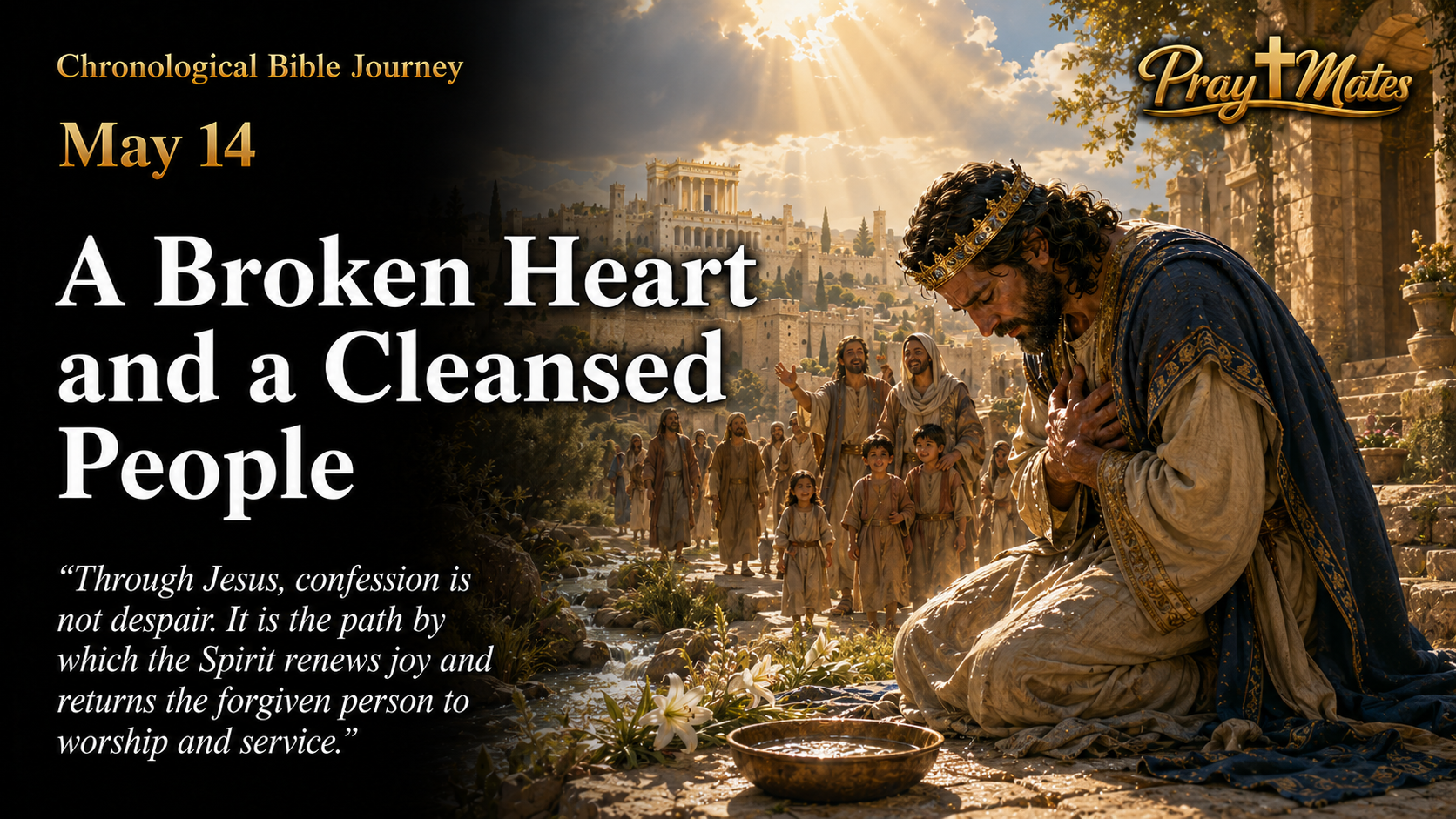
May 14 — A Broken Heart and a Cleansed People
May 14 — A Broken Heart and a Cleansed People
SCRIPTURE READING:
Psalms 32, 51, 86, 122
SCRIPTURE:
Psalm 32
¹ [A Psalm] of David, Maschil. Blessed [is he whose] transgression [is] forgiven, [whose] sin [is] covered.
² Blessed [is] the man unto whom the LORD imputeth not iniquity, and in whose spirit [there is] no guile.
³ When I kept silence, my bones waxed old through my roaring all the day long.
⁴ For day and night thy hand was heavy upon me: my moisture is turned into the drought of summer. Selah.
⁵ I acknowledged my sin unto thee, and mine iniquity have I not hid. I said, I will confess my transgressions unto the LORD; and thou forgavest the iniquity of my sin. Selah.
⁶ For this shall every one that is godly pray unto thee in a time when thou mayest be found: surely in the floods of great waters they shall not come nigh unto him.
⁷ Thou [art] my hiding place; thou shalt preserve me from trouble; thou shalt compass me about with songs of deliverance. Selah.
⁸ I will instruct thee and teach thee in the way which thou shalt go: I will guide thee with mine eye.
⁹ Be ye not as the horse, [or] as the mule, [which] have no understanding: whose mouth must be held in with bit and bridle, lest they come near unto thee.
¹⁰ Many sorrows [shall be] to the wicked: but he that trusteth in the LORD, mercy shall compass him about.
¹¹ Be glad in the LORD, and rejoice, ye righteous: and shout for joy, all [ye that are] upright in heart.
Psalm 51
¹ To the chief Musician, A Psalm of David, when Nathan the prophet came unto him, after he had gone in to Bathsheba. Have mercy upon me, O God, according to thy lovingkindness: according unto the multitude of thy tender mercies blot out my transgressions.
² Wash me throughly from mine iniquity, and cleanse me from my sin.
³ For I acknowledge my transgressions: and my sin [is] ever before me.
⁴ Against thee, thee only, have I sinned, and done [this] evil in thy sight: that thou mightest be justified when thou speakest, [and] be clear when thou judgest.
⁵ Behold, I was shapen in iniquity; and in sin did my mother conceive me.
⁶ Behold, thou desirest truth in the inward parts: and in the hidden [part] thou shalt make me to know wisdom.
⁷ Purge me with hyssop, and I shall be clean: wash me, and I shall be whiter than snow.
⁸ Make me to hear joy and gladness; [that] the bones [which] thou hast broken may rejoice.
⁹ Hide thy face from my sins, and blot out all mine iniquities.
¹⁰ Create in me a clean heart, O God; and renew a right spirit within me.
¹¹ Cast me not away from thy presence; and take not thy holy spirit from me.
¹² Restore unto me the joy of thy salvation; and uphold me [with thy] free spirit.
¹³ [Then] will I teach transgressors thy ways; and sinners shall be converted unto thee.
¹⁴ Deliver me from bloodguiltiness, O God, thou God of my salvation: [and] my tongue shall sing aloud of thy righteousness.
¹⁵ O Lord, open thou my lips; and my mouth shall shew forth thy praise.
¹⁶ For thou desirest not sacrifice; else would I give [it]: thou delightest not in burnt offering.
¹⁷ The sacrifices of God [are] a broken spirit: a broken and a contrite heart, O God, thou wilt not despise.
¹⁸ Do good in thy good pleasure unto Zion: build thou the walls of Jerusalem.
¹⁹ Then shalt thou be pleased with the sacrifices of righteousness, with burnt offering and whole burnt offering: then shall they offer bullocks upon thine altar.
Psalm 86
¹ A Prayer of David. Bow down thine ear, O LORD, hear me: for I [am] poor and needy.
² Preserve my soul; for I [am] holy: O thou my God, save thy servant that trusteth in thee.
³ Be merciful unto me, O Lord: for I cry unto thee daily.
⁴ Rejoice the soul of thy servant: for unto thee, O Lord, do I lift up my soul.
⁵ For thou, Lord, [art] good, and ready to forgive; and plenteous in mercy unto all them that call upon thee.
⁶ Give ear, O LORD, unto my prayer; and attend to the voice of my supplications.
⁷ In the day of my trouble I will call upon thee: for thou wilt answer me.
⁸ Among the gods [there is] none like unto thee, O Lord; neither [are there any works] like unto thy works.
⁹ All nations whom thou hast made shall come and worship before thee, O Lord; and shall glorify thy name.
¹⁰ For thou [art] great, and doest wondrous things: thou [art] God alone.
¹¹ Teach me thy way, O LORD; I will walk in thy truth: unite my heart to fear thy name.
¹² I will praise thee, O Lord my God, with all my heart: and I will glorify thy name for evermore.
¹³ For great [is] thy mercy toward me: and thou hast delivered my soul from the lowest hell.
¹⁴ O God, the proud are risen against me, and the assemblies of violent [men] have sought after my soul; and have not set thee before them.
¹⁵ But thou, O Lord, [art] a God full of compassion, and gracious, longsuffering, and plenteous in mercy and truth.
¹⁶ O turn unto me, and have mercy upon me; give thy strength unto thy servant, and save the son of thine handmaid.
¹⁷ Shew me a token for good; that they which hate me may see [it], and be ashamed: because thou, LORD, hast holpen me, and comforted me.
Psalm 122
¹ A Song of degrees of David. I was glad when they said unto me, Let us go into the house of the LORD.
² Our feet shall stand within thy gates, O Jerusalem.
³ Jerusalem is builded as a city that is compact together:
⁴ Whither the tribes go up, the tribes of the LORD, unto the testimony of Israel, to give thanks unto the name of the LORD.
⁵ For there are set thrones of judgment, the thrones of the house of David.
⁶ Pray for the peace of Jerusalem: they shall prosper that love thee.
⁷ Peace be within thy walls, [and] prosperity within thy palaces.
⁸ For my brethren and companions’ sakes, I will now say, Peace [be] within thee.
⁹ Because of the house of the LORD our God I will seek thy good.
DEVOTIONAL:
Psalms 32 and 51 give the inner language that follows exposed sin: blessed forgiveness, honest confession, a clean heart, and renewed joy. David does not heal himself through denial or image repair. He turns toward the LORD with a broken spirit, asking for cleansing that only God can give. Psalm 86 adds dependence on the Lord's mercy, while Psalm 122 widens the prayer toward the peace of Jerusalem.
In Israel's covenant worship, confession was not merely emotional relief. Sin was a covenant offense against the holy God, and restoration required truth. The blessed person is not the one who never needed mercy, but the one whose transgression is forgiven and whose spirit has no guile. Forgiveness then becomes a doorway into teaching others, praising God, and seeking peace among the people of the LORD.
The prayers also show that personal repentance and communal peace belong together. A clean heart is not isolated from Jerusalem's peace. The life of worship must move from inward cleansing to public faithfulness, from hidden honesty to love for the gathered people of God. Sin fragments, but grace restores worship, witness, and community.
Jesus fulfills the hope of cleansing that David could only plead for. He is the sacrifice by which sinners are washed, the teacher who creates truthful hearts, and the builder of peace for God's people. Through Him, confession is not despair. It is the path by which the Spirit renews joy and returns the forgiven person to worship and service.
In daily life, this passage calls believers to obey God through honest confession rather than defensive self-protection. Character is formed when we let mercy search us, cleanse us, and reshape our speech. Families can practice repentance without humiliation games, workplaces can be strengthened by clean consciences and truthful repair, and churches can hold together forgiveness, holiness, teaching, and peace in the name of Christ.
In U.S. civic life, the passage presses the virtue of humble confession into public life. It directs prayer toward people burdened by guilt, families needing reconciliation, and churches seeking truthful restoration. Christians should show up by admitting sin without excuse and pointing others to God's cleansing mercy in Christ.
DISCUSSION QUESTIONS:
What part of this passage most clearly shows the LORD's character?
How does this reading strengthen your understanding of covenant faithfulness?
How does Jesus fulfill or complete the hope shown here?
Where do you need to practice humble confession in ordinary life?
PRAYER:
ADORATION:
King of heaven, Your purposes stand, and Your word never fails.
CONFESSION:
Forgive me for hiding sin, excusing selfishness, or using Your gifts for my own name.
THANKSGIVING:
Thank You for hearing prayer and for making Your grace known in the Son of David.
SUPPLICATION – GENERAL:
Give me courage to live out humble confession in hidden places as well as visible responsibilities.
SUPPLICATION – U.S. / CIVIC:
Form Your church in humble confession, and let our prayers and service bless people burdened by guilt, families needing reconciliation, and churches seeking truthful restoration.
SCRIPTURE:
¹⁰ Create in me a clean heart, O God; and renew a right spirit within me.
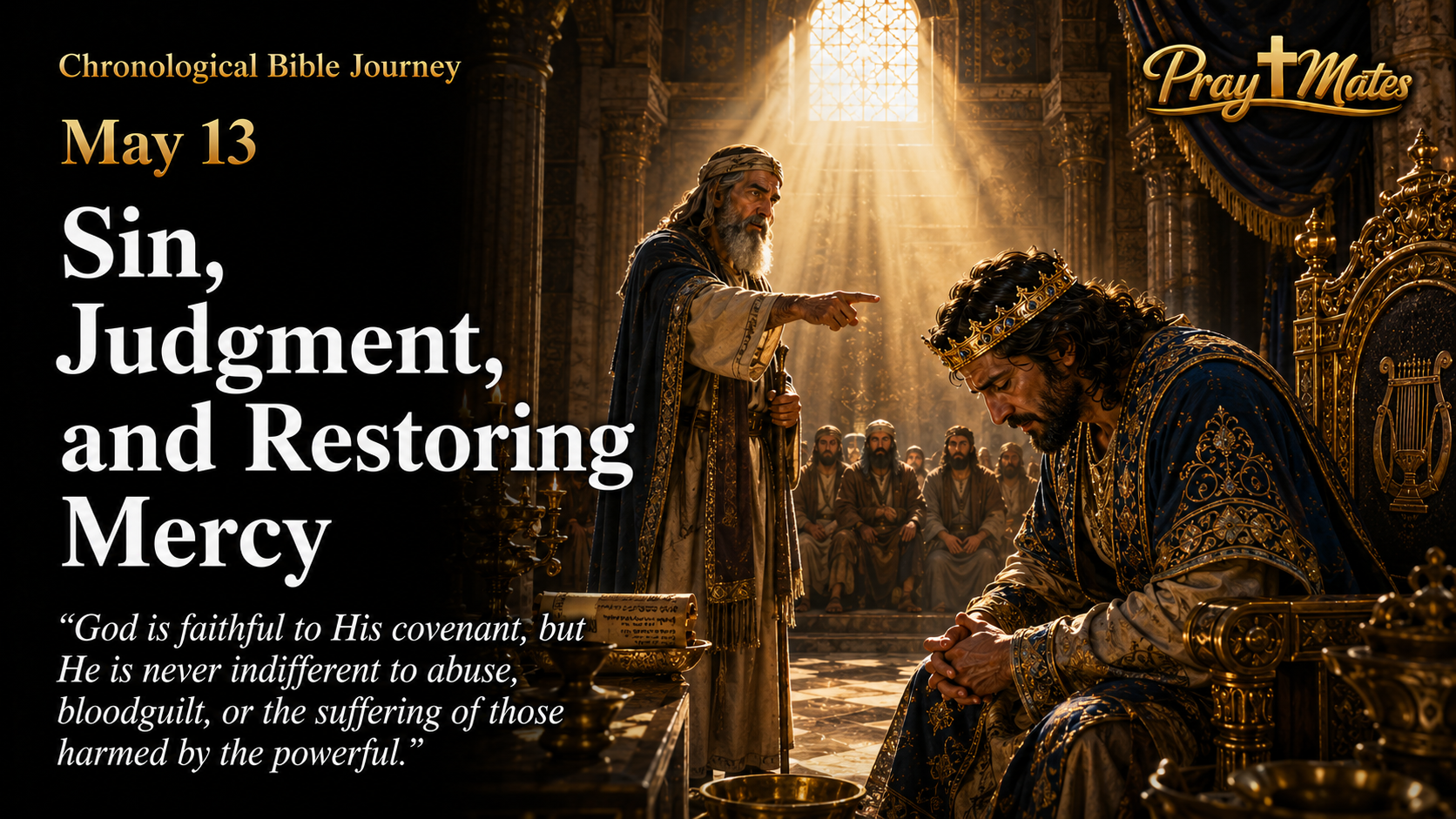
May 13 — Sin, Judgment, and Restoring Mercy
May 13 — Sin, Judgment, and Restoring Mercy
SCRIPTURE READING:
2 Samuel 11-12; 1 Chronicles 20
SCRIPTURE:
Second Samuel 11
¹ And it came to pass, after the year was expired, at the time when kings go forth [to battle], that David sent Joab, and his servants with him, and all Israel; and they destroyed the children of Ammon, and besieged Rabbah. But David tarried still at Jerusalem.
² And it came to pass in an eveningtide, that David arose from off his bed, and walked upon the roof of the king’s house: and from the roof he saw a woman washing herself; and the woman [was] very beautiful to look upon.
³ And David sent and inquired after the woman. And [one] said, [Is] not this Bathsheba, the daughter of Eliam, the wife of Uriah the Hittite?
⁴ And David sent messengers, and took her; and she came in unto him, and he lay with her; for she was purified from her uncleanness: and she returned unto her house.
⁵ And the woman conceived, and sent and told David, and said, I [am] with child.
⁶ And David sent to Joab, [saying], Send me Uriah the Hittite. And Joab sent Uriah to David.
⁷ And when Uriah was come unto him, David demanded [of him] how Joab did, and how the people did, and how the war prospered.
⁸ And David said to Uriah, Go down to thy house, and wash thy feet. And Uriah departed out of the king’s house, and there followed him a mess [of meat] from the king.
⁹ But Uriah slept at the door of the king’s house with all the servants of his lord, and went not down to his house.
¹⁰ And when they had told David, saying, Uriah went not down unto his house, David said unto Uriah, Camest thou not from [thy] journey? why [then] didst thou not go down unto thine house?
¹¹ And Uriah said unto David, The ark, and Israel, and Judah, abide in tents; and my lord Joab, and the servants of my lord, are encamped in the open fields; shall I then go into mine house, to eat and to drink, and to lie with my wife? [as] thou livest, and [as] thy soul liveth, I will not do this thing.
¹² And David said to Uriah, Tarry here to day also, and to morrow I will let thee depart. So Uriah abode in Jerusalem that day, and the morrow.
¹³ And when David had called him, he did eat and drink before him; and he made him drunk: and at even he went out to lie on his bed with the servants of his lord, but went not down to his house.
¹⁴ And it came to pass in the morning, that David wrote a letter to Joab, and sent [it] by the hand of Uriah.
¹⁵ And he wrote in the letter, saying, Set ye Uriah in the forefront of the hottest battle, and retire ye from him, that he may be smitten, and die.
¹⁶ And it came to pass, when Joab observed the city, that he assigned Uriah unto a place where he knew that valiant men [were].
¹⁷ And the men of the city went out, and fought with Joab: and there fell [some] of the people of the servants of David; and Uriah the Hittite died also.
¹⁸ Then Joab sent and told David all the things concerning the war;
¹⁹ And charged the messenger, saying, When thou hast made an end of telling the matters of the war unto the king,
²⁰ And if so be that the king’s wrath arise, and he say unto thee, Wherefore approached ye so nigh unto the city when ye did fight? knew ye not that they would shoot from the wall?
²¹ Who smote Abimelech the son of Jerubbesheth? did not a woman cast a piece of a millstone upon him from the wall, that he died in Thebez? why went ye nigh the wall? then say thou, Thy servant Uriah the Hittite is dead also.
²² So the messenger went, and came and shewed David all that Joab had sent him for.
²³ And the messenger said unto David, Surely the men prevailed against us, and came out unto us into the field, and we were upon them even unto the entering of the gate.
²⁴ And the shooters shot from off the wall upon thy servants; and [some] of the king’s servants be dead, and thy servant Uriah the Hittite is dead also.
²⁵ Then David said unto the messenger, Thus shalt thou say unto Joab, Let not this thing displease thee, for the sword devoureth one as well as another: make thy battle more strong against the city, and overthrow it: and encourage thou him.
²⁶ And when the wife of Uriah heard that Uriah her husband was dead, she mourned for her husband.
²⁷ And when the mourning was past, David sent and fetched her to his house, and she became his wife, and bare him a son. But the thing that David had done displeased the LORD.
Second Samuel 12
¹ And the LORD sent Nathan unto David. And he came unto him, and said unto him, There were two men in one city; the one rich, and the other poor.
² The rich [man] had exceeding many flocks and herds:
³ But the poor [man] had nothing, save one little ewe lamb, which he had bought and nourished up: and it grew up together with him, and with his children; it did eat of his own meat, and drank of his own cup, and lay in his bosom, and was unto him as a daughter.
⁴ And there came a traveller unto the rich man, and he spared to take of his own flock and of his own herd, to dress for the wayfaring man that was come unto him; but took the poor man’s lamb, and dressed it for the man that was come to him.
⁵ And David’s anger was greatly kindled against the man; and he said to Nathan, [As] the LORD liveth, the man that hath done this [thing] shall surely die:
⁶ And he shall restore the lamb fourfold, because he did this thing, and because he had no pity.
⁷ And Nathan said to David, Thou [art] the man. Thus saith the LORD God of Israel, I anointed thee king over Israel, and I delivered thee out of the hand of Saul;
⁸ And I gave thee thy master’s house, and thy master’s wives into thy bosom, and gave thee the house of Israel and of Judah; and if [that had been] too little, I would moreover have given unto thee such and such things.
⁹ Wherefore hast thou despised the commandment of the LORD, to do evil in his sight? thou hast killed Uriah the Hittite with the sword, and hast taken his wife [to be] thy wife, and hast slain him with the sword of the children of Ammon.
¹⁰ Now therefore the sword shall never depart from thine house; because thou hast despised me, and hast taken the wife of Uriah the Hittite to be thy wife.
¹¹ Thus saith the LORD, Behold, I will raise up evil against thee out of thine own house, and I will take thy wives before thine eyes, and give [them] unto thy neighbour, and he shall lie with thy wives in the sight of this sun.
¹² For thou didst [it] secretly: but I will do this thing before all Israel, and before the sun.
¹³ And David said unto Nathan, I have sinned against the LORD. And Nathan said unto David, The LORD also hath put away thy sin; thou shalt not die.
¹⁴ Howbeit, because by this deed thou hast given great occasion to the enemies of the LORD to blaspheme, the child also [that is] born unto thee shall surely die.
¹⁵ And Nathan departed unto his house. And the LORD struck the child that Uriah’s wife bare unto David, and it was very sick.
¹⁶ David therefore besought God for the child; and David fasted, and went in, and lay all night upon the earth.
¹⁷ And the elders of his house arose, [and went] to him, to raise him up from the earth: but he would not, neither did he eat bread with them.
¹⁸ And it came to pass on the seventh day, that the child died. And the servants of David feared to tell him that the child was dead: for they said, Behold, while the child was yet alive, we spake unto him, and he would not hearken unto our voice: how will he then vex himself, if we tell him that the child is dead?
¹⁹ But when David saw that his servants whispered, David perceived that the child was dead: therefore David said unto his servants, Is the child dead? And they said, He is dead.
²⁰ Then David arose from the earth, and washed, and anointed [himself], and changed his apparel, and came into the house of the LORD, and worshipped: then he came to his own house; and when he required, they set bread before him, and he did eat.
²¹ Then said his servants unto him, What thing [is] this that thou hast done? thou didst fast and weep for the child, [while it was] alive; but when the child was dead, thou didst rise and eat bread.
²² And he said, While the child was yet alive, I fasted and wept: for I said, Who can tell [whether] GOD will be gracious to me, that the child may live?
²³ But now he is dead, wherefore should I fast? can I bring him back again? I shall go to him, but he shall not return to me.
²⁴ And David comforted Bathsheba his wife, and went in unto her, and lay with her: and she bare a son, and he called his name Solomon: and the LORD loved him.
²⁵ And he sent by the hand of Nathan the prophet; and he called his name Jedidiah, because of the LORD.
²⁶ And Joab fought against Rabbah of the children of Ammon, and took the royal city.
²⁷ And Joab sent messengers to David, and said, I have fought against Rabbah, and have taken the city of waters.
²⁸ Now therefore gather the rest of the people together, and encamp against the city, and take it: lest I take the city, and it be called after my name.
²⁹ And David gathered all the people together, and went to Rabbah, and fought against it, and took it.
³⁰ And he took their king’s crown from off his head, the weight whereof [was] a talent of gold with the precious stones: and it was [set] on David’s head. And he brought forth the spoil of the city in great abundance.
³¹ And he brought forth the people that [were] therein, and put [them] under saws, and under harrows of iron, and under axes of iron, and made them pass through the brickkiln: and thus did he unto all the cities of the children of Ammon. So David and all the people returned unto Jerusalem.
First Chronicles 20
¹ And it came to pass, that after the year was expired, at the time that kings go out [to battle], Joab led forth the power of the army, and wasted the country of the children of Ammon, and came and besieged Rabbah. But David tarried at Jerusalem. And Joab smote Rabbah, and destroyed it.
² And David took the crown of their king from off his head, and found it to weigh a talent of gold, and [there were] precious stones in it; and it was set upon David’s head: and he brought also exceeding much spoil out of the city.
³ And he brought out the people that [were] in it, and cut [them] with saws, and with harrows of iron, and with axes. Even so dealt David with all the cities of the children of Ammon. And David and all the people returned to Jerusalem.
⁴ And it came to pass after this, that there arose war at Gezer with the Philistines; at which time Sibbechai the Hushathite slew Sippai, [that was] of the children of the giant: and they were subdued.
⁵ And there was war again with the Philistines; and Elhanan the son of Jair slew Lahmi the brother of Goliath the Gittite, whose spear staff [was] like a weaver’s beam.
⁶ And yet again there was war at Gath, where was a man of [great] stature, whose fingers and toes [were] four and twenty, six [on each hand], and six [on each foot]: and he also was the son of the giant.
⁷ But when he defied Israel, Jonathan the son of Shimea David’s brother slew him.
⁸ These were born unto the giant in Gath; and they fell by the hand of David, and by the hand of his servants.
DEVOTIONAL:
David's sin with Bathsheba and against Uriah is one of Scripture's most sobering portraits of corrupted power. The king who should have guarded the people takes, conceals, manipulates, and destroys. The language echoes earlier warnings about kings who take for themselves, and the tragedy widens because private desire becomes public injustice. Uriah's integrity makes David's schemes look even darker, and the sword begins to enter the house.
Nathan's parable is covenant confrontation. He does not flatter the king, minimize the offense, or treat leadership as protection from rebuke. The word of the LORD exposes what David has hidden, and David's confession opens the door to mercy without erasing consequences. This is a vital covenant lesson: forgiveness is real, but sin still wounds people, families, communities, and the name of the LORD.
The Jewish background of kingship sharpens the warning. Israel's king was to rule under Torah, shepherd the people, and embody justice. David fails at precisely the point where power should have served righteousness. The passage therefore protects us from romanticizing even beloved leaders. God is faithful to His covenant, but He is never indifferent to abuse, bloodguilt, or the suffering of those harmed by the powerful.
Jesus is the righteous Son of David who never exploits authority. He protects the vulnerable, speaks truth to sin, and bears judgment for guilty people who can offer no defense. His mercy is not cheap concealment; it is costly atonement. In Christ, sinners may confess and be restored, while the church learns to care about truth, repentance, victims, and holiness together.
In daily life, this reading calls believers to obey God when temptation is hidden and when correction is painful. Character grows through quick confession, guarded desires, and willingness to be accountable. Families need truth that protects rather than excuses, workplaces need authority exercised without manipulation, and churches must become communities where repentance is serious, the harmed are cared for, and grace never becomes a cover for evil.
In U.S. civic life, this reading commends the virtue of truthful repentance. It turns prayer toward homes, churches, workplaces, and public offices where abuses of trust need exposure, justice, and healing. Christians should show up by telling the truth about wrongdoing while seeking restoration only through repentance and God's mercy.
DISCUSSION QUESTIONS:
What does this reading reveal about God's work in the original setting?
How does the covenant background deepen the meaning of this passage?
Where does this Scripture point you toward Jesus the Messiah?
How should the virtue of truthful repentance shape your obedience this week?
PRAYER:
ADORATION:
Merciful LORD, You are near to Your people and mighty to save.
CONFESSION:
Forgive me for treating Your mercy lightly and for failing to love others with covenant faithfulness.
THANKSGIVING:
Thank You for guiding, correcting, and sustaining Your people through every generation.
SUPPLICATION – GENERAL:
Shape my life with truthful repentance, so that my choices, words, and relationships honor Jesus.
SUPPLICATION – U.S. / CIVIC:
Guide believers across the United States to show truthful repentance, and answer the needs of homes, churches, workplaces, and public offices where abuses of trust need exposure, justice, and healing.
SCRIPTURE:
¹³ And David said unto Nathan, I have sinned against the LORD. And Nathan said unto David, The LORD also hath put away thy sin; thou shalt not die.
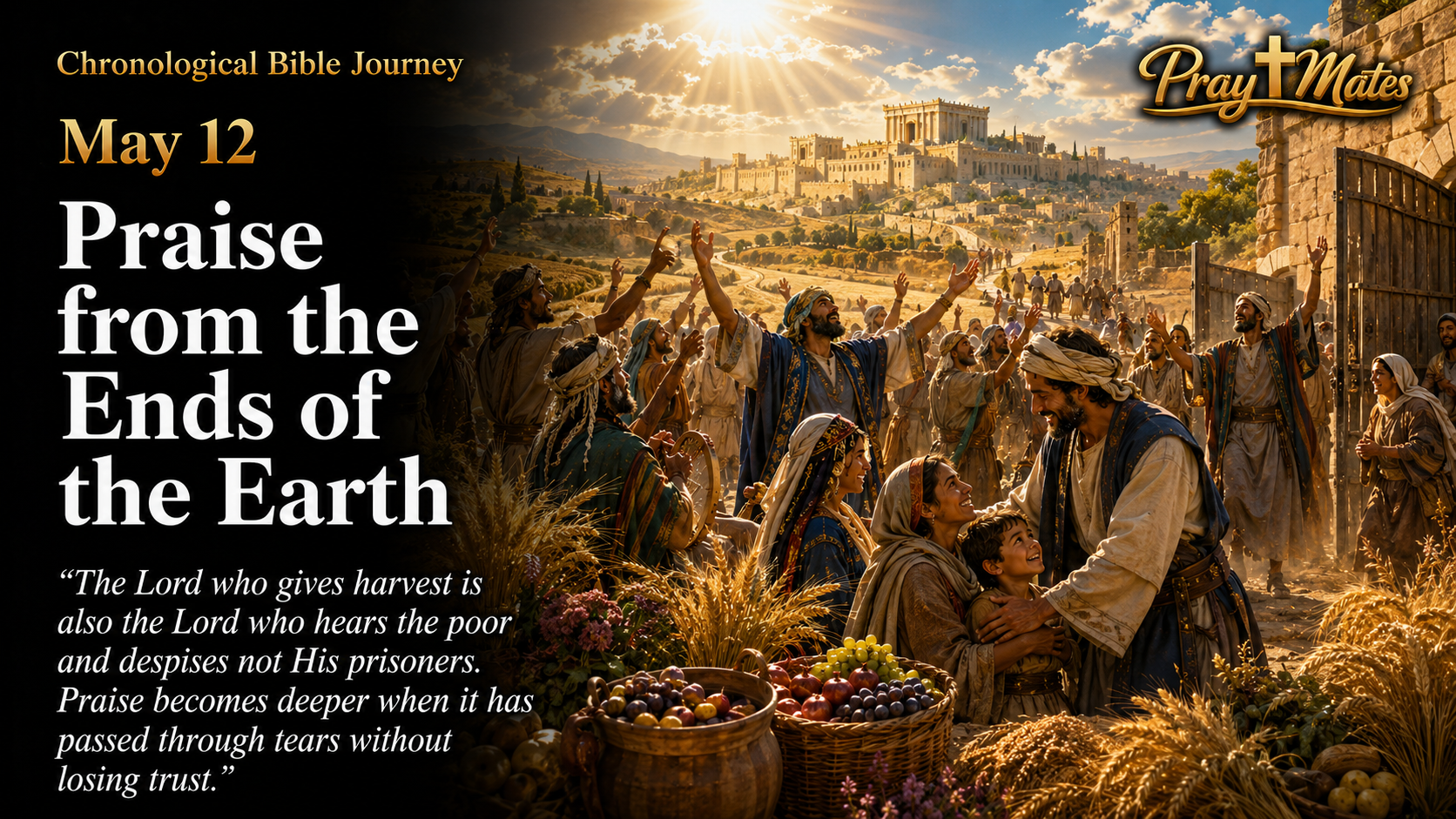
May 12 — Praise from the Ends of the Earth
May 12 — Praise from the Ends of the Earth
SCRIPTURE READING:
Psalms 65-67, 69-70
SCRIPTURE:
Psalm 65
¹ To the chief Musician, A Psalm [and] Song of David. Praise waiteth for thee, O God, in Sion: and unto thee shall the vow be performed.
² O thou that hearest prayer, unto thee shall all flesh come.
³ Iniquities prevail against me: [as for] our transgressions, thou shalt purge them away.
⁴ Blessed [is the man whom] thou choosest, and causest to approach [unto thee, that] he may dwell in thy courts: we shall be satisfied with the goodness of thy house, [even] of thy holy temple.
⁵ [By] terrible things in righteousness wilt thou answer us, O God of our salvation; [who art] the confidence of all the ends of the earth, and of them that are afar off [upon] the sea:
⁶ Which by his strength setteth fast the mountains; [being] girded with power:
⁷ Which stilleth the noise of the seas, the noise of their waves, and the tumult of the people.
⁸ They also that dwell in the uttermost parts are afraid at thy tokens: thou makest the outgoings of the morning and evening to rejoice.
⁹ Thou visitest the earth, and waterest it: thou greatly enrichest it with the river of God, [which] is full of water: thou preparest them corn, when thou hast so provided for it.
¹⁰ Thou waterest the ridges thereof abundantly: thou settlest the furrows thereof: thou makest it soft with showers: thou blessest the springing thereof.
¹¹ Thou crownest the year with thy goodness; and thy paths drop fatness.
¹² They drop [upon] the pastures of the wilderness: and the little hills rejoice on every side.
¹³ The pastures are clothed with flocks; the valleys also are covered over with corn; they shout for joy, they also sing.
Psalm 66
¹ To the chief Musician, A Song [or] Psalm. Make a joyful noise unto God, all ye lands:
² Sing forth the honour of his name: make his praise glorious.
³ Say unto God, How terrible [art thou in] thy works! through the greatness of thy power shall thine enemies submit themselves unto thee.
⁴ All the earth shall worship thee, and shall sing unto thee; they shall sing [to] thy name. Selah.
⁵ Come and see the works of God: [he is] terrible [in his] doing toward the children of men.
⁶ He turned the sea into dry [land]: they went through the flood on foot: there did we rejoice in him.
⁷ He ruleth by his power for ever; his eyes behold the nations: let not the rebellious exalt themselves. Selah.
⁸ O bless our God, ye people, and make the voice of his praise to be heard:
⁹ Which holdeth our soul in life, and suffereth not our feet to be moved.
¹⁰ For thou, O God, hast proved us: thou hast tried us, as silver is tried.
¹¹ Thou broughtest us into the net; thou laidst affliction upon our loins.
¹² Thou hast caused men to ride over our heads; we went through fire and through water: but thou broughtest us out into a wealthy [place].
¹³ I will go into thy house with burnt offerings: I will pay thee my vows,
¹⁴ Which my lips have uttered, and my mouth hath spoken, when I was in trouble.
¹⁵ I will offer unto thee burnt sacrifices of fatlings, with the incense of rams; I will offer bullocks with goats. Selah.
¹⁶ Come [and] hear, all ye that fear God, and I will declare what he hath done for my soul.
¹⁷ I cried unto him with my mouth, and he was extolled with my tongue.
¹⁸ If I regard iniquity in my heart, the Lord will not hear [me]:
¹⁹ [But] verily God hath heard [me]; he hath attended to the voice of my prayer.
²⁰ Blessed [be] God, which hath not turned away my prayer, nor his mercy from me.
Psalm 67
¹ To the chief Musician on Neginoth, A Psalm [or] Song. God be merciful unto us, and bless us; [and] cause his face to shine upon us; Selah.
² That thy way may be known upon earth, thy saving health among all nations.
³ Let the people praise thee, O God; let all the people praise thee.
⁴ O let the nations be glad and sing for joy: for thou shalt judge the people righteously, and govern the nations upon earth. Selah.
⁵ Let the people praise thee, O God; let all the people praise thee.
⁶ [Then] shall the earth yield her increase; [and] God, [even] our own God, shall bless us.
⁷ God shall bless us; and all the ends of the earth shall fear him.
Psalm 69
¹ To the chief Musician upon Shoshannim, [A Psalm] of David. Save me, O God; for the waters are come in unto [my] soul.
² I sink in deep mire, where [there is] no standing: I am come into deep waters, where the floods overflow me.
³ I am weary of my crying: my throat is dried: mine eyes fail while I wait for my God.
⁴ They that hate me without a cause are more than the hairs of mine head: they that would destroy me, [being] mine enemies wrongfully, are mighty: then I restored [that] which I took not away.
⁵ O God, thou knowest my foolishness; and my sins are not hid from thee.
⁶ Let not them that wait on thee, O Lord GOD of hosts, be ashamed for my sake: let not those that seek thee be confounded for my sake, O God of Israel.
⁷ Because for thy sake I have borne reproach; shame hath covered my face.
⁸ I am become a stranger unto my brethren, and an alien unto my mother’s children.
⁹ For the zeal of thine house hath eaten me up; and the reproaches of them that reproached thee are fallen upon me.
¹⁰ When I wept, [and chastened] my soul with fasting, that was to my reproach.
¹¹ I made sackcloth also my garment; and I became a proverb to them.
¹² They that sit in the gate speak against me; and I [was] the song of the drunkards.
¹³ But as for me, my prayer [is] unto thee, O LORD, [in] an acceptable time: O God, in the multitude of thy mercy hear me, in the truth of thy salvation.
¹⁴ Deliver me out of the mire, and let me not sink: let me be delivered from them that hate me, and out of the deep waters.
¹⁵ Let not the waterflood overflow me, neither let the deep swallow me up, and let not the pit shut her mouth upon me.
¹⁶ Hear me, O LORD; for thy lovingkindness [is] good: turn unto me according to the multitude of thy tender mercies.
¹⁷ And hide not thy face from thy servant; for I am in trouble: hear me speedily.
¹⁸ Draw nigh unto my soul, [and] redeem it: deliver me because of mine enemies.
¹⁹ Thou hast known my reproach, and my shame, and my dishonour: mine adversaries [are] all before thee.
²⁰ Reproach hath broken my heart; and I am full of heaviness: and I looked [for some] to take pity, but [there was] none; and for comforters, but I found none.
²¹ They gave me also gall for my meat; and in my thirst they gave me vinegar to drink.
²² Let their table become a snare before them: and [that which should have been] for [their] welfare, [let it become] a trap.
²³ Let their eyes be darkened, that they see not; and make their loins continually to shake.
²⁴ Pour out thine indignation upon them, and let thy wrathful anger take hold of them.
²⁵ Let their habitation be desolate; [and] let none dwell in their tents.
²⁶ For they persecute [him] whom thou hast smitten; and they talk to the grief of those whom thou hast wounded.
²⁷ Add iniquity unto their iniquity: and let them not come into thy righteousness.
²⁸ Let them be blotted out of the book of the living, and not be written with the righteous.
²⁹ But I [am] poor and sorrowful: let thy salvation, O God, set me up on high.
³⁰ I will praise the name of God with a song, and will magnify him with thanksgiving.
³¹ [This] also shall please the LORD better than an ox [or] bullock that hath horns and hoofs.
³² The humble shall see [this, and] be glad: and your heart shall live that seek God.
³³ For the LORD heareth the poor, and despiseth not his prisoners.
³⁴ Let the heaven and earth praise him, the seas, and every thing that moveth therein.
³⁵ For God will save Zion, and will build the cities of Judah: that they may dwell there, and have it in possession.
³⁶ The seed also of his servants shall inherit it: and they that love his name shall dwell therein.
Psalm 70
¹ To the chief Musician, [A Psalm] of David, to bring to remembrance. [Make haste], O God, to deliver me; make haste to help me, O LORD.
² Let them be ashamed and confounded that seek after my soul: let them be turned backward, and put to confusion, that desire my hurt.
³ Let them be turned back for a reward of their shame that say, Aha, aha.
⁴ Let all those that seek thee rejoice and be glad in thee: and let such as love thy salvation say continually, Let God be magnified.
⁵ But I [am] poor and needy: make haste unto me, O God: thou [art] my help and my deliverer; O LORD, make no tarrying.
DEVOTIONAL:
Psalms 65-67 overflow with harvest, forgiveness, blessing, and the hope that all nations will praise the LORD. Psalms 69-70 move into distress, reproach, urgency, and the cry of the suffering righteous one. The range is striking. The same worshiping community that blesses God for watering the earth also teaches the afflicted to cry, "Make haste." Israel's prayer book refuses to separate joy from sorrow.
In covenant perspective, abundance is not self-generated prosperity. The LORD visits the earth, waters it, crowns the year, and stills the noise of the seas and peoples. Blessing is meant to travel outward, so that God's way may be known upon earth and His saving health among all nations. Israel praises as a people chosen not to hoard mercy but to bear witness to the God who judges righteously and blesses the peoples.
Yet the covenant people also learn to bring humiliation and pain into worship. Psalm 69 is not polite spirituality. It names reproach, shame, enemies, weariness, and the longing for deliverance. This honesty keeps praise from becoming sentimental. The Lord who gives harvest is also the Lord who hears the poor and despises not His prisoners. Praise becomes deeper when it has passed through tears without losing trust.
The New Testament draws Psalm 69 into the suffering of Jesus. The reproaches, zeal for God's house, and righteous anguish find their fullest meaning in the Messiah who bears shame for His people. Through Christ, blessing reaches the nations, and the afflicted discover that their cries are not outside God's redemptive plan. The cross joins the suffering servant and the worldwide praise of God.
In daily life, this reading calls believers to obey God in both gratitude and distress. Character is formed when we can thank Him for provision without ignoring neighbors who are grieving. Families can practice honest prayer at the table and in the sickroom, workers can notice people strained by want or shame, and churches can become places where harvest praise and intercession for the wounded rise together before Christ.
In U.S. civic life, this reading teaches compassionate praise as a public good. It calls for prayer over farmers, caregivers, the poor, the grieving, and those whose suffering is hidden from public view. Christians should show up by joining thanksgiving with mercy so that praise becomes visible in care for neighbors.
DISCUSSION QUESTIONS:
What does this reading teach about the difference between human strength and God's purpose?
Which covenant theme in this passage should shape your worship?
How does this Scripture prepare your heart to see Jesus more clearly?
What faithful action would grow from compassionate praise today?
PRAYER:
ADORATION:
Lord God, You reign with holiness, wisdom, and steadfast love.
CONFESSION:
Forgive me for the pride, fear, or impatience that keeps me from walking in Your ways.
THANKSGIVING:
Thank You for mercy that reaches sinners and for a kingdom that is secure in Christ.
SUPPLICATION – GENERAL:
Teach me to practice compassionate praise with a steady heart and to obey You when obedience is costly.
SUPPLICATION – U.S. / CIVIC:
Raise up Christians who carry compassionate praise into public life, and give help to farmers, caregivers, the poor, the grieving, and those whose suffering is hidden from public view.
SCRIPTURE:
¹ To the chief Musician on Neginoth, A Psalm [or] Song. God be merciful unto us, and bless us; [and] cause his face to shine upon us; Selah.
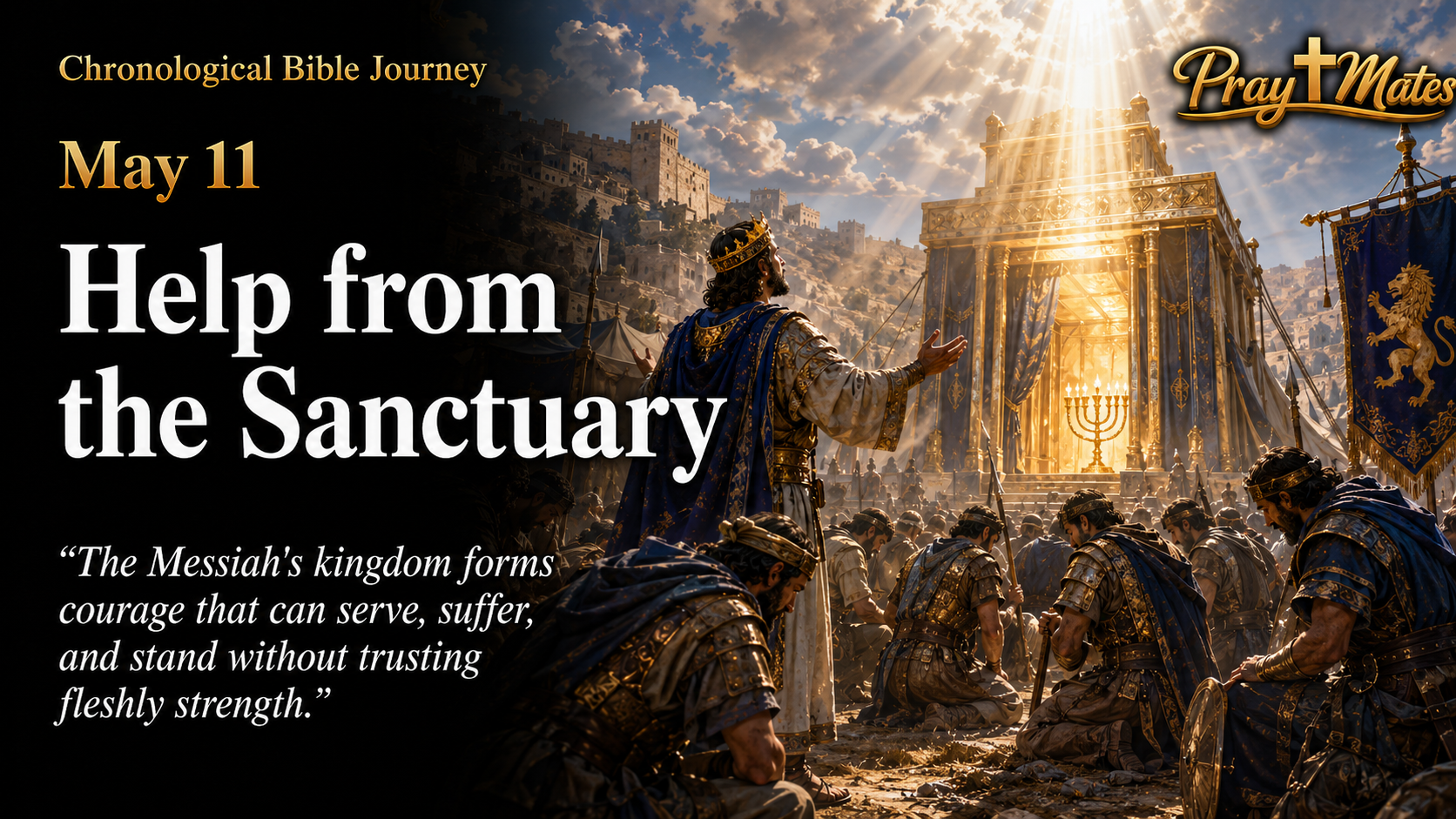
May 11 — Help from the Sanctuary
May 11 — Help from the Sanctuary
SCRIPTURE READING:
2 Samuel 10; 1 Chronicles 19; Psalm 20
SCRIPTURE:
Second Samuel 10
¹ And it came to pass after this, that the king of the children of Ammon died, and Hanun his son reigned in his stead.
² Then said David, I will shew kindness unto Hanun the son of Nahash, as his father shewed kindness unto me. And David sent to comfort him by the hand of his servants for his father. And David’s servants came into the land of the children of Ammon.
³ And the princes of the children of Ammon said unto Hanun their lord, Thinkest thou that David doth honour thy father, that he hath sent comforters unto thee? hath not David [rather] sent his servants unto thee, to search the city, and to spy it out, and to overthrow it?
⁴ Wherefore Hanun took David’s servants, and shaved off the one half of their beards, and cut off their garments in the middle, [even] to their buttocks, and sent them away.
⁵ When they told [it] unto David, he sent to meet them, because the men were greatly ashamed: and the king said, Tarry at Jericho until your beards be grown, and [then] return.
⁶ And when the children of Ammon saw that they stank before David, the children of Ammon sent and hired the Syrians of Bethrehob, and the Syrians of Zoba, twenty thousand footmen, and of king Maacah a thousand men, and of Ishtob twelve thousand men.
⁷ And when David heard of [it], he sent Joab, and all the host of the mighty men.
⁸ And the children of Ammon came out, and put the battle in array at the entering in of the gate: and the Syrians of Zoba, and of Rehob, and Ishtob, and Maacah, [were] by themselves in the field.
⁹ When Joab saw that the front of the battle was against him before and behind, he chose of all the choice [men] of Israel, and put [them] in array against the Syrians:
¹⁰ And the rest of the people he delivered into the hand of Abishai his brother, that he might put [them] in array against the children of Ammon.
¹¹ And he said, If the Syrians be too strong for me, then thou shalt help me: but if the children of Ammon be too strong for thee, then I will come and help thee.
¹² Be of good courage, and let us play the men for our people, and for the cities of our God: and the LORD do that which seemeth him good.
¹³ And Joab drew nigh, and the people that [were] with him, unto the battle against the Syrians: and they fled before him.
¹⁴ And when the children of Ammon saw that the Syrians were fled, then fled they also before Abishai, and entered into the city. So Joab returned from the children of Ammon, and came to Jerusalem.
¹⁵ And when the Syrians saw that they were smitten before Israel, they gathered themselves together.
¹⁶ And Hadarezer sent, and brought out the Syrians that [were] beyond the river: and they came to Helam; and Shobach the captain of the host of Hadarezer [went] before them.
¹⁷ And when it was told David, he gathered all Israel together, and passed over Jordan, and came to Helam. And the Syrians set themselves in array against David, and fought with him.
¹⁸ And the Syrians fled before Israel; and David slew [the men of] seven hundred chariots of the Syrians, and forty thousand horsemen, and smote Shobach the captain of their host, who died there.
¹⁹ And when all the kings [that were] servants to Hadarezer saw that they were smitten before Israel, they made peace with Israel, and served them. So the Syrians feared to help the children of Ammon any more.
First Chronicles 19
¹ Now it came to pass after this, that Nahash the king of the children of Ammon died, and his son reigned in his stead.
² And David said, I will shew kindness unto Hanun the son of Nahash, because his father shewed kindness to me. And David sent messengers to comfort him concerning his father. So the servants of David came into the land of the children of Ammon to Hanun, to comfort him.
³ But the princes of the children of Ammon said to Hanun, Thinkest thou that David doth honour thy father, that he hath sent comforters unto thee? are not his servants come unto thee for to search, and to overthrow, and to spy out the land?
⁴ Wherefore Hanun took David’s servants, and shaved them, and cut off their garments in the midst hard by their buttocks, and sent them away.
⁵ Then there went [certain], and told David how the men were served. And he sent to meet them: for the men were greatly ashamed. And the king said, Tarry at Jericho until your beards be grown, and [then] return.
⁶ And when the children of Ammon saw that they had made themselves odious to David, Hanun and the children of Ammon sent a thousand talents of silver to hire them chariots and horsemen out of Mesopotamia, and out of Syriamaachah, and out of Zobah.
⁷ So they hired thirty and two thousand chariots, and the king of Maachah and his people; who came and pitched before Medeba. And the children of Ammon gathered themselves together from their cities, and came to battle.
⁸ And when David heard [of it], he sent Joab, and all the host of the mighty men.
⁹ And the children of Ammon came out, and put the battle in array before the gate of the city: and the kings that were come [were] by themselves in the field.
¹⁰ Now when Joab saw that the battle was set against him before and behind, he chose out of all the choice of Israel, and put [them] in array against the Syrians.
¹¹ And the rest of the people he delivered unto the hand of Abishai his brother, and they set [themselves] in array against the children of Ammon.
¹² And he said, If the Syrians be too strong for me, then thou shalt help me: but if the children of Ammon be too strong for thee, then I will help thee.
¹³ Be of good courage, and let us behave ourselves valiantly for our people, and for the cities of our God: and let the LORD do [that which is] good in his sight.
¹⁴ So Joab and the people that [were] with him drew nigh before the Syrians unto the battle; and they fled before him.
¹⁵ And when the children of Ammon saw that the Syrians were fled, they likewise fled before Abishai his brother, and entered into the city. Then Joab came to Jerusalem.
¹⁶ And when the Syrians saw that they were put to the worse before Israel, they sent messengers, and drew forth the Syrians that [were] beyond the river: and Shophach the captain of the host of Hadarezer [went] before them.
¹⁷ And it was told David; and he gathered all Israel, and passed over Jordan, and came upon them, and set [the battle] in array against them. So when David had put the battle in array against the Syrians, they fought with him.
¹⁸ But the Syrians fled before Israel; and David slew of the Syrians seven thousand [men which fought in] chariots, and forty thousand footmen, and killed Shophach the captain of the host.
¹⁹ And when the servants of Hadarezer saw that they were put to the worse before Israel, they made peace with David, and became his servants: neither would the Syrians help the children of Ammon any more.
Psalm 20
¹ To the chief Musician, A Psalm of David. The LORD hear thee in the day of trouble; the name of the God of Jacob defend thee;
² Send thee help from the sanctuary, and strengthen thee out of Zion;
³ Remember all thy offerings, and accept thy burnt sacrifice; Selah.
⁴ Grant thee according to thine own heart, and fulfil all thy counsel.
⁵ We will rejoice in thy salvation, and in the name of our God we will set up [our] banners: the LORD fulfil all thy petitions.
⁶ Now know I that the LORD saveth his anointed; he will hear him from his holy heaven with the saving strength of his right hand.
⁷ Some [trust] in chariots, and some in horses: but we will remember the name of the LORD our God.
⁸ They are brought down and fallen: but we are risen, and stand upright.
⁹ Save, LORD: let the king hear us when we call.
DEVOTIONAL:
The conflict with Ammon begins with a gesture meant for comfort. David sends servants to show kindness after the death of Nahash, but suspicion twists the act into humiliation and war. The Ammonites misread mercy as manipulation, shame David's messengers, and then hire allies to defend their insult. The chapter shows how distrust, pride, and public dishonor can turn a moment of sympathy into a widening conflict.
Joab's words before battle are among the strongest covenant statements in the passage. He urges courage, strength for the people and the cities of God, and then entrusts the outcome to the LORD. Israel does not fight as a people confident in technique alone. They stand because the LORD governs the result. Psalm 20 gives worship language to the same truth: help comes from the sanctuary, and trust belongs not in chariots or horses but in the name of the LORD.
The Jewish covenant background holds courage and dependence together. Israel's armies could organize, plan, and fight, yet their hope was never to rest finally in military instruments. The people were to remember that God's name, God's sanctuary, and God's saving power were their true confidence. The passage does not glorify conflict; it teaches that when conflict comes, God's people must seek courage without surrendering dependence.
Jesus fulfills the hope of Psalm 20 as the anointed King whom the Father hears. He conquers not by chariot or horse, but by the cross, where apparent weakness becomes victory. He also teaches His people to receive humiliation without becoming ruled by retaliation. The Messiah's kingdom forms courage that can serve, suffer, and stand without trusting fleshly strength.
In daily life, this reading calls believers to obey God when kindness is misunderstood and courage is required. Character is formed when we refuse cynicism, seek peace where possible, and entrust outcomes to the Lord rather than to control. Families can learn to clarify before accusing, workers can respond to insult without reckless escalation, and churches can pray for strength that serves the people of God while trusting the name of Christ above every human resource.
In U.S. civic life, this passage forms the virtue of courageous dependence. It turns our prayers toward service members, first responders, peacemakers, and citizens facing conflict or fear. Christians should show up by acting with courage while openly confessing that salvation and security belong to the Lord.
DISCUSSION QUESTIONS:
What warning or encouragement would the first hearers have received from this passage?
How does Israel's covenant story help you read this text with greater care?
What does this passage teach you to treasure about Christ?
How can your family, work, or church life reflect courageous dependence?
PRAYER:
ADORATION:
Holy Father, You are faithful in covenant mercy and righteous in all Your ways.
CONFESSION:
Forgive me for trusting my own judgment more than Your word and for resisting the correction You give.
THANKSGIVING:
Thank You for revealing Your faithfulness through Scripture and for giving us Jesus, the promised Messiah.
SUPPLICATION – GENERAL:
Strengthen me to walk in courageous dependence, to receive Your word with humility, and to serve others faithfully.
SUPPLICATION – U.S. / CIVIC:
Teach Your people in our nation to practice courageous dependence, and bring mercy, wisdom, and healing to service members, first responders, peacemakers, and citizens facing conflict or fear.
SCRIPTURE:
⁷ Some [trust] in chariots, and some in horses: but we will remember the name of the LORD our God.
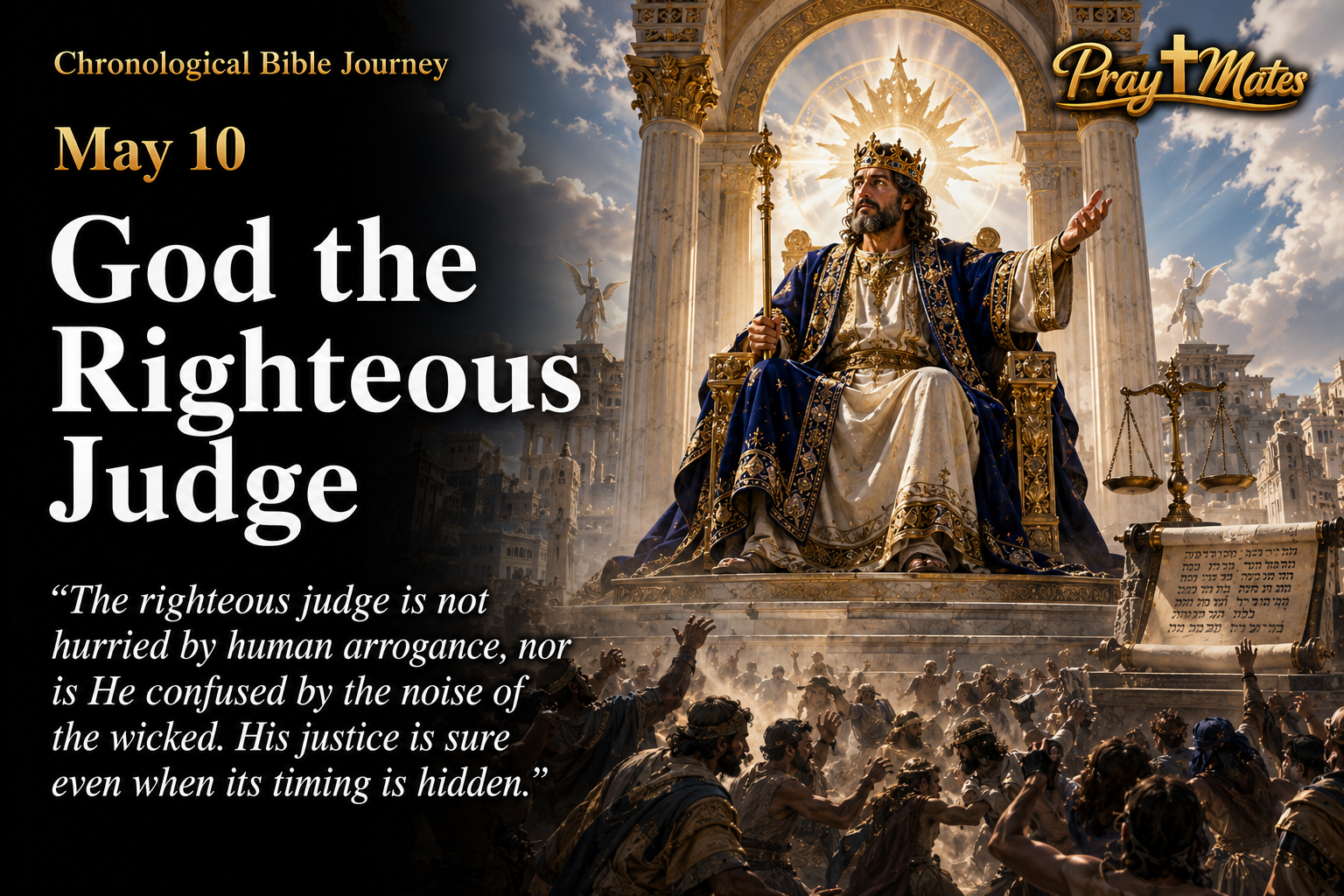
May 10 — God the Righteous Judge
May 10 — God the Righteous Judge
SCRIPTURE READING:
Psalms 50, 53, 60, 75
SCRIPTURE:
Psalm 50
¹ A Psalm of Asaph. The mighty God, [even] the LORD, hath spoken, and called the earth from the rising of the sun unto the going down thereof.
² Out of Zion, the perfection of beauty, God hath shined.
³ Our God shall come, and shall not keep silence: a fire shall devour before him, and it shall be very tempestuous round about him.
⁴ He shall call to the heavens from above, and to the earth, that he may judge his people.
⁵ Gather my saints together unto me; those that have made a covenant with me by sacrifice.
⁶ And the heavens shall declare his righteousness: for God [is] judge himself. Selah.
⁷ Hear, O my people, and I will speak; O Israel, and I will testify against thee: I [am] God, [even] thy God.
⁸ I will not reprove thee for thy sacrifices or thy burnt offerings, [to have been] continually before me.
⁹ I will take no bullock out of thy house, [nor] he goats out of thy folds.
¹⁰ For every beast of the forest [is] mine, [and] the cattle upon a thousand hills.
¹¹ I know all the fowls of the mountains: and the wild beasts of the field [are] mine.
¹² If I were hungry, I would not tell thee: for the world [is] mine, and the fulness thereof.
¹³ Will I eat the flesh of bulls, or drink the blood of goats?
¹⁴ Offer unto God thanksgiving; and pay thy vows unto the most High:
¹⁵ And call upon me in the day of trouble: I will deliver thee, and thou shalt glorify me.
¹⁶ But unto the wicked God saith, What hast thou to do to declare my statutes, or [that] thou shouldest take my covenant in thy mouth?
¹⁷ Seeing thou hatest instruction, and castest my words behind thee.
¹⁸ When thou sawest a thief, then thou consentedst with him, and hast been partaker with adulterers.
¹⁹ Thou givest thy mouth to evil, and thy tongue frameth deceit.
²⁰ Thou sittest [and] speakest against thy brother; thou slanderest thine own mother’s son.
²¹ These [things] hast thou done, and I kept silence; thou thoughtest that I was altogether [such an one] as thyself: [but] I will reprove thee, and set [them] in order before thine eyes.
²² Now consider this, ye that forget God, lest I tear [you] in pieces, and [there be] none to deliver.
²³ Whoso offereth praise glorifieth me: and to him that ordereth [his] conversation [aright] will I shew the salvation of God.
Psalm 53
¹ To the chief Musician upon Mahalath, Maschil, [A Psalm] of David. The fool hath said in his heart, [There is] no God. Corrupt are they, and have done abominable iniquity: [there is] none that doeth good.
² God looked down from heaven upon the children of men, to see if there were [any] that did understand, that did seek God.
³ Every one of them is gone back: they are altogether become filthy; [there is] none that doeth good, no, not one.
⁴ Have the workers of iniquity no knowledge? who eat up my people [as] they eat bread: they have not called upon God.
⁵ There were they in great fear, [where] no fear was: for God hath scattered the bones of him that encampeth [against] thee: thou hast put [them] to shame, because God hath despised them.
⁶ Oh that the salvation of Israel [were come] out of Zion! When God bringeth back the captivity of his people, Jacob shall rejoice, [and] Israel shall be glad.
Psalm 60
¹ To the chief Musician upon Shushaneduth, Michtam of David, to teach; when he strove with Aramnaharaim and with Aramzobah, when Joab returned, and smote of Edom in the valley of salt twelve thousand. O God, thou hast cast us off, thou hast scattered us, thou hast been displeased; O turn thyself to us again.
² Thou hast made the earth to tremble; thou hast broken it: heal the breaches thereof; for it shaketh.
³ Thou hast shewed thy people hard things: thou hast made us to drink the wine of astonishment.
⁴ Thou hast given a banner to them that fear thee, that it may be displayed because of the truth. Selah.
⁵ That thy beloved may be delivered; save [with] thy right hand, and hear me.
⁶ God hath spoken in his holiness; I will rejoice, I will divide Shechem, and mete out the valley of Succoth.
⁷ Gilead [is] mine, and Manasseh [is] mine; Ephraim also [is] the strength of mine head; Judah [is] my lawgiver;
⁸ Moab [is] my washpot; over Edom will I cast out my shoe: Philistia, triumph thou because of me.
⁹ Who will bring me [into] the strong city? who will lead me into Edom?
¹⁰ [Wilt] not thou, O God, [which] hadst cast us off? and [thou], O God, [which] didst not go out with our armies?
¹¹ Give us help from trouble: for vain [is] the help of man.
¹² Through God we shall do valiantly: for he [it is that] shall tread down our enemies.
Psalm 75
¹ To the chief Musician, Altaschith, A Psalm [or] Song of Asaph. Unto thee, O God, do we give thanks, [unto thee] do we give thanks: for [that] thy name is near thy wondrous works declare.
² When I shall receive the congregation I will judge uprightly.
³ The earth and all the inhabitants thereof are dissolved: I bear up the pillars of it. Selah.
⁴ I said unto the fools, Deal not foolishly: and to the wicked, Lift not up the horn:
⁵ Lift not up your horn on high: speak [not with] a stiff neck.
⁶ For promotion [cometh] neither from the east, nor from the west, nor from the south.
⁷ But God [is] the judge: he putteth down one, and setteth up another.
⁸ For in the hand of the LORD [there is] a cup, and the wine is red; it is full of mixture; and he poureth out of the same: but the dregs thereof, all the wicked of the earth shall wring [them] out, [and] drink [them].
⁹ But I will declare for ever; I will sing praises to the God of Jacob.
¹⁰ All the horns of the wicked also will I cut off; [but] the horns of the righteous shall be exalted.
DEVOTIONAL:
These psalms bring the worshiper before God as judge, witness, and defender. Psalm 50 confronts empty religion and calls the people to thanksgiving, obedience, and truth. Psalm 53 laments human corruption and unbelief. Psalm 60 cries for restoration after defeat. Psalm 75 praises the God who lifts up one and puts down another. The collection refuses a shallow view of worship because the LORD sees both public sacrifice and hidden motives.
In Israel's covenant life, accountability before God was not an abstract doctrine. The LORD had delivered His people, given His instruction, and called them to live as a holy nation. Sacrifices were never meant to cover a life that despised correction. God does not need bulls from human hands as though He were hungry. He desires thanksgiving, faithfulness, and a people who honor His covenant from the heart.
The psalms also speak to the instability of nations and leaders. Human boasting rises quickly, but God holds the cup, sets the time of judgment, and steadies the earth when its pillars seem shaken. Israel could lament defeat and still confess divine sovereignty. The righteous judge is not hurried by human arrogance, nor is He confused by the noise of the wicked. His justice is sure even when its timing is hidden.
Jesus fulfills these psalms by exposing false religion and bearing judgment for sinners. He is the righteous one who gives true thanks, obeys from the heart, and receives the cup of wrath so that His people may receive mercy. At the cross, God shows that justice and salvation are not enemies. The Judge Himself provides the way for corrupt people to be restored.
In daily life, this passage calls believers to obey God with sincerity instead of relying on religious appearance. Character grows when we invite correction, tell the truth, and refuse the arrogance that assumes we answer to no one. Families need habits of honest repentance, workplaces need integrity when results are reviewed, and churches need worship that joins praise with obedience, gratitude, and moral seriousness.
In U.S. civic life, the civic virtue rising from this reading is honest accountability. It leads us to pray for public speech, courts, institutions, churches, and homes where truthfulness and repentance are needed. Christians should show up by living transparently before God and refusing both cynicism and self-righteousness.
DISCUSSION QUESTIONS:
What part of this passage most clearly shows the LORD's character?
How does this reading strengthen your understanding of covenant faithfulness?
How does Jesus fulfill or complete the hope shown here?
Where do you need to practice honest accountability in ordinary life?
PRAYER:
ADORATION:
Righteous Father, You see truly, judge rightly, and show mercy to the humble.
CONFESSION:
Forgive me for neglecting prayer, gratitude, and obedience when life feels pressured.
THANKSGIVING:
Thank You for the hope, cleansing, wisdom, and refuge You provide through Christ.
SUPPLICATION – GENERAL:
Lead me in honest accountability, and make my home, work, and church life more faithful to Your will.
SUPPLICATION – U.S. / CIVIC:
Make Your people witnesses of honest accountability, and bring righteous care to public speech, courts, institutions, churches, and homes where truthfulness and repentance are needed.
SCRIPTURE:
¹⁵ And call upon me in the day of trouble: I will deliver thee, and thou shalt glorify me.
May 9 — Mercy at the King's Table
May 9 — Mercy at the King's Table
SCRIPTURE READING:
2 Samuel 8-9; 1 Chronicles 18
SCRIPTURE:
Second Samuel 8
¹ And after this it came to pass, that David smote the Philistines, and subdued them: and David took Methegammah out of the hand of the Philistines.
² And he smote Moab, and measured them with a line, casting them down to the ground; even with two lines measured he to put to death, and with one full line to keep alive. And [so] the Moabites became David’s servants, [and] brought gifts.
³ David smote also Hadadezer, the son of Rehob, king of Zobah, as he went to recover his border at the river Euphrates.
⁴ And David took from him a thousand [chariots], and seven hundred horsemen, and twenty thousand footmen: and David houghed all the chariot [horses], but reserved of them [for] an hundred chariots.
⁵ And when the Syrians of Damascus came to succour Hadadezer king of Zobah, David slew of the Syrians two and twenty thousand men.
⁶ Then David put garrisons in Syria of Damascus: and the Syrians became servants to David, [and] brought gifts. And the LORD preserved David whithersoever he went.
⁷ And David took the shields of gold that were on the servants of Hadadezer, and brought them to Jerusalem.
⁸ And from Betah, and from Berothai, cities of Hadadezer, king David took exceeding much brass.
⁹ When Toi king of Hamath heard that David had smitten all the host of Hadadezer,
¹⁰ Then Toi sent Joram his son unto king David, to salute him, and to bless him, because he had fought against Hadadezer, and smitten him: for Hadadezer had wars with Toi. And [Joram] brought with him vessels of silver, and vessels of gold, and vessels of brass:
¹¹ Which also king David did dedicate unto the LORD, with the silver and gold that he had dedicated of all nations which he subdued;
¹² Of Syria, and of Moab, and of the children of Ammon, and of the Philistines, and of Amalek, and of the spoil of Hadadezer, son of Rehob, king of Zobah.
¹³ And David gat [him] a name when he returned from smiting of the Syrians in the valley of salt, [being] eighteen thousand [men].
¹⁴ And he put garrisons in Edom; throughout all Edom put he garrisons, and all they of Edom became David’s servants. And the LORD preserved David whithersoever he went.
¹⁵ And David reigned over all Israel; and David executed judgment and justice unto all his people.
¹⁶ And Joab the son of Zeruiah [was] over the host; and Jehoshaphat the son of Ahilud [was] recorder;
¹⁷ And Zadok the son of Ahitub, and Ahimelech the son of Abiathar, [were] the priests; and Seraiah [was] the scribe;
¹⁸ And Benaiah the son of Jehoiada [was over] both the Cherethites and the Pelethites; and David’s sons were chief rulers.
Second Samuel 9
¹ And David said, Is there yet any that is left of the house of Saul, that I may shew him kindness for Jonathan’s sake?
² And [there was] of the house of Saul a servant whose name [was] Ziba. And when they had called him unto David, the king said unto him, [Art] thou Ziba? And he said, Thy servant [is he].
³ And the king said, [Is] there not yet any of the house of Saul, that I may shew the kindness of God unto him? And Ziba said unto the king, Jonathan hath yet a son, [which is] lame on [his] feet.
⁴ And the king said unto him, Where [is] he? And Ziba said unto the king, Behold, he [is] in the house of Machir, the son of Ammiel, in Lodebar.
⁵ Then king David sent, and fetched him out of the house of Machir, the son of Ammiel, from Lodebar.
⁶ Now when Mephibosheth, the son of Jonathan, the son of Saul, was come unto David, he fell on his face, and did reverence. And David said, Mephibosheth. And he answered, Behold thy servant!
⁷ And David said unto him, Fear not: for I will surely shew thee kindness for Jonathan thy father’s sake, and will restore thee all the land of Saul thy father; and thou shalt eat bread at my table continually.
⁸ And he bowed himself, and said, What [is] thy servant, that thou shouldest look upon such a dead dog as I [am]?
⁹ Then the king called to Ziba, Saul’s servant, and said unto him, I have given unto thy master’s son all that pertained to Saul and to all his house.
¹⁰ Thou therefore, and thy sons, and thy servants, shall till the land for him, and thou shalt bring in [the fruits], that thy master’s son may have food to eat: but Mephibosheth thy master’s son shall eat bread alway at my table. Now Ziba had fifteen sons and twenty servants.
¹¹ Then said Ziba unto the king, According to all that my lord the king hath commanded his servant, so shall thy servant do. As for Mephibosheth, [said the king], he shall eat at my table, as one of the king’s sons.
¹² And Mephibosheth had a young son, whose name [was] Micha. And all that dwelt in the house of Ziba [were] servants unto Mephibosheth.
¹³ So Mephibosheth dwelt in Jerusalem: for he did eat continually at the king’s table; and was lame on both his feet.
First Chronicles 18
¹ Now after this it came to pass, that David smote the Philistines, and subdued them, and took Gath and her towns out of the hand of the Philistines.
² And he smote Moab; and the Moabites became David’s servants, [and] brought gifts.
³ And David smote Hadarezer king of Zobah unto Hamath, as he went to stablish his dominion by the river Euphrates.
⁴ And David took from him a thousand chariots, and seven thousand horsemen, and twenty thousand footmen: David also houghed all the chariot [horses], but reserved of them an hundred chariots.
⁵ And when the Syrians of Damascus came to help Hadarezer king of Zobah, David slew of the Syrians two and twenty thousand men.
⁶ Then David put [garrisons] in Syriadamascus; and the Syrians became David’s servants, [and] brought gifts. Thus the LORD preserved David whithersoever he went.
⁷ And David took the shields of gold that were on the servants of Hadarezer, and brought them to Jerusalem.
⁸ Likewise from Tibhath, and from Chun, cities of Hadarezer, brought David very much brass, wherewith Solomon made the brasen sea, and the pillars, and the vessels of brass.
⁹ Now when Tou king of Hamath heard how David had smitten all the host of Hadarezer king of Zobah;
¹⁰ He sent Hadoram his son to king David, to inquire of his welfare, and to congratulate him, because he had fought against Hadarezer, and smitten him; (for Hadarezer had war with Tou;) and [with him] all manner of vessels of gold and silver and brass.
¹¹ Them also king David dedicated unto the LORD, with the silver and the gold that he brought from all [these] nations; from Edom, and from Moab, and from the children of Ammon, and from the Philistines, and from Amalek.
¹² Moreover Abishai the son of Zeruiah slew of the Edomites in the valley of salt eighteen thousand.
¹³ And he put garrisons in Edom; and all the Edomites became David’s servants. Thus the LORD preserved David whithersoever he went.
¹⁴ So David reigned over all Israel, and executed judgment and justice among all his people.
¹⁵ And Joab the son of Zeruiah [was] over the host; and Jehoshaphat the son of Ahilud, recorder.
¹⁶ And Zadok the son of Ahitub, and Abimelech the son of Abiathar, [were] the priests; and Shavsha was scribe;
¹⁷ And Benaiah the son of Jehoiada [was] over the Cherethites and the Pelethites; and the sons of David [were] chief about the king.
DEVOTIONAL:
David's victories in 2 Samuel 8 and 1 Chronicles 18 show the kingdom being secured, but the most tender scene comes at the table. David seeks someone from Saul's house so that he may show kindness for Jonathan's sake. Mephibosheth arrives as a vulnerable descendant of a fallen rival, lame in his feet and unsure of what the king intends. Instead of vengeance, he receives land, protection, and a permanent place at David's table.
In covenant context, David's mercy is not random generosity. It is loyalty to a sworn bond. Jonathan's covenant with David continues to bear fruit after Jonathan's death, and Mephibosheth benefits from faithfulness he did not create. This is a deeply biblical picture of hesed, steadfast covenant kindness. The throne is not made righteous only by military success; it is also shown righteous by remembering promises and honoring the weak.
The passage also exposes how different God's kingdom is from ordinary power. A new dynasty often secured itself by eliminating threats, but David looks for a way to bless the house of Saul. He uses royal strength to restore rather than erase. This does not remove the complexity of David's life, but here the king acts with a mercy that points beyond himself to the LORD who keeps covenant and remembers the lowly.
Jesus is the greater King who welcomes undeserving people to His table. Sinners come not because they possess a claim of their own, but because of covenant mercy secured by another. In Christ, the disabled, forgotten, ashamed, and fearful are not treated as liabilities in the kingdom. They are received by grace, given a place, and taught that the King's kindness is stronger than their insecurity.
In daily life, this reading calls believers to obey God by remembering promises even when keeping them costs comfort or attention. Character is shaped when mercy becomes specific enough to seek out people rather than merely feel kind thoughts toward them. Families can practice covenant loyalty through care for vulnerable relatives, workplaces can honor those who are easily overlooked, and churches can make room at the table for people who carry weakness, grief, disability, or shame.
In U.S. civic life, this Scripture calls for covenant mercy. It gives us a current prayer focus in people with disabilities, forgotten neighbors, foster families, widows, and those living with social isolation. Christians should show up by using influence to make room for the vulnerable and treating mercy as strength rather than weakness.
DISCUSSION QUESTIONS:
What does this reading reveal about God's work in the original setting?
How does the covenant background deepen the meaning of this passage?
Where does this Scripture point you toward Jesus the Messiah?
How should the virtue of covenant mercy shape your obedience this week?
PRAYER:
ADORATION:
King of heaven, Your purposes stand, and Your word never fails.
CONFESSION:
Forgive me for hiding sin, excusing selfishness, or using Your gifts for my own name.
THANKSGIVING:
Thank You for hearing prayer and for making Your grace known in the Son of David.
SUPPLICATION – GENERAL:
Give me courage to live out covenant mercy in hidden places as well as visible responsibilities.
SUPPLICATION – U.S. / CIVIC:
Form Your church in covenant mercy, and let our prayers and service bless people with disabilities, forgotten neighbors, foster families, widows, and those living with social isolation.
SCRIPTURE:
⁷ And David said unto him, Fear not: for I will surely shew thee kindness for Jonathan thy father’s sake, and will restore thee all the land of Saul thy father; and thou shalt eat bread at my table continually.
May 8 — Trusting the LORD with Clean Hands
May 8 — Trusting the LORD with Clean Hands
SCRIPTURE READING:
Psalms 25, 29, 33, 36, 39
SCRIPTURE:
Psalm 25
¹ [A Psalm] of David. Unto thee, O LORD, do I lift up my soul. ב
² O my God, I trust in thee: let me not be ashamed, let not mine enemies triumph over me. ג
³ Yea, let none that wait on thee be ashamed: let them be ashamed which transgress without cause. ד
⁴ Shew me thy ways, O LORD; teach me thy paths. הו
⁵ Lead me in thy truth, and teach me: for thou [art] the God of my salvation; on thee do I wait all the day. ז
⁶ Remember, O LORD, thy tender mercies and thy lovingkindnesses; for they [have been] ever of old. ח
⁷ Remember not the sins of my youth, nor my transgressions: according to thy mercy remember thou me for thy goodness’ sake, O LORD. ט
⁸ Good and upright [is] the LORD: therefore will he teach sinners in the way. י
⁹ The meek will he guide in judgment: and the meek will he teach his way. כ
¹⁰ All the paths of the LORD [are] mercy and truth unto such as keep his covenant and his testimonies. ל
¹¹ For thy name’s sake, O LORD, pardon mine iniquity; for it [is] great. מ
¹² What man [is] he that feareth the LORD? him shall he teach in the way [that] he shall choose. נ
¹³ His soul shall dwell at ease; and his seed shall inherit the earth. ס
¹⁴ The secret of the LORD [is] with them that fear him; and he will shew them his covenant. ע
¹⁵ Mine eyes [are] ever toward the LORD; for he shall pluck my feet out of the net. פ
¹⁶ Turn thee unto me, and have mercy upon me; for I [am] desolate and afflicted. צ
¹⁷ The troubles of my heart are enlarged: [O] bring thou me out of my distresses. ר
¹⁸ Look upon mine affliction and my pain; and forgive all my sins.
¹⁹ Consider mine enemies; for they are many; and they hate me with cruel hatred. ש
²⁰ O keep my soul, and deliver me: let me not be ashamed; for I put my trust in thee. ת
²¹ Let integrity and uprightness preserve me; for I wait on thee.
²² Redeem Israel, O God, out of all his troubles.
Psalm 29
¹ A Psalm of David. Give unto the LORD, O ye mighty, give unto the LORD glory and strength.
² Give unto the LORD the glory due unto his name; worship the LORD in the beauty of holiness.
³ The voice of the LORD [is] upon the waters: the God of glory thundereth: the LORD [is] upon many waters.
⁴ The voice of the LORD [is] powerful; the voice of the LORD [is] full of majesty.
⁵ The voice of the LORD breaketh the cedars; yea, the LORD breaketh the cedars of Lebanon.
⁶ He maketh them also to skip like a calf; Lebanon and Sirion like a young unicorn.
⁷ The voice of the LORD divideth the flames of fire.
⁸ The voice of the LORD shaketh the wilderness; the LORD shaketh the wilderness of Kadesh.
⁹ The voice of the LORD maketh the hinds to calve, and discovereth the forests: and in his temple doth every one speak of [his] glory.
¹⁰ The LORD sitteth upon the flood; yea, the LORD sitteth King for ever.
¹¹ The LORD will give strength unto his people; the LORD will bless his people with peace.
Psalm 33
¹ Rejoice in the LORD, O ye righteous: [for] praise is comely for the upright.
² Praise the LORD with harp: sing unto him with the psaltery [and] an instrument of ten strings.
³ Sing unto him a new song; play skilfully with a loud noise.
⁴ For the word of the LORD [is] right; and all his works [are done] in truth.
⁵ He loveth righteousness and judgment: the earth is full of the goodness of the LORD.
⁶ By the word of the LORD were the heavens made; and all the host of them by the breath of his mouth.
⁷ He gathereth the waters of the sea together as an heap: he layeth up the depth in storehouses.
⁸ Let all the earth fear the LORD: let all the inhabitants of the world stand in awe of him.
⁹ For he spake, and it was [done]; he commanded, and it stood fast.
¹⁰ The LORD bringeth the counsel of the heathen to nought: he maketh the devices of the people of none effect.
¹¹ The counsel of the LORD standeth for ever, the thoughts of his heart to all generations.
¹² Blessed [is] the nation whose God [is] the LORD; [and] the people [whom] he hath chosen for his own inheritance.
¹³ The LORD looketh from heaven; he beholdeth all the sons of men.
¹⁴ From the place of his habitation he looketh upon all the inhabitants of the earth.
¹⁵ He fashioneth their hearts alike; he considereth all their works.
¹⁶ There is no king saved by the multitude of an host: a mighty man is not delivered by much strength.
¹⁷ An horse [is] a vain thing for safety: neither shall he deliver [any] by his great strength.
¹⁸ Behold, the eye of the LORD [is] upon them that fear him, upon them that hope in his mercy;
¹⁹ To deliver their soul from death, and to keep them alive in famine.
²⁰ Our soul waiteth for the LORD: he [is] our help and our shield.
²¹ For our heart shall rejoice in him, because we have trusted in his holy name.
²² Let thy mercy, O LORD, be upon us, according as we hope in thee.
Psalm 36
¹ To the chief Musician, [A Psalm] of David the servant of the LORD. The transgression of the wicked saith within my heart, [that there is] no fear of God before his eyes.
² For he flattereth himself in his own eyes, until his iniquity be found to be hateful.
³ The words of his mouth [are] iniquity and deceit: he hath left off to be wise, [and] to do good.
⁴ He deviseth mischief upon his bed; he setteth himself in a way [that is] not good; he abhorreth not evil.
⁵ Thy mercy, O LORD, [is] in the heavens; [and] thy faithfulness [reacheth] unto the clouds.
⁶ Thy righteousness [is] like the great mountains; thy judgments [are] a great deep: O LORD, thou preservest man and beast.
⁷ How excellent [is] thy lovingkindness, O God! therefore the children of men put their trust under the shadow of thy wings.
⁸ They shall be abundantly satisfied with the fatness of thy house; and thou shalt make them drink of the river of thy pleasures.
⁹ For with thee [is] the fountain of life: in thy light shall we see light.
¹⁰ O continue thy lovingkindness unto them that know thee; and thy righteousness to the upright in heart.
¹¹ Let not the foot of pride come against me, and let not the hand of the wicked remove me.
¹² There are the workers of iniquity fallen: they are cast down, and shall not be able to rise.
Psalm 39
¹ To the chief Musician, [even] to Jeduthun, A Psalm of David. I said, I will take heed to my ways, that I sin not with my tongue: I will keep my mouth with a bridle, while the wicked is before me.
² I was dumb with silence, I held my peace, [even] from good; and my sorrow was stirred.
³ My heart was hot within me, while I was musing the fire burned: [then] spake I with my tongue,
⁴ LORD, make me to know mine end, and the measure of my days, what it [is; that] I may know how frail I [am].
⁵ Behold, thou hast made my days [as] an handbreadth; and mine age [is] as nothing before thee: verily every man at his best state [is] altogether vanity. Selah.
⁶ Surely every man walketh in a vain shew: surely they are disquieted in vain: he heapeth up [riches], and knoweth not who shall gather them.
⁷ And now, Lord, what wait I for? my hope [is] in thee.
⁸ Deliver me from all my transgressions: make me not the reproach of the foolish.
⁹ I was dumb, I opened not my mouth; because thou didst [it].
¹⁰ Remove thy stroke away from me: I am consumed by the blow of thine hand.
¹¹ When thou with rebukes dost correct man for iniquity, thou makest his beauty to consume away like a moth: surely every man [is] vanity. Selah.
¹² Hear my prayer, O LORD, and give ear unto my cry; hold not thy peace at my tears: for I [am] a stranger with thee, [and] a sojourner, as all my fathers [were].
¹³ O spare me, that I may recover strength, before I go hence, and be no more.
DEVOTIONAL:
These psalms gather prayers for guidance, awe, praise, covenant mercy, and human frailty. Psalm 25 asks the LORD to teach, lead, remember mercy, and forgive. Psalm 29 hears His voice over the waters and in the storm. Psalm 33 celebrates the Creator whose counsel stands forever. Psalm 36 contrasts the flatteries of wickedness with the fountain of God's lovingkindness, while Psalm 39 faces the brevity of life with trembling honesty. Together they form a school of clean-handed trust.
In their original worship setting, these prayers teach Israel that wisdom begins by being teachable before the LORD. The covenant people are not merely asking for information; they are asking God to shape their way, protect their integrity, and keep them from pride. The voice of the LORD that shakes the wilderness is the same voice that guides sinners in the way. The God who counts nations as nothing still bends near to the soul that confesses need.
The Jewish background of these psalms keeps worship from becoming private sentiment alone. They are covenant songs for a people who must walk in truth, fear the LORD, remember His works, and live under His instruction. God's mercy is not vague kindness. It is covenant faithfulness, the steadfast love by which He forgives, preserves, teaches, and shelters those who trust Him. Human life is brief, but the counsel of the LORD stands sure from generation to generation.
Jesus embodies the clean hands and pure trust for which these psalms long. He walks the path of obedience without deceit, hears the Father's voice, and becomes the fountain of life for sinners. Through Him, believers can pray Psalm 25 without pretending that they have earned forgiveness. We are taught by the Spirit, covered by mercy, and brought into the worship of the Son whose trust never failed.
In daily life, the reading invites believers to obey God by becoming teachable before His word and honest about the limits of life. Character grows when praise, confession, and humility shape our reactions before pressure does. Families can practice this by asking the Lord for guidance together, workers can choose integrity over flattery or fear, and churches can become communities where awe before God's voice produces gentleness, courage, and patient wisdom.
In U.S. civic life, the passage presses the virtue of teachable wisdom into public life. It directs prayer toward students, parents, workers, officials, and church leaders facing decisions that require humility and truth. Christians should show up by choosing prayerful discernment over impulse and honoring God's word in public and private choices.
DISCUSSION QUESTIONS:
What does this reading teach about the difference between human strength and God's purpose?
Which covenant theme in this passage should shape your worship?
How does this Scripture prepare your heart to see Jesus more clearly?
What faithful action would grow from teachable wisdom today?
PRAYER:
ADORATION:
Merciful LORD, You are near to Your people and mighty to save.
CONFESSION:
Forgive me for treating Your mercy lightly and for failing to love others with covenant faithfulness.
THANKSGIVING:
Thank You for guiding, correcting, and sustaining Your people through every generation.
SUPPLICATION – GENERAL:
Shape my life with teachable wisdom, so that my choices, words, and relationships honor Jesus.
SUPPLICATION – U.S. / CIVIC:
Guide believers across the United States to show teachable wisdom, and answer the needs of students, parents, workers, officials, and church leaders facing decisions that require humility and truth.
SCRIPTURE:
⁴ Shew me thy ways, O LORD; teach me thy paths. הו

May 7 — The Covenant Promise to David
May 7 — The Covenant Promise to David
SCRIPTURE READING:
2 Samuel 6-7; 1 Chronicles 17
SCRIPTURE:
Second Samuel 6
¹ Again, David gathered together all [the] chosen [men] of Israel, thirty thousand.
² And David arose, and went with all the people that [were] with him from Baale of Judah, to bring up from thence the ark of God, whose name is called by the name of the LORD of hosts that dwelleth [between] the cherubims.
³ And they set the ark of God upon a new cart, and brought it out of the house of Abinadab that [was] in Gibeah: and Uzzah and Ahio, the sons of Abinadab, drave the new cart.
⁴ And they brought it out of the house of Abinadab which [was] at Gibeah, accompanying the ark of God: and Ahio went before the ark.
⁵ And David and all the house of Israel played before the LORD on all manner of [instruments made of] fir wood, even on harps, and on psalteries, and on timbrels, and on cornets, and on cymbals.
⁶ And when they came to Nachon’s threshingfloor, Uzzah put forth [his hand] to the ark of God, and took hold of it; for the oxen shook [it].
⁷ And the anger of the LORD was kindled against Uzzah; and God smote him there for [his] error; and there he died by the ark of God.
⁸ And David was displeased, because the LORD had made a breach upon Uzzah: and he called the name of the place Perezuzzah to this day.
⁹ And David was afraid of the LORD that day, and said, How shall the ark of the LORD come to me?
¹⁰ So David would not remove the ark of the LORD unto him into the city of David: but David carried it aside into the house of Obededom the Gittite.
¹¹ And the ark of the LORD continued in the house of Obededom the Gittite three months: and the LORD blessed Obededom, and all his household.
¹² And it was told king David, saying, The LORD hath blessed the house of Obededom, and all that [pertaineth] unto him, because of the ark of God. So David went and brought up the ark of God from the house of Obededom into the city of David with gladness.
¹³ And it was [so], that when they that bare the ark of the LORD had gone six paces, he sacrificed oxen and fatlings.
¹⁴ And David danced before the LORD with all [his] might; and David [was] girded with a linen ephod.
¹⁵ So David and all the house of Israel brought up the ark of the LORD with shouting, and with the sound of the trumpet.
¹⁶ And as the ark of the LORD came into the city of David, Michal Saul’s daughter looked through a window, and saw king David leaping and dancing before the LORD; and she despised him in her heart.
¹⁷ And they brought in the ark of the LORD, and set it in his place, in the midst of the tabernacle that David had pitched for it: and David offered burnt offerings and peace offerings before the LORD.
¹⁸ And as soon as David had made an end of offering burnt offerings and peace offerings, he blessed the people in the name of the LORD of hosts.
¹⁹ And he dealt among all the people, [even] among the whole multitude of Israel, as well to the women as men, to every one a cake of bread, and a good piece [of flesh], and a flagon [of wine]. So all the people departed every one to his house.
²⁰ Then David returned to bless his household. And Michal the daughter of Saul came out to meet David, and said, How glorious was the king of Israel to day, who uncovered himself to day in the eyes of the handmaids of his servants, as one of the vain fellows shamelessly uncovereth himself!
²¹ And David said unto Michal, [It was] before the LORD, which chose me before thy father, and before all his house, to appoint me ruler over the people of the LORD, over Israel: therefore will I play before the LORD.
²² And I will yet be more vile than thus, and will be base in mine own sight: and of the maidservants which thou hast spoken of, of them shall I be had in honour.
²³ Therefore Michal the daughter of Saul had no child unto the day of her death.
Second Samuel 7
¹ And it came to pass, when the king sat in his house, and the LORD had given him rest round about from all his enemies;
² That the king said unto Nathan the prophet, See now, I dwell in an house of cedar, but the ark of God dwelleth within curtains.
³ And Nathan said to the king, Go, do all that [is] in thine heart; for the LORD [is] with thee.
⁴ And it came to pass that night, that the word of the LORD came unto Nathan, saying,
⁵ Go and tell my servant David, Thus saith the LORD, Shalt thou build me an house for me to dwell in?
⁶ Whereas I have not dwelt in [any] house since the time that I brought up the children of Israel out of Egypt, even to this day, but have walked in a tent and in a tabernacle.
⁷ In all [the places] wherein I have walked with all the children of Israel spake I a word with any of the tribes of Israel, whom I commanded to feed my people Israel, saying, Why build ye not me an house of cedar?
⁸ Now therefore so shalt thou say unto my servant David, Thus saith the LORD of hosts, I took thee from the sheepcote, from following the sheep, to be ruler over my people, over Israel:
⁹ And I was with thee whithersoever thou wentest, and have cut off all thine enemies out of thy sight, and have made thee a great name, like unto the name of the great [men] that [are] in the earth.
¹⁰ Moreover I will appoint a place for my people Israel, and will plant them, that they may dwell in a place of their own, and move no more; neither shall the children of wickedness afflict them any more, as beforetime,
¹¹ And as since the time that I commanded judges [to be] over my people Israel, and have caused thee to rest from all thine enemies. Also the LORD telleth thee that he will make thee an house.
¹² And when thy days be fulfilled, and thou shalt sleep with thy fathers, I will set up thy seed after thee, which shall proceed out of thy bowels, and I will establish his kingdom.
¹³ He shall build an house for my name, and I will stablish the throne of his kingdom for ever.
¹⁴ I will be his father, and he shall be my son. If he commit iniquity, I will chasten him with the rod of men, and with the stripes of the children of men:
¹⁵ But my mercy shall not depart away from him, as I took [it] from Saul, whom I put away before thee.
¹⁶ And thine house and thy kingdom shall be established for ever before thee: thy throne shall be established for ever.
¹⁷ According to all these words, and according to all this vision, so did Nathan speak unto David.
¹⁸ Then went king David in, and sat before the LORD, and he said, Who [am] I, O Lord GOD? and what [is] my house, that thou hast brought me hitherto?
¹⁹ And this was yet a small thing in thy sight, O Lord GOD; but thou hast spoken also of thy servant’s house for a great while to come. And [is] this the manner of man, O Lord GOD?
²⁰ And what can David say more unto thee? for thou, Lord GOD, knowest thy servant.
²¹ For thy word’s sake, and according to thine own heart, hast thou done all these great things, to make thy servant know [them].
²² Wherefore thou art great, O LORD God: for [there is] none like thee, neither [is there any] God beside thee, according to all that we have heard with our ears.
²³ And what one nation in the earth [is] like thy people, [even] like Israel, whom God went to redeem for a people to himself, and to make him a name, and to do for you great things and terrible, for thy land, before thy people, which thou redeemedst to thee from Egypt, [from] the nations and their gods?
²⁴ For thou hast confirmed to thyself thy people Israel [to be] a people unto thee for ever: and thou, LORD, art become their God.
²⁵ And now, O LORD God, the word that thou hast spoken concerning thy servant, and concerning his house, establish [it] for ever, and do as thou hast said.
²⁶ And let thy name be magnified for ever, saying, The LORD of hosts [is] the God over Israel: and let the house of thy servant David be established before thee.
²⁷ For thou, O LORD of hosts, God of Israel, hast revealed to thy servant, saying, I will build thee an house: therefore hath thy servant found in his heart to pray this prayer unto thee.
²⁸ And now, O Lord GOD, thou [art] that God, and thy words be true, and thou hast promised this goodness unto thy servant:
²⁹ Therefore now let it please thee to bless the house of thy servant, that it may continue for ever before thee: for thou, O Lord GOD, hast spoken [it]: and with thy blessing let the house of thy servant be blessed for ever.
First Chronicles 17
¹ Now it came to pass, as David sat in his house, that David said to Nathan the prophet, Lo, I dwell in an house of cedars, but the ark of the covenant of the LORD [remaineth] under curtains.
² Then Nathan said unto David, Do all that [is] in thine heart; for God [is] with thee.
³ And it came to pass the same night, that the word of God came to Nathan, saying,
⁴ Go and tell David my servant, Thus saith the LORD, Thou shalt not build me an house to dwell in:
⁵ For I have not dwelt in an house since the day that I brought up Israel unto this day; but have gone from tent to tent, and from [one] tabernacle [to another].
⁶ Wheresoever I have walked with all Israel, spake I a word to any of the judges of Israel, whom I commanded to feed my people, saying, Why have ye not built me an house of cedars?
⁷ Now therefore thus shalt thou say unto my servant David, Thus saith the LORD of hosts, I took thee from the sheepcote, [even] from following the sheep, that thou shouldest be ruler over my people Israel:
⁸ And I have been with thee whithersoever thou hast walked, and have cut off all thine enemies from before thee, and have made thee a name like the name of the great men that [are] in the earth.
⁹ Also I will ordain a place for my people Israel, and will plant them, and they shall dwell in their place, and shall be moved no more; neither shall the children of wickedness waste them any more, as at the beginning,
¹⁰ And since the time that I commanded judges [to be] over my people Israel. Moreover I will subdue all thine enemies. Furthermore I tell thee that the LORD will build thee an house.
¹¹ And it shall come to pass, when thy days be expired that thou must go [to be] with thy fathers, that I will raise up thy seed after thee, which shall be of thy sons; and I will establish his kingdom.
¹² He shall build me an house, and I will stablish his throne for ever.
¹³ I will be his father, and he shall be my son: and I will not take my mercy away from him, as I took [it] from [him] that was before thee:
¹⁴ But I will settle him in mine house and in my kingdom for ever: and his throne shall be established for evermore.
¹⁵ According to all these words, and according to all this vision, so did Nathan speak unto David.
¹⁶ And David the king came and sat before the LORD, and said, Who [am] I, O LORD God, and what [is] mine house, that thou hast brought me hitherto?
¹⁷ And [yet] this was a small thing in thine eyes, O God; for thou hast [also] spoken of thy servant’s house for a great while to come, and hast regarded me according to the estate of a man of high degree, O LORD God.
¹⁸ What can David [speak] more to thee for the honour of thy servant? for thou knowest thy servant.
¹⁹ O LORD, for thy servant’s sake, and according to thine own heart, hast thou done all this greatness, in making known all [these] great things.
²⁰ O LORD, [there is] none like thee, neither [is there any] God beside thee, according to all that we have heard with our ears.
²¹ And what one nation in the earth [is] like thy people Israel, whom God went to redeem [to be] his own people, to make thee a name of greatness and terribleness, by driving out nations from before thy people, whom thou hast redeemed out of Egypt?
²² For thy people Israel didst thou make thine own people for ever; and thou, LORD, becamest their God.
²³ Therefore now, LORD, let the thing that thou hast spoken concerning thy servant and concerning his house be established for ever, and do as thou hast said.
²⁴ Let it even be established, that thy name may be magnified for ever, saying, The LORD of hosts [is] the God of Israel, [even] a God to Israel: and [let] the house of David thy servant [be] established before thee.
²⁵ For thou, O my God, hast told thy servant that thou wilt build him an house: therefore thy servant hath found [in his heart] to pray before thee.
²⁶ And now, LORD, thou art God, and hast promised this goodness unto thy servant:
²⁷ Now therefore let it please thee to bless the house of thy servant, that it may be before thee for ever: for thou blessest, O LORD, and [it shall be] blessed for ever.
DEVOTIONAL:
When the ark is brought toward Jerusalem, David is learning that zeal for the LORD must be governed by the LORD's own holiness. The first attempt is filled with joy, music, and national hope, yet Uzzah's death reminds Israel that sacred things cannot be handled casually. David's fear is not a contradiction of worship; it is the needed recovery of reverence. When the ark finally comes up with sacrifice, shouting, and gladness, the king rejoices before the LORD as a servant before his God, not as a monarch displaying his own greatness.
The promise of 2 Samuel 7 moves the story even deeper. David wants to build a house for the LORD, but the LORD declares that He will build David a house. This reversal is covenant grace. The God who brought David from the sheepcote, defeated his enemies, and planted Israel in the land is not dependent on David's architecture or ambition. The covenant with David anchors the kingdom in divine promise rather than royal achievement, and it teaches Israel that the throne will stand only because the LORD has spoken.
This background matters for understanding Jewish hope for the Messiah. The son of David would not simply be another political successor. He would carry the promise of an enduring kingdom, a settled people, and a throne established by God. The ark in Jerusalem, the promise of a house, and David's humbled prayer all draw Israel's eyes toward the faithful LORD who chooses Zion, appoints the king, and binds His own name to His covenant word.
Jesus fulfills this promise as the Son of David whose kingdom has no end. He is greater than the temple David desired to build and greater than the throne Solomon later occupied. In Him, God's presence dwells with His people, and through His death and resurrection the covenant promise reaches its true height. David's response is fitting for every believer: sit before the LORD, confess that grace has exceeded all deserving, and receive God's promise with worship.
In daily life, this passage calls believers to obey God with reverence rather than treating holy things as tools for personal meaning. Character is formed when we let the Lord correct our enthusiasm, humble our plans, and teach us gratitude. Families need this kind of worshipful humility in their decisions, work needs servants who do not measure worth by visibility, and churches need leaders who serve God's promise instead of trying to build a name for themselves.
In U.S. civic life, this reading commends the virtue of humble trust. It turns prayer toward families, churches, and leaders who are tempted to measure worth by projects, platforms, or visible success. Christians should show up by serving faithfully while confessing that every lasting good gift comes from the Lord.
DISCUSSION QUESTIONS:
What warning or encouragement would the first hearers have received from this passage?
How does Israel's covenant story help you read this text with greater care?
What does this passage teach you to treasure about Christ?
How can your family, work, or church life reflect humble trust?
PRAYER:
ADORATION:
Lord God, You reign with holiness, wisdom, and steadfast love.
CONFESSION:
Forgive me for the pride, fear, or impatience that keeps me from walking in Your ways.
THANKSGIVING:
Thank You for mercy that reaches sinners and for a kingdom that is secure in Christ.
SUPPLICATION – GENERAL:
Teach me to practice humble trust with a steady heart and to obey You when obedience is costly.
SUPPLICATION – U.S. / CIVIC:
Raise up Christians who carry humble trust into public life, and give help to families, churches, and leaders who are tempted to measure worth by projects, platforms, or visible success.
SCRIPTURE:
¹⁶ And thine house and thy kingdom shall be established for ever before thee: thy throne shall be established for ever.