Every event we host is designed with intention, from the atmosphere we create to the way each session flows.
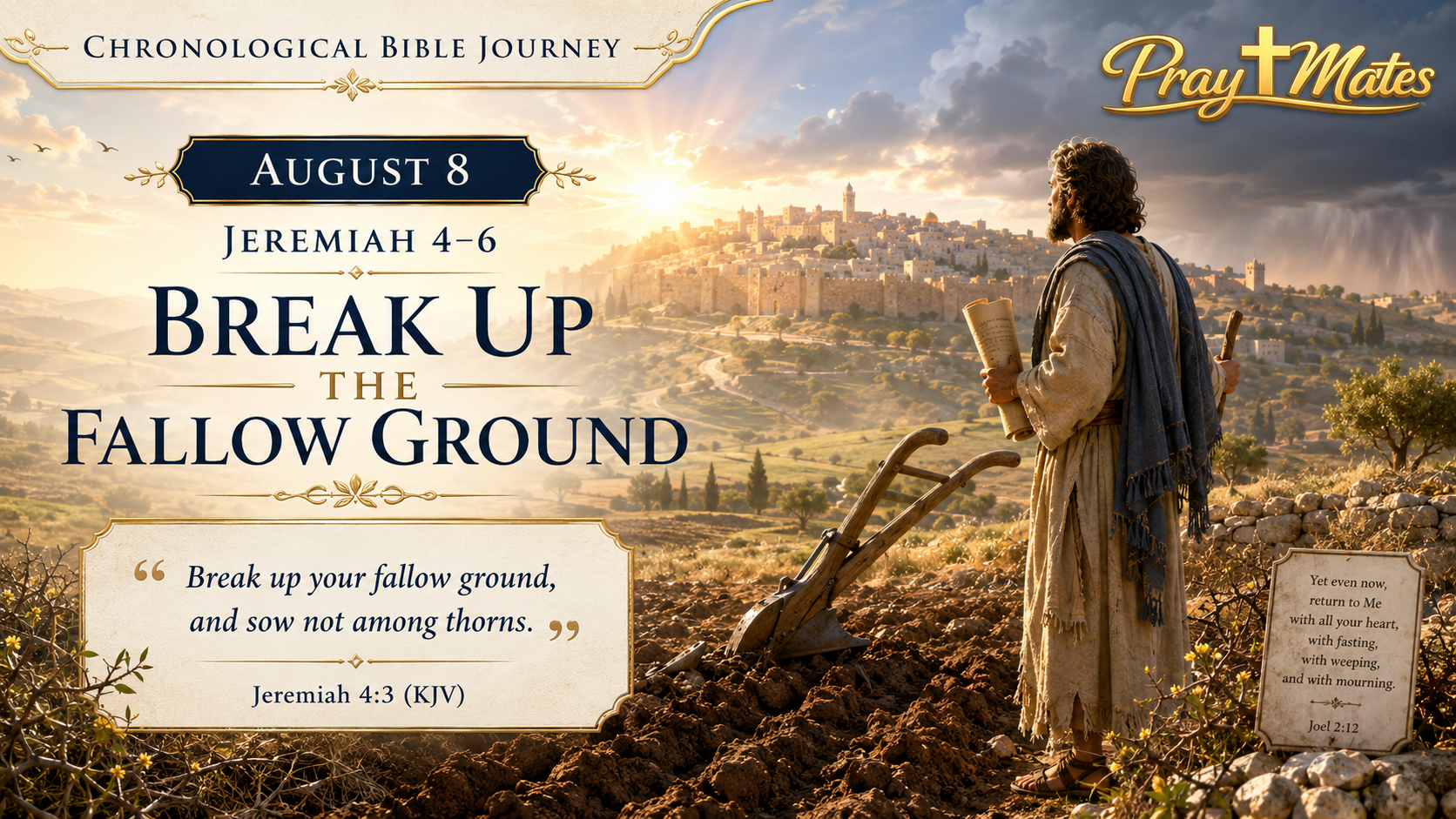
Break Up the Fallow Ground
Break Up the Fallow Ground
SCRIPTURE READING:
Jeremiah 4-6
SCRIPTURE:
Jeremiah 4
¹ If thou wilt return, O Israel, saith the LORD, return unto me: and if thou wilt put away thine abominations out of my sight, then shalt thou not remove.
² And thou shalt swear, The LORD liveth, in truth, in judgment, and in righteousness; and the nations shall bless themselves in him, and in him shall they glory.
³ For thus saith the LORD to the men of Judah and Jerusalem, Break up your fallow ground, and sow not among thorns.
⁴ Circumcise yourselves to the LORD, and take away the foreskins of your heart, ye men of Judah and inhabitants of Jerusalem: lest my fury come forth like fire, and burn that none can quench it, because of the evil of your doings.
⁵ Declare ye in Judah, and publish in Jerusalem; and say, Blow ye the trumpet in the land: cry, gather together, and say, Assemble yourselves, and let us go into the defenced cities.
⁶ Set up the standard toward Zion: retire, stay not: for I will bring evil from the north, and a great destruction.
⁷ The lion is come up from his thicket, and the destroyer of the Gentiles is on his way; he is gone forth from his place to make thy land desolate; and thy cities shall be laid waste, without an inhabitant.
⁸ For this gird you with sackcloth, lament and howl: for the fierce anger of the LORD is not turned back from us.
⁹ And it shall come to pass at that day, saith the LORD, that the heart of the king shall perish, and the heart of the princes; and the priests shall be astonished, and the prophets shall wonder.
¹⁰ Then said I, Ah, Lord GOD! surely thou hast greatly deceived this people and Jerusalem, saying, Ye shall have peace; whereas the sword reacheth unto the soul.
¹¹ At that time shall it be said to this people and to Jerusalem, A dry wind of the high places in the wilderness toward the daughter of my people, not to fan, nor to cleanse,
¹² Even a full wind from those places shall come unto me: now also will I give sentence against them.
¹³ Behold, he shall come up as clouds, and his chariots shall be as a whirlwind: his horses are swifter than eagles. Woe unto us! for we are spoiled.
¹⁴ O Jerusalem, wash thine heart from wickedness, that thou mayest be saved. How long shall thy vain thoughts lodge within thee?
¹⁵ For a voice declareth from Dan, and publisheth affliction from mount Ephraim.
¹⁶ Make ye mention to the nations; behold, publish against Jerusalem, that watchers come from a far country, and give out their voice against the cities of Judah.
¹⁷ As keepers of a field, are they against her round about; because she hath been rebellious against me, saith the LORD.
¹⁸ Thy way and thy doings have procured these things unto thee; this is thy wickedness, because it is bitter, because it reacheth unto thine heart.
¹⁹ My bowels, my bowels! I am pained at my very heart; my heart maketh a noise in me; I cannot hold my peace, because thou hast heard, O my soul, the sound of the trumpet, the alarm of war.
²⁰ Destruction upon destruction is cried; for the whole land is spoiled: suddenly are my tents spoiled, and my curtains in a moment.
²¹ How long shall I see the standard, and hear the sound of the trumpet?
²² For my people is foolish, they have not known me; they are sottish children, and they have none understanding: they are wise to do evil, but to do good they have no knowledge.
²³ I beheld the earth, and, lo, it was without form, and void; and the heavens, and they had no light.
²⁴ I beheld the mountains, and, lo, they trembled, and all the hills moved lightly.
²⁵ I beheld, and, lo, there was no man, and all the birds of the heavens were fled.
²⁶ I beheld, and, lo, the fruitful place was a wilderness, and all the cities thereof were broken down at the presence of the LORD, and by his fierce anger.
²⁷ For thus hath the LORD said, The whole land shall be desolate; yet will I not make a full end.
²⁸ For this shall the earth mourn, and the heavens above be black: because I have spoken it, I have purposed it, and will not repent, neither will I turn back from it.
²⁹ The whole city shall flee for the noise of the horsemen and bowmen; they shall go into thickets, and climb up upon the rocks: every city shall be forsaken, and not a man dwell therein.
³⁰ And when thou art spoiled, what wilt thou do? Though thou clothest thyself with crimson, though thou deckest thee with ornaments of gold, though thou rentest thy face with painting, in vain shalt thou make thyself fair; thy lovers will despise thee, they will seek thy life.
³¹ For I have heard a voice as of a woman in travail, and the anguish as of her that bringeth forth her first child, the voice of the daughter of Zion, that bewaileth herself, that spreadeth her hands, saying, Woe is me now! for my soul is wearied because of murderers.
Jeremiah 5
¹ Run ye to and fro through the streets of Jerusalem, and see now, and know, and seek in the broad places thereof, if ye can find a man, if there be any that executeth judgment, that seeketh the truth; and I will pardon it.
² And though they say, The LORD liveth; surely they swear falsely.
³ O LORD, are not thine eyes upon the truth? thou hast stricken them, but they have not grieved; thou hast consumed them, but they have refused to receive correction: they have made their faces harder than a rock; they have refused to return.
⁴ Therefore I said, Surely these are poor; they are foolish: for they know not the way of the LORD, nor the judgment of their God.
⁵ I will get me unto the great men, and will speak unto them; for they have known the way of the LORD, and the judgment of their God: but these have altogether broken the yoke, and burst the bonds.
⁶ Wherefore a lion out of the forest shall slay them, and a wolf of the evenings shall spoil them, a leopard shall watch over their cities: every one that goeth out thence shall be torn in pieces: because their transgressions are many, and their backslidings are increased.
⁷ How shall I pardon thee for this? thy children have forsaken me, and sworn by them that are no gods: when I had fed them to the full, they then committed adultery, and assembled themselves by troops in the harlots' houses.
⁸ They were as fed horses in the morning: every one neighed after his neighbour's wife.
⁹ Shall I not visit for these things? saith the LORD: and shall not my soul be avenged on such a nation as this?
¹⁰ Go ye up upon her walls, and destroy; but make not a full end: take away her battlements; for they are not the LORD's.
¹¹ For the house of Israel and the house of Judah have dealt very treacherously against me, saith the LORD.
¹² They have belied the LORD, and said, It is not he; neither shall evil come upon us; neither shall we see sword nor famine:
¹³ And the prophets shall become wind, and the word is not in them: thus shall it be done unto them.
¹⁴ Wherefore thus saith the LORD God of hosts, Because ye speak this word, behold, I will make my words in thy mouth fire, and this people wood, and it shall devour them.
¹⁵ Lo, I will bring a nation upon you from far, O house of Israel, saith the LORD: it is a mighty nation, it is an ancient nation, a nation whose language thou knowest not, neither understandest what they say.
¹⁶ Their quiver is as an open sepulchre, they are all mighty men.
¹⁷ And they shall eat up thine harvest, and thy bread, which thy sons and thy daughters should eat: they shall eat up thy flocks and thine herds: they shall eat up thy vines and thy fig trees: they shall impoverish thy fenced cities, wherein thou trustedst, with the sword.
¹⁸ Nevertheless in those days, saith the LORD, I will not make a full end with you.
¹⁹ And it shall come to pass, when ye shall say, Wherefore doeth the LORD our God all these things unto us? then shalt thou answer them, Like as ye have forsaken me, and served strange gods in your land, so shall ye serve strangers in a land that is not yours.
²⁰ Declare this in the house of Jacob, and publish it in Judah, saying,
²¹ Hear now this, O foolish people, and without understanding; which have eyes, and see not; which have ears, and hear not:
²² Fear ye not me? saith the LORD: will ye not tremble at my presence, which have placed the sand for the bound of the sea by a perpetual decree, that it cannot pass it: and though the waves thereof toss themselves, yet can they not prevail; though they roar, yet can they not pass over it?
²³ But this people hath a revolting and a rebellious heart; they are revolted and gone.
²⁴ Neither say they in their heart, Let us now fear the LORD our God, that giveth rain, both the former and the latter, in his season: he reserveth unto us the appointed weeks of the harvest.
²⁵ Your iniquities have turned away these things, and your sins have withholden good things from you.
²⁶ For among my people are found wicked men: they lay wait, as he that setteth snares; they set a trap, they catch men.
²⁷ As a cage is full of birds, so are their houses full of deceit: therefore they are become great, and waxen rich.
²⁸ They are waxen fat, they shine: yea, they overpass the deeds of the wicked: they judge not the cause, the cause of the fatherless, yet they prosper; and the right of the needy do they not judge.
²⁹ Shall I not visit for these things? saith the LORD: shall not my soul be avenged on such a nation as this?
³⁰ A wonderful and horrible thing is committed in the land;
³¹ The prophets prophesy falsely, and the priests bear rule by their means; and my people love to have it so: and what will ye do in the end thereof?
Jeremiah 6
¹ O ye children of Benjamin, gather yourselves to flee out of the midst of Jerusalem, and blow the trumpet in Tekoa, and set up a sign of fire in Beth-haccerem: for evil appeareth out of the north, and great destruction.
² I have likened the daughter of Zion to a comely and delicate woman.
³ The shepherds with their flocks shall come unto her; they shall pitch their tents against her round about; they shall feed every one in his place.
⁴ Prepare ye war against her; arise, and let us go up at noon. Woe unto us! for the day goeth away, for the shadows of the evening are stretched out.
⁵ Arise, and let us go by night, and let us destroy her palaces.
⁶ For thus hath the LORD of hosts said, Hew ye down trees, and cast a mount against Jerusalem: this is the city to be visited; she is wholly oppression in the midst of her.
⁷ As a fountain casteth out her waters, so she casteth out her wickedness: violence and spoil is heard in her; before me continually is grief and wounds.
⁸ Be thou instructed, O Jerusalem, lest my soul depart from thee; lest I make thee desolate, a land not inhabited.
⁹ Thus saith the LORD of hosts, They shall throughly glean the remnant of Israel as a vine: turn back thine hand as a grapegatherer into the baskets.
¹⁰ To whom shall I speak, and give warning, that they may hear? behold, their ear is uncircumcised, and they cannot hearken: behold, the word of the LORD is unto them a reproach; they have no delight in it.
¹¹ Therefore I am full of the fury of the LORD; I am weary with holding in: I will pour it out upon the children abroad, and upon the assembly of young men together: for even the husband with the wife shall be taken, the aged with him that is full of days.
¹² And their houses shall be turned unto others, with their fields and wives together: for I will stretch out my hand upon the inhabitants of the land, saith the LORD.
¹³ For from the least of them even unto the greatest of them every one is given to covetousness; and from the prophet even unto the priest every one dealeth falsely.
¹⁴ They have healed also the hurt of the daughter of my people slightly, saying, Peace, peace; when there is no peace.
¹⁵ Were they ashamed when they had committed abomination? nay, they were not at all ashamed, neither could they blush: therefore they shall fall among them that fall: at the time that I visit them they shall be cast down, saith the LORD.
¹⁶ Thus saith the LORD, Stand ye in the ways, and see, and ask for the old paths, where is the good way, and walk therein, and ye shall find rest for your souls. But they said, We will not walk therein.
¹⁷ Also I set watchmen over you, saying, Hearken to the sound of the trumpet. But they said, We will not hearken.
¹⁸ Therefore hear, ye nations, and know, O congregation, what is among them.
¹⁹ Hear, O earth: behold, I will bring evil upon this people, even the fruit of their thoughts, because they have not hearkened unto my words, nor to my law, but rejected it.
²⁰ To what purpose cometh there to me incense from Sheba, and the sweet cane from a far country? your burnt offerings are not acceptable, nor your sacrifices sweet unto me.
²¹ Therefore thus saith the LORD, Behold, I will lay stumblingblocks before this people, and the fathers and the sons together shall fall upon them; the neighbour and his friend shall perish.
²² Thus saith the LORD, Behold, a people cometh from the north country, and a great nation shall be raised from the sides of the earth.
²³ They shall lay hold on bow and spear; they are cruel, and have no mercy; their voice roareth like the sea; and they ride upon horses, set in array as men for war against thee, O daughter of Zion.
²⁴ We have heard the fame thereof: our hands wax feeble: anguish hath taken hold of us, and pain, as of a woman in travail.
²⁵ Go not forth into the field, nor walk by the way; for the sword of the enemy and fear is on every side.
²⁶ O daughter of my people, gird thee with sackcloth, and wallow thyself in ashes: make thee mourning, as for an only son, most bitter lamentation: for the spoiler shall suddenly come upon us.
²⁷ I have set thee for a tower and a fortress among my people, that thou mayest know and try their way.
²⁸ They are all grievous revolters, walking with slanders: they are brass and iron; they are all corrupters.
²⁹ The bellows are burned, the lead is consumed of the fire; the founder melteth in vain: for the wicked are not plucked away.
³⁰ Reprobate silver shall men call them, because the LORD hath rejected them.
DEVOTIONAL:
Jeremiah 4 begins with the possibility of return, but the LORD defines its substance. Israel must put away abominations, swear in truth, judgment, and righteousness, and become a means of blessing among the nations. The command to break up fallow ground shifts the picture from religious performance to cultivated receptivity. Seed scattered over hardened, thorn-filled soil cannot produce covenant fruit. Likewise, circumcision of the flesh without circumcision of the heart cannot restrain rebellion. Torah already demanded inward love and heart allegiance, and Jeremiah applies that covenant truth to a people whose worship had become detached from obedience. Repentance is not adding spiritual language to an unchanged field. It is allowing God's word to cut, clear, and reorder the interior life from which conduct grows.
The coming invader from the north is described as lion, whirlwind, and advancing army. Jeremiah does not observe this prospect with detached satisfaction. His anguish is bodily: his heart pounds, and he cannot keep silent because he hears the trumpet of war. Faithful proclamation can include grief over the very judgment it announces. The prophet then sees the land “without form, and void,” echoing Genesis to portray covenant rebellion as a movement toward decreation. Yet even in this devastating vision the LORD says, “Yet will I not make a full end.” Judgment is real, but God's redemptive purpose is not exhausted. The remnant hope prevents covenant discipline from being confused with the cancellation of every promise made to Israel.
Chapters 5 and 6 expose the social anatomy of corruption. Jeremiah searches Jerusalem for someone who executes judgment and seeks truth, but deceit crosses class lines. The poor do not know the way of the LORD, while the great have broken the yoke with greater knowledge and therefore greater accountability. Prophets speak falsely, priests exercise power through their influence, and the people prefer it so. The cry of “Peace, peace” treats a mortal wound as superficial. False reassurance is not compassion when it shields people from repentance. God calls Judah to ask for the old paths, the good way revealed in covenant faithfulness, but they refuse to walk in it and reject the watchmen's trumpet. Their resistance is not lack of information; it is settled unwillingness.
Jesus enters this prophetic landscape as the One who both announces the kingdom and bears judgment for his people. He weeps over Jerusalem, refuses the flattering peace of religious leaders, and compares hearers to different soils. At the cross, the innocent Messiah experiences the curse produced by human rebellion, and in resurrection he begins the new creation that Jeremiah's decreation imagery makes necessary. The gospel does not cultivate the old heart through determination alone. It grants forgiveness and the Holy Spirit, who circumcises the heart and produces love, truth, and obedience. Those saved by grace are therefore called to become good soil: receiving the word, abandoning false peace, and bearing fruit that blesses neighbors rather than merely decorating a religious identity.
In daily life, name the thorns before asking why growth is weak. Unexamined resentment, constant distraction, concealed lust, unmanaged debt, or the need to appear right can harden the soil around God's word. Set aside time for honest prayer, make a specific confession to someone you have harmed, and replace vague intentions with an obedient next step. Within the family, do not pronounce peace over unresolved patterns merely to avoid tension; pursue reconciliation with truth, patience, and appropriate boundaries. At work, resist cultures where everyone knows a practice is misleading but no one will disturb it. In church, test comforting messages by the whole counsel of Scripture and welcome preaching that wounds in order to heal rather than soothing people into spiritual danger.
In U.S. civic life, these chapters commend truth-seeking as a civic virtue, because public peace cannot be built upon denied wounds or preferred falsehoods. Pray for careful investigation of violence, corruption, addiction, family breakdown, and institutional failure, along with wise reforms that address causes rather than merely managing appearances. Christians should show up as patient truth-seekers who reject propaganda, listen to affected neighbors, and pursue peace through righteousness instead of demanding quiet at the expense of justice.
DISCUSSION QUESTIONS:
What does the image of fallow ground reveal about repentance that remains only verbal?
How does Jeremiah's grief challenge the temptation to speak about judgment with coldness or superiority?
Why is the promise that God will not make a full end important for understanding Israel's place in the prophetic story?
How does Jesus answer both the need for heart circumcision and the threat of decreation?
Where have you accepted the words “peace, peace” while avoiding a wound that requires truthful care?
PRAYER:
ADORATION:
LORD of truth and mercy, you search every heart, warn before judgment, and preserve your covenant purpose even when human faithfulness collapses. You alone can turn desolation toward new creation.
CONFESSION:
We confess hardened ground, cultivated thorns, and our preference for comforting words that leave sin undisturbed. We have hidden behind group habits, blamed other classes of people, and resisted watchmen who challenged our peace.
THANKSGIVING:
Thank you for the tears of Jesus over sinners, for the cross where judgment was borne, and for the resurrection that announces new creation. Thank you that your Spirit can make resistant hearts receptive and fruitful.
SUPPLICATION – GENERAL:
Plow deeply through our excuses. Give us courage to face wounds, wisdom to repair what can be repaired, and endurance to walk the good path. Make families and churches places where truth and mercy labor together.
SUPPLICATION – U.S. / CIVIC:
Grant our communities an honest understanding of their wounds. Protect investigators and caregivers, guide reforms with evidence and compassion, and restrain those who profit from confusion. Help believers pursue just peace without exaggeration or denial.
SCRIPTURE:
³ For thus saith the LORD to the men of Judah and Jerusalem, Break up your fallow ground, and sow not among thorns.
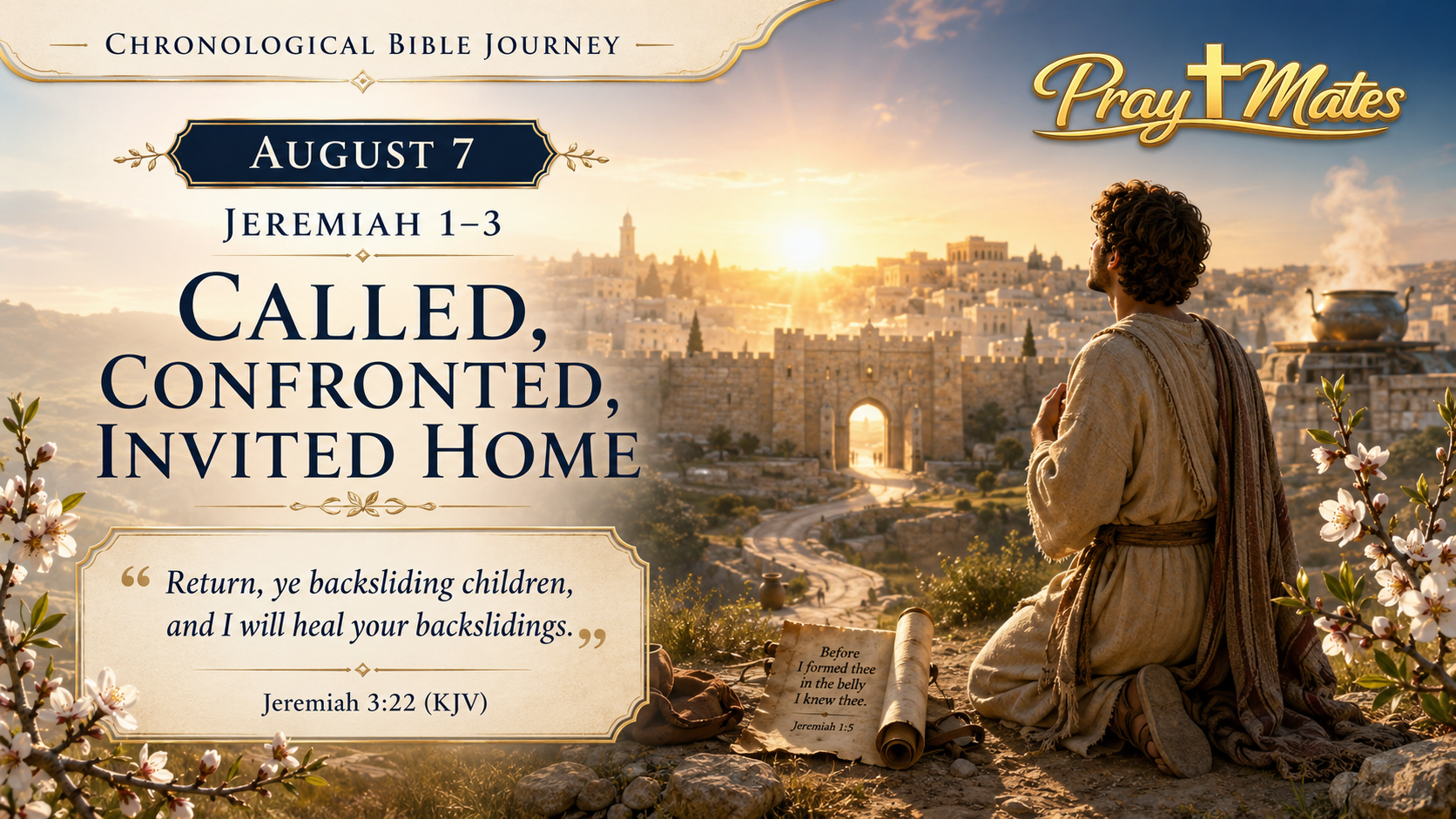
Called, Confronted, Invited Home
Called, Confronted, Invited Home
SCRIPTURE READING:
Jeremiah 1-3
SCRIPTURE:
Jeremiah 1
¹ The words of Jeremiah the son of Hilkiah, of the priests that were in Anathoth in the land of Benjamin:
² To whom the word of the LORD came in the days of Josiah the son of Amon king of Judah, in the thirteenth year of his reign.
³ It came also in the days of Jehoiakim the son of Josiah king of Judah, unto the end of the eleventh year of Zedekiah the son of Josiah king of Judah, unto the carrying away of Jerusalem captive in the fifth month.
⁴ Then the word of the LORD came unto me, saying,
⁵ Before I formed thee in the belly I knew thee; and before thou camest forth out of the womb I sanctified thee, and I ordained thee a prophet unto the nations.
⁶ Then said I, Ah, Lord GOD! behold, I cannot speak: for I am a child.
⁷ But the LORD said unto me, Say not, I am a child: for thou shalt go to all that I shall send thee, and whatsoever I command thee thou shalt speak.
⁸ Be not afraid of their faces: for I am with thee to deliver thee, saith the LORD.
⁹ Then the LORD put forth his hand, and touched my mouth. And the LORD said unto me, Behold, I have put my words in thy mouth.
¹⁰ See, I have this day set thee over the nations and over the kingdoms, to root out, and to pull down, and to destroy, and to throw down, to build, and to plant.
¹¹ Moreover the word of the LORD came unto me, saying, Jeremiah, what seest thou? And I said, I see a rod of an almond tree.
¹² Then said the LORD unto me, Thou hast well seen: for I will hasten my word to perform it.
¹³ And the word of the LORD came unto me the second time, saying, What seest thou? And I said, I see a seething pot; and the face thereof is toward the north.
¹⁴ Then the LORD said unto me, Out of the north an evil shall break forth upon all the inhabitants of the land.
¹⁵ For, lo, I will call all the families of the kingdoms of the north, saith the LORD; and they shall come, and they shall set every one his throne at the entering of the gates of Jerusalem, and against all the walls thereof round about, and against all the cities of Judah.
¹⁶ And I will utter my judgments against them touching all their wickedness, who have forsaken me, and have burned incense unto other gods, and worshipped the works of their own hands.
¹⁷ Thou therefore gird up thy loins, and arise, and speak unto them all that I command thee: be not dismayed at their faces, lest I confound thee before them.
¹⁸ For, behold, I have made thee this day a defenced city, and an iron pillar, and brasen walls against the whole land, against the kings of Judah, against the princes thereof, against the priests thereof, and against the people of the land.
¹⁹ And they shall fight against thee; but they shall not prevail against thee; for I am with thee, saith the LORD, to deliver thee.
Jeremiah 2
¹ Moreover the word of the LORD came to me, saying,
² Go and cry in the ears of Jerusalem, saying, Thus saith the LORD; I remember thee, the kindness of thy youth, the love of thine espousals, when thou wentest after me in the wilderness, in a land that was not sown.
³ Israel was holiness unto the LORD, and the firstfruits of his increase: all that devour him shall offend; evil shall come upon them, saith the LORD.
⁴ Hear ye the word of the LORD, O house of Jacob, and all the families of the house of Israel:
⁵ Thus saith the LORD, What iniquity have your fathers found in me, that they are gone far from me, and have walked after vanity, and are become vain?
⁶ Neither said they, Where is the LORD that brought us up out of the land of Egypt, that led us through the wilderness, through a land of deserts and of pits, through a land of drought, and of the shadow of death, through a land that no man passed through, and where no man dwelt?
⁷ And I brought you into a plentiful country, to eat the fruit thereof and the goodness thereof; but when ye entered, ye defiled my land, and made mine heritage an abomination.
⁸ The priests said not, Where is the LORD? and they that handle the law knew me not: the pastors also transgressed against me, and the prophets prophesied by Baal, and walked after things that do not profit.
⁹ Wherefore I will yet plead with you, saith the LORD, and with your children's children will I plead.
¹⁰ For pass over the isles of Chittim, and see; and send unto Kedar, and consider diligently, and see if there be such a thing.
¹¹ Hath a nation changed their gods, which are yet no gods? but my people have changed their glory for that which doth not profit.
¹² Be astonished, O ye heavens, at this, and be horribly afraid, be ye very desolate, saith the LORD.
¹³ For my people have committed two evils; they have forsaken me the fountain of living waters, and hewed them out cisterns, broken cisterns, that can hold no water.
¹⁴ Is Israel a servant? is he a homeborn slave? why is he spoiled?
¹⁵ The young lions roared upon him, and yelled, and they made his land waste: his cities are burned without inhabitant.
¹⁶ Also the children of Noph and Tahapanes have broken the crown of thy head.
¹⁷ Hast thou not procured this unto thyself, in that thou hast forsaken the LORD thy God, when he led thee by the way?
¹⁸ And now what hast thou to do in the way of Egypt, to drink the waters of Sihor? or what hast thou to do in the way of Assyria, to drink the waters of the river?
¹⁹ Thine own wickedness shall correct thee, and thy backslidings shall reprove thee: know therefore and see that it is an evil thing and bitter, that thou hast forsaken the LORD thy God, and that my fear is not in thee, saith the Lord GOD of hosts.
²⁰ For of old time I have broken thy yoke, and burst thy bands; and thou saidst, I will not transgress; when upon every high hill and under every green tree thou wanderest, playing the harlot.
²¹ Yet I had planted thee a noble vine, wholly a right seed: how then art thou turned into the degenerate plant of a strange vine unto me?
²² For though thou wash thee with nitre, and take thee much soap, yet thine iniquity is marked before me, saith the Lord GOD.
²³ How canst thou say, I am not polluted, I have not gone after Baalim? see thy way in the valley, know what thou hast done: thou art a swift dromedary traversing her ways;
²⁴ A wild ass used to the wilderness, that snuffeth up the wind at her pleasure; in her occasion who can turn her away? all they that seek her will not weary themselves; in her month they shall find her.
²⁵ Withhold thy foot from being unshod, and thy throat from thirst: but thou saidst, There is no hope: no; for I have loved strangers, and after them will I go.
²⁶ As the thief is ashamed when he is found, so is the house of Israel ashamed; they, their kings, their princes, and their priests, and their prophets,
²⁷ Saying to a stock, Thou art my father; and to a stone, Thou hast brought me forth: for they have turned their back unto me, and not their face: but in the time of their trouble they will say, Arise, and save us.
²⁸ But where are thy gods that thou hast made thee? let them arise, if they can save thee in the time of thy trouble: for according to the number of thy cities are thy gods, O Judah.
²⁹ Wherefore will ye plead with me? ye all have transgressed against me, saith the LORD.
³⁰ In vain have I smitten your children; they received no correction: your own sword hath devoured your prophets, like a destroying lion.
³¹ O generation, see ye the word of the LORD. Have I been a wilderness unto Israel? a land of darkness? wherefore say my people, We are lords; we will come no more unto thee?
³² Can a maid forget her ornaments, or a bride her attire? yet my people have forgotten me days without number.
³³ Why trimmest thou thy way to seek love? therefore hast thou also taught the wicked ones thy ways.
³⁴ Also in thy skirts is found the blood of the souls of the poor innocents: I have not found it by secret search, but upon all these.
³⁵ Yet thou sayest, Because I am innocent, surely his anger shall turn from me. Behold, I will plead with thee, because thou sayest, I have not sinned.
³⁶ Why gaddest thou about so much to change thy way? thou also shalt be ashamed of Egypt, as thou wast ashamed of Assyria.
³⁷ Yea, thou shalt go forth from him, and thine hands upon thine head: for the LORD hath rejected thy confidences, and thou shalt not prosper in them.
Jeremiah 3
¹ They say, If a man put away his wife, and she go from him, and become another man's, shall he return unto her again? shall not that land be greatly polluted? but thou hast played the harlot with many lovers; yet return again to me, saith the LORD.
² Lift up thine eyes unto the high places, and see where thou hast not been lien with. In the ways hast thou sat for them, as the Arabian in the wilderness; and thou hast polluted the land with thy whoredoms and with thy wickedness.
³ Therefore the showers have been withholden, and there hath been no latter rain; and thou hadst a whore's forehead, thou refusedst to be ashamed.
⁴ Wilt thou not from this time cry unto me, My father, thou art the guide of my youth?
⁵ Will he reserve his anger for ever? will he keep it to the end? Behold, thou hast spoken and done evil things as thou couldest.
⁶ The LORD said also unto me in the days of Josiah the king, Hast thou seen that which backsliding Israel hath done? she is gone up upon every high mountain and under every green tree, and there hath played the harlot.
⁷ And I said after she had done all these things, Turn thou unto me. But she returned not. And her treacherous sister Judah saw it.
⁸ And I saw, when for all the causes whereby backsliding Israel committed adultery I had put her away, and given her a bill of divorce; yet her treacherous sister Judah feared not, but went and played the harlot also.
⁹ And it came to pass through the lightness of her whoredom, that she defiled the land, and committed adultery with stones and with stocks.
¹⁰ And yet for all this her treacherous sister Judah hath not turned unto me with her whole heart, but feignedly, saith the LORD.
¹¹ And the LORD said unto me, The backsliding Israel hath justified herself more than treacherous Judah.
¹² Go and proclaim these words toward the north, and say, Return, thou backsliding Israel, saith the LORD; and I will not cause mine anger to fall upon you: for I am merciful, saith the LORD, and I will not keep anger for ever.
¹³ Only acknowledge thine iniquity, that thou hast transgressed against the LORD thy God, and hast scattered thy ways to the strangers under every green tree, and ye have not obeyed my voice, saith the LORD.
¹⁴ Turn, O backsliding children, saith the LORD; for I am married unto you: and I will take you one of a city, and two of a family, and I will bring you to Zion:
¹⁵ And I will give you pastors according to mine heart, which shall feed you with knowledge and understanding.
¹⁶ And it shall come to pass, when ye be multiplied and increased in the land, in those days, saith the LORD, they shall say no more, The ark of the covenant of the LORD: neither shall it come to mind: neither shall they remember it; neither shall they visit it; neither shall that be done any more.
¹⁷ At that time they shall call Jerusalem the throne of the LORD; and all the nations shall be gathered unto it, to the name of the LORD, to Jerusalem: neither shall they walk any more after the imagination of their evil heart.
¹⁸ In those days the house of Judah shall walk with the house of Israel, and they shall come together out of the land of the north to the land that I have given for an inheritance unto your fathers.
¹⁹ But I said, How shall I put thee among the children, and give thee a pleasant land, a goodly heritage of the hosts of nations? and I said, Thou shalt call me, My father; and shalt not turn away from me.
²⁰ Surely as a wife treacherously departeth from her husband, so have ye dealt treacherously with me, O house of Israel, saith the LORD.
²¹ A voice was heard upon the high places, weeping and supplications of the children of Israel: for they have perverted their way, and they have forgotten the LORD their God.
²² Return, ye backsliding children, and I will heal your backslidings. Behold, we come unto thee; for thou art the LORD our God.
²³ Truly in vain is salvation hoped for from the hills, and from the multitude of mountains: truly in the LORD our God is the salvation of Israel.
²⁴ For shame hath devoured the labour of our fathers from our youth; their flocks and their herds, their sons and their daughters.
²⁵ We lie down in our shame, and our confusion covereth us: for we have sinned against the LORD our God, we and our fathers, from our youth even unto this day, and have not obeyed the voice of the LORD our God.
DEVOTIONAL:
Jeremiah's book opens by locating his ministry across the reigns of Judah's final kings, from Josiah's thirteenth year until Jerusalem's captivity. His call is therefore not a momentary assignment but a costly vocation stretched across national decline. Before Jeremiah formed an argument about his ability, the LORD declared divine knowledge, consecration, and appointment. “Before I formed thee in the belly I knew thee” speaks first about God's sovereign claim upon this prophet, not a generic promise that every personal ambition is preapproved. Jeremiah objects that he is a child and cannot speak, but the answer is not confidence coaching. God places his own words in the prophet's mouth, commands him to go, and promises presence amid opposition. The authority belongs to the Sender; the servant's courage rests in obedience and divine companionship.
The almond branch and the seething pot define the ministry. The Hebrew wordplay behind the almond branch links the early-waking tree with the LORD's watchfulness over his word. Judgment from the north is not empty rhetoric. Judah's rulers, priests, and people have forsaken the covenant God and worshiped the work of their hands. Jeremiah is commissioned both to tear down and to build, because prophetic truth exposes false foundations while preserving the possibility of repentance and future restoration. God makes him like a defended city, iron pillar, and bronze walls, yet does not promise an easy reception. Faithfulness can include being fought by the very people one is sent to serve. The decisive assurance is not that conflict disappears but that rebellion will not finally overturn the word God has entrusted.
Chapters 2 and 3 portray covenant sin as astonishing ingratitude and marital treachery. Israel followed the LORD through the wilderness, received a fruitful land, and then exchanged glory for what could not profit. The two evils are inseparable: forsaking the fountain of living waters and carving broken cisterns that cannot hold water. Idolatry is not merely choosing the wrong object in a religious marketplace. It is abandoning the Giver of life and becoming shaped by empty substitutes. Yet the repeated command is “Return.” The LORD names adultery without softening it, distinguishes the northern kingdom's backsliding from Judah's feigned reform, and still promises merciful welcome to those who acknowledge their iniquity. Israel and Judah are envisioned together, gathered to Zion under shepherds who feed with knowledge and understanding.
Jesus brings these themes into their fullest light. He is the Word made flesh who speaks only what the Father gives, the faithful prophet rejected in Jerusalem, and the living water offered to the thirsty. He is also the covenant Bridegroom who bears the shame and judgment deserved by an unfaithful people in order to cleanse and reclaim them. Grace does not deny spiritual adultery; it pays its dreadful cost and opens a real path home. Through faith in Messiah, sinners receive forgiveness, the Spirit's indwelling presence, and a new allegiance that begins to heal their wandering desires. Christian witness therefore requires both Jeremiah's firmness and God's invitation: tell the truth about broken cisterns, refuse fear of faces, and call people to return to the Lord who alone can heal backsliding.
In daily life, distinguish between insecurity and disobedience. Jeremiah's awareness of weakness did not disqualify him, but it could not become permission to ignore God's command. Prepare carefully, speak accurately, and let Scripture rather than outrage supply your message. Identify the cistern you keep repairing even though it cannot hold life: approval, secret pleasure, financial control, endless information, or another person's dependence upon you. In family life, practice truthful return by confessing specific wrongs and rebuilding trust patiently. At work, refuse assignments that require deception, but do not confuse harshness with courage. In church life, receive shepherding that feeds knowledge and understanding, and support servants whose faithfulness may be costly even when it is not dramatic.
In U.S. civic life, Jeremiah commends principled courage, since public truth is easily muted by fear of influential faces. Pray for whistleblowers, judges, journalists, pastors, educators, and ordinary workers who must speak accurately under pressure, and for institutions willing to correct rather than punish responsible truth-telling. Christians should show up as accountable witnesses who reject both cowardly silence and reckless accusation, grounding moral speech in evidence, humility, and love of neighbor.
DISCUSSION QUESTIONS:
What parts of Jeremiah's call belong uniquely to his prophetic office, and what principles apply to every believer's obedience?
Why does God combine the work of rooting out and tearing down with building and planting?
What makes a broken cistern attractive even after it has repeatedly failed to satisfy?
How does Jesus fulfill the roles of faithful Prophet, living water, and covenant Bridegroom?
Where are you being called to speak or return without making fear the governing factor?
PRAYER:
ADORATION:
Sovereign LORD, you form your servants, watch over your word, expose every false refuge, and remain the fountain of living waters. Your mercy calls wanderers home without compromising your holiness.
CONFESSION:
We confess that we have feared human faces, trusted our own words, and repaired broken cisterns instead of returning to you. Our repentance has often been partial, outward, or delayed until consequences became painful.
THANKSGIVING:
Thank you for Jesus, the faithful Word and Bridegroom, who was rejected yet did not turn from the Father's will. Thank you for living water, forgiveness, and the Spirit who teaches unfaithful hearts to love you again.
SUPPLICATION – GENERAL:
Put your truth deeply within us before we speak it. Give courage without arrogance, repentance without despair, and shepherds who feed your people with understanding. Heal backsliding in homes, ministries, and individual lives.
SUPPLICATION – U.S. / CIVIC:
Protect truthful witnesses from intimidation and false charges. Give integrity to institutions that investigate wrongdoing, wisdom to those who publish serious claims, and humility to citizens who must revise mistaken judgments. Make your church trustworthy in speech and conduct.
SCRIPTURE:
⁸ Be not afraid of their faces: for I am with thee to deliver thee, saith the LORD.
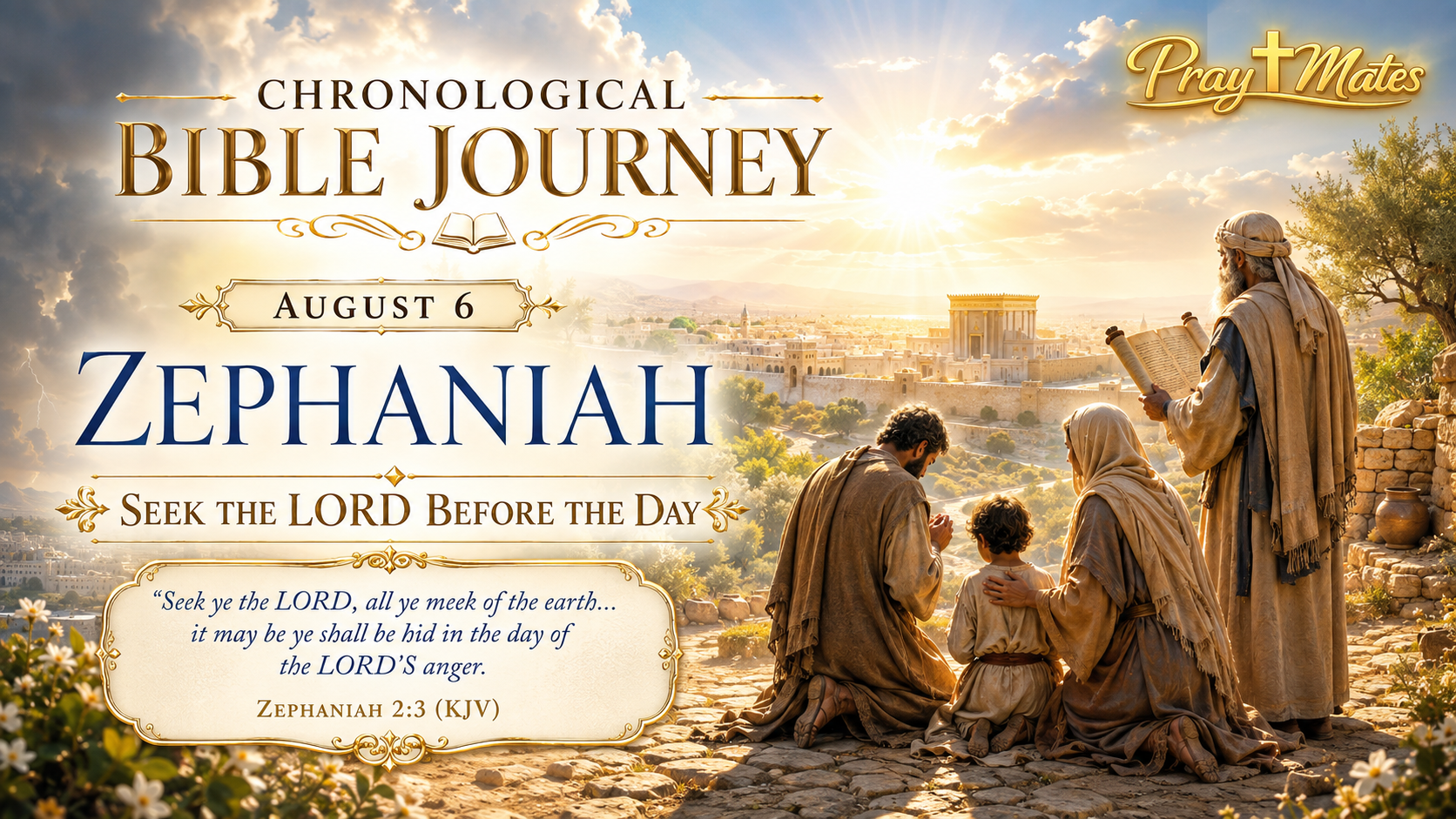
Seek the LORD Before the Day
Seek the LORD Before the Day
SCRIPTURE READING:
Zephaniah
SCRIPTURE:
Zephaniah 1
¹ The word of the LORD which came unto Zephaniah the son of Cushi, the son of Gedaliah, the son of Amariah, the son of Hizkiah, in the days of Josiah the son of Amon, king of Judah.
² I will utterly consume all things from off the land, saith the LORD.
³ I will consume man and beast; I will consume the fowls of the heaven, and the fishes of the sea, and the stumblingblocks with the wicked; and I will cut off man from off the land, saith the LORD.
⁴ I will also stretch out mine hand upon Judah, and upon all the inhabitants of Jerusalem; and I will cut off the remnant of Baal from this place, and the name of the Chemarims with the priests;
⁵ And them that worship the host of heaven upon the housetops; and them that worship and that swear by the LORD, and that swear by Malcham;
⁶ And them that are turned back from the LORD; and those that have not sought the LORD, nor enquired for him.
⁷ Hold thy peace at the presence of the Lord GOD: for the day of the LORD is at hand: for the LORD hath prepared a sacrifice, he hath bid his guests.
⁸ And it shall come to pass in the day of the LORD's sacrifice, that I will punish the princes, and the king's children, and all such as are clothed with strange apparel.
⁹ In the same day also will I punish all those that leap on the threshold, which fill their masters' houses with violence and deceit.
¹⁰ And it shall come to pass in that day, saith the LORD, that there shall be the noise of a cry from the fish gate, and an howling from the second, and a great crashing from the hills.
¹¹ Howl, ye inhabitants of Maktesh, for all the merchant people are cut down; all they that bear silver are cut off.
¹² And it shall come to pass at that time, that I will search Jerusalem with candles, and punish the men that are settled on their lees: that say in their heart, The LORD will not do good, neither will he do evil.
¹³ Therefore their goods shall become a booty, and their houses a desolation: they shall also build houses, but not inhabit them; and they shall plant vineyards, but not drink the wine thereof.
¹⁴ The great day of the LORD is near, it is near, and hasteth greatly, even the voice of the day of the LORD: the mighty man shall cry there bitterly.
¹⁵ That day is a day of wrath, a day of trouble and distress, a day of wasteness and desolation, a day of darkness and gloominess, a day of clouds and thick darkness,
¹⁶ A day of the trumpet and alarm against the fenced cities, and against the high towers.
¹⁷ And I will bring distress upon men, that they shall walk like blind men, because they have sinned against the LORD: and their blood shall be poured out as dust, and their flesh as the dung.
¹⁸ Neither their silver nor their gold shall be able to deliver them in the day of the LORD's wrath; but the whole land shall be devoured by the fire of his jealousy: for he shall make even a speedy riddance of all them that dwell in the land.
Zephaniah 2
¹ Gather yourselves together, yea, gather together, O nation not desired;
² Before the decree bring forth, before the day pass as the chaff, before the fierce anger of the LORD come upon you, before the day of the LORD's anger come upon you.
³ Seek ye the LORD, all ye meek of the earth, which have wrought his judgment; seek righteousness, seek meekness: it may be ye shall be hid in the day of the LORD's anger.
⁴ For Gaza shall be forsaken, and Ashkelon a desolation: they shall drive out Ashdod at the noon day, and Ekron shall be rooted up.
⁵ Woe unto the inhabitants of the sea coast, the nation of the Cherethites! the word of the LORD is against you; O Canaan, the land of the Philistines, I will even destroy thee, that there shall be no inhabitant.
⁶ And the sea coast shall be dwellings and cottages for shepherds, and folds for flocks.
⁷ And the coast shall be for the remnant of the house of Judah; they shall feed thereupon: in the houses of Ashkelon shall they lie down in the evening: for the LORD their God shall visit them, and turn away their captivity.
⁸ I have heard the reproach of Moab, and the revilings of the children of Ammon, whereby they have reproached my people, and magnified themselves against their border.
⁹ Therefore as I live, saith the LORD of hosts, the God of Israel, Surely Moab shall be as Sodom, and the children of Ammon as Gomorrah, even the breeding of nettles, and saltpits, and a perpetual desolation: the residue of my people shall spoil them, and the remnant of my people shall possess them.
¹⁰ This shall they have for their pride, because they have reproached and magnified themselves against the people of the LORD of hosts.
¹¹ The LORD will be terrible unto them: for he will famish all the gods of the earth; and men shall worship him, every one from his place, even all the isles of the heathen.
¹² Ye Ethiopians also, ye shall be slain by my sword.
¹³ And he will stretch out his hand against the north, and destroy Assyria; and will make Nineveh a desolation, and dry like a wilderness.
¹⁴ And flocks shall lie down in the midst of her, all the beasts of the nations: both the cormorant and the bittern shall lodge in the upper lintels of it; their voice shall sing in the windows; desolation shall be in the thresholds: for he shall uncover the cedar work.
¹⁵ This is the rejoicing city that dwelt carelessly, that said in her heart, I am, and there is none beside me: how is she become a desolation, a place for beasts to lie down in! every one that passeth by her shall hiss, and wag his hand.
Zephaniah 3
¹ Woe to her that is filthy and polluted, to the oppressing city!
² She obeyed not the voice; she received not correction; she trusted not in the LORD; she drew not near to her God.
³ Her princes within her are roaring lions; her judges are evening wolves; they gnaw not the bones till the morrow.
⁴ Her prophets are light and treacherous persons: her priests have polluted the sanctuary, they have done violence to the law.
⁵ The just LORD is in the midst thereof; he will not do iniquity: every morning doth he bring his judgment to light, he faileth not; but the unjust knoweth no shame.
⁶ I have cut off the nations: their towers are desolate; I made their streets waste, that none passeth by: their cities are destroyed, so that there is no man, that there is none inhabitant.
⁷ I said, Surely thou wilt fear me, thou wilt receive instruction; so their dwelling should not be cut off, howsoever I punished them: but they rose early, and corrupted all their doings.
⁸ Therefore wait ye upon me, saith the LORD, until the day that I rise up to the prey: for my determination is to gather the nations, that I may assemble the kingdoms, to pour upon them mine indignation, even all my fierce anger: for all the earth shall be devoured with the fire of my jealousy.
⁹ For then will I turn to the people a pure language, that they may all call upon the name of the LORD, to serve him with one consent.
¹⁰ From beyond the rivers of Ethiopia my suppliants, even the daughter of my dispersed, shall bring mine offering.
¹¹ In that day shalt thou not be ashamed for all thy doings, wherein thou hast transgressed against me: for then I will take away out of the midst of thee them that rejoice in thy pride, and thou shalt no more be haughty because of my holy mountain.
¹² I will also leave in the midst of thee an afflicted and poor people, and they shall trust in the name of the LORD.
¹³ The remnant of Israel shall not do iniquity, nor speak lies; neither shall a deceitful tongue be found in their mouth: for they shall feed and lie down, and none shall make them afraid.
¹⁴ Sing, O daughter of Zion; shout, O Israel; be glad and rejoice with all the heart, O daughter of Jerusalem.
¹⁵ The LORD hath taken away thy judgments, he hath cast out thine enemy: the king of Israel, even the LORD, is in the midst of thee: thou shalt not see evil any more.
¹⁶ In that day it shall be said to Jerusalem, Fear thou not: and to Zion, Let not thine hands be slack.
¹⁷ The LORD thy God in the midst of thee is mighty; he will save, he will rejoice over thee with joy; he will rest in his love, he will joy over thee with singing.
¹⁸ I will gather them that are sorrowful for the solemn assembly, who are of thee, to whom the reproach of it was a burden.
¹⁹ Behold, at that time I will undo all that afflict thee: and I will save her that halteth, and gather her that was driven out; and I will get them praise and fame in every land where they have been put to shame.
²⁰ At that time will I bring you again, even in the time that I gather you: for I will make you a name and a praise among all people of the earth, when I turn back your captivity before your eyes, saith the LORD.
DEVOTIONAL:
Zephaniah prophesies in the days of Josiah, when public reform had begun but spiritual mixture still marked Judah. His opening words announce the day of the LORD with creation-wide severity. The language deliberately reverses the order of Genesis as man, beast, birds, and fish are swept into judgment. Sin is not a harmless private preference; it disorders the world entrusted to human stewardship and provokes the Creator who made it good. Zephaniah names overt Baal worship, devotion to the heavenly bodies, and a subtler divided allegiance among those who swear by the LORD while also swearing by Malcham. The covenant God will not be added to a shelf of competing securities. He searches Jerusalem with lamps and exposes those settled in complacency, convinced that God will neither act for good nor call evil to account.
The prophet's warning is not fatalism. Between the announcement and the judgment stands an urgent invitation: gather, seek the LORD, seek righteousness, seek meekness. Biblical meekness is not moral passivity. It is the posture of people who abandon self-exaltation, receive God's correction, and order their lives under his rule. The nations surrounding Judah are also addressed, from Philistia in the west to Assyria in the north. No border, commercial strength, military reputation, or proud city lies outside the LORD's jurisdiction. Nineveh says in her heart, “I am, and there is none beside me,” borrowing for herself the kind of ultimacy that belongs to God alone. The result is desolation. Pride makes a creature imagine independence; judgment reveals that every breath, institution, and civilization remains contingent upon the Creator.
Zephaniah 3 turns the indictment toward Jerusalem's officials, judges, prophets, and priests, yet it does not end with abandonment. The just LORD remains in the midst of the polluted city, bringing his judgment to light every morning. After purifying judgment, he promises a people who call upon his name with one consent, an afflicted and poor remnant who trust in him, and a restored Israel over whom he rejoices with singing. This promise honors Israel's continuing place in God's redemptive purpose. The nations are not blessed by erasing Zion but by being gathered to worship Israel's God. Judgment removes pride and falsehood so that communion can be restored. The King of Israel himself will be in the midst of his people, saving, gathering the outcast, and turning shame into praise.
The New Testament presents Jesus as the King who brings this prophetic pattern to fulfillment. At the cross, the day of judgment and the work of salvation meet. The sinless Messiah bears wrath for all who repent and believe, while his resurrection declares that evil, death, and every rival lord will not have the final word. Through him Jews and Gentiles call upon the same Lord without denying the particular promises made to Israel. The church now lives between the inauguration and completion of that day: warned against complacency, cleansed by grace, and sent to announce refuge in Christ. Zephaniah's final song prevents terror from becoming the last note. The God who exposes divided worship is also the God who delights to save and whose covenant love quiets the fears of his humbled people.
In daily life, examine where you have tried to maintain double allegiance. A person may confess Christ while allowing money, partisan identity, sexual desire, professional ambition, fear of rejection, or the promise of control to function as an alternate lord. Seeking the LORD means more than feeling concern; it includes changing schedules, ending dishonest arrangements, refusing spiritual substitutes, and practicing righteousness when no audience applauds. In the family, teach children that God's judgment makes choices meaningful and God's mercy makes repentance possible. At work, reject complacency that says wrongdoing will never be noticed, and do not mistake institutional silence for divine approval. In the church, cultivate reverence without despair, meekness without cowardice, and joyful worship grounded in the presence of the saving King.
In U.S. civic life, Zephaniah commends vigilance against complacency, because communities decay when citizens assume that corruption, violence, and spiritual indifference carry no consequence. Pray for a renewed concern for truth, for leaders who reject divided loyalties and hidden enrichment, and for protection of those pushed aside by powerful systems. Christians should show up as sober hopeful people who neither idolize the nation nor abandon their neighbors, but seek righteousness, practice meekness, and bear public witness to the coming reign of Christ.
DISCUSSION QUESTIONS:
How does Zephaniah's creation-reversing language deepen your understanding of the seriousness of sin?
Where does the prophecy expose divided allegiance rather than only obvious idolatry?
What do the remnant promises reveal about God's purposes for Israel and the nations?
How does Jesus unite the warning of the day of the LORD with the offer of salvation?
Which form of complacency in your private or public life needs to be replaced by watchful obedience?
PRAYER:
ADORATION:
LORD God, you are just in the midst of your people, mighty to save, and unrivaled among all powers. You bring hidden things to light, gather the scattered, and rejoice over those whom you redeem.
CONFESSION:
We confess divided hearts, practical atheism, and the complacent belief that you will not address our choices. We have spoken your name while leaning upon rival securities and have overlooked suffering that disturbed our comfort.
THANKSGIVING:
Thank you for the refuge offered before judgment, for the meekness produced by grace, and for the King of Israel who bore our condemnation. Thank you that Jesus gathers worshipers from the nations while confirming the faithfulness of your promises.
SUPPLICATION – GENERAL:
Teach us to seek you while the invitation stands. Purify our worship, steady fearful hands, restore those burdened by shame, and make our congregations truthful communities in which the weak are gathered and the proud learn repentance.
SUPPLICATION – U.S. / CIVIC:
Awaken our country from moral indifference. Give public servants undivided integrity, restrain violence and deceit, and strengthen local communities to care for displaced, poor, and forgotten people. Let Christians serve without national idolatry, despair, or contempt.
SCRIPTURE:
¹⁷ The LORD thy God in the midst of thee is mighty; he will save, he will rejoice over thee with joy; he will rest in his love, he will joy over thee with singing.
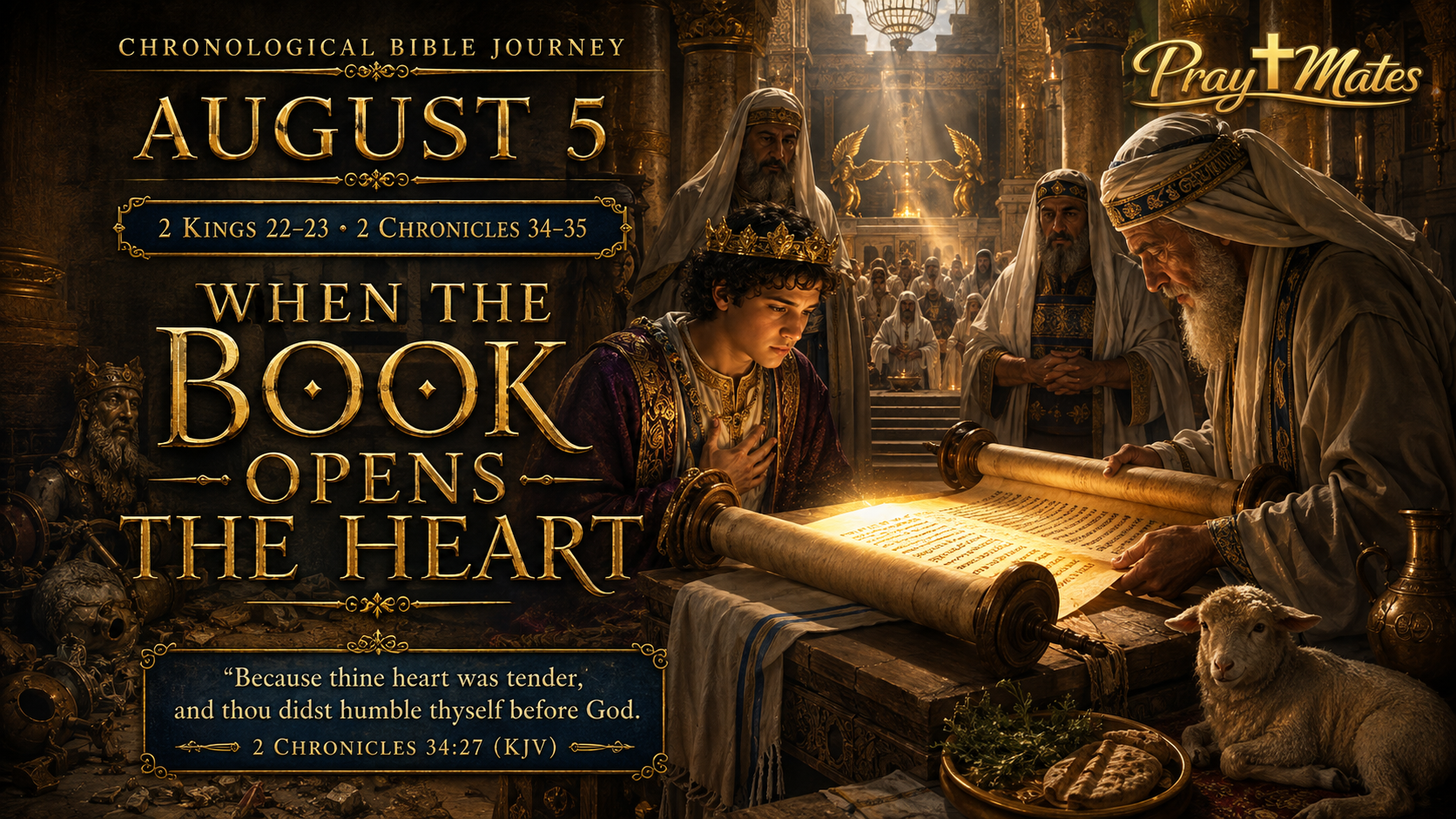
When the Book Opens the Heart
When the Book Opens the Heart
SCRIPTURE READING:
2 Kings 22-23; 2 Chronicles 34-35
SCRIPTURE:
2 Kings 22
¹ Josiah was eight years old when he began to reign, and he reigned thirty and one years in Jerusalem. And his mother's name was Jedidah, the daughter of Adaiah of Boscath.
² And he did that which was right in the sight of the LORD, and walked in all the way of David his father, and turned not aside to the right hand or to the left.
³ And it came to pass in the eighteenth year of king Josiah, that the king sent Shaphan the son of Azaliah, the son of Meshullam, the scribe, to the house of the LORD, saying,
⁴ Go up to Hilkiah the high priest, that he may sum the silver which is brought into the house of the LORD, which the keepers of the door have gathered of the people:
⁵ And let them deliver it into the hand of the doers of the work, that have the oversight of the house of the LORD: and let them give it to the doers of the work which is in the house of the LORD, to repair the breaches of the house,
⁶ Unto carpenters, and builders, and masons, and to buy timber and hewn stone to repair the house.
⁷ Howbeit there was no reckoning made with them of the money that was delivered into their hand, because they dealt faithfully.
⁸ And Hilkiah the high priest said unto Shaphan the scribe, I have found the book of the law in the house of the LORD. And Hilkiah gave the book to Shaphan, and he read it.
⁹ And Shaphan the scribe came to the king, and brought the king word again, and said, Thy servants have gathered the money that was found in the house, and have delivered it into the hand of them that do the work, that have the oversight of the house of the LORD.
¹⁰ And Shaphan the scribe shewed the king, saying, Hilkiah the priest hath delivered me a book. And Shaphan read it before the king.
¹¹ And it came to pass, when the king had heard the words of the book of the law, that he rent his clothes.
¹² And the king commanded Hilkiah the priest, and Ahikam the son of Shaphan, and Achbor the son of Michaiah, and Shaphan the scribe, and Asahiah a servant of the king's, saying,
¹³ Go ye, enquire of the LORD for me, and for the people, and for all Judah, concerning the words of this book that is found: for great is the wrath of the LORD that is kindled against us, because our fathers have not hearkened unto the words of this book, to do according unto all that which is written concerning us.
¹⁴ So Hilkiah the priest, and Ahikam, and Achbor, and Shaphan, and Asahiah, went unto Huldah the prophetess, the wife of Shallum the son of Tikvah, the son of Harhas, keeper of the wardrobe; (now she dwelt in Jerusalem in the college;) and they communed with her.
¹⁵ And she said unto them, Thus saith the LORD God of Israel, Tell the man that sent you to me,
¹⁶ Thus saith the LORD, Behold, I will bring evil upon this place, and upon the inhabitants thereof, even all the words of the book which the king of Judah hath read:
¹⁷ Because they have forsaken me, and have burned incense unto other gods, that they might provoke me to anger with all the works of their hands; therefore my wrath shall be kindled against this place, and shall not be quenched.
¹⁸ But to the king of Judah which sent you to enquire of the LORD, thus shall ye say to him, Thus saith the LORD God of Israel, As touching the words which thou hast heard;
¹⁹ Because thine heart was tender, and thou hast humbled thyself before the LORD, when thou heardest what I spake against this place, and against the inhabitants thereof, that they should become a desolation and a curse, and hast rent thy clothes, and wept before me; I also have heard thee, saith the LORD.
²⁰ Behold therefore, I will gather thee unto thy fathers, and thou shalt be gathered into thy grave in peace; and thine eyes shall not see all the evil which I will bring upon this place. And they brought the king word again.
2 Kings 23
¹ And the king sent, and they gathered unto him all the elders of Judah and of Jerusalem.
² And the king went up into the house of the LORD, and all the men of Judah and all the inhabitants of Jerusalem with him, and the priests, and the prophets, and all the people, both small and great: and he read in their ears all the words of the book of the covenant which was found in the house of the LORD.
³ And the king stood by a pillar, and made a covenant before the LORD, to walk after the LORD, and to keep his commandments and his testimonies and his statutes with all their heart and all their soul, to perform the words of this covenant that were written in this book. And all the people stood to the covenant.
⁴ And the king commanded Hilkiah the high priest, and the priests of the second order, and the keepers of the door, to bring forth out of the temple of the LORD all the vessels that were made for Baal, and for the grove, and for all the host of heaven: and he burned them without Jerusalem in the fields of Kidron, and carried the ashes of them unto Bethel.
⁵ And he put down the idolatrous priests, whom the kings of Judah had ordained to burn incense in the high places in the cities of Judah, and in the places round about Jerusalem; them also that burned incense unto Baal, to the sun, and to the moon, and to the planets, and to all the host of heaven.
⁶ And he brought out the grove from the house of the LORD, without Jerusalem, unto the brook Kidron, and burned it at the brook Kidron, and stamped it small to powder, and cast the powder thereof upon the graves of the children of the people.
⁷ And he brake down the houses of the sodomites, that were by the house of the LORD, where the women wove hangings for the grove.
⁸ And he brought all the priests out of the cities of Judah, and defiled the high places where the priests had burned incense, from Geba to Beer-sheba, and brake down the high places of the gates that were in the entering in of the gate of Joshua the governor of the city, which were on a man's left hand at the gate of the city.
⁹ Nevertheless the priests of the high places came not up to the altar of the LORD in Jerusalem, but they did eat of the unleavened bread among their brethren.
¹⁰ And he defiled Topheth, which is in the valley of the children of Hinnom, that no man might make his son or his daughter to pass through the fire to Molech.
¹¹ And he took away the horses that the kings of Judah had given to the sun, at the entering in of the house of the LORD, by the chamber of Nathan-melech the chamberlain, which was in the suburbs, and burned the chariots of the sun with fire.
¹² And the altars that were on the top of the upper chamber of Ahaz, which the kings of Judah had made, and the altars which Manasseh had made in the two courts of the house of the LORD, did the king beat down, and brake them down from thence, and cast the dust of them into the brook Kidron.
¹³ And the high places that were before Jerusalem, which were on the right hand of the mount of corruption, which Solomon the king of Israel had builded for Ashtoreth the abomination of the Zidonians, and for Chemosh the abomination of the Moabites, and for Milcom the abomination of the children of Ammon, did the king defile.
¹⁴ And he brake in pieces the images, and cut down the groves, and filled their places with the bones of men.
¹⁵ Moreover the altar that was at Bethel, and the high place which Jeroboam the son of Nebat, who made Israel to sin, had made, both that altar and the high place he brake down, and burned the high place, and stamped it small to powder, and burned the grove.
¹⁶ And as Josiah turned himself, he spied the sepulchres that were there in the mount, and sent, and took the bones out of the sepulchres, and burned them upon the altar, and polluted it, according to the word of the LORD which the man of God proclaimed, who proclaimed these words.
¹⁷ Then he said, What title is that that I see? And the men of the city told him, It is the sepulchre of the man of God, which came from Judah, and proclaimed these things that thou hast done against the altar of Bethel.
¹⁸ And he said, Let him alone; let no man move his bones. So they let his bones alone, with the bones of the prophet that came out of Samaria.
¹⁹ And all the houses also of the high places that were in the cities of Samaria, which the kings of Israel had made to provoke the LORD to anger, Josiah took away, and did to them according to all the acts that he had done in Bethel.
²⁰ And he slew all the priests of the high places that were there upon the altars, and burned men's bones upon them, and returned to Jerusalem.
²¹ And the king commanded all the people, saying, Keep the passover unto the LORD your God, as it is written in the book of this covenant.
²² Surely there was not holden such a passover from the days of the judges that judged Israel, nor in all the days of the kings of Israel, nor of the kings of Judah;
²³ But in the eighteenth year of king Josiah, wherein this passover was holden to the LORD in Jerusalem.
²⁴ Moreover the workers with familiar spirits, and the wizards, and the images, and the idols, and all the abominations that were spied in the land of Judah and in Jerusalem, did Josiah put away, that he might perform the words of the law which were written in the book that Hilkiah the priest found in the house of the LORD.
²⁵ And like unto him was there no king before him, that turned to the LORD with all his heart, and with all his soul, and with all his might, according to all the law of Moses; neither after him arose there any like him.
²⁶ Notwithstanding the LORD turned not from the fierceness of his great wrath, wherewith his anger was kindled against Judah, because of all the provocations that Manasseh had provoked him withal.
²⁷ And the LORD said, I will remove Judah also out of my sight, as I have removed Israel, and will cast off this city Jerusalem which I have chosen, and the house of which I said, My name shall be there.
²⁸ Now the rest of the acts of Josiah, and all that he did, are they not written in the book of the chronicles of the kings of Judah?
²⁹ In his days Pharaoh-nechoh king of Egypt went up against the king of Assyria to the river Euphrates: and king Josiah went against him; and he slew him at Megiddo, when he had seen him.
³⁰ And his servants carried him in a chariot dead from Megiddo, and brought him to Jerusalem, and buried him in his own sepulchre. And the people of the land took Jehoahaz the son of Josiah, and anointed him, and made him king in his father's stead.
³¹ Jehoahaz was twenty and three years old when he began to reign; and he reigned three months in Jerusalem. And his mother's name was Hamutal, the daughter of Jeremiah of Libnah.
³² And he did that which was evil in the sight of the LORD, according to all that his fathers had done.
³³ And Pharaoh-nechoh put him in bands at Riblah in the land of Hamath, that he might not reign in Jerusalem; and put the land to a tribute of an hundred talents of silver, and a talent of gold.
³⁴ And Pharaoh-nechoh made Eliakim the son of Josiah king in the room of Josiah his father, and turned his name to Jehoiakim, and took Jehoahaz away: and he came to Egypt, and died there.
³⁵ And Jehoiakim gave the silver and the gold to Pharaoh; but he taxed the land to give the money according to the commandment of Pharaoh: he exacted the silver and the gold of the people of the land, of every one according to his taxation, to give it unto Pharaoh-nechoh.
³⁶ Jehoiakim was twenty and five years old when he began to reign; and he reigned eleven years in Jerusalem. And his mother's name was Zebudah, the daughter of Pedaiah of Rumah.
³⁷ And he did that which was evil in the sight of the LORD, according to all that his fathers had done.
2 Chronicles 34
¹ Josiah was eight years old when he began to reign, and he reigned in Jerusalem one and thirty years.
² And he did that which was right in the sight of the LORD, and walked in the ways of David his father, and declined neither to the right hand, nor to the left.
³ For in the eighth year of his reign, while he was yet young, he began to seek after the God of David his father: and in the twelfth year he began to purge Judah and Jerusalem from the high places, and the groves, and the carved images, and the molten images.
⁴ And they brake down the altars of Baalim in his presence; and the images, that were on high above them, he cut down; and the groves, and the carved images, and the molten images, he brake in pieces, and made dust of them, and strowed it upon the graves of them that had sacrificed unto them.
⁵ And he burnt the bones of the priests upon their altars, and cleansed Judah and Jerusalem.
⁶ And so did he in the cities of Manasseh, and Ephraim, and Simeon, even unto Naphtali, with their mattocks round about.
⁷ And when he had broken down the altars and the groves, and had beaten the graven images into powder, and cut down all the idols throughout all the land of Israel, he returned to Jerusalem.
⁸ Now in the eighteenth year of his reign, when he had purged the land, and the house, he sent Shaphan the son of Azaliah, and Maaseiah the governor of the city, and Joah the son of Joahaz the recorder, to repair the house of the LORD his God.
⁹ And when they came to Hilkiah the high priest, they delivered the money that was brought into the house of God, which the Levites that kept the doors had gathered of the hand of Manasseh and Ephraim, and of all the remnant of Israel, and of all Judah and Benjamin; and they returned to Jerusalem.
¹⁰ And they put it in the hand of the workmen that had the oversight of the house of the LORD, and they gave it to the workmen that wrought in the house of the LORD, to repair and amend the house:
¹¹ Even to the artificers and builders gave they it, to buy hewn stone, and timber for couplings, and to floor the houses which the kings of Judah had destroyed.
¹² And the men did the work faithfully: and the overseers of them were Jahath and Obadiah, the Levites, of the sons of Merari; and Zechariah and Meshullam, of the sons of the Kohathites, to set it forward; and other of the Levites, all that could skill of instruments of musick.
¹³ Also they were over the bearers of burdens, and were overseers of all that wrought the work in any manner of service: and of the Levites there were scribes, and officers, and porters.
¹⁴ And when they brought out the money that was brought into the house of the LORD, Hilkiah the priest found a book of the law of the LORD given by Moses.
¹⁵ And Hilkiah answered and said to Shaphan the scribe, I have found the book of the law in the house of the LORD. And Hilkiah delivered the book to Shaphan.
¹⁶ And Shaphan carried the book to the king, and brought the king word back again, saying, All that was committed to thy servants, they do it.
¹⁷ And they have gathered together the money that was found in the house of the LORD, and have delivered it into the hand of the overseers, and to the hand of the workmen.
¹⁸ Then Shaphan the scribe told the king, saying, Hilkiah the priest hath given me a book. And Shaphan read it before the king.
¹⁹ And it came to pass, when the king had heard the words of the law, that he rent his clothes.
²⁰ And the king commanded Hilkiah, and Ahikam the son of Shaphan, and Abdon the son of Micah, and Shaphan the scribe, and Asaiah a servant of the king's, saying,
²¹ Go, enquire of the LORD for me, and for them that are left in Israel and in Judah, concerning the words of the book that is found: for great is the wrath of the LORD that is poured out upon us, because our fathers have not kept the word of the LORD, to do after all that is written in this book.
²² And Hilkiah, and they that the king had appointed, went to Huldah the prophetess, the wife of Shallum the son of Tikvath, the son of Hasrah, keeper of the wardrobe; (now she dwelt in Jerusalem in the college:) and they spake to her to that effect.
²³ And she answered them, Thus saith the LORD God of Israel, Tell ye the man that sent you to me,
²⁴ Thus saith the LORD, Behold, I will bring evil upon this place, and upon the inhabitants thereof, even all the curses that are written in the book which they have read before the king of Judah:
²⁵ Because they have forsaken me, and have burned incense unto other gods, that they might provoke me to anger with all the works of their hands; therefore my wrath shall be poured out upon this place, and shall not be quenched.
²⁶ And as for the king of Judah, who sent you to enquire of the LORD, so shall ye say unto him, Thus saith the LORD God of Israel concerning the words which thou hast heard;
²⁷ Because thine heart was tender, and thou didst humble thyself before God, when thou heardest his words against this place, and against the inhabitants thereof, and humbledst thyself before me, and didst rend thy clothes, and weep before me; I have even heard thee also, saith the LORD.
²⁸ Behold, I will gather thee to thy fathers, and thou shalt be gathered to thy grave in peace, neither shall thine eyes see all the evil that I will bring upon this place, and upon the inhabitants of the same. So they brought the king word again.
²⁹ Then the king sent and gathered together all the elders of Judah and Jerusalem.
³⁰ And the king went up into the house of the LORD, and all the men of Judah, and the inhabitants of Jerusalem, and the priests, and the Levites, and all the people, great and small: and he read in their ears all the words of the book of the covenant that was found in the house of the LORD.
³¹ And the king stood in his place, and made a covenant before the LORD, to walk after the LORD, and to keep his commandments, and his testimonies, and his statutes, with all his heart, and with all his soul, to perform the words of the covenant which are written in this book.
³² And he caused all that were present in Jerusalem and Benjamin to stand to it. And the inhabitants of Jerusalem did according to the covenant of God, the God of their fathers.
³³ And Josiah took away all the abominations out of all the countries that pertained to the children of Israel, and made all that were present in Israel to serve, even to serve the LORD their God. And all his days they departed not from following the LORD, the God of their fathers.
2 Chronicles 35
¹ Moreover Josiah kept a passover unto the LORD in Jerusalem: and they killed the passover on the fourteenth day of the first month.
² And he set the priests in their charges, and encouraged them to the service of the house of the LORD,
³ And said unto the Levites that taught all Israel, which were holy unto the LORD, Put the holy ark in the house which Solomon the son of David king of Israel did build; it shall not be a burden upon your shoulders: serve now the LORD your God, and his people Israel,
⁴ And prepare yourselves by the houses of your fathers, after your courses, according to the writing of David king of Israel, and according to the writing of Solomon his son.
⁵ And stand in the holy place according to the divisions of the families of the fathers of your brethren the people, and after the division of the families of the Levites.
⁶ So kill the passover, and sanctify yourselves, and prepare your brethren, that they may do according to the word of the LORD by the hand of Moses.
⁷ And Josiah gave to the people, of the flock, lambs and kids, all for the passover offerings, for all that were present, to the number of thirty thousand, and three thousand bullocks: these were of the king's substance.
⁸ And his princes gave willingly unto the people, to the priests, and to the Levites: Hilkiah and Zechariah and Jehiel, rulers of the house of God, gave unto the priests for the passover offerings two thousand and six hundred small cattle, and three hundred oxen.
⁹ Conaniah also, and Shemaiah and Nethaneel, his brethren, and Hashabiah and Jeiel and Jozabad, chief of the Levites, gave unto the Levites for passover offerings five thousand small cattle, and five hundred oxen.
¹⁰ So the service was prepared, and the priests stood in their place, and the Levites in their courses, according to the king's commandment.
¹¹ And they killed the passover, and the priests sprinkled the blood from their hands, and the Levites flayed them.
¹² And they removed the burnt offerings, that they might give according to the divisions of the families of the people, to offer unto the LORD, as it is written in the book of Moses. And so did they with the oxen.
¹³ And they roasted the passover with fire according to the ordinance: but the other holy offerings sod they in pots, and in caldrons, and in pans, and divided them speedily among all the people.
¹⁴ And afterward they made ready for themselves, and for the priests: because the priests the sons of Aaron were busied in offering of burnt offerings and the fat until night; therefore the Levites prepared for themselves, and for the priests the sons of Aaron.
¹⁵ And the singers the sons of Asaph were in their place, according to the commandment of David, and Asaph, and Heman, and Jeduthun the king's seer; and the porters waited at every gate; they might not depart from their service; for their brethren the Levites prepared for them.
¹⁶ So all the service of the LORD was prepared the same day, to keep the passover, and to offer burnt offerings upon the altar of the LORD, according to the commandment of king Josiah.
¹⁷ And the children of Israel that were present kept the passover at that time, and the feast of unleavened bread seven days.
¹⁸ And there was no passover like to that kept in Israel from the days of Samuel the prophet; neither did all the kings of Israel keep such a passover as Josiah kept, and the priests, and the Levites, and all Judah and Israel that were present, and the inhabitants of Jerusalem.
¹⁹ In the eighteenth year of the reign of Josiah was this passover kept.
²⁰ After all this, when Josiah had prepared the temple, Necho king of Egypt came up to fight against Carchemish by Euphrates: and Josiah went out against him.
²¹ But he sent ambassadors to him, saying, What have I to do with thee, thou king of Judah? I come not against thee this day, but against the house wherewith I have war: for God commanded me to make haste: forbear thee from meddling with God, who is with me, that he destroy thee not.
²² Nevertheless Josiah would not turn his face from him, but disguised himself, that he might fight with him, and hearkened not unto the words of Necho from the mouth of God, and came to fight in the valley of Megiddo.
²³ And the archers shot at king Josiah; and the king said to his servants, Have me away; for I am sore wounded.
²⁴ His servants therefore took him out of that chariot, and put him in the second chariot that he had; and they brought him to Jerusalem, and he died, and was buried in one of the sepulchres of his fathers. And all Judah and Jerusalem mourned for Josiah.
²⁵ And Jeremiah lamented for Josiah: and all the singing men and the singing women spake of Josiah in their lamentations to this day, and made them an ordinance in Israel: and, behold, they are written in the lamentations.
²⁶ Now the rest of the acts of Josiah, and his goodness, according to that which was written in the law of the LORD,
²⁷ And his deeds, first and last, behold, they are written in the book of the kings of Israel and Judah.
DEVOTIONAL:
The accounts of Josiah in Kings and Chronicles show reform beginning before the Book of the Law was found, yet deepening decisively when the king heard its words. As a young ruler he sought the God of David, removed public idols, and repaired the neglected temple. Then Hilkiah discovered the covenant document, Shaphan read it aloud, and Josiah tore his clothes. The king did not congratulate himself for improvements already made. Scripture revealed the remaining distance between Judah's life and the LORD's command, and a tender heart received that exposure as mercy. Huldah's message confirmed both realities: covenant judgment would come because generations had forsaken God, but Josiah's humility had been seen and heard. True renewal is not the excitement of discovering an old religious object. It occurs when the living word searches the conscience, destroys self-approval, and produces repentance that takes concrete form.
The reforms reach farther than private devotion. Objects dedicated to Baal and the host of heaven are removed from the temple, idolatrous sites are dismantled, Topheth is defiled so that children will no longer be offered to Molech, and the unlawful worship established at Bethel is judged. Josiah understands that covenant loyalty cannot coexist peacefully with institutions built to normalize what God forbids. Yet his zeal is governed by the Book. He does not invent a new spirituality; he returns Judah to the Torah given through Moses. The Passover therefore becomes central. Israel is summoned to remember that redemption began with the LORD's deliverance from bondage through the blood of the appointed sacrifice. Reform without remembrance can become mere cultural cleanup. Biblical repentance returns to the God who redeems, listens to his revealed will, and orders worship and life under his authority.
The narrative also guards against shallow conclusions. Josiah's faithfulness delays disaster in his lifetime, but it does not erase the accumulated guilt described in the covenant lawsuit against Judah. His reforms are real, and many people outwardly follow him, yet later history shows that public conformity is not identical with inward renewal. The law can identify sin, summon obedience, and guide the redeemed people, but it cannot by itself replace a heart of stone. This is why the prophets move beyond a recovered scroll toward the promise of a new covenant in which God's instruction is written within. The problem was never a defect in God's word. The problem was the rebellious heart that could hear commandments, participate in ceremonies, and still turn away when faithful leadership disappeared.
Josiah's Passover directs Christian hope to Jesus the Messiah. He is not merely another reforming son of David but the obedient King and true Passover Lamb. His blood delivers sinners from judgment, and his resurrection inaugurates the new creation that outward reform could not produce. Salvation is by grace through faith, not by tearing down enough idols to establish personal worth. Yet grace does not leave idols standing. Those united to Christ receive the Holy Spirit, learn to love God's commands, and bring hidden loyalties into the light. The gospel therefore joins pardon and transformation: Christ bears the curse for his people, cleanses the conscience, gathers a covenant community, and teaches that obedience is the grateful fruit of redemption rather than the price paid to obtain it.
In daily life, let Josiah's tenderness govern the way you approach Scripture. Do not read only to confirm what you already practice or to collect material for correcting someone else. Ask where the word exposes loyalties, habits, entertainment, financial choices, family patterns, or church customs that have been treated as untouchable. Repentance may require removing access to temptation, repairing neglected responsibilities, making restitution, changing a household rhythm, or ending participation in something that profits from harm. Parents and grandparents should make God's works known, not merely enforce unexplained rules. At work, deal faithfully with money and materials as the temple workers did, and welcome accountability rather than resenting it. In the church, value leaders who read the whole counsel of God, listen to wise voices such as Huldah's, and lead people toward Christ-centered worship rather than personality-centered enthusiasm.
In U.S. civic life, the passage commends moral teachability, because healthy public service requires the humility to be corrected by truth rather than protected by status. Pray for officials, judges, educators, ministry leaders, and citizens to recognize practices that endanger children, exploit bodies, corrupt worship, or reward dishonesty, and to pursue lawful reform with courage and restraint. Christians should show up as repentant, well-informed neighbors who defend human dignity, honor legitimate process, and begin moral accountability with themselves rather than demanding standards they refuse to bear.
DISCUSSION QUESTIONS:
Why did Josiah respond to the Book of the Law with grief rather than pride in the reforms he had already begun?
What does the Passover contribute to the meaning of repentance and covenant renewal in these chapters?
How does Jesus accomplish the inward renewal that even Josiah's faithful leadership could not secure for Judah?
Which accepted habit or institution in your sphere of responsibility needs to be examined under God's word?
How can Christians pursue public reform without self-righteousness, coercive zeal, or indifference to due process?
PRAYER:
ADORATION:
Holy LORD, your word is true, your judgments are righteous, and your mercy reaches those whose hearts are tender before you. You redeem a people for yourself and teach them how to worship, work, and live in covenant faithfulness.
CONFESSION:
We confess that we often prefer partial reform to wholehearted surrender. We remove visible sins while protecting cherished idols, read Scripture without submitting to it, and measure ourselves against others instead of receiving your searching verdict.
THANKSGIVING:
Thank you for preserving your word, sending faithful witnesses, and giving Jesus Christ as our Passover and King. Thank you that his sacrifice cleanses guilty people and that the Holy Spirit writes holy desires upon hearts that could never renew themselves.
SUPPLICATION – GENERAL:
Give us responsive consciences, disciplined obedience, and wisdom to distinguish biblical reform from restless activism. Strengthen families to remember your redemption, churches to proclaim the whole gospel, and leaders to handle sacred responsibilities with integrity.
SUPPLICATION – U.S. / CIVIC:
Make our communities teachable before truth. Protect children from sacrifice to appetite and power, expose systems that reward exploitation, and grant courage to those entrusted with reform. Keep your people humble, lawful, compassionate, and unwavering in defense of human dignity.
SCRIPTURE:
² And he did that which was right in the sight of the LORD, and walked in all the way of David his father, and turned not aside to the right hand or to the left.
The Stronghold Who Knows His Own
The Stronghold Who Knows His Own
SCRIPTURE READING:
Nahum
SCRIPTURE:
Nahum 1
¹ The burden of Nineveh. The book of the vision of Nahum the Elkoshite.
² God is jealous, and the LORD revengeth; the LORD revengeth, and is furious; the LORD will take vengeance on his adversaries, and he reserveth wrath for his enemies.
³ The LORD is slow to anger, and great in power, and will not at all acquit the wicked: the LORD hath his way in the whirlwind and in the storm, and the clouds are the dust of his feet.
⁴ He rebuketh the sea, and maketh it dry, and drieth up all the rivers: Bashan languisheth, and Carmel, and the flower of Lebanon languisheth.
⁵ The mountains quake at him, and the hills melt, and the earth is burned at his presence, yea, the world, and all that dwell therein.
⁶ Who can stand before his indignation? and who can abide in the fierceness of his anger? his fury is poured out like fire, and the rocks are thrown down by him.
⁷ The LORD is good, a strong hold in the day of trouble; and he knoweth them that trust in him.
⁸ But with an overrunning flood he will make an utter end of the place thereof, and darkness shall pursue his enemies.
⁹ What do ye imagine against the LORD? he will make an utter end: affliction shall not rise up the second time.
¹⁰ For while they be folden together as thorns, and while they are drunken as drunkards, they shall be devoured as stubble fully dry.
¹¹ There is one come out of thee, that imagineth evil against the LORD, a wicked counsellor.
¹² Thus saith the LORD; Though they be quiet, and likewise many, yet thus shall they be cut down, when he shall pass through. Though I have afflicted thee, I will afflict thee no more.
¹³ For now will I break his yoke from off thee, and will burst thy bonds in sunder.
¹⁴ And the LORD hath given a commandment concerning thee, that no more of thy name be sown: out of the house of thy gods will I cut off the graven image and the molten image: I will make thy grave; for thou art vile.
¹⁵ Behold upon the mountains the feet of him that bringeth good tidings, that publisheth peace! O Judah, keep thy solemn feasts, perform thy vows: for the wicked shall no more pass through thee; he is utterly cut off.
Nahum 2
¹ He that dasheth in pieces is come up before thy face: keep the munition, watch the way, make thy loins strong, fortify thy power mightily.
² For the LORD hath turned away the excellency of Jacob, as the excellency of Israel: for the emptiers have emptied them out, and marred their vine branches.
³ The shield of his mighty men is made red, the valiant men are in scarlet: the chariots shall be with flaming torches in the day of his preparation, and the fir trees shall be terribly shaken.
⁴ The chariots shall rage in the streets, they shall justle one against another in the broad ways: they shall seem like torches, they shall run like the lightnings.
⁵ He shall recount his worthies: they shall stumble in their walk; they shall make haste to the wall thereof, and the defence shall be prepared.
⁶ The gates of the rivers shall be opened, and the palace shall be dissolved.
⁷ And Huzzab shall be led away captive, she shall be brought up, and her maids shall lead her as with the voice of doves, tabering upon their breasts.
⁸ But Nineveh is of old like a pool of water: yet they shall flee away. Stand, stand, shall they cry; but none shall look back.
⁹ Take ye the spoil of silver, take the spoil of gold: for there is none end of the store and glory out of all the pleasant furniture.
¹⁰ She is empty, and void, and waste: and the heart melteth, and the knees smite together, and much pain is in all loins, and the faces of them all gather blackness.
¹¹ Where is the dwelling of the lions, and the feedingplace of the young lions, where the lion, even the old lion, walked, and the lion’s whelp, and none made them afraid?
¹² The lion did tear in pieces enough for his whelps, and strangled for his lionesses, and filled his holes with prey, and his dens with ravin.
¹³ Behold, I am against thee, saith the LORD of hosts, and I will burn her chariots in the smoke, and the sword shall devour thy young lions: and I will cut off thy prey from the earth, and the voice of thy messengers shall no more be heard.
Nahum 3
¹ Woe to the bloody city! it is all full of lies and robbery; the prey departeth not;
² The noise of a whip, and the noise of the rattling of the wheels, and of the pransing horses, and of the jumping chariots.
³ The horseman lifteth up both the bright sword and the glittering spear: and there is a multitude of slain, and a great number of carcases; and there is none end of their corpses; they stumble upon their corpses:
⁴ Because of the multitude of the whoredoms of the wellfavoured harlot, the mistress of witchcrafts, that selleth nations through her whoredoms, and families through her witchcrafts.
⁵ Behold, I am against thee, saith the LORD of hosts; and I will discover thy skirts upon thy face, and I will shew the nations thy nakedness, and the kingdoms thy shame.
⁶ And I will cast abominable filth upon thee, and make thee vile, and will set thee as a gazingstock.
⁷ And it shall come to pass, that all they that look upon thee shall flee from thee, and say, Nineveh is laid waste: who will bemoan her? whence shall I seek comforters for thee?
⁸ Art thou better than populous No, that was situate among the rivers, that had the waters round about it, whose rampart was the sea, and her wall was from the sea?
⁹ Ethiopia and Egypt were her strength, and it was infinite; Put and Lubim were thy helpers.
¹⁰ Yet was she carried away, she went into captivity: her young children also were dashed in pieces at the top of all the streets: and they cast lots for her honourable men, and all her great men were bound in chains.
¹¹ Thou also shalt be drunken: thou shalt be hid, thou also shalt seek strength because of the enemy.
¹² All thy strong holds shall be like fig trees with the firstripe figs: if they be shaken, they shall even fall into the mouth of the eater.
¹³ Behold, thy people in the midst of thee are women: the gates of thy land shall be set wide open unto thine enemies: the fire shall devour thy bars.
¹⁴ Draw thee waters for the siege, fortify thy strong holds: go into clay, and tread the morter, make strong the brickkiln.
¹⁵ There shall the fire devour thee; the sword shall cut thee off, it shall eat thee up like the cankerworm: make thyself many as the cankerworm, make thyself many as the locusts.
¹⁶ Thou hast multiplied thy merchants above the stars of heaven: the cankerworm spoileth, and fleeth away.
¹⁷ Thy crowned are as the locusts, and thy captains as the great grasshoppers, which camp in the hedges in the cold day, but when the sun ariseth they flee away, and their place is not known where they are.
¹⁸ Thy shepherds slumber, O king of Assyria: thy nobles shall dwell in the dust: thy people is scattered upon the mountains, and no man gathereth them.
¹⁹ There is no healing of thy bruise; thy wound is grievous: all that hear the bruit of thee shall clap the hands over thee: for upon whom hath not thy wickedness passed continually?
DEVOTIONAL:
Nahum speaks a “burden” against Nineveh, the capital of Assyria, an empire remembered in Scripture for military terror, calculated humiliation, deportation, and arrogant defiance of the LORD. A century earlier, Nineveh had responded to Jonah’s preaching with public repentance, and God withheld the announced destruction. Nahum therefore does not contradict Jonah. Together the books reveal both divine patience and moral accountability. One generation’s repentance does not grant a civilization permanent immunity while later generations return to cruelty. The LORD is “slow to anger,” but slowness is not indifference. His patience gives room to turn; it does not convert wickedness into innocence or permit oppressors to conclude that judgment will never arrive.
Nahum’s opening hymn holds attributes together that fallen people often separate. God is jealous, avenging, powerful, patient, good, and personally attentive to those who trust him. Divine jealousy is not insecure envy. It is the holy commitment of the covenant God to his own name, to the worship due him alone, and to the people with whom he has bound himself. His vengeance is likewise not uncontrolled retaliation. It is the judicial action by which the righteous Judge answers entrenched evil. The statement that he “will not at all acquit the wicked” means that evil cannot be dismissed as though its victims and its offense against God do not matter. Yet in the same breath Nahum declares, “The LORD is good, a strong hold in the day of trouble.” Judgment upon unrepentant violence and refuge for the trusting are not competing truths. The same holiness that opposes the predator secures the oppressed.
The description of Nineveh’s fall is deliberately vivid. Chariots race, defenses collapse, treasure is stripped, and the lion’s den becomes empty. Assyria had pictured itself as a lion tearing prey for its household, an image of power sustained by plunder. The LORD answers, “Behold, I am against thee.” That sentence overturns every calculation based on wealth, walls, commerce, allies, or reputation. Nineveh’s merchants may be numerous, its officers may appear settled, and its fortifications may seem secure, but strength gathered through robbery contains the seed of its own ruin. Nahum refuses the mythology by which violent systems rename predation as greatness. God sees the bodies, the lies, the stolen goods, the families sold through corruption, and the nations wounded by relentless expansion.
The prophecy also disciplines the response of those who long for justice. Judah is told to keep the feasts and perform vows because the oppressor’s yoke will be broken. Liberation is meant to restore worship and covenant faithfulness, not merely transfer domination to another set of hands. The good news of peace is not permission for the delivered to become cruel. It summons them back to the LORD. Nahum’s severe images should therefore never be recruited to sanctify personal revenge, ethnic hatred, or delight in suffering as suffering. The prophet announces God’s judgment, not a private license to imitate Assyria. Believers may pray for evil to be restrained and exposed while still leaving vengeance to the righteous Judge, loving enemies, seeking repentance, and protecting neighbors from harm.
The New Testament gathers Nahum’s themes around Jesus the Messiah. Paul echoes the language of beautiful feet bringing good tidings when describing the proclamation of the gospel. The deepest peace announced to sinners is reconciliation with God through the crucified and risen Christ. At the cross, God did not acquit wickedness by pretending it harmless; the Son bore judgment for all who repent and believe. The resurrection declared that the powers of sin, death, and the devil will not rule forever. Jesus is both refuge and Judge. Those who flee to him find no condemnation, while those who persistently oppose his kingdom cannot make evil permanent. This double truth preserves the gospel from sentimentality and the doctrine of judgment from self-righteousness. Christians stand by mercy, not moral superiority, and warn of judgment because the Lord is true.
Nahum’s closing question asks upon whom Nineveh’s wickedness had not passed continually. Sin that becomes systemic spreads suffering far beyond the original decision-makers. Trade can distribute exploitation, propaganda can normalize lies, military power can terrorize households, and sleeping shepherds can leave people scattered. The church must learn to see both personal guilt and organized patterns of harm without reducing one to the other. Individuals need repentance and faith; institutions need truthful practices, just accountability, and leaders who refuse predation. Hope does not rest in the fantasy that every earthly power will reform itself. It rests in the LORD who knows those who trust him, breaks yokes in his time, and will bring every hidden work into judgment.
In daily life, take refuge in God without using refuge as an excuse to avoid responsible action. Name the trouble truthfully, seek protection where danger is real, document wrongdoing when wisdom requires it, and ask mature believers for help rather than suffering in enforced secrecy. Refuse Assyria’s habits in ordinary form: do not build comfort from another person’s vulnerability, use intimidation to win an argument, turn confidential knowledge into leverage, or call success good when it depends upon deceit. In family life, teach children that strength serves and protects; it does not humiliate. At work, question incentives that reward exploitation even when they are profitable. In church life, care for those harmed by abuse, resist reputational concealment, practice due process, and remember that spiritual language cannot convert predation into pastoral authority.
In U.S. civic life, Nahum commends impartial justice as a civic virtue, because a society cannot remain healthy when wealth, force, status, or institutional loyalty shields persistent violence and fraud. Pray for current efforts to protect victims of trafficking, domestic abuse, organized crime, financial exploitation, and coercive power; ask God to give investigators, judges, advocates, social workers, military leaders, and local officials courage joined with truth and restraint. Christians should show up in public life as protectors of the vulnerable who reject mob vengeance, insist on honest evidence, support proportionate accountability, and proclaim that neither the state nor any powerful institution stands above the judgment of God.
DISCUSSION QUESTIONS:
How do Jonah and Nahum together reveal the relationship between God’s patience, repentance, and judgment?
Why are the LORD’s goodness and his opposition to entrenched evil inseparable rather than contradictory?
What practices allowed Nineveh to describe predatory power as security and greatness?
How does the cross demonstrate that God neither ignores sin nor refuses mercy to repentant sinners?
Where can you replace intimidation, exploitation, or silent complicity with truthful protection and accountable love?
PRAYER:
ADORATION:
Righteous LORD, you are slow to anger and great in power. You command storms, humble empires, know those who trust you, and remain a secure refuge when every earthly defense is shaken.
CONFESSION:
We confess the ways we have excused force, deception, and exploitation when they benefited us or those we favored. We have sometimes desired punishment without mercy, ignored the suffering behind success, and remained silent when truth threatened reputation or comfort.
THANKSGIVING:
Thank you for breaking the dominion of sin through Jesus the Messiah, for offering peace to enemies who repent, and for promising that cruelty will not endure forever. Thank you for seeing victims whom powerful people overlook and for knowing every person who takes refuge in you.
SUPPLICATION – GENERAL:
Shelter those in danger, expose hidden abuse, grant repentance to wrongdoers, and give wisdom to those who must intervene. Shape our homes, workplaces, and churches into places where authority protects, truth is welcomed, and mercy never becomes permission for continued harm.
SUPPLICATION – U.S. / CIVIC:
Strengthen those who investigate violence, defend exploited people, administer justice, and restrain predatory power. Guard them from corruption and vengeance. Teach your church to support truthful accountability, practical protection, and gospel witness with courage, patience, and humility.
SCRIPTURE:
⁷ The LORD is good, a strong hold in the day of trouble; and he knoweth them that trust in him.
Strength Beyond the Arm of Flesh
Strength Beyond the Arm of Flesh
SCRIPTURE READING:
2 Chronicles 32-33
SCRIPTURE:
2 Chronicles 32
¹ After these things, and the establishment thereof, Sennacherib king of Assyria came, and entered into Judah, and encamped against the fenced cities, and thought to win them for himself.
² And when Hezekiah saw that Sennacherib was come, and that he was purposed to fight against Jerusalem,
³ He took counsel with his princes and his mighty men to stop the waters of the fountains which were without the city: and they did help him.
⁴ So there was gathered much people together, who stopped all the fountains, and the brook that ran through the midst of the land, saying, Why should the kings of Assyria come, and find much water?
⁵ Also he strengthened himself, and built up all the wall that was broken, and raised it up to the towers, and another wall without, and repaired Millo in the city of David, and made darts and shields in abundance.
⁶ And he set captains of war over the people, and gathered them together to him in the street of the gate of the city, and spake comfortably to them, saying,
⁷ Be strong and courageous, be not afraid nor dismayed for the king of Assyria, nor for all the multitude that is with him: for there be more with us than with him:
⁸ With him is an arm of flesh; but with us is the LORD our God to help us, and to fight our battles. And the people rested themselves upon the words of Hezekiah king of Judah.
⁹ After this did Sennacherib king of Assyria send his servants to Jerusalem, (but he himself laid siege against Lachish, and all his power with him,) unto Hezekiah king of Judah, and unto all Judah that were at Jerusalem, saying,
¹⁰ Thus saith Sennacherib king of Assyria, Whereon do ye trust, that ye abide in the siege in Jerusalem?
¹¹ Doth not Hezekiah persuade you to give over yourselves to die by famine and by thirst, saying, The LORD our God shall deliver us out of the hand of the king of Assyria?
¹² Hath not the same Hezekiah taken away his high places and his altars, and commanded Judah and Jerusalem, saying, Ye shall worship before one altar, and burn incense upon it?
¹³ Know ye not what I and my fathers have done unto all the people of other lands? were the gods of the nations of those lands any ways able to deliver their lands out of mine hand?
¹⁴ Who was there among all the gods of those nations that my fathers utterly destroyed, that could deliver his people out of mine hand, that your God should be able to deliver you out of mine hand?
¹⁵ Now therefore let not Hezekiah deceive you, nor persuade you on this manner, neither yet believe him: for no god of any nation or kingdom was able to deliver his people out of mine hand, and out of the hand of my fathers: how much less shall your God deliver you out of mine hand?
¹⁶ And his servants spake yet more against the LORD God, and against his servant Hezekiah.
¹⁷ He wrote also letters to rail on the LORD God of Israel, and to speak against him, saying, As the gods of the nations of other lands have not delivered their people out of mine hand, so shall not the God of Hezekiah deliver his people out of mine hand.
¹⁸ Then they cried with a loud voice in the Jews’ speech unto the people of Jerusalem that were on the wall, to affright them, and to trouble them; that they might take the city.
¹⁹ And they spake against the God of Jerusalem, as against the gods of the people of the earth, which were the work of the hands of man.
²⁰ And for this cause Hezekiah the king, and the prophet Isaiah the son of Amoz, prayed and cried to heaven.
²¹ And the LORD sent an angel, which cut off all the mighty men of valour, and the leaders and captains in the camp of the king of Assyria. So he returned with shame of face to his own land. And when he was come into the house of his god, they that came forth of his own bowels slew him there with the sword.
²² Thus the LORD saved Hezekiah and the inhabitants of Jerusalem from the hand of Sennacherib the king of Assyria, and from the hand of all other, and guided them on every side.
²³ And many brought gifts unto the LORD to Jerusalem, and presents to Hezekiah king of Judah: so that he was magnified in the sight of all nations from thenceforth.
²⁴ In those days Hezekiah was sick to the death, and prayed unto the LORD: and he spake unto him, and he gave him a sign.
²⁵ But Hezekiah rendered not again according to the benefit done unto him; for his heart was lifted up: therefore there was wrath upon him, and upon Judah and Jerusalem.
²⁶ Notwithstanding Hezekiah humbled himself for the pride of his heart, both he and the inhabitants of Jerusalem, so that the wrath of the LORD came not upon them in the days of Hezekiah.
²⁷ And Hezekiah had exceeding much riches and honour: and he made himself treasuries for silver, and for gold, and for precious stones, and for spices, and for shields, and for all manner of pleasant jewels;
²⁸ Storehouses also for the increase of corn, and wine, and oil; and stalls for all manner of beasts, and cotes for flocks.
²⁹ Moreover he provided him cities, and possessions of flocks and herds in abundance: for God had given him substance very much.
³⁰ This same Hezekiah also stopped the upper watercourse of Gihon, and brought it straight down to the west side of the city of David. And Hezekiah prospered in all his works.
³¹ Howbeit in the business of the ambassadors of the princes of Babylon, who sent unto him to enquire of the wonder that was done in the land, God left him, to try him, that he might know all that was in his heart.
³² Now the rest of the acts of Hezekiah, and his goodness, behold, they are written in the vision of Isaiah the prophet, the son of Amoz, and in the book of the kings of Judah and Israel.
³³ And Hezekiah slept with his fathers, and they buried him in the chiefest of the sepulchres of the sons of David: and all Judah and the inhabitants of Jerusalem did him honour at his death. And Manasseh his son reigned in his stead.
2 Chronicles 33
¹ Manasseh was twelve years old when he began to reign, and he reigned fifty and five years in Jerusalem:
² But did that which was evil in the sight of the LORD, like unto the abominations of the heathen, whom the LORD had cast out before the children of Israel.
³ For he built again the high places which Hezekiah his father had broken down, and he reared up altars for Baalim, and made groves, and worshipped all the host of heaven, and served them.
⁴ Also he built altars in the house of the LORD, whereof the LORD had said, In Jerusalem shall my name be for ever.
⁵ And he built altars for all the host of heaven in the two courts of the house of the LORD.
⁶ And he caused his children to pass through the fire in the valley of the son of Hinnom: also he observed times, and used enchantments, and used witchcraft, and dealt with a familiar spirit, and with wizards: he wrought much evil in the sight of the LORD, to provoke him to anger.
⁷ And he set a carved image, the idol which he had made, in the house of God, of which God had said to David and to Solomon his son, In this house, and in Jerusalem, which I have chosen before all the tribes of Israel, will I put my name for ever:
⁸ Neither will I any more remove the foot of Israel from out of the land which I have appointed for your fathers; so that they will take heed to do all that I have commanded them, according to the whole law and the statutes and the ordinances by the hand of Moses.
⁹ So Manasseh made Judah and the inhabitants of Jerusalem to err, and to do worse than the heathen, whom the LORD had destroyed before the children of Israel.
¹⁰ And the LORD spake to Manasseh, and to his people: but they would not hearken.
¹¹ Wherefore the LORD brought upon them the captains of the host of the king of Assyria, which took Manasseh among the thorns, and bound him with fetters, and carried him to Babylon.
¹² And when he was in affliction, he besought the LORD his God, and humbled himself greatly before the God of his fathers,
¹³ And prayed unto him: and he was intreated of him, and heard his supplication, and brought him again to Jerusalem into his kingdom. Then Manasseh knew that the LORD he was God.
¹⁴ Now after this he built a wall without the city of David, on the west side of Gihon, in the valley, even to the entering in at the fish gate, and compassed about Ophel, and raised it up a very great height, and put captains of war in all the fenced cities of Judah.
¹⁵ And he took away the strange gods, and the idol out of the house of the LORD, and all the altars that he had built in the mount of the house of the LORD, and in Jerusalem, and cast them out of the city.
¹⁶ And he repaired the altar of the LORD, and sacrificed thereon peace offerings and thank offerings, and commanded Judah to serve the LORD God of Israel.
¹⁷ Nevertheless the people did sacrifice still in the high places, yet unto the LORD their God only.
¹⁸ Now the rest of the acts of Manasseh, and his prayer unto his God, and the words of the seers that spake to him in the name of the LORD God of Israel, behold, they are written in the book of the kings of Israel.
¹⁹ His prayer also, and how God was intreated of him, and all his sins, and his trespass, and the places wherein he built high places, and set up groves and graven images, before he was humbled: behold, they are written among the sayings of the seers.
²⁰ So Manasseh slept with his fathers, and they buried him in his own house: and Amon his son reigned in his stead.
²¹ Amon was two and twenty years old when he began to reign, and reigned two years in Jerusalem.
²² But he did that which was evil in the sight of the LORD, as did Manasseh his father: for Amon sacrificed unto all the carved images which Manasseh his father had made, and served them;
²³ And humbled not himself before the LORD, as Manasseh his father had humbled himself; but Amon trespassed more and more.
²⁴ And his servants conspired against him, and slew him in his own house.
²⁵ But the people of the land slew all them that had conspired against king Amon; and the people of the land made Josiah his son king in his stead.
DEVOTIONAL:
The Chronicler places Sennacherib’s invasion “after these things, and the establishment thereof.” Hezekiah had pursued worship, order, and obedience, yet faithfulness did not remove conflict. The Assyrian threat came precisely when Judah’s reforms appeared established. This guards us from treating obedience as a bargain by which God must prevent hardship. The covenant Lord never promised that his people would avoid every siege; he promised to remain God to them and to vindicate his name. Hezekiah therefore combines prudent preparation with explicit dependence. He repairs walls, secures water, organizes commanders, and equips the city, but he refuses to name those preparations as Judah’s ultimate strength. Sennacherib possesses “an arm of flesh,” while Jerusalem has the LORD who helps and fights. Biblical trust is not passivity. It is responsible action stripped of the illusion that means, plans, and power can replace God.
Assyria’s psychological campaign aims at the people’s imagination before it reaches their walls. The enemy speaks in their own language, recites past conquests, misrepresents Hezekiah’s reform of worship, and reduces the living God to the idols of defeated nations. Fear is cultivated by repeating visible facts while excluding the decisive fact of God’s identity. Hezekiah and Isaiah answer by praying and crying to heaven. Their prayer is not denial of Assyria’s strength; it is an appeal to the One whom Assyria has blasphemed. The LORD’s deliverance exposes the category error at the heart of Sennacherib’s boasting: Israel’s God is not an artifact within creation. The gods Assyria burned were works of human hands, but the LORD rules armies, kings, breath, and history. What looks invincible when God is omitted becomes fragile when measured against his sovereignty.
The narrative then turns its scrutiny upon Hezekiah. Public courage does not guarantee private humility. After rescue, healing, wealth, and honor, “his heart was lifted up.” The Chronicler interprets the Babylonian visit as a test that disclosed what was already within him. The statement that God “left him” does not mean the covenant Lord ceased to sustain his existence or abandoned every purpose of grace. It describes a providential withdrawal of special help in which Hezekiah’s unguarded heart became visible. Trials reveal dependence, but prosperity can reveal it with equal force. A person may lean upon God under siege and begin leaning upon reputation once the danger passes. The king’s hope lies in the next sentence: he humbles himself for the pride of his heart. Repentance does not undo every consequence, yet it is the proper response when grace exposes what success concealed.
Manasseh’s history takes the doctrine of repentance into darker territory. He does not merely neglect his father’s reforms. He rebuilds idolatrous sites, profanes the temple, practices sorcery, sacrifices his children, and leads Judah into aggravated evil. His conduct violates the Torah at every level: exclusive worship, reverence for God’s dwelling, protection of life, rejection of occult powers, and faithful leadership. When the LORD speaks, Manasseh refuses to hear. Affliction finally brings him low, and in Babylon he seeks the God he had defied. The text makes no attempt to minimize his crimes, but neither does it portray him as beyond the reach of mercy. He humbles himself greatly, prays, and is restored. His repentance bears visible fruit: he removes idols, repairs the altar, offers thanks, and commands service to the LORD. These actions do not purchase forgiveness; they demonstrate that his turning is more than fear of punishment.
The contrast between Manasseh and Amon is deliberate. Amon imitates his father’s sins but not his father’s humility. He inherits the idols and rejects the repentance. This warns against romanticizing testimony. God’s mercy to a notorious sinner never makes the notorious sin safe. A child, disciple, or hearer may remember the rebellion while ignoring the brokenness through which the rebel returned. The proper lesson from Manasseh is not that one can wander freely and repent later. It is that no sinner should despair of grace, and no hearer should delay obedience. Repentance is not an accessory to faith; it is the Godward turn inseparable from trusting his mercy. Amon’s brief reign shows the peril of treasuring another person’s former darkness while refusing the humbled posture that marked restoration.
Jesus the Messiah is the greater Son of David who defeats enemies no human wall can withstand. He did not conquer by an arm of flesh but through obedient suffering, the cross, and resurrection. At Calvary the powers of sin and death appeared triumphant, yet God vindicated his Son and made open display of hostile powers. Christ also receives sinners whose records resemble Manasseh’s rather than Hezekiah’s. The gospel does not call evil good. It announces that the blood of Jesus cleanses those who repent and believe, that the Spirit breaks allegiance to idols, and that restored people are summoned to repair what they can. Grace is large enough for the deeply guilty and strong enough to produce changed worship. The church therefore speaks both truths without apology: no sin is trivial before the Holy One, and no contrite sinner who comes through Messiah is refused.
In daily life, identify both the wall you must repair and the arm of flesh you are tempted to trust. Make the plan, seek counsel, use skill, and fulfill your responsibility, then confess plainly that outcomes belong to God. When criticism or fear repeats itself in the language of inevitability, answer it with the character and promises of the LORD rather than with slogans. Examine prosperity as seriously as adversity: praise, financial growth, influence, and successful ministry can uncover pride that crisis once kept subdued. In family life, tell stories of repentance with moral clarity, naming the damage of sin as well as the mercy of God. At work, build accountability before success isolates you from correction. In church life, welcome repentant sinners without trivializing restitution, and teach that spiritual warfare is not fascination with darkness but steadfast allegiance to Christ, prayer, truth, holiness, and obedience.
In U.S. civic life, these chapters commend accountable humility as a civic virtue, because strength becomes dangerous when leaders treat human capacity as ultimate or regard correction as beneath them. Pray for military, executive, legislative, judicial, educational, and local authorities to use legitimate means responsibly, resist fear-driven manipulation, reject occult and dehumanizing practices, protect children and innocent life, and repent openly when pride distorts judgment. Christians should show up in public life as courageous realists who prepare diligently, refuse to worship power, expose propaganda without spreading panic, and extend the possibility of restoration to wrongdoers while still pursuing justice for those harmed.
DISCUSSION QUESTIONS:
How does Hezekiah’s response to Assyria hold practical preparation and dependence upon God together?
Which features of Sennacherib’s message were designed to produce fear by distorting truth?
What did prosperity expose in Hezekiah that crisis had not removed?
How does Manasseh’s repentance display both the seriousness of sin and the reach of divine mercy?
Where do you need to reject an arm of flesh, receive correction, or make repentance visible through concrete change?
PRAYER:
ADORATION:
LORD our God, you are not like the works of human hands. You rule over armies and empires, hear prayer from heaven, humble the proud, and show astonishing mercy to those who truly turn to you.
CONFESSION:
We confess our confidence in visible strength, our susceptibility to fearful speech, and our pride after success. We have delayed repentance, excused inherited sins, and sometimes desired restoration without the costly work of removing idols and repairing what we damaged.
THANKSGIVING:
Thank you for preserving your people, answering prayer, and revealing what lies within the heart. We praise you for receiving even deeply guilty sinners through Jesus the Messiah and for granting a repentance that produces new allegiance and changed conduct.
SUPPLICATION – GENERAL:
Give us courage under pressure, wisdom in preparation, humility in success, and promptness in repentance. Free households from destructive spiritual inheritance, strengthen churches in truth and prayer, and help restored people pursue honest restitution and grateful worship.
SUPPLICATION – U.S. / CIVIC:
Make our public institutions humble enough to be corrected and strong enough to defend the innocent. Restrain manipulation, pride, occult evil, and the misuse of force. Give Christians disciplined courage, truthful speech, respect for lawful responsibility, and confidence that no human power occupies your throne.
SCRIPTURE:
⁸ With him is an arm of flesh; but with us is the LORD our God to help us, and to fight our battles.
Mercy Received, Legacy Revealed
Mercy Received, Legacy Revealed
SCRIPTURE READING:
2 Kings 20-21
SCRIPTURE:
2 Kings 20
¹ In those days was Hezekiah sick unto death. And the prophet Isaiah the son of Amoz came to him, and said unto him, Thus saith the LORD, Set thine house in order; for thou shalt die, and not live.
² Then he turned his face to the wall, and prayed unto the LORD, saying,
³ I beseech thee, O LORD, remember now how I have walked before thee in truth and with a perfect heart, and have done that which is good in thy sight. And Hezekiah wept sore.
⁴ And it came to pass, afore Isaiah was gone out into the middle court, that the word of the LORD came to him, saying,
⁵ Turn again, and tell Hezekiah the captain of my people, Thus saith the LORD, the God of David thy father, I have heard thy prayer, I have seen thy tears: behold, I will heal thee: on the third day thou shalt go up unto the house of the LORD.
⁶ And I will add unto thy days fifteen years; and I will deliver thee and this city out of the hand of the king of Assyria; and I will defend this city for mine own sake, and for my servant David’s sake.
⁷ And Isaiah said, Take a lump of figs. And they took and laid it on the boil, and he recovered.
⁸ And Hezekiah said unto Isaiah, What shall be the sign that the LORD will heal me, and that I shall go up into the house of the LORD the third day?
⁹ And Isaiah said, This sign shalt thou have of the LORD, that the LORD will do the thing that he hath spoken: shall the shadow go forward ten degrees, or go back ten degrees?
¹⁰ And Hezekiah answered, It is a light thing for the shadow to go down ten degrees: nay, but let the shadow return backward ten degrees.
¹¹ And Isaiah the prophet cried unto the LORD: and he brought the shadow ten degrees backward, by which it had gone down in the dial of Ahaz.
¹² At that time Berodachbaladan, the son of Baladan, king of Babylon, sent letters and a present unto Hezekiah: for he had heard that Hezekiah had been sick.
¹³ And Hezekiah hearkened unto them, and shewed them all the house of his precious things, the silver, and the gold, and the spices, and the precious ointment, and all the house of his armour, and all that was found in his treasures: there was nothing in his house, nor in all his dominion, that Hezekiah shewed them not.
¹⁴ Then came Isaiah the prophet unto king Hezekiah, and said unto him, What said these men? and from whence came they unto thee? And Hezekiah said, They are come from a far country, even from Babylon.
¹⁵ And he said, What have they seen in thine house? And Hezekiah answered, All the things that are in mine house have they seen: there is nothing among my treasures that I have not shewed them.
¹⁶ And Isaiah said unto Hezekiah, Hear the word of the LORD.
¹⁷ Behold, the days come, that all that is in thine house, and that which thy fathers have laid up in store unto this day, shall be carried into Babylon: nothing shall be left, saith the LORD.
¹⁸ And of thy sons that shall issue from thee, which thou shalt beget, shall they take away; and they shall be eunuchs in the palace of the king of Babylon.
¹⁹ Then said Hezekiah unto Isaiah, Good is the word of the LORD which thou hast spoken. And he said, Is it not good, if peace and truth be in my days?
²⁰ And the rest of the acts of Hezekiah, and all his might, and how he made a pool, and a conduit, and brought water into the city, are they not written in the book of the chronicles of the kings of Judah?
²¹ And Hezekiah slept with his fathers: and Manasseh his son reigned in his stead.
2 Kings 21
¹ Manasseh was twelve years old when he began to reign, and reigned fifty and five years in Jerusalem. And his mother’s name was Hephzibah.
² And he did that which was evil in the sight of the LORD, after the abominations of the heathen, whom the LORD cast out before the children of Israel.
³ For he built up again the high places which Hezekiah his father had destroyed; and he reared up altars for Baal, and made a grove, as did Ahab king of Israel; and worshipped all the host of heaven, and served them.
⁴ And he built altars in the house of the LORD, of which the LORD said, In Jerusalem will I put my name.
⁵ And he built altars for all the host of heaven in the two courts of the house of the LORD.
⁶ And he made his son pass through the fire, and observed times, and used enchantments, and dealt with familiar spirits and wizards: he wrought much wickedness in the sight of the LORD, to provoke him to anger.
⁷ And he set a graven image of the grove that he had made in the house, of which the LORD said to David, and to Solomon his son, In this house, and in Jerusalem, which I have chosen out of all tribes of Israel, will I put my name for ever:
⁸ Neither will I make the feet of Israel move any more out of the land which I gave their fathers; only if they will observe to do according to all that I have commanded them, and according to all the law that my servant Moses commanded them.
⁹ But they hearkened not: and Manasseh seduced them to do more evil than did the nations whom the LORD destroyed before the children of Israel.
¹⁰ And the LORD spake by his servants the prophets, saying,
¹¹ Because Manasseh king of Judah hath done these abominations, and hath done wickedly above all that the Amorites did, which were before him, and hath made Judah also to sin with his idols:
¹² Therefore thus saith the LORD God of Israel, Behold, I am bringing such evil upon Jerusalem and Judah, that whosoever heareth of it, both his ears shall tingle.
¹³ And I will stretch over Jerusalem the line of Samaria, and the plummet of the house of Ahab: and I will wipe Jerusalem as a man wipeth a dish, wiping it, and turning it upside down.
¹⁴ And I will forsake the remnant of mine inheritance, and deliver them into the hand of their enemies; and they shall become a prey and a spoil to all their enemies;
¹⁵ Because they have done that which was evil in my sight, and have provoked me to anger, since the day their fathers came forth out of Egypt, even unto this day.
¹⁶ Moreover Manasseh shed innocent blood very much, till he had filled Jerusalem from one end to another; beside his sin wherewith he made Judah to sin, in doing that which was evil in the sight of the LORD.
¹⁷ Now the rest of the acts of Manasseh, and all that he did, and his sin that he sinned, are they not written in the book of the chronicles of the kings of Judah?
¹⁸ And Manasseh slept with his fathers, and was buried in the garden of his own house, in the garden of Uzza: and Amon his son reigned in his stead.
¹⁹ Amon was twenty and two years old when he began to reign, and he reigned two years in Jerusalem. And his mother’s name was Meshullemeth, the daughter of Haruz of Jotbah.
²⁰ And he did that which was evil in the sight of the LORD, as his father Manasseh did.
²¹ And he walked in all the way that his father walked in, and served the idols that his father served, and worshipped them:
²² And he forsook the LORD God of his fathers, and walked not in the way of the LORD.
²³ And the servants of Amon conspired against him, and slew the king in his own house.
²⁴ And the people of the land slew all them that had conspired against king Amon; and the people of the land made Josiah his son king in his stead.
²⁵ Now the rest of the acts of Amon which he did, are they not written in the book of the chronicles of the kings of Judah?
²⁶ And he was buried in his sepulchre in the garden of Uzza: and Josiah his son reigned in his stead.
DEVOTIONAL:
Hezekiah’s illness comes after a season in which the LORD had delivered Jerusalem from Assyria, yet yesterday’s victory did not exempt the king from mortality. Isaiah’s command, “Set thine house in order,” confronts him with the finality of death and the stewardship of everything entrusted to him. Hezekiah turns his face to the wall and prays, not because his record has earned control over God, but because covenant prayer brings need honestly before the God who hears. The LORD’s response is deeply personal: “I have heard thy prayer, I have seen thy tears.” God adds fifteen years, provides a visible sign, and promises continued protection for Jerusalem for his own name and for David’s sake. The reference to David locates this mercy within God’s covenant purpose. Hezekiah receives life not as an isolated favor but within the unfolding promise that God would preserve David’s line until the rightful King came.
The means of healing is also instructive. Isaiah orders a lump of figs to be placed on the boil, and the king recovers. Scripture does not force a rivalry between prayer and ordinary means. The LORD who reverses the shadow is also free to work through a medicinal application. Faith does not require contempt for embodied care, competent treatment, or practical action. At the same time, the sign makes clear that the healing cannot be reduced to technique. The God who governs the movement of time has spoken, and his word stands. Hezekiah’s additional years are therefore a trust. Every answer to prayer carries a summons: the life restored, the opportunity reopened, and the strength renewed are to be offered back to the One who gave them.
Yet the chapter turns from tears to pride with painful speed. Babylonian envoys arrive bearing letters and a present, and Hezekiah shows them every treasure, weapon, and resource in his realm. The narrative does not merely criticize hospitality. His display reveals a heart eager to be admired and a ruler disclosing the kingdom’s strength without spiritual discernment. The visitors from Babylon represent a power that will later carry Judah’s treasures and royal descendants away. Isaiah’s question, “What have they seen in thine house?” reaches beyond palace security. It exposes what Hezekiah wanted foreign eyes to notice. The king who had spread Assyria’s threatening letter before the LORD now displays his possessions before men. Grace received does not make pride impossible. Indeed, blessings can become occasions for self-exaltation when gratitude loosens and the desire for recognition takes command.
Hezekiah’s response to the prophecy of exile is sobering: “Is it not good, if peace and truth be in my days?” He acknowledges God’s word, but his relief appears narrowed to his own lifetime. Scripture does not say that he desired his descendants’ suffering, yet the sentence reveals how easily a leader can measure faithfulness by immediate calm while leaving future generations exposed. Second Kings 21 then shows the dreadful weight of that failure. Manasseh reverses Hezekiah’s reforms, fills the temple with idolatry, practices occult wickedness, sacrifices his son, sheds innocent blood, and draws Judah into deeper rebellion. The covenant warnings given through Moses are not obsolete background. The land, the temple, and the Davidic throne are gifts to be enjoyed under the authority of the Giver; persistent idolatry and violence call forth the judgment the Torah had announced.
This history also prevents simplistic ideas about family influence. Hezekiah’s faithfulness did not mechanically guarantee a faithful son, and Manasseh’s evil did not erase God’s sovereign ability to work through later generations. Parents possess real influence but not saving power. Children must personally hear and answer the Lord. Still, the text refuses to let adults treat legacy as irrelevant. What we normalize, celebrate, conceal, fund, and display helps form the moral world inherited by those after us. Manasseh’s long reign institutionalized rebellion and made private corruption public policy. Sin is never merely personal when it is joined to authority. Leaders can seduce people into evil, protect systems that shed innocent blood, and use sacred institutions to legitimize what God condemns.
The need for Jesus the Messiah becomes unmistakable. Judah required more than a succession of improved kings, because even faithful rulers remained mortal, inconsistent, and unable to renew the hearts of their people. Jesus is the Son of David whose life cannot be terminated by death, whose kingdom cannot be carried away by Babylon, and whose glory is not secured by displaying earthly treasure. When tempted with the kingdoms of the world, he refused idolatrous power. When facing the cross, he entrusted himself to the Father. Through his atoning death and resurrection, he grants forgiveness and new life to repentant sinners, and by the Holy Ghost he forms a people who treasure obedience above applause. Grace through faith does not excuse carelessness about legacy. It frees believers from self-salvation so they can steward time, influence, possessions, and family relationships under the lordship of the risen King.
In daily life, receive each day as entrusted time rather than personal property. When illness or loss exposes your limits, pray plainly, seek wise care, and place both the outcome and the means in God’s hands. When success returns, ask what others are being invited to admire in your life: Christ’s mercy or your accumulated treasure, faithful service or personal status. In family life, speak about answered prayer, confess failures without shifting blame, and build habits that help the next generation recognize idolatry rather than inherit it unnoticed. At work, protect confidential information, resist the urge to impress through careless disclosure, and consider how today’s decisions will affect people who will carry responsibility after you. In church life, refuse reforms that depend only on one strong personality; cultivate Scripture-shaped convictions, accountable leadership, intergenerational discipleship, and practices that remain faithful when circumstances change.
In U.S. civic life, this passage commends foresight as a civic virtue, because public stewardship must weigh the welfare of future generations rather than settle for peace and advantage in the present moment. Pray for leaders at every level to resist vanity, protect innocent life, expose occult and exploitative evil, manage public resources honestly, and consider the long consequences of decisions involving debt, education, security, family stability, and institutional trust. Christians should show up in public life as humble stewards who tell the truth about long-term costs, defend those vulnerable to powerful interests, and refuse to trade their descendants’ good for immediate praise or comfort.
DISCUSSION QUESTIONS:
What does the LORD’s answer to Hezekiah teach about prayer, providence, and the wise use of practical means?
How did Hezekiah’s desire to impress Babylon reveal a danger that remained after his physical healing?
What does Manasseh’s reign show about the social consequences of idolatry, violence, and corrupt leadership?
How does Jesus fulfill the need for a Davidic King who is faithful, death-conquering, and able to renew his people?
Which decision in your family, work, church, or civic responsibilities requires greater concern for those who will come after you?
PRAYER:
ADORATION:
LORD God of David, you rule our days, hear the cries of your people, govern creation by your word, and remain faithful to every promise. No treasure, throne, illness, or empire lies beyond your authority.
CONFESSION:
We confess that answered prayer has not always produced lasting gratitude in us. We have displayed what should have been guarded, sought admiration for gifts received by grace, preferred present comfort to future faithfulness, and underestimated the harm our sins can bring upon others.
THANKSGIVING:
Thank you for seeing tears, sustaining life, providing wise means of care, and preserving your redemptive purpose despite human weakness. Thank you above all for Jesus the Messiah, the faithful Son of David, whose resurrection secures an inheritance no enemy can carry away.
SUPPLICATION – GENERAL:
Teach us to number our days, order our households, steward possessions with discernment, and use renewed strength for your glory. Protect families from inherited patterns of idolatry, give churches durable faithfulness, and make leaders mindful of the people shaped by their example.
SUPPLICATION – U.S. / CIVIC:
Grant foresight and integrity to public servants, judges, educators, employers, and voters. Restrain policies and practices that sacrifice the vulnerable for power or convenience, strengthen institutions that serve future generations, and make Christians courageous advocates for truth, life, responsibility, and long-term faithfulness.
SCRIPTURE:
⁵ I have heard thy prayer, I have seen thy tears: behold, I will heal thee.
A Contrite Heart and a New Creation
A Contrite Heart and a New Creation
SCRIPTURE READING:
Isaiah 64-66
SCRIPTURE:
Isaiah 64
¹ Oh that thou wouldest rend the heavens, that thou wouldest come down, that the mountains might flow down at thy presence,
² As when the melting fire burneth, the fire causeth the waters to boil, to make thy name known to thine adversaries, that the nations may tremble at thy presence!
³ When thou didst terrible things which we looked not for, thou camest down, the mountains flowed down at thy presence.
⁴ For since the beginning of the world men have not heard, nor perceived by the ear, neither hath the eye seen, O God, beside thee, what he hath prepared for him that waiteth for him.
⁵ Thou meetest him that rejoiceth and worketh righteousness, those that remember thee in thy ways: behold, thou art wroth; for we have sinned: in those is continuance, and we shall be saved.
⁶ But we are all as an unclean thing, and all our righteousnesses are as filthy rags; and we all do fade as a leaf; and our iniquities, like the wind, have taken us away.
⁷ And there is none that calleth upon thy name, that stirreth up himself to take hold of thee: for thou hast hid thy face from us, and hast consumed us, because of our iniquities.
⁸ But now, O LORD, thou art our father; we are the clay, and thou our potter; and we all are the work of thy hand.
⁹ Be not wroth very sore, O LORD, neither remember iniquity for ever: behold, see, we beseech thee, we are all thy people.
¹⁰ Thy holy cities are a wilderness, Zion is a wilderness, Jerusalem a desolation.
¹¹ Our holy and our beautiful house, where our fathers praised thee, is burned up with fire: and all our pleasant things are laid waste.
¹² Wilt thou refrain thyself for these things, O LORD? wilt thou hold thy peace, and afflict us very sore?
Isaiah 65
¹ I am sought of them that asked not for me; I am found of them that sought me not: I said, Behold me, behold me, unto a nation that was not called by my name.
² I have spread out my hands all the day unto a rebellious people, which walketh in a way that was not good, after their own thoughts;
³ A people that provoketh me to anger continually to my face; that sacrificeth in gardens, and burneth incense upon altars of brick;
⁴ Which remain among the graves, and lodge in the monuments, which eat swine’s flesh, and broth of abominable things is in their vessels;
⁵ Which say, Stand by thyself, come not near to me; for I am holier than thou. These are a smoke in my nose, a fire that burneth all the day.
⁶ Behold, it is written before me: I will not keep silence, but will recompense, even recompense into their bosom,
⁷ Your iniquities, and the iniquities of your fathers together, saith the LORD, which have burned incense upon the mountains, and blasphemed me upon the hills: therefore will I measure their former work into their bosom.
⁸ Thus saith the LORD, As the new wine is found in the cluster, and one saith, Destroy it not; for a blessing is in it: so will I do for my servants’ sakes, that I may not destroy them all.
⁹ And I will bring forth a seed out of Jacob, and out of Judah an inheritor of my mountains: and mine elect shall inherit it, and my servants shall dwell there.
¹⁰ And Sharon shall be a fold of flocks, and the valley of Achor a place for the herds to lie down in, for my people that have sought me.
¹¹ But ye are they that forsake the LORD, that forget my holy mountain, that prepare a table for that troop, and that furnish the drink offering unto that number.
¹² Therefore will I number you to the sword, and ye shall all bow down to the slaughter: because when I called, ye did not answer; when I spake, ye did not hear; but did evil before mine eyes, and did choose that wherein I delighted not.
¹³ Therefore thus saith the Lord GOD, Behold, my servants shall eat, but ye shall be hungry: behold, my servants shall drink, but ye shall be thirsty: behold, my servants shall rejoice, but ye shall be ashamed:
¹⁴ Behold, my servants shall sing for joy of heart, but ye shall cry for sorrow of heart, and shall howl for vexation of spirit.
¹⁵ And ye shall leave your name for a curse unto my chosen: for the Lord GOD shall slay thee, and call his servants by another name:
¹⁶ That he who blesseth himself in the earth shall bless himself in the God of truth; and he that sweareth in the earth shall swear by the God of truth; because the former troubles are forgotten, and because they are hid from mine eyes.
¹⁷ For, behold, I create new heavens and a new earth: and the former shall not be remembered, nor come into mind.
¹⁸ But be ye glad and rejoice for ever in that which I create: for, behold, I create Jerusalem a rejoicing, and her people a joy.
¹⁹ And I will rejoice in Jerusalem, and joy in my people: and the voice of weeping shall be no more heard in her, nor the voice of crying.
²⁰ There shall be no more thence an infant of days, nor an old man that hath not filled his days: for the child shall die an hundred years old; but the sinner being an hundred years old shall be accursed.
²¹ And they shall build houses, and inhabit them; and they shall plant vineyards, and eat the fruit of them.
²² They shall not build, and another inhabit; they shall not plant, and another eat: for as the days of a tree are the days of my people, and mine elect shall long enjoy the work of their hands.
²³ They shall not labour in vain, nor bring forth for trouble; for they are the seed of the blessed of the LORD, and their offspring with them.
²⁴ And it shall come to pass, that before they call, I will answer; and while they are yet speaking, I will hear.
²⁵ The wolf and the lamb shall feed together, and the lion shall eat straw like the bullock: and dust shall be the serpent’s meat. They shall not hurt nor destroy in all my holy mountain, saith the LORD.
Isaiah 66
¹ Thus saith the LORD, The heaven is my throne, and the earth is my footstool: where is the house that ye build unto me? and where is the place of my rest?
² For all those things hath mine hand made, and all those things have been, saith the LORD: but to this man will I look, even to him that is poor and of a contrite spirit, and trembleth at my word.
³ He that killeth an ox is as if he slew a man; he that sacrificeth a lamb, as if he cut off a dog’s neck; he that offereth an oblation, as if he offered swine’s blood; he that burneth incense, as if he blessed an idol. Yea, they have chosen their own ways, and their soul delighteth in their abominations.
⁴ I also will choose their delusions, and will bring their fears upon them; because when I called, none did answer; when I spake, they did not hear: but they did evil before mine eyes, and chose that in which I delighted not.
⁵ Hear the word of the LORD, ye that tremble at his word; Your brethren that hated you, that cast you out for my name’s sake, said, Let the LORD be glorified: but he shall appear to your joy, and they shall be ashamed.
⁶ A voice of noise from the city, a voice from the temple, a voice of the LORD that rendereth recompence to his enemies.
⁷ Before she travailed, she brought forth; before her pain came, she was delivered of a man child.
⁸ Who hath heard such a thing? who hath seen such things? Shall the earth be made to bring forth in one day? or shall a nation be born at once? for as soon as Zion travailed, she brought forth her children.
⁹ Shall I bring to the birth, and not cause to bring forth? saith the LORD: shall I cause to bring forth, and shut the womb? saith thy God.
¹⁰ Rejoice ye with Jerusalem, and be glad with her, all ye that love her: rejoice for joy with her, all ye that mourn for her:
¹¹ That ye may suck, and be satisfied with the breasts of her consolations; that ye may milk out, and be delighted with the abundance of her glory.
¹² For thus saith the LORD, Behold, I will extend peace to her like a river, and the glory of the Gentiles like a flowing stream: then shall ye suck, ye shall be borne upon her sides, and be dandled upon her knees.
¹³ As one whom his mother comforteth, so will I comfort you; and ye shall be comforted in Jerusalem.
¹⁴ And when ye see this, your heart shall rejoice, and your bones shall flourish like an herb: and the hand of the LORD shall be known toward his servants, and his indignation toward his enemies.
¹⁵ For, behold, the LORD will come with fire, and with his chariots like a whirlwind, to render his anger with fury, and his rebuke with flames of fire.
¹⁶ For by fire and by his sword will the LORD plead with all flesh: and the slain of the LORD shall be many.
¹⁷ They that sanctify themselves, and purify themselves in the gardens behind one tree in the midst, eating swine’s flesh, and the abomination, and the mouse, shall be consumed together, saith the LORD.
¹⁸ For I know their works and their thoughts: it shall come, that I will gather all nations and tongues; and they shall come, and see my glory.
¹⁹ And I will set a sign among them, and I will send those that escape of them unto the nations, to Tarshish, Pul, and Lud, that draw the bow, to Tubal, and Javan, to the isles afar off, that have not heard my fame, neither have seen my glory; and they shall declare my glory among the Gentiles.
²⁰ And they shall bring all your brethren for an offering unto the LORD out of all nations upon horses, and in chariots, and in litters, and upon mules, and upon swift beasts, to my holy mountain Jerusalem, saith the LORD, as the children of Israel bring an offering in a clean vessel into the house of the LORD.
²¹ And I will also take of them for priests and for Levites, saith the LORD.
²² For as the new heavens and the new earth, which I will make, shall remain before me, saith the LORD, so shall your seed and your name remain.
²³ And it shall come to pass, that from one new moon to another, and from one sabbath to another, shall all flesh come to worship before me, saith the LORD.
²⁴ And they shall go forth, and look upon the carcases of the men that have transgressed against me: for their worm shall not die, neither shall their fire be quenched; and they shall be an abhorring unto all flesh.
DEVOTIONAL:
Isaiah’s prayer begins with a holy ache: “Oh that thou wouldest rend the heavens, that thou wouldest come down.” The people know the covenant God is mighty, and they also know they are not. Their confession is blunt—our “righteousnesses” look like “filthy rags”—and the pain is concrete: Zion and Jerusalem lie in ruins. Yet even in lament they call Him Father and Potter, appealing to mercy, not merit.
The Lord’s answer cuts through two common lies at once. First, He refuses to be manipulated by outward religion—He owns heaven as His throne, so no building can contain Him. Second, He refuses to be ignored—He has “spread out” His hands all the day to a rebellious people, and He can also be “found” by those who were not even seeking. In Israel’s story, that is both warning and hope: covenant unfaithfulness brings real judgment, but the covenant Lord preserves a people for His name.
Then the horizon opens: “I create new heavens and a new earth.” Isaiah is not offering a motivational poster; he is declaring a Creator’s promise. The New Testament reads this light through Jesus: His outstretched hands gather the repentant and expose the self-righteous, and Paul even quotes Isaiah to explain Gentiles being brought in by grace. The coming “new creation” is tasted now wherever Messiah reigns in the heart, and it will be completed when He returns and makes all things new.
Isaiah 66 adds the surprising doorway into that future: God looks “to him that is poor and of a contrite spirit, and trembleth at my word.” That posture is deeply Jewish—humble, teachable, covenant-aware—and it is deeply Christian, because Jesus blesses the poor in spirit and gives rest to the lowly. The same Lord who judges hypocrisy also comforts His people “as one whom his mother comforteth,” and His glory is meant to be declared “among the Gentiles,” until all flesh comes to worship before Him.
In daily life, … let today’s prayer become your posture: repent quickly, hold your accomplishments loosely, and bring your whole self to the Potter’s hands. Let Scripture be weighty enough to correct you and sweet enough to comfort you, and let the promise of new heavens and a new earth steady you in family tensions, workplace pressure, and the slow work of faithfulness in the church.
In U.S. civic life, … practice the civic virtue of humility, because God opposes proud religion but draws near to the contrite. Pray for our leaders, courts, schools, and churches to tremble at God’s truth, to protect the vulnerable, and to pursue justice with mercy. Christians should show up as steady, repentant neighbors who speak truth without swagger and serve the common good with Christlike compassion.
DISCUSSION QUESTIONS:
Where do you see Isaiah’s blend of confession and hope in Isaiah 64, and what does it teach you about prayer?
Why does Isaiah 66 emphasize a contrite spirit over impressive religious activity, and how does that reframe your worship?
How do Isaiah’s promises of a new creation shape the way you endure suffering and disappointment right now?
What would humble, Scripture-trembling faith look like in your conversations and responsibilities this week?
PRAYER:
ADORATION:
Lord, you are the Creator whose throne is heaven and whose hands made all things; you are holy, just, and wonderfully near to the lowly.
CONFESSION:
We confess that our best efforts cannot cleanse us, and that we often cling to pride, performative religion, and stubborn self-will instead of repentance.
THANKSGIVING:
Thank you for stretching out your hands to sinners and for finding us in mercy through Jesus the Messiah; thank you for the sure promise of a new creation.
SUPPLICATION – GENERAL:
Make us poor and contrite in spirit; teach us to tremble at your word with joy, to walk in righteousness, and to hope in your coming renewal.
SUPPLICATION – U.S. / CIVIC:
Grant humility and integrity to our leaders, courts, educators, and pastors; turn our nation from proud confusion to truthful repentance, and let your people be peacemakers who protect the vulnerable.
SCRIPTURE:
² But to this man will I look, even to him that is poor and of a contrite spirit, and trembleth at my word.

July 31 — Arise, Shine
July 31 — Arise, Shine
SCRIPTURE READING:
Isaiah 59-63
SCRIPTURE:
Isaiah 59:¹ Behold, the LORD’s hand is not shortened, that it cannot save; neither his ear heavy, that it cannot hear:
Isaiah 59:² But your iniquities have separated between you and your God, and your sins have hid his face from you, that he will not hear.
Isaiah 59:³ For your hands are defiled with blood, and your fingers with iniquity; your lips have spoken lies, your tongue hath muttered perverseness.
Isaiah 59:⁴ None calleth for justice, nor any pleadeth for truth: they trust in vanity, and speak lies; they conceive mischief, and bring forth iniquity.
Isaiah 59:⁵ They hatch cockatrice’ eggs, and weave the spider’s web: he that eateth of their eggs dieth, and that which is crushed breaketh out into a viper.
Isaiah 59:⁶ Their webs shall not become garments, neither shall they cover themselves with their works: their works are works of iniquity, and the act of violence is in their hands.
Isaiah 59:⁷ Their feet run to evil, and they make haste to shed innocent blood: their thoughts are thoughts of iniquity; wasting and destruction are in their paths.
Isaiah 59:⁸ The way of peace they know not; and there is no judgment in their goings: they have made them crooked paths: whosoever goeth therein shall not know peace.
Isaiah 59:⁹ Therefore is judgment far from us, neither doth justice overtake us: we wait for light, but behold obscurity; for brightness, but we walk in darkness.
Isaiah 59:¹⁰ We grope for the wall like the blind, and we grope as if we had no eyes: we stumble at noonday as in the night; we are in desolate places as dead men.
Isaiah 59:¹¹ We roar all like bears, and mourn sore like doves: we look for judgment, but there is none; for salvation, but it is far off from us.
Isaiah 59:¹² For our transgressions are multiplied before thee, and our sins testify against us: for our transgressions are with us; and as for our iniquities, we know them;
Isaiah 59:¹³ In transgressing and lying against the LORD, and departing away from our God, speaking oppression and revolt, conceiving and uttering from the heart words of falsehood.
Isaiah 59:¹⁴ And judgment is turned away backward, and justice standeth afar off: for truth is fallen in the street, and equity cannot enter.
Isaiah 59:¹⁵ Yea, truth faileth; and he that departeth from evil maketh himself a prey: and the LORD saw it, and it displeased him that there was no judgment.
Isaiah 59:¹⁶ And he saw that there was no man, and wondered that there was no intercessor: therefore his arm brought salvation unto him; and his righteousness, it sustained him.
Isaiah 59:¹⁷ For he put on righteousness as a breastplate, and an helmet of salvation upon his head; and he put on the garments of vengeance for clothing, and was clad with zeal as a cloke.
Isaiah 59:¹⁸ According to their deeds, accordingly he will repay, fury to his adversaries, recompence to his enemies; to the islands he will repay recompence.
Isaiah 59:¹⁹ So shall they fear the name of the LORD from the west, and his glory from the rising of the sun. When the enemy shall come in like a flood, the Spirit of the LORD shall lift up a standard against him.
Isaiah 59:²⁰ And the Redeemer shall come to Zion, and unto them that turn from transgression in Jacob, saith the LORD.
Isaiah 59:²¹ As for me, this is my covenant with them, saith the LORD; My spirit that is upon thee, and my words which I have put in thy mouth, shall not depart out of thy mouth, nor out of the mouth of thy seed, nor out of the mouth of thy seed’s seed, saith the LORD, from henceforth and for ever.
Isaiah 60:¹ Arise, shine; for thy light is come, and the glory of the LORD is risen upon thee.
Isaiah 60:² For, behold, the darkness shall cover the earth, and gross darkness the people: but the LORD shall arise upon thee, and his glory shall be seen upon thee.
Isaiah 60:³ And the Gentiles shall come to thy light, and kings to the brightness of thy rising.
Isaiah 60:⁴ Lift up thine eyes round about, and see: all they gather themselves together, they come to thee: thy sons shall come from far, and thy daughters shall be nursed at thy side.
Isaiah 60:⁵ Then thou shalt see, and flow together, and thine heart shall fear, and be enlarged; because the abundance of the sea shall be converted unto thee, the forces of the Gentiles shall come unto thee.
Isaiah 60:⁶ The multitude of camels shall cover thee, the dromedaries of Midian and Ephah; all they from Sheba shall come: they shall bring gold and incense; and they shall shew forth the praises of the LORD.
Isaiah 60:⁷ All the flocks of Kedar shall be gathered together unto thee, the rams of Nebaioth shall minister unto thee: they shall come up with acceptance on mine altar, and I will glorify the house of my glory.
Isaiah 60:⁸ Who are these that fly as a cloud, and as the doves to their windows?
Isaiah 60:⁹ Surely the isles shall wait for me, and the ships of Tarshish first, to bring thy sons from far, their silver and their gold with them, unto the name of the LORD thy God, and to the Holy One of Israel, because he hath glorified thee.
Isaiah 60:¹⁰ And the sons of strangers shall build up thy walls, and their kings shall minister unto thee: for in my wrath I smote thee, but in my favour have I had mercy on thee.
Isaiah 60:¹¹ Therefore thy gates shall be open continually; they shall not be shut day nor night; that men may bring unto thee the forces of the Gentiles, and that their kings may be brought.
Isaiah 60:¹² For the nation and kingdom that will not serve thee shall perish; yea, those nations shall be utterly wasted.
Isaiah 60:¹³ The glory of Lebanon shall come unto thee, the fir tree, the pine tree, and the box together, to beautify the place of my sanctuary; and I will make the place of my feet glorious.
Isaiah 60:¹⁴ The sons also of them that afflicted thee shall come bending unto thee; and all they that despised thee shall bow themselves down at the soles of thy feet; and they shall call thee, The city of the LORD, The Zion of the Holy One of Israel.
Isaiah 60:¹⁵ Whereas thou hast been forsaken and hated, so that no man went through thee, I will make thee an eternal excellency, a joy of many generations.
Isaiah 60:¹⁶ Thou shalt also suck the milk of the Gentiles, and shalt suck the breast of kings: and thou shalt know that I the LORD am thy Saviour and thy Redeemer, the mighty One of Jacob.
Isaiah 60:¹⁷ For brass I will bring gold, and for iron I will bring silver, and for wood brass, and for stones iron: I will also make thy officers peace, and thine exactors righteousness.
Isaiah 60:¹⁸ Violence shall no more be heard in thy land, wasting nor destruction within thy borders; but thou shalt call thy walls Salvation, and thy gates Praise.
Isaiah 60:¹⁹ The sun shall be no more thy light by day; neither for brightness shall the moon give light unto thee: but the LORD shall be unto thee an everlasting light, and thy God thy glory.
Isaiah 60:²⁰ Thy sun shall no more go down; neither shall thy moon withdraw itself: for the LORD shall be thine everlasting light, and the days of thy mourning shall be ended.
Isaiah 60:²¹ Thy people also shall be all righteous: they shall inherit the land for ever, the branch of my planting, the work of my hands, that I may be glorified.
Isaiah 60:²² A little one shall become a thousand, and a small one a strong nation: I the LORD will hasten it in his time.
Isaiah 61:¹ The Spirit of the Lord GOD is upon me; because the LORD hath anointed me to preach good tidings unto the meek; he hath sent me to bind up the brokenhearted, to proclaim liberty to the captives, and the opening of the prison to them that are bound;
Isaiah 61:² To proclaim the acceptable year of the LORD, and the day of vengeance of our God; to comfort all that mourn;
Isaiah 61:³ To appoint unto them that mourn in Zion, to give unto them beauty for ashes, the oil of joy for mourning, the garment of praise for the spirit of heaviness; that they might be called trees of righteousness, the planting of the LORD, that he might be glorified.
Isaiah 61:⁴ And they shall build the old wastes, they shall raise up the former desolations, and they shall repair the waste cities, the desolations of many generations.
Isaiah 61:⁵ And strangers shall stand and feed your flocks, and the sons of the alien shall be your plowmen and your vinedressers.
Isaiah 61:⁶ But ye shall be named the Priests of the LORD: men shall call you the Ministers of our God: ye shall eat the riches of the Gentiles, and in their glory shall ye boast yourselves.
Isaiah 61:⁷ For your shame ye shall have double; and for confusion they shall rejoice in their portion: therefore in their land they shall possess the double: everlasting joy shall be unto them.
Isaiah 61:⁸ For I the LORD love judgment, I hate robbery for burnt offering; and I will direct their work in truth, and I will make an everlasting covenant with them.
Isaiah 61:⁹ And their seed shall be known among the Gentiles, and their offspring among the people: all that see them shall acknowledge them, that they are the seed which the LORD hath blessed.
Isaiah 61:¹⁰ I will greatly rejoice in the LORD, my soul shall be joyful in my God; for he hath clothed me with the garments of salvation, he hath covered me with the robe of righteousness, as a bridegroom decketh himself with ornaments, and as a bride adorneth herself with her jewels.
Isaiah 61:¹¹ For as the earth bringeth forth her bud, and as the garden causeth the things that are sown in it to spring forth; so the Lord GOD will cause righteousness and praise to spring forth before all the nations.
Isaiah 62:¹ For Zion’s sake will I not hold my peace, and for Jerusalem’s sake I will not rest, until the righteousness thereof go forth as brightness, and the salvation thereof as a lamp that burneth.
Isaiah 62:² And the Gentiles shall see thy righteousness, and all kings thy glory: and thou shalt be called by a new name, which the mouth of the LORD shall name.
Isaiah 62:³ Thou shalt also be a crown of glory in the hand of the LORD, and a royal diadem in the hand of thy God.
Isaiah 62:⁴ Thou shalt no more be termed Forsaken; neither shall thy land any more be termed Desolate: but thou shalt be called Hephzi-bah, and thy land Beulah: for the LORD delighteth in thee, and thy land shall be married.
Isaiah 62:⁵ For as a young man marrieth a virgin, so shall thy sons marry thee: and as the bridegroom rejoiceth over the bride, so shall thy God rejoice over thee.
Isaiah 62:⁶ I have set watchmen upon thy walls, O Jerusalem, which shall never hold their peace day nor night: ye that make mention of the LORD, keep not silence,
Isaiah 62:⁷ And give him no rest, till he establish, and till he make Jerusalem a praise in the earth.
Isaiah 62:⁸ The LORD hath sworn by his right hand, and by the arm of his strength, Surely I will no more give thy corn to be meat for thine enemies; and the sons of the stranger shall not drink thy wine, for the which thou hast laboured:
Isaiah 62:⁹ But they that have gathered it shall eat it, and praise the LORD; and they that have brought it together shall drink it in the courts of my holiness.
Isaiah 62:¹⁰ Go through, go through the gates; prepare ye the way of the people; cast up, cast up the highway; gather out the stones; lift up a standard for the people.
Isaiah 62:¹¹ Behold, the LORD hath proclaimed unto the end of the world, Say ye to the daughter of Zion, Behold, thy salvation cometh; behold, his reward is with him, and his work before him.
Isaiah 62:¹² And they shall call them, The holy people, The redeemed of the LORD: and thou shalt be called, Sought out, A city not forsaken.
Isaiah 63:¹ Who is this that cometh from Edom, with dyed garments from Bozrah? this that is glorious in his apparel, travelling in the greatness of his strength? I that speak in righteousness, mighty to save.
Isaiah 63:² Wherefore art thou red in thine apparel, and thy garments like him that treadeth in the winefat?
Isaiah 63:³ I have trodden the winepress alone; and of the people there was none with me: for I will tread them in mine anger, and trample them in my fury; and their blood shall be sprinkled upon my garments, and I will stain all my raiment.
Isaiah 63:⁴ For the day of vengeance is in mine heart, and the year of my redeemed is come.
Isaiah 63:⁵ And I looked, and there was none to help; and I wondered that there was none to uphold: therefore mine own arm brought salvation unto me; and my fury, it upheld me.
Isaiah 63:⁶ And I will tread down the people in mine anger, and make them drunk in my fury, and I will bring down their strength to the earth.
Isaiah 63:⁷ I will mention the lovingkindnesses of the LORD, and the praises of the LORD, according to all that the LORD hath bestowed on us, and the great goodness toward the house of Israel, which he hath bestowed on them according to his mercies, and according to the multitude of his lovingkindnesses.
Isaiah 63:⁸ For he said, Surely they are my people, children that will not lie: so he was their Saviour.
Isaiah 63:⁹ In all their affliction he was afflicted, and the angel of his presence saved them: in his love and in his pity he redeemed them; and he bare them, and carried them all the days of old.
Isaiah 63:¹⁰ But they rebelled, and vexed his holy Spirit: therefore he was turned to be their enemy, and he fought against them.
Isaiah 63:¹¹ Then he remembered the days of old, Moses, and his people, saying, Where is he that brought them up out of the sea with the shepherd of his flock? where is he that put his holy Spirit within him?
Isaiah 63:¹² That led them by the right hand of Moses with his glorious arm, dividing the water before them, to make himself an everlasting name?
Isaiah 63:¹³ That led them through the deep, as an horse in the wilderness, that they should not stumble?
Isaiah 63:¹⁴ As a beast goeth down into the valley, the Spirit of the LORD caused him to rest: so didst thou lead thy people, to make thyself a glorious name.
Isaiah 63:¹⁵ Look down from heaven, and behold from the habitation of thy holiness and of thy glory: where is thy zeal and thy strength, the sounding of thy bowels and of thy mercies toward me? are they restrained?
Isaiah 63:¹⁶ Doubtless thou art our father, though Abraham be ignorant of us, and Israel acknowledge us not: thou, O LORD, art our father, our redeemer; thy name is from everlasting.
Isaiah 63:¹⁷ O LORD, why hast thou made us to err from thy ways, and hardened our heart from thy fear? Return for thy servants’ sake, the tribes of thine inheritance.
Isaiah 63:¹⁸ The people of thy holiness have possessed it but a little while: our adversaries have trodden down thy sanctuary.
Isaiah 63:¹⁹ We are thine: thou never barest rule over them; they were not called by thy name.
DEVOTIONAL:
Isaiah 59 begins by refusing a false explanation for unanswered prayer. The Lord's hand is not shortened, and His ear is not heavy. The problem is iniquity. Bloodstained hands, lying tongues, unjust paths, and darkness in the public square reveal a society estranged from God. Isaiah does not treat sin as a private inconvenience. When truth fails and justice stands afar off, the whole community feels the darkness. Honest diagnosis is a mercy because it drives us away from denial.
The Lord sees that there is no man and no intercessor, so His own arm brings salvation. He appears as a divine warrior clothed with righteousness, salvation, vengeance, and zeal. The Redeemer comes to Zion and to those who turn from transgression in Jacob. This promise is both particular and expansive. God remains faithful to His covenant people, and His glory will be feared from west to east. Salvation is not produced by human reform alone; it comes because the Lord intervenes.
Isaiah 60 lifts the eyes with the command, 'Arise, shine.' Zion's light comes because the glory of the Lord rises upon her, and nations come to that light. The imagery of sons and daughters gathered, wealth brought, gates open, and peace established portrays restored worship and public beauty under God's reign. The nations are not invited to replace Zion but to stream toward the Lord's glory revealed there. The covenant God draws the world into blessing through His faithful promises.
Isaiah 61 announces good tidings to the meek, healing for the brokenhearted, liberty for captives, comfort for mourners, and the year of the Lord's favor. Jesus reads this passage in Nazareth and declares its fulfillment in Himself. His first coming brings gospel liberty through His Spirit-anointed ministry, death, and resurrection. Isaiah also speaks of vengeance, judgment, and the winepress in chapter 63, reminding us that the Messiah who saves the humble will also judge evil fully. Grace and justice meet in Him without contradiction.
In daily life, this reading calls for truthful repentance and radiant witness. Families can reject lies and practice reconciliation, workers can pursue justice even when dishonesty seems normal, and churches can proclaim good news to the brokenhearted while warning against unrepentant evil. The light we bear is not self-generated optimism. It is the reflected glory of Christ, who forgives sinners, gives the Spirit, and sends His people into dark places with hope.
In U.S. civic life, the civic virtue tied to this reading is public truthfulness. A fitting current prayer focus is for justice systems, law enforcement, civic discourse, victims of violence, and communities wounded by mistrust to receive truth, repentance, protection, and healing. Christians should show up as Spirit-dependent witnesses who tell the truth, seek peace, defend the oppressed, and shine with hope rooted in the Redeemer.
DISCUSSION QUESTIONS:
How does Isaiah 59 connect personal sin with public injustice and darkness?
Why must the Lord Himself intervene as Redeemer and divine warrior?
How does Jesus fulfill Isaiah 61, and why does judgment still matter?
Where is God calling you to practice truthful repentance and radiant witness?
PRAYER:
ADORATION: Redeemer of Zion, Your arm brings salvation, Your Spirit proclaims good news, and Your glory rises over darkness.
CONFESSION: We confess lies, injustice, prayerless denial, and the ways we prefer dim compromise to Your holy light.
THANKSGIVING: Thank You for Jesus, who fulfills the good news of Isaiah, frees captives, comforts mourners, and will judge evil rightly.
SUPPLICATION – GENERAL: Make us truthful, repentant, Spirit-filled witnesses who carry Christ's light into families, workplaces, and churches.
SUPPLICATION – U.S. / CIVIC: Bring truth, repentance, protection, and healing to justice systems, law enforcement, civic discourse, victims of violence, and wounded communities.
SCRIPTURE: "Arise, shine; for thy light is come, and the glory of the LORD is risen upon thee."

July 30 — Everlasting Kindness and True Fasting
July 30 — Everlasting Kindness and True Fasting
SCRIPTURE READING:
Isaiah 54-58
SCRIPTURE:
Isaiah 54:¹ Sing, O barren, thou that didst not bear; break forth into singing, and cry aloud, thou that didst not travail with child: for more are the children of the desolate than the children of the married wife, saith the LORD.
Isaiah 54:² Enlarge the place of thy tent, and let them stretch forth the curtains of thine habitations: spare not, lengthen thy cords, and strengthen thy stakes;
Isaiah 54:³ For thou shalt break forth on the right hand and on the left; and thy seed shall inherit the Gentiles, and make the desolate cities to be inhabited.
Isaiah 54:⁴ Fear not; for thou shalt not be ashamed: neither be thou confounded; for thou shalt not be put to shame: for thou shalt forget the shame of thy youth, and shalt not remember the reproach of thy widowhood any more.
Isaiah 54:⁵ For thy Maker is thine husband; the LORD of hosts is his name; and thy Redeemer the Holy One of Israel; The God of the whole earth shall he be called.
Isaiah 54:⁶ For the LORD hath called thee as a woman forsaken and grieved in spirit, and a wife of youth, when thou wast refused, saith thy God.
Isaiah 54:⁷ For a small moment have I forsaken thee; but with great mercies will I gather thee.
Isaiah 54:⁸ In a little wrath I hid my face from thee for a moment; but with everlasting kindness will I have mercy on thee, saith the LORD thy Redeemer.
Isaiah 54:⁹ For this is as the waters of Noah unto me: for as I have sworn that the waters of Noah should no more go over the earth; so have I sworn that I would not be wroth with thee, nor rebuke thee.
Isaiah 54:¹⁰ For the mountains shall depart, and the hills be removed; but my kindness shall not depart from thee, neither shall the covenant of my peace be removed, saith the LORD that hath mercy on thee.
Isaiah 54:¹¹ O thou afflicted, tossed with tempest, and not comforted, behold, I will lay thy stones with fair colours, and lay thy foundations with sapphires.
Isaiah 54:¹² And I will make thy windows of agates, and thy gates of carbuncles, and all thy borders of pleasant stones.
Isaiah 54:¹³ And all thy children shall be taught of the LORD; and great shall be the peace of thy children.
Isaiah 54:¹⁴ In righteousness shalt thou be established: thou shalt be far from oppression; for thou shalt not fear: and from terror; for it shall not come near thee.
Isaiah 54:¹⁵ Behold, they shall surely gather together, but not by me: whosoever shall gather together against thee shall fall for thy sake.
Isaiah 54:¹⁶ Behold, I have created the smith that bloweth the coals in the fire, and that bringeth forth an instrument for his work; and I have created the waster to destroy.
Isaiah 54:¹⁷ No weapon that is formed against thee shall prosper; and every tongue that shall rise against thee in judgment thou shalt condemn. This is the heritage of the servants of the LORD, and their righteousness is of me, saith the LORD.
Isaiah 55:¹ Ho, every one that thirsteth, come ye to the waters, and he that hath no money; come ye, buy, and eat; yea, come, buy wine and milk without money and without price.
Isaiah 55:² Wherefore do ye spend money for that which is not bread? and your labour for that which satisfieth not? hearken diligently unto me, and eat ye that which is good, and let your soul delight itself in fatness.
Isaiah 55:³ Incline your ear, and come unto me: hear, and your soul shall live; and I will make an everlasting covenant with you, even the sure mercies of David.
Isaiah 55:⁴ Behold, I have given him for a witness to the people, a leader and commander to the people.
Isaiah 55:⁵ Behold, thou shalt call a nation that thou knowest not, and nations that knew not thee shall run unto thee because of the LORD thy God, and for the Holy One of Israel; for he hath glorified thee.
Isaiah 55:⁶ Seek ye the LORD while he may be found, call ye upon him while he is near:
Isaiah 55:⁷ Let the wicked forsake his way, and the unrighteous man his thoughts: and let him return unto the LORD, and he will have mercy upon him; and to our God, for he will abundantly pardon.
Isaiah 55:⁸ For my thoughts are not your thoughts, neither are your ways my ways, saith the LORD.
Isaiah 55:⁹ For as the heavens are higher than the earth, so are my ways higher than your ways, and my thoughts than your thoughts.
Isaiah 55:¹⁰ For as the rain cometh down, and the snow from heaven, and returneth not thither, but watereth the earth, and maketh it bring forth and bud, that it may give seed to the sower, and bread to the eater:
Isaiah 55:¹¹ So shall my word be that goeth forth out of my mouth: it shall not return unto me void, but it shall accomplish that which I please, and it shall prosper in the thing whereto I sent it.
Isaiah 55:¹² For ye shall go out with joy, and be led forth with peace: the mountains and the hills shall break forth before you into singing, and all the trees of the field shall clap their hands.
Isaiah 55:¹³ Instead of the thorn shall come up the fir tree, and instead of the brier shall come up the myrtle tree: and it shall be to the LORD for a name, for an everlasting sign that shall not be cut off.
Isaiah 56:¹ Thus saith the LORD, Keep ye judgment, and do justice: for my salvation is near to come, and my righteousness to be revealed.
Isaiah 56:² Blessed is the man that doeth this, and the son of man that layeth hold on it; that keepeth the sabbath from polluting it, and keepeth his hand from doing any evil.
Isaiah 56:³ Neither let the son of the stranger, that hath joined himself to the LORD, speak, saying, The LORD hath utterly separated me from his people: neither let the eunuch say, Behold, I am a dry tree.
Isaiah 56:⁴ For thus saith the LORD unto the eunuchs that keep my sabbaths, and choose the things that please me, and take hold of my covenant;
Isaiah 56:⁵ Even unto them will I give in mine house and within my walls a place and a name better than of sons and of daughters: I will give them an everlasting name, that shall not be cut off.
Isaiah 56:⁶ Also the sons of the stranger, that join themselves to the LORD, to serve him, and to love the name of the LORD, to be his servants, every one that keepeth the sabbath from polluting it, and taketh hold of my covenant;
Isaiah 56:⁷ Even them will I bring to my holy mountain, and make them joyful in my house of prayer: their burnt offerings and their sacrifices shall be accepted upon mine altar; for mine house shall be called an house of prayer for all people.
Isaiah 56:⁸ The Lord GOD which gathereth the outcasts of Israel saith, Yet will I gather others to him, beside those that are gathered unto him.
Isaiah 56:⁹ All ye beasts of the field, come to devour, yea, all ye beasts in the forest.
Isaiah 56:¹⁰ His watchmen are blind: they are all ignorant, they are all dumb dogs, they cannot bark; sleeping, lying down, loving to slumber.
Isaiah 56:¹¹ Yea, they are greedy dogs which can never have enough, and they are shepherds that cannot understand: they all look to their own way, every one for his gain, from his quarter.
Isaiah 56:¹² Come ye, say they, I will fetch wine, and we will fill ourselves with strong drink; and to morrow shall be as this day, and much more abundant.
Isaiah 57:¹ The righteous perisheth, and no man layeth it to heart: and merciful men are taken away, none considering that the righteous is taken away from the evil to come.
Isaiah 57:² He shall enter into peace: they shall rest in their beds, each one walking in his uprightness.
Isaiah 57:³ But draw near hither, ye sons of the sorceress, the seed of the adulterer and the whore.
Isaiah 57:⁴ Against whom do ye sport yourselves? against whom make ye a wide mouth, and draw out the tongue? are ye not children of transgression, a seed of falsehood,
Isaiah 57:⁵ Enflaming yourselves with idols under every green tree, slaying the children in the valleys under the clifts of the rocks?
Isaiah 57:⁶ Among the smooth stones of the stream is thy portion; they, they are thy lot: even to them hast thou poured a drink offering, thou hast offered a meat offering. Should I receive comfort in these?
Isaiah 57:⁷ Upon a lofty and high mountain hast thou set thy bed: even thither wentest thou up to offer sacrifice.
Isaiah 57:⁸ Behind the doors also and the posts hast thou set up thy remembrance: for thou hast discovered thyself to another than me, and art gone up; thou hast enlarged thy bed, and made thee a covenant with them; thou lovedst their bed where thou sawest it.
Isaiah 57:⁹ And thou wentest to the king with ointment, and didst increase thy perfumes, and didst send thy messengers far off, and didst debase thyself even unto hell.
Isaiah 57:¹⁰ Thou art wearied in the greatness of thy way; yet saidst thou not, There is no hope: thou hast found the life of thine hand; therefore thou wast not grieved.
Isaiah 57:¹¹ And of whom hast thou been afraid or feared, that thou hast lied, and hast not remembered me, nor laid it to thy heart? have not I held my peace even of old, and thou fearest me not?
Isaiah 57:¹² I will declare thy righteousness, and thy works; for they shall not profit thee.
Isaiah 57:¹³ When thou criest, let thy companies deliver thee; but the wind shall carry them all away; vanity shall take them: but he that putteth his trust in me shall possess the land, and shall inherit my holy mountain;
Isaiah 57:¹⁴ And shall say, Cast ye up, cast ye up, prepare the way, take up the stumblingblock out of the way of my people.
Isaiah 57:¹⁵ For thus saith the high and lofty One that inhabiteth eternity, whose name is Holy; I dwell in the high and holy place, with him also that is of a contrite and humble spirit, to revive the spirit of the humble, and to revive the heart of the contrite ones.
Isaiah 57:¹⁶ For I will not contend for ever, neither will I be always wroth: for the spirit should fail before me, and the souls which I have made.
Isaiah 57:¹⁷ For the iniquity of his covetousness was I wroth, and smote him: I hid me, and was wroth, and he went on frowardly in the way of his heart.
Isaiah 57:¹⁸ I have seen his ways, and will heal him: I will lead him also, and restore comforts unto him and to his mourners.
Isaiah 57:¹⁹ I create the fruit of the lips; Peace, peace to him that is far off, and to him that is near, saith the LORD; and I will heal him.
Isaiah 57:²⁰ But the wicked are like the troubled sea, when it cannot rest, whose waters cast up mire and dirt.
Isaiah 57:²¹ There is no peace, saith my God, to the wicked.
Isaiah 58:¹ Cry aloud, spare not, lift up thy voice like a trumpet, and shew my people their transgression, and the house of Jacob their sins.
Isaiah 58:² Yet they seek me daily, and delight to know my ways, as a nation that did righteousness, and forsook not the ordinance of their God: they ask of me the ordinances of justice; they take delight in approaching to God.
Isaiah 58:³ Wherefore have we fasted, say they, and thou seest not? wherefore have we afflicted our soul, and thou takest no knowledge? Behold, in the day of your fast ye find pleasure, and exact all your labours.
Isaiah 58:⁴ Behold, ye fast for strife and debate, and to smite with the fist of wickedness: ye shall not fast as ye do this day, to make your voice to be heard on high.
Isaiah 58:⁵ Is it such a fast that I have chosen? a day for a man to afflict his soul? is it to bow down his head as a bulrush, and to spread sackcloth and ashes under him? wilt thou call this a fast, and an acceptable day to the LORD?
Isaiah 58:⁶ Is not this the fast that I have chosen? to loose the bands of wickedness, to undo the heavy burdens, and to let the oppressed go free, and that ye break every yoke?
Isaiah 58:⁷ Is it not to deal thy bread to the hungry, and that thou bring the poor that are cast out to thy house? when thou seest the naked, that thou cover him; and that thou hide not thyself from thine own flesh?
Isaiah 58:⁸ Then shall thy light break forth as the morning, and thine health shall spring forth speedily: and thy righteousness shall go before thee; the glory of the LORD shall be thy rereward.
Isaiah 58:⁹ Then shalt thou call, and the LORD shall answer; thou shalt cry, and he shall say, Here I am. If thou take away from the midst of thee the yoke, the putting forth of the finger, and speaking vanity;
Isaiah 58:¹⁰ And if thou draw out thy soul to the hungry, and satisfy the afflicted soul; then shall thy light rise in obscurity, and thy darkness be as the noonday:
Isaiah 58:¹¹ And the LORD shall guide thee continually, and satisfy thy soul in drought, and make fat thy bones: and thou shalt be like a watered garden, and like a spring of water, whose waters fail not.
Isaiah 58:¹² And they that shall be of thee shall build the old waste places: thou shalt raise up the foundations of many generations; and thou shalt be called, The repairer of the breach, The restorer of paths to dwell in.
Isaiah 58:¹³ If thou turn away thy foot from the sabbath, from doing thy pleasure on my holy day; and call the sabbath a delight, the holy of the LORD, honourable; and shalt honour him, not doing thine own ways, nor finding thine own pleasure, nor speaking thine own words:
Isaiah 58:¹⁴ Then shalt thou delight thyself in the LORD; and I will cause thee to ride upon the high places of the earth, and feed thee with the heritage of Jacob thy father: for the mouth of the LORD hath spoken it.
DEVOTIONAL:
Isaiah 54 answers the Servant's suffering with songs of restored covenant love. The barren one is told to sing, the tent is enlarged, and shame is removed. The Lord speaks as Husband and Redeemer, promising everlasting kindness and a covenant of peace. This does not erase the grief of judgment; it reveals mercy beyond it. The suffering Servant of Isaiah 53 makes possible the comfort of Isaiah 54. Forgiveness opens the future.
Isaiah 55 extends the invitation: everyone who thirsts is called to come to the waters, buy wine and milk without money and without price, and hear so the soul may live. The Lord promises the sure mercies of David, rooting the invitation in covenant kingship. Grace is free, but it summons the wicked to forsake his way and the unrighteous man his thoughts. God's abundant pardon is not permission to remain unchanged; it is power to return.
Isaiah 56 widens the welcome to foreigners and eunuchs who join themselves to the Lord, keep covenant, and love His name. This inclusion honors the God of Israel rather than replacing Israel. The house of prayer will be for all people because the Lord's saving purpose always aimed to bless the nations through His covenant faithfulness. At the same time, Isaiah rebukes irresponsible watchmen and greedy shepherds. Inclusion and holiness belong together.
Isaiah 58 exposes fasting that is religious in appearance but unjust in practice. The people ask why God has not noticed their devotion, but their fasting coexists with oppression, strife, and neglect of the hungry. The fast God chooses looses wicked bands, deals bread to the hungry, shelters the poor, clothes the naked, and delights in the Sabbath. Worship that refuses mercy contradicts the God it claims to seek. True devotion moves from prayer into embodied love.
Jesus fulfills these chapters as the Son of David, the Bridegroom, the giver of living water, and the One who cleanses the temple as a house of prayer for all nations. He welcomes the thirsty by grace and then forms a people zealous for good works. We are not saved by fasting, mercy ministries, or Sabbath delight; we are saved by Christ. Yet saving faith bears fruit in justice, generosity, holy rest, and love for those once kept at the margins.
In daily life, this reading calls us to receive free grace and practice costly mercy. Families can open tables to the lonely, workers can treat subordinates justly, and churches can unite prayer with care for the hungry, poor, immigrant, disabled, and overlooked. Returning to the Lord includes forsaking thoughts that protect selfishness. The everlasting covenant creates people whose worship is credible because mercy becomes visible.
In U.S. civic life, the civic virtue tied to this reading is merciful justice. A fitting current prayer focus is for those facing hunger, homelessness, disability, immigration hardship, and exploitation to receive protection, wise help, and dignity. Christians should show up as worshipers whose prayers are joined to practical mercy, honest advocacy, and joyful Sabbath trust.
DISCUSSION QUESTIONS:
How does Isaiah 54 flow from the suffering Servant in Isaiah 53?
What does Isaiah 55 teach about free grace and real repentance?
Why does Isaiah 58 reject religious practice separated from mercy and justice?
How does Jesus gather the thirsty and form them into people of visible compassion?
PRAYER:
ADORATION: Redeeming Husband and generous King, Your everlasting kindness welcomes the thirsty and restores the ashamed.
CONFESSION: We confess worship that remains comfortable while neighbors suffer, and repentance that avoids costly change.
THANKSGIVING: Thank You for Jesus, who gives living water freely and secures the sure mercies of David.
SUPPLICATION – GENERAL: Make our homes and churches places of prayer, pardon, Sabbath delight, justice, and practical mercy.
SUPPLICATION – U.S. / CIVIC: Protect and provide for those facing hunger, homelessness, disability, immigration hardship, and exploitation with wise help and dignity.
SCRIPTURE: "and I will make an everlasting covenant with you, even the sure mercies of David"