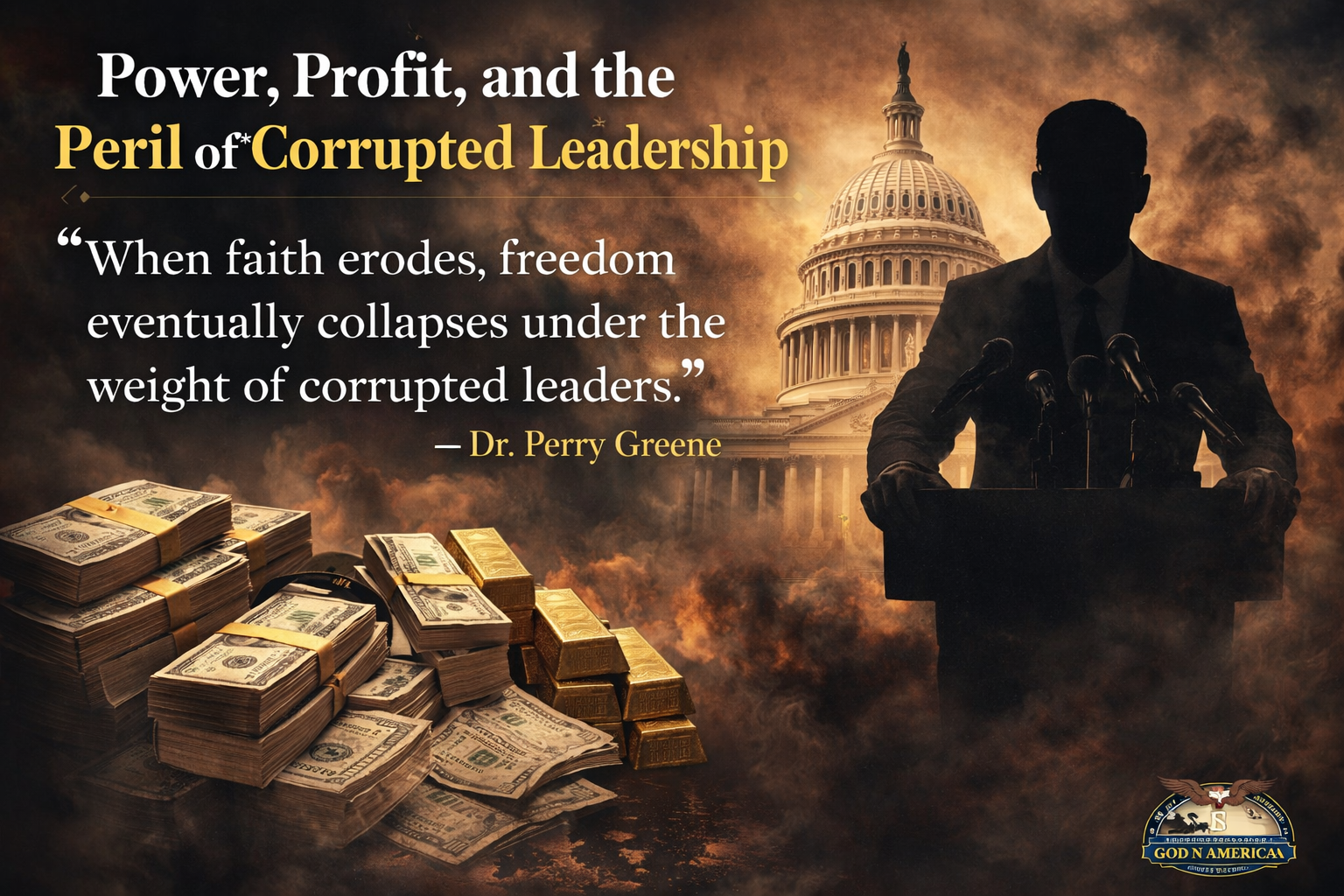
Power, Profit, and the Peril of a Corrupted Leadership
It All Begins Here
How does a nation lose its moral footing? Dr. Perry Greene argues that the slide begins when leadership stops serving and starts feeding on power, profit, and public approval. In this episode, he uses Luke 16:14–15 to connect ancient Israel’s corrupt religious leadership with modern public life, and he explains why freedom cannot last without virtue, accountability, and leaders who fear God more than they fear losing power.
Dr. Perry Greene opens with a vivid story about a civic leader in a small town whose locked desk drawer eventually revealed envelopes of cash from businesses seeking city contracts. He uses that image to show how corruption often begins quietly. A public servant may start with promise and sincere intentions, but power can reshape motives, and financial gain can turn a calling into a private empire. For Dr. Greene, the point is not merely that one man failed. It is that this pattern is familiar. He argues that the same corruption appeared in ancient Israel and still appears in American public life today.
From there, Dr. Perry Greene grounds the episode in Luke 16:14–15. He highlights Jesus’ rebuke of the Pharisees as lovers of money who justified themselves before men while God knew their hearts. That passage becomes the controlling lens for the rest of his message. His concern is not simply outward misconduct. It is the deeper spiritual problem of leaders who appear honorable in public while pursuing status, wealth, and control in private. In his telling, corruption is not only a legal or political failure. It is a heart issue that God sees clearly even when the public does not.
Dr. Greene then looks back at the Pharisees and Sadducees as Israel’s religious authorities. He notes that many, though not all, held positions that carried wealth, visibility, and prestige. According to his explanation, some leaders were drawn to those roles for personal advantage rather than devotion to God or service to the people. He describes religion becoming a means of manipulation, where guilt, ritual, and fear were used to control others. In that framework, sacrifices meant to honor God became sources of revenue, and spiritual leadership became distorted into a tool for self-enrichment.
One of the sharpest lines in the episode is Dr. Greene’s contrast between true shepherding and exploitation. Instead of caring for the flock, he says, corrupt leaders sheared it for profit. That image helps define the kind of leadership he believes Jesus condemned. The problem was not simply that the leaders were imperfect. It was that their authority was being used against the people they were supposed to guide. Public respectability covered private corruption, and religious influence became a means of bondage rather than freedom.
After establishing that biblical backdrop, Dr. Greene turns toward America. He says the nation was built on the belief that leaders exist to serve the people, yet he argues that many now enter office to gain wealth, increase status, and stay entrenched in power. He points to what he sees as familiar signs of self-serving leadership: officials who leave office far wealthier than when they entered, unequal standards of accountability, political dynasties, and leaders who benefit from fear, division, and confusion. Rather than presenting those examples as isolated scandals, he treats them as symptoms of a deeper moral disorder.
Dr. Greene strengthens that comparison by placing ancient and modern corruption side by side. In his framing, ancient religious elites used ritual, while modern leaders use regulation. Ancient leaders manipulated guilt, while modern leaders manipulate fear. In both settings, leaders justify themselves before people while their motives remain disordered before God. The result, he argues, is the same: ordinary people carry the weight of a corrupted system while those at the top protect themselves. That comparison is central to his message because it shows that corruption changes its costume over time, but not its basic character.
To show that this concern is not foreign to the American experiment, Dr. Greene turns to the founders. He points to Benjamin Franklin’s warning that paying members of Congress would attract men seeking advantage rather than service. He also emphasizes Franklin’s belief that in a free government the rulers are servants and the people are their superiors. Dr. Greene uses that idea to argue that self-government depends on a moral understanding of authority. Public office is not meant to function as personal property or a lifelong ladder for self-advancement. It is supposed to be a form of stewardship under higher accountability.
He then brings in John Adams, who warned that government alone cannot restrain human passion when morality and religion are absent. Dr. Greene uses that warning to make a larger point about national health. In his view, constitutional structures matter, but they are not enough by themselves. Without virtue, even a well-designed system eventually rots from within. That is why he treats leadership corruption as more than a policy issue. He sees it as evidence of moral erosion, and he argues that when moral restraint disappears, freedom becomes vulnerable to manipulation by ambitious people.
The final movement of the episode is practical. Dr. Greene says corruption must be named truthfully as sin. He calls for prayer and for public demand for righteous leadership shaped by moral courage rather than personal gain. He also urges families and communities to teach children that public office is a calling, not a career. That phrase summarizes much of his application. A calling is measured by faithfulness and service. A career, in the negative sense he is warning against, can be reduced to advancement, security, and self-protection. By making that distinction, he tries to recover a moral vision of leadership that places duty ahead of self-interest.
Dr. Greene does not leave the response only at the level of national politics. He also brings the message down to ordinary life. He says God sees the heart, weighs motives, judges evil leadership, and defends the oppressed. Because of that, integrity matters wherever a person has influence. The same temptations that can corrupt a nation can also corrupt a church, a workplace, a family, or a local community when people begin using responsibility for self-benefit rather than service. His argument is that citizens cannot meaningfully call for integrity in high office while excusing compromise in everyday life.
That is why one of his clearest applications is refusal to be complicit. For Dr. Greene, corruption loses strength when people stop normalizing it, stop admiring it, and stop rewarding it. The answer is not cynicism, but moral clarity. He calls for citizens who can recognize the difference between servant leadership and self-serving leadership, and who are willing to support the former even when it costs comfort or political convenience. In his presentation, righteous leadership is not sentimental or weak. It is disciplined, accountable, and willing to lose power rather than lose integrity.
The episode closes by contrasting two rival visions of leadership. Dr. Greene says that virtue, service, and sacrifice are good, while power, wealth, and indulgence become corrupting when they are made ultimate. His conclusion is direct: if freedom is going to survive, America must rediscover righteous leadership. In the terms of this message, that means leadership that fears God more than it fears losing influence, position, or public approval. The burden of the episode is therefore both civic and spiritual. A nation cannot remain healthy when leadership is treated as a marketplace for profit. It endures when authority is understood as service under God.
TL;DR
Dr. Greene begins with a story of a civic leader whose hidden cash envelopes illustrate how corruption can turn public service into private empire.
He centers the episode on Luke 16:14–15, where Jesus exposes leaders who justify themselves publicly while God knows their hearts.
He argues that many religious leaders in ancient Israel used position, ritual, guilt, and fear for personal gain rather than faithful service.
He applies that same pattern to modern America, where he says power, profit, and entrenchment often replace servant leadership.
He points to examples he sees as signs of corruption, including self-enrichment, unequal accountability, dynastic politics, and fear-based control.
He uses Benjamin Franklin and John Adams to argue that the founders saw virtue and moral restraint as essential to self-government.
He says corruption must be called what it is—sin—and that citizens should pray for and demand righteous leadership.
He urges families to teach that public office is a calling to service, not simply a career path for personal advancement.
He also applies the message personally, saying integrity must be practiced wherever people hold responsibility.
His conclusion is that freedom survives only when leadership fears God more than it fears losing power.
Discussion Questions
How does Dr. Greene distinguish between authority used for service and authority used for self-protection?
Why does Luke 16:14–15 matter so much to his understanding of leadership corruption?
What parallels does he draw between ancient religious manipulation and modern political manipulation?
What does it mean to treat public office as a calling rather than a career?
Where is the temptation toward self-serving leadership most visible in everyday life, not just in national politics?
Apply It This Week
Read Luke 16:14–15 and reflect on how the passage speaks to motives, public image, and accountability.
Pray specifically for local, state, and national leaders to value integrity above power, profit, and prestige.
Identify one area of personal responsibility—at home, at church, at work, or in the community—and choose a concrete act of servant leadership there.
Talk with a child, student, or younger believer about why leadership should be measured by faithfulness and service rather than status.
Prayer Prompt
Lord, search hearts, expose corruption, raise up leaders who love truth more than power, and make Your people faithful, courageous, and unwilling to excuse what You call evil. Amen.
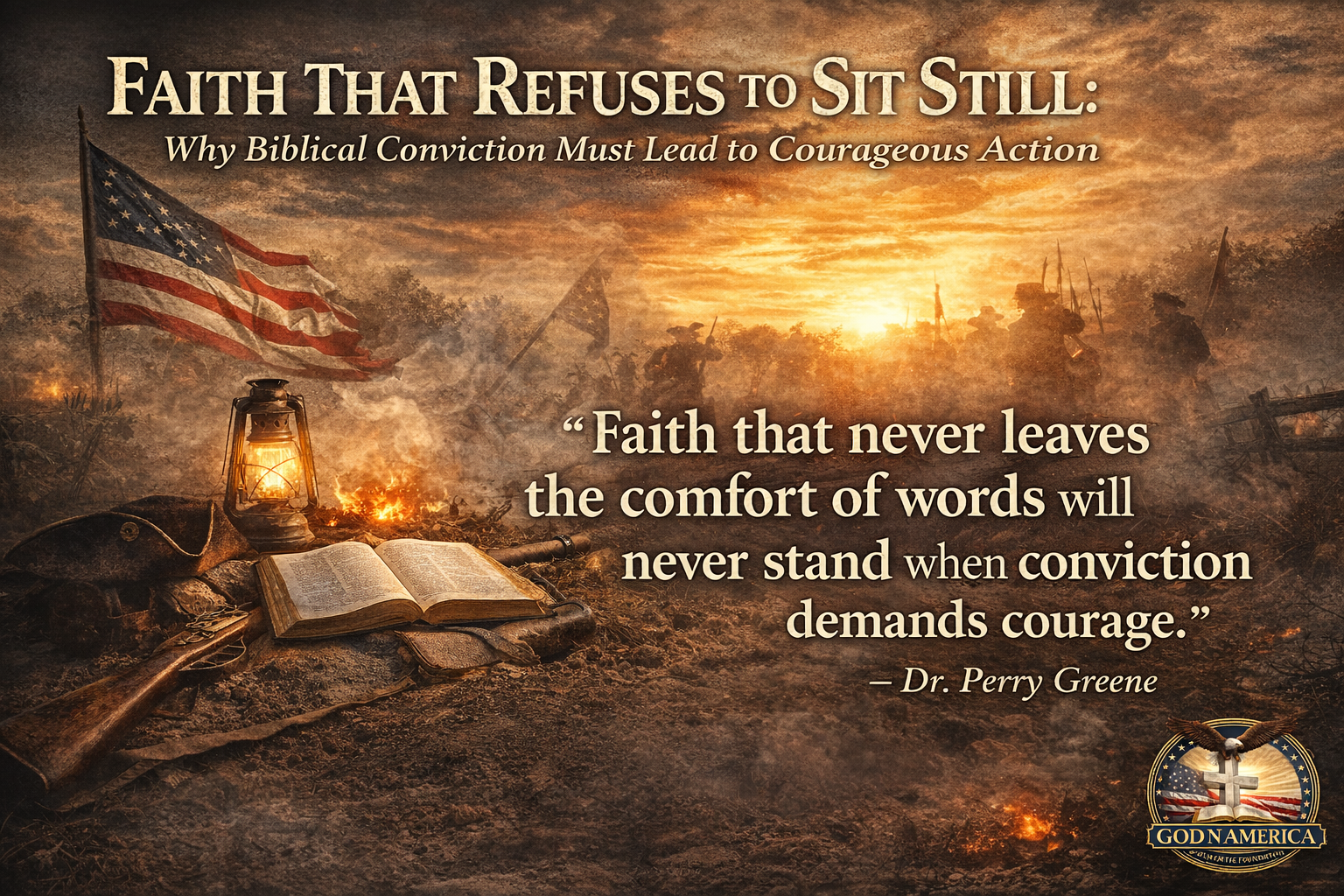
Faith That Refuses to Sit Still: Why Biblical Conviction Must Lead to Courageous Action
It All Begins Here
Some beliefs sound strong until they are tested. In this episode, Dr. Perry Greene argues that true faith cannot remain trapped in conversation, sentiment, or private agreement. It must move. Drawing from Scripture, early American history, and the witness of the Black Regiment, he shows why faith that works matters not only for personal discipleship, but also for moral courage, public righteousness, and the preservation of liberty.
Dr. Perry Greene opens with an image that makes the point immediately clear: a fireman who only studies fire is of no use when the alarm sounds. Manuals, training, and discussion matter, but in the moment of crisis, knowledge without response saves no one. He uses that picture to frame the central burden of the episode. Faith must eventually leave the realm of words and prove itself in action. Otherwise, it is exposed as empty.
He then widens the lens beyond the personal and places the issue inside the larger story of faith and freedom. Dr. Greene contends that faith that never leaves the comfort of speech will never glorify God, preserve liberty, shape character, or resist evil. In his telling, history repeatedly shows that when faith becomes timid, freedom soon becomes fragile. For that reason, he does not present active faith as an optional spiritual enhancement. He presents it as a moral necessity.
To illustrate that point, Dr. Greene turns to the American War of Independence and highlights the colonial pastors remembered as the Black Regiment. Their name came from the black robes they wore in the pulpit, but their reputation came from boldness. He describes them as men who did not separate theology from responsibility. They preached that liberty was a gift from God and that defending it was a moral duty. In their ministries, doctrine did not remain abstract. It shaped conscience, strengthened resolve, and prepared people to act when the hour demanded it.
One of the clearest examples he offers is Jonas Clark of Lexington, Massachusetts. As British troops moved toward town on April 19, 1775, Clark’s congregation, including the Lexington Minutemen, was ready. Dr. Greene connects that readiness to preaching that had already formed convictions about duty, courage, and liberty. In that setting, public action did not appear disconnected from faith. It grew out of faith. The men who stood their ground had been shaped by teaching that linked belief with responsibility.
This is one of the episode’s most important themes: Christianity must not be confused with comfort. Dr. Greene argues that the pastors he highlights did not believe obedience to Christ meant retreat from hard realities. Instead, they understood faithful living to include resisting tyranny, defending the innocent, and standing for righteousness both in the pulpit and in the public square. Their faith worked because it trusted God enough to move beyond safety and speak with clarity.
He then anchors the message in Scripture. James 2:17 becomes a governing text for the whole episode: faith by itself, if it does not have works, is dead. Dr. Greene emphasizes the force of that warning. Dead faith is not merely underdeveloped faith. It is faith that lacks living evidence. Biblical faith acts because it is rooted in trust. It does not perform in order to manufacture belief; it moves because belief is already real.
From there, Dr. Greene adds Proverbs 29:25, which warns that the fear of man brings a snare, while the one who trusts in the Lord will be safe. The contrast matters. Fear of man traps people into silence, hesitation, and compromise. Trust in the Lord frees people to obey despite consequences. He reinforces that point with the example of the early church, which preached under pressure and proclaimed repentance without apology. In his presentation, courage is not recklessness. It is the fruit of fearing God more than human opposition.
That same thread continues in his reference to Matthew 10:28, where Jesus says not to fear those who kill the body but cannot kill the soul. Dr. Greene uses that teaching to distinguish between a faith governed by public pressure and a faith governed by reverence for God. A faith that fears man will eventually mute itself. A faith that fears God cannot stay quiet forever. It will speak, serve, and stand because it knows that ultimate authority belongs to the Lord.
The episode also contains a sharp warning for the modern church. Dr. Greene observes that many pulpits have grown cautious, that moral clarity is often avoided for fear of giving offense, and that silence is too easily treated as wisdom. His concern is not merely about tone. It is about consequence. When churches lose their voice, he argues, nations lose their virtue. In other words, public moral collapse is not disconnected from spiritual retreat. Silence creates a vacuum, and that vacuum never stays empty for long.
His use of Revelation 21:8 makes the warning even more sober. By noting that the cowardly are included among those who reject God’s authority, Dr. Greene presents cowardice as more than a personality weakness. In this episode, cowardice becomes a spiritual issue because it denies God’s power and abandons God’s people in moments when truth and courage are required. That makes the call to active faith much more serious than a motivational challenge. It becomes a matter of obedience.
Dr. Greene also ties this directly to liberty. He argues that God-given freedom requires moral courage to sustain it. Freedom cannot survive indefinitely in a culture of comfort, fear, and passivity. If liberty is treated lightly, it will eventually be lost. The Black Regiment understood that principle, and he presents them as an example of people who recognized both the sacredness of liberty and the responsibility attached to it. They did not see silence as a neutral posture when God’s gifts were under threat.
Near the end of the episode, the challenge becomes personal. Dr. Greene asks whether people are content merely to talk about faith or whether they are ready to live it. That question reaches beyond ministers, public leaders, or historical figures. It touches everyday discipleship. Faith that works is faith that prays and participates. It tells the truth when truth is costly. It refuses to surrender conviction for comfort. It remains faithful not only when applause is available, but also when pressure rises.
His final appeal draws on Galatians 5:1: it is for freedom that Christ has set us free. In context, Dr. Greene uses that reminder to call listeners to recovery. He urges a return to faith that refuses to sit still, faith that is strong enough to stand, act, and remain faithful across generations. The emphasis is not on noise for its own sake, nor on action detached from truth. It is on conviction that produces faithful response.
Applied to daily life, Dr. Greene’s message calls for visible obedience. That may look like refusing moral compromise in the workplace, speaking biblical truth with humility and firmness, defending those who are vulnerable, leading a family with integrity, or refusing to let fear keep conviction private. It may also mean praying with seriousness and then stepping forward in the responsibilities God has already made clear. The episode does not celebrate activism detached from the Lord. It calls for action that grows out of reverence, trust, and biblical clarity.
At its core, this episode insists that genuine faith cannot remain seated forever. It learns, listens, prays, and prepares, but eventually it must stand. Dr. Perry Greene’s message is that words alone are not the measure of conviction. The measure is whether belief remains faithful when courage is required.
TL;DR
Dr. Perry Greene argues that faith is not proven by talk alone, but by action rooted in conviction.
He uses the image of a fireman to show that knowledge without response is useless in a real crisis.
The Black Regiment serves as his historical example of pastors who connected biblical faith with public responsibility.
Jonas Clark and the Lexington Minutemen illustrate how preaching can shape courage before a defining moment arrives.
James 2:17 is central to the message: faith without works is dead.
Fear of man leads to silence and compromise, while trust in the Lord produces courage.
Dr. Greene warns that when churches lose moral clarity, nations lose virtue.
He presents cowardice as a serious spiritual issue, not merely a personal weakness.
God-given liberty requires moral courage and cannot be preserved by passive people.
The episode calls for faith that prays, speaks, stands, and acts when obedience demands courage.
Discussion Questions
What is the difference between talking about faith and living by faith in daily life?
Why does Dr. Greene connect moral courage so strongly to the preservation of liberty?
How does the example of the Black Regiment challenge modern assumptions about the role of faith in public life?
In what ways can fear of man quietly shape silence, compromise, or hesitation?
What would it look like for a church, family, or individual to recover a faith that refuses to sit still?
Apply It This Week
Identify one area where conviction has remained private when obedience should become visible.
Read James 2:17, Proverbs 29:25, Matthew 10:28, and Galatians 5:1, then write down one action step tied to each passage.
Have one honest conversation this week where truth is spoken with both courage and grace.
Pray specifically for moral clarity, boldness, and faithfulness in the place where God has already assigned responsibility.
Prayer Prompt
Lord, give Your people a faith that does not hide in comfort or fear. Strengthen hearts to trust You more than man, to stand for truth with humility, and to act with courage wherever obedience requires it. Amen.
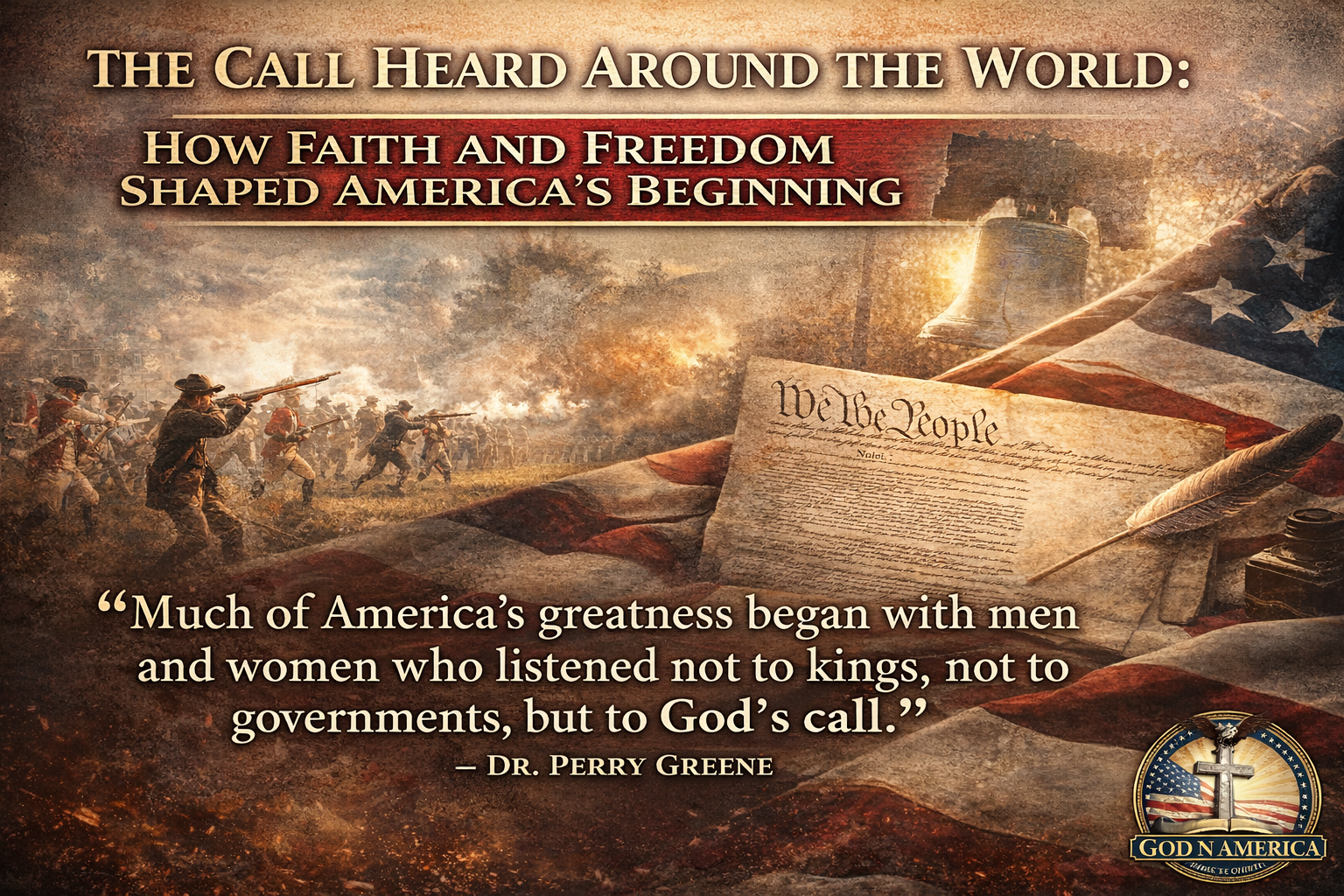
The Call Heard Around the World: How Faith and Freedom Shaped America’s Beginning
It All Begins Here
In this episode, Dr. Perry Greene uses the approaching anniversary of Lexington Green to argue that America’s fight for liberty began long before the first exchange of fire. He traces a line from the Pilgrims to the Founding era, showing how conscience, biblical conviction, and courageous obedience shaped the nation’s understanding of freedom. Readers will see how he connects early American history to a present-day call for prayer, moral clarity, and faithful action.
Dr. Perry Greene opens with a moment that has become one of the defining images of American memory. As the anniversary of April 19, 1775 approaches, he points to Lexington Green and the “shot heard around the world” as more than the beginning of armed conflict. In his telling, that encounter represented the visible eruption of a much deeper spiritual and moral formation. A small group of minutemen stood against hundreds of British regulars, and Dr. Greene emphasizes that these were men from Pastor Jonas Clark’s church, trained for such a moment by Clark and Deacon John Parker. The scene matters because it shows that public courage is rarely improvised. By the time history reaches a crisis, convictions have already been formed in homes, churches, and local communities.
That opening leads Dr. Perry Greene to his central argument: America’s greatness did not begin merely with institutions, military victories, or political theory. It began with men and women who believed they were under a higher authority than any earthly ruler. He describes early America as an idea before it was a nation, a divine stirring in the hearts of ordinary believers who trusted that liberty and faith could exist together. To support that claim, he turns to John Adams, who said the Revolution took place first in the minds and hearts of the people. For Dr. Greene, that observation is essential. The real American Revolution was not only a break from the crown. It was a change in convictions, duties, and affections. External independence followed an internal transformation.
From there, Dr. Greene reaches back to 1620 and the arrival of the Pilgrims. He does not present them as explorers chasing opportunity or politicians searching for power. He presents them as believers willing to cross the Atlantic in order to worship God without persecution. Their journey, in his view, reveals something foundational about liberty: it is often born in sacrifice rather than comfort. Before setting foot on land, they formed the Mayflower Compact and pledged themselves to a civic order under God. Dr. Greene treats that covenant as an early sign that public life and spiritual accountability were never meant to be enemies. He also draws on Governor William Bradford’s reflection that great things can come from small beginnings, using that thought to show how acts of faith can shape generations beyond the people who first take them.
Dr. Greene then connects the Pilgrims’ story to Hebrews 11:8 and the example of Abraham, who obeyed and went out without knowing exactly where he was going. That scriptural connection clarifies the point he wants readers to see. In his message, liberty is not primarily the product of self-assertion. It begins with obedience. The courage to move, build, and endure comes from trust in God before outcomes are visible. That is why he says true liberty begins not in government halls, but in hearts that fear God more than men. Political systems matter in his argument, but they come after the more basic question of who or what ultimately governs the human heart.
Roger Williams becomes the next major example in Dr. Greene’s account. Williams, a Puritan minister, argued that faith cannot be forced, and that conviction cost him his place in Massachusetts Bay. Dr. Greene highlights Williams’ exile and the founding of Rhode Island as a turning point in the American understanding of conscience. The issue was not simply disagreement between churchmen. It was the deeper principle that no earthly authority can manufacture genuine belief. By recalling Williams’ declaration that forced worship “stinks in God’s nostrils,” Dr. Greene underscores a theme that runs throughout the episode: freedom of conscience is not a modern political convenience but a moral necessity. He pairs this with Galatians 5:1 and frames spiritual liberty as a condition in which broader freedom can flourish.
That is why Dr. Greene says Williams laid groundwork for the freedoms later protected in the First Amendment. His point is not that liberty emerged in a vacuum or all at once. Rather, the nation’s commitment to religious freedom grew from convictions defended at personal cost. When faith is free, Dr. Greene argues, freedom flourishes. In that short line he compresses a larger warning as well. A society that tries to control conscience will eventually place pressure on every other freedom. Once belief is treated as something the state may shape or punish, liberty itself begins to narrow.
Dr. Greene next turns to John Winthrop aboard the Arbella in 1630 and the well-known image of a “city upon a hill.” He connects Winthrop’s language to Matthew 5:14, where Jesus describes a city set on a hill that cannot be hidden. In this episode, Dr. Greene does not use that phrase as a claim of national perfection. He uses it as a description of responsibility. America’s calling, in his presentation, was not to be flawless but to be an example. The nation’s influence, then, depends not merely on strength or prosperity, but on whether its public life reflects the light it claims to carry. He states that when America has walked with God, her light has shone brightly, and when she has wandered, her influence has dimmed. The standard is spiritual consistency, not self-congratulation.
William Penn’s “holy experiment” continues that same thread. Dr. Greene presents Penn as a man who believed government should protect conscience rather than persecute it. He uses Penn’s warning that people must be governed by God or they will be ruled by tyrants to explain what happens when moral order collapses. In Dr. Greene’s message, tyranny does not appear only through dramatic conquest. It also enters when a people surrender humility, justice, mercy, and reverence for God. That is why he brings in Micah 6:8. The verse provides a moral pattern for public life: do justly, love mercy, and walk humbly with God. Dr. Greene’s point is that liberty cannot survive on rebellion alone. It requires righteousness sturdy enough to sustain freedom once it has been won.
By the time the story reaches the Revolutionary era, Dr. Greene says the call to freedom had already spread through pulpits and homes. He names Samuel Adams, Patrick Henry, and John Witherspoon as men who understood liberty not as a human invention but as something tied to God’s design and moral order. Samuel Adams’ insistence that religion and good morals form the solid foundation of public liberty fits neatly within the framework Dr. Greene has built from the beginning of the episode. Patrick Henry’s cry for liberty, in his view, was not just political rhetoric. Dr. Greene frames it as a spiritual conviction and links it to 2 Corinthians 3:17: where the Spirit of the Lord is, there is liberty. This is one of the most important moves in the message. It interprets the American founding not simply as a struggle over power, but as a struggle over the source and purpose of freedom itself.
After surveying those historical voices, Dr. Greene turns directly to the present. The same call, he says, still echoes across America. The forms of the challenge may look different, but the underlying issue remains the same. The Pilgrims faced persecution; modern believers often face apathy. Roger Williams faced exile; the present age is marked, in Dr. Greene’s description, by moral confusion and conflict. Yet the answer has not changed. The call is still to obey God rather than men, to choose courage over passivity, and to refuse the idea that national renewal can be engineered by policy alone. In one of the strongest lines of the episode, Dr. Greene says America cannot be saved through politics or policy by themselves. For him, lasting hope rests in the people of God living by faith.
That conviction leads naturally to 2 Chronicles 7:14, which Dr. Greene treats as a standing summons to humility, prayer, repentance, and renewal. The healing he points toward is not partisan triumph. It is spiritual restoration. This is a crucial distinction in the message. He does not dismiss the importance of public life, but he insists that public life cannot be healthy when private and collective hearts are disordered. The nation’s future, then, is tied not merely to elections, institutions, or strategies, but to whether God’s people humble themselves, seek His face, and turn from wickedness. The historical examples in the episode all build toward that final appeal.
In practical terms, Dr. Greene’s message calls believers to reject nostalgia without action. Remembering Lexington Green, Plymouth Rock, Rhode Island, or Pennsylvania is not enough on its own. The point of remembrance is response. His message urges families to teach the spiritual roots of liberty, churches to form consciences strong enough to withstand pressure, and individual Christians to resist apathy with prayerful obedience. It also calls for a renewed defense of freedom of conscience, since a society that forgets why belief must remain free will eventually lose more than religious liberty. Above all, Dr. Greene presents faithfulness as the starting place for any wider renewal. Just as a small band of believers helped light a path in the nation’s earliest days, he argues that God can still use ordinary people today if they will hear His call and answer it.
TL;DR
Dr. Perry Greene uses the anniversary of Lexington Green to show that America’s fight for liberty was rooted in spiritual conviction before it became military conflict.
He argues that the American Revolution began in the minds and hearts of the people, echoing John Adams’ view that inner change preceded political independence.
The Pilgrims, in his telling, modeled a faith-driven pursuit of liberty by seeking a place to worship God freely and forming the Mayflower Compact under God.
Roger Williams represents the principle of freedom of conscience, and Dr. Greene says his stand helped lay groundwork for later religious liberty protections.
John Winthrop’s “city upon a hill” vision is presented as a call for America to be an example shaped by faith rather than a claim of national perfection.
William Penn’s “holy experiment” shows Dr. Greene’s belief that liberty depends on justice, mercy, humility, and government that protects conscience.
He presents figures like Samuel Adams, Patrick Henry, and John Witherspoon as leaders who saw liberty as tied to God’s moral order, not merely political preference.
Dr. Greene concludes that America’s hope is not politics alone, but God’s people living by faith, praying, repenting, and answering God’s call with courage.
Discussion Questions
Why does Dr. Greene place such strong emphasis on the condition of the heart before the structure of government?
How does his use of the Pilgrims’ story shape his understanding of the relationship between faith and liberty?
What does Roger Williams’ defense of conscience suggest about the importance of religious liberty in the present day?
How does Dr. Greene distinguish between national strength and spiritual faithfulness?
What would it look like, in practical terms, to answer God’s call with courage rather than apathy?
Apply It This Week
Read 2 Chronicles 7:14, Micah 6:8, and 2 Corinthians 3:17, and note how Dr. Greene connects those passages to public life and personal responsibility.
Set aside time to pray specifically for humility, repentance, and renewed moral clarity in the church, the home, and the nation.
Discuss one historical figure from the episode with family, friends, or a small group and consider how conscience shaped that person’s decisions.
Identify one area where apathy has replaced conviction, then take one concrete step of faithful obedience this week.
Prayer Prompt
Father, raise up humble and obedient hearts that fear You more than men. Strengthen the church to live by faith, protect freedom of conscience, and bring healing where there has been apathy, confusion, and compromise. Amen.
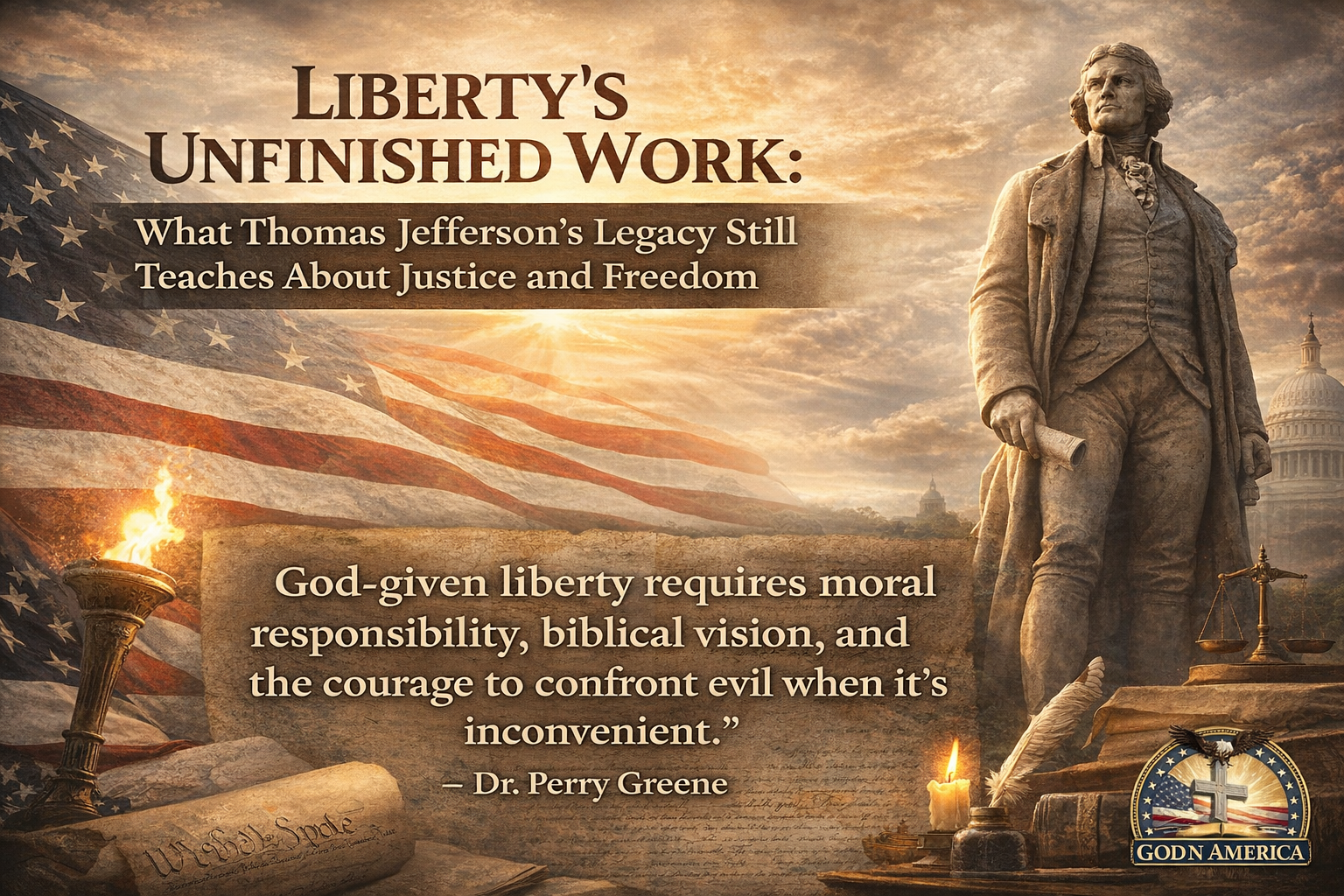
Liberty’s Unfinished Work: What Thomas Jefferson’s Legacy Still Teaches About Justice and Freedom
It All Begins Here
Dr. Perry Greene uses the anniversary of Thomas Jefferson’s birth to examine a question larger than one founder’s reputation: what happens when a nation declares God-given liberty but delays the moral work that liberty requires? This episode matters because it connects freedom to vigilance, justice, biblical accountability, and the courage to confront unresolved wrongdoing. Readers will see why Dr. Greene argues that liberty usually erodes through neglect, why Jefferson’s conflict over slavery still matters, and what it means to guard freedom with truth, moral restraint, and educated citizenship.
Dr. Perry Greene opens this episode with a simple but unsettling picture. In the last stretch of winter, a homeowner can stop checking the roof because everything appears stable. Snow has sat there for months. Nothing seems broken. Daily life has adjusted to the weight overhead. Yet, out of sight, ice dams can begin to form, water can seep into places it does not belong, and eventually the ceiling can collapse. In Dr. Greene’s telling, the failure does not come because the house was necessarily weak. It comes because attention faded.
That image becomes the governing idea for the entire message. Dr. Greene argues that liberty often declines in the same quiet way. Free societies do not usually lose their freedom only in moments of open crisis. More often, freedom deteriorates during ordinary seasons when people assume the structure will keep holding on its own. Vigilance weakens. Moral seriousness fades. Citizens stop inspecting what sustains their freedom. By the time the damage is obvious, the decay has already been at work for a long time. His warning is direct: liberty disappears not only because it is attacked, but because it is neglected.
From that starting point, Dr. Greene turns to Thomas Jefferson on the anniversary of his birth. He presents Jefferson as a figure worth revisiting not because he was simple, but because he was not. Jefferson matters in this episode because, in Dr. Greene’s view, he understood liberty as more than a political slogan or a constitutional arrangement. He understood it as a moral responsibility. At the same time, Jefferson’s life exposes the painful contradictions that can exist when a nation speaks noble truths but delays the difficult work of applying them consistently.
Dr. Greene focuses especially on Jefferson’s role in drafting the Declaration of Independence. He highlights the revolutionary claim at the heart of that document: human rights do not come from kings, governments, or political favor, but from God Himself. That claim established a moral foundation for liberty that reached beyond policy and beyond empire. For Dr. Greene, this is one reason Jefferson still matters. The American founding did not merely assert independence from Britain. It announced that human dignity rests on divine authority, which means liberty cannot be treated as a gift handed down by rulers and withdrawn whenever power finds it convenient.
But Dr. Greene refuses to reduce Jefferson to a patriotic symbol polished free of moral conflict. Instead, he points to the issue that continues to shadow Jefferson’s legacy: slavery. He notes that many Americans do not realize Jefferson included a forceful condemnation of slavery in his original draft of the Declaration. According to Dr. Greene, Jefferson accused King George III of carrying on a “cruel war against human nature itself” by sustaining the slave trade and imposing slavery on the colonies. He described slavery as a violation of the most sacred rights of life and liberty. Dr. Greene treats that deleted paragraph as important evidence that the contradiction was recognized from the beginning. The founding language of liberty was never meant to sit comfortably beside human bondage.
The fact that those words were removed is just as important to Dr. Greene’s argument. He explains that delegates from Georgia and South Carolina strongly objected because their economies depended on slavery, and the unity needed for independence was at risk. Jefferson yielded the point. Dr. Greene is careful about how he frames that moment. He does not describe the removal as approval of slavery. He describes it as concession. In his reading, Jefferson believed the issue would have to be addressed later, after independence had been secured. That delay preserved political unity in the short term, but it also left the republic carrying unfinished moral work from its first days.
That theme of unfinished work sits near the center of the episode. Dr. Greene is not merely recounting a historical dispute inside the Continental Congress. He is showing how nations can postpone hard truths for the sake of immediate stability. The problem, in his telling, is that delayed truth does not disappear. It waits. A contradiction can be buried in law, rhetoric, or political compromise for a season, but eventually it demands to be faced. This is one of the most searching claims in the message: unfinished truths eventually return with greater moral weight because neglect does not heal them.
Dr. Greene also stresses that Jefferson’s revulsion toward slavery was not momentary or accidental. He cites Jefferson’s warning, “I tremble for my country when I reflect that God is just, that his justice cannot sleep forever.” Dr. Greene interprets that statement not as polished public language, but as genuine moral dread. Jefferson understood that a nation cannot continuously violate justice and assume there will be no reckoning. At the same time, Dr. Greene says Jefferson feared that immediate abolition without moral and civic preparation could tear apart the fragile republic. This tension does not remove the contradiction. Rather, it reveals how unstable liberty becomes when a society affirms truth in principle but hesitates to obey it in practice.
To frame that tension, Dr. Greene turns to Scripture. He cites Genesis 1:27, where every human being is made in the image of God. He also cites Micah 6:8, which calls people to do justice, love kindness, and walk humbly with God. These references are not decorative in the episode. They supply the standard by which the entire discussion is judged. If every person bears God’s image, then no economic interest, inherited system, social habit, or political convenience can justify treating some lives as less fully human. If justice and humility are what the Lord requires, then liberty cannot be defended honestly while injustice is being tolerated. Dr. Greene presents justice as a divine standard, not a human invention, and he insists that nations are accountable to God, not only to history.
From there, the episode moves from Jefferson’s world to the modern American condition. Dr. Greene suggests that Jefferson would likely feel conflicted if he could see the present nation. He would likely grieve that a people founded on God-given rights often treat liberty like a disposable convenience rather than a sacred trust. He would likely be alarmed by the expansion of centralized power and recall his warning that liberty tends to yield while government gains ground. Dr. Greene also imagines Jefferson seeing widespread moral confusion where moral clarity is needed, and hearing again the truth that an ignorant people cannot remain both free and secure in that freedom.
These observations are not presented as mere nostalgia for the founding generation. Dr. Greene does not argue that America’s problem is simply that it has moved too far away from a glorious past. His point is more demanding than that. He argues that the nation is still wrestling with the same temptation it faced in Jefferson’s day: the temptation to prefer comfort over conviction and peace over moral courage. In that sense, Jefferson’s “unfinished work” is not only a matter of eighteenth-century history. It becomes a recurring national pattern whenever people delay necessary truth because confronting it would be costly or disruptive.
That warning gives the episode its contemporary force. Liberty, in Dr. Greene’s account, cannot survive on patriotic memory alone. It must be guarded. Justice, likewise, cannot remain a slogan. It must be pursued. If freedom is disconnected from righteousness, it becomes unstable. If liberty is separated from justice, it becomes hollow and hypocritical. Those are not only national principles in this message; they are moral realities. Dr. Greene treats faith and freedom as inseparable because rights that come from God require a people willing to live under God’s moral order.
The practical implications of that argument are wide-ranging. In everyday life, guarding liberty begins long before legislation or elections enter the picture. It begins in whether people tell the truth, whether families and churches teach moral responsibility, whether citizens understand history well enough to recognize repeating dangers, and whether communities are willing to confront evil when it is inconvenient to do so. Dr. Greene’s message presses against passivity. It asks whether a people have become so used to the weight on the roof that they no longer examine what is cracking overhead. It asks whether comfort has replaced conscience and whether habit has dulled the ability to recognize injustice before it hardens into accepted normality.
That is why his conclusion is neither despairing nor simplistic. He does not call for erasing America’s founding claims. He calls for living up to them. The truth announced at the founding, as he presents it, was larger than any one founder and larger than any one generation’s obedience to it. Because rights are God-given, every generation inherits both a gift and an obligation. The gift is liberty. The obligation is to order that liberty under truth, justice, humility, and reverence for God. Only then can freedom remain more than a political inheritance.
By the end of the episode, Dr. Greene has brought the listener back to his opening image. Houses require inspection, repair, and watchfulness. So do free societies. The danger is not only open hostility from outside, but drifting neglect within. His message about Jefferson is therefore also a message about the present: liberty requires moral restraint, educated citizens, and reverence for truth that rises above political fashion. The light of liberty, in his closing vision, is something that must be tended. It will not keep burning simply because earlier generations once lit the flame.
TL;DR
Dr. Perry Greene argues that liberty usually collapses through neglect before it collapses through open attack.
He uses Thomas Jefferson’s birthday to revisit freedom as a moral responsibility, not just a political principle.
Dr. Greene highlights Jefferson’s original Declaration language condemning slavery as a violation of life and liberty.
He presents the removal of that paragraph as a concession for unity, not as moral approval.
The episode argues that America began with unfinished moral work, and delayed truths eventually demand to be faced.
Genesis 1:27 and Micah 6:8 provide the biblical frame for human dignity, justice, kindness, and humility.
Dr. Greene says liberty separated from justice becomes hypocrisy, and freedom separated from righteousness becomes unstable.
He warns that centralized power, moral confusion, and civic ignorance all threaten a free people.
The response he calls for includes vigilance, moral restraint, educated citizenship, and courage to confront evil when it is inconvenient.
Discussion Questions
Why does Dr. Greene compare liberty to a roof that fails after long neglect rather than after a single dramatic event?
How does Jefferson’s deleted anti-slavery paragraph deepen the moral meaning of the Declaration of Independence in this episode?
What does Dr. Greene’s distinction between concession and approval reveal about political compromise?
Why does the episode insist that liberty and justice cannot be separated without damaging both?
Where can a nation, a church, a family, or a community be tempted to delay hard truths for the sake of temporary peace?
Apply It This Week
Read the Declaration of Independence alongside Genesis 1:27 and Micah 6:8, then note how Dr. Greene’s argument connects rights to God’s moral order.
Choose one area of civic responsibility this week—local government, school policy, community service, or informed reading—and engage it with greater attention instead of passive frustration.
Have one honest conversation about a difficult issue that is often postponed for the sake of comfort, and aim for truth spoken with humility and kindness.
Identify one way liberty is being treated casually in daily life and replace that carelessness with a deliberate act of responsibility, learning, or service.
Prayer Prompt
Lord, give this nation the courage to honor the dignity You have placed in every person. Teach us to love truth, pursue justice, walk humbly, and guard liberty with reverence, wisdom, and faithful moral courage. Amen.

Who Truly Belongs? Dr. Perry Greene on Identity, Faithfulness, and True Allegiance
It All Begins Here
In this episode, Dr. Perry Greene takes up a difficult passage from Revelation and asks a deeper biblical question: what really establishes that someone belongs to God? By drawing together Romans 2, Abraham’s example, and an early American warning about false authority, he argues that labels, heritage, and outward claims cannot replace inward faithfulness. Readers will come away with a clearer understanding of how he distinguishes between public identity and genuine allegiance—and why that distinction still matters for the church and the culture today.
Dr. Perry Greene opens with a story about a property dispute that had lingered for decades. Multiple people claimed the land. Multiple families had stories, papers, and a sense of certainty. Yet the question was not finally settled by confidence, family memory, or repeated assertion. It was settled by the deed. He uses that simple picture to frame the spiritual issue at the center of the episode: when people say they belong to God, what actually makes that claim true?
That opening illustration leads into one of the more difficult statements in Revelation, where Jesus speaks of those who say they are Jews and are not. Dr. Greene does not treat that phrase lightly. He says it has been misunderstood, misused, and abused throughout history, which is why he calls for a careful reading. In his explanation, the passage is not about ethnicity. It is about whether a public claim to covenant identity matches real allegiance to God.
To make that point, he turns to Romans 2:28–29. There Paul says that a person is not a Jew merely outwardly, and that true circumcision is not merely external, but of the heart, by the Spirit. Dr. Greene treats that passage as a key to the larger question of belonging. In his reading, Paul is teaching that biblical identity cannot be reduced to external signs, inherited status, or visible religious markers. Outward forms may say something real, but they do not settle the deepest question. The heart must be aligned with God.
Dr. Greene also emphasizes that this principle did not begin with Paul. He connects it to Moses, Jeremiah, and the prophets, all of whom warned that covenant life was never supposed to be treated as a matter of bloodline alone. From his perspective, Scripture consistently presses beyond the visible sign to the moral and spiritual reality underneath it. That is why he says God’s people are defined by faith and obedience, not simply ancestry or title.
He reinforces that argument by pointing to Abraham. Abraham, he notes, was counted righteous before he was circumcised. Faith came first. The outward sign followed. For Dr. Greene, that order matters because it shows that the sign was never meant to replace trust in God. He extends that logic to the New Testament teaching that all who belong to Christ, Jew and Gentile alike, are heirs of the promise. At the same time, he is careful to say that this does not erase ethnic Israel or deny God’s historical covenants. Instead, he argues that it clarifies a principle already present in Scripture: standing before God has always rested on faithfulness, not claim alone.
When he returns to Revelation, Dr. Greene places the passage in the setting of first-century believers who were facing persecution. He says Jesus is addressing religious authorities who claimed exclusive covenant authority, rejected Jesus as the Messiah, and used religious power against believers. He makes the point plainly that Jesus, the apostles, and the early church were Jewish. Because of that, he argues that the issue cannot be ethnicity. The issue is spiritual allegiance. To claim God’s name while opposing God’s work, he says, is the essence of false authority and hypocrisy.
From there, Dr. Greene connects the biblical warning to early American thought. He says the colonists were wary of titles, inherited power, and unsupported claims of legitimacy. In that setting he points to Jonathan Mayhew, whose sermon language helped shape the conviction that rebellion to tyrants is obedience to God. The historical example serves a larger purpose in the episode. Just as a ruler does not remain legitimate merely because of lineage or office, a religious claim does not become true merely because it is repeated with confidence. Authority, in both civic and spiritual life, must answer to truth, justice, conscience, and submission to God.
That connection sets up one of the most searching turns in the message. Dr. Greene says this passage in Revelation is often used to identify what is wrong with somebody else, but he argues that its first force should be self-examination. He compares the human tendency to blame others to Adam and Eve. The more urgent question is not who can be exposed, but whether actions match allegiance. He applies that question broadly—to churches that carry Christ’s name, to leaders who use religious language, and to institutions that appeal to God outwardly while neglecting obedience inwardly.
He deepens that warning by recalling Jesus’ teaching that many will say, “Lord, Lord,” and still not know Him. In other words, verbal confession by itself is not the same thing as faithful discipleship. Dr. Greene presses this point hard: formulas do not replace faithfulness, and labels do not override obedience. That warning, in his presentation, is universal. Whether the category is Jew or Gentile, church or nation, the measure remains the same. The real question is whether there is alignment with God’s truth and purposes.
Because of that, the episode lands as a call to humility. Dr. Greene says humility is where genuine faith begins, because humility allows God’s truth to examine the heart. It does not assume that a title, tradition, or public reputation has settled the matter. It asks whether inward allegiance and outward conduct are moving in the same direction. It asks whether God’s name is being carried with integrity.
That emphasis gives the message a practical edge. In daily life, Dr. Greene’s teaching calls believers to test visible claims by lived obedience, to resist the comfort of appearances, and to let Scripture search the heart before criticizing others. It also speaks to public life. When leaders or institutions claim moral legitimacy, the standard cannot be branding, lineage, or rhetoric alone. The question is whether truth, justice, and moral responsibility are actually being honored.
By the end of the episode, Dr. Greene brings the message to a simple but demanding conclusion: in God’s economy, belonging is not about what people say, but about who they follow. That line gathers the whole message into one clear challenge. Real belonging is not established by volume, status, ancestry, or title. It is revealed through faithful allegiance. That makes the episode both clarifying and confronting. It clarifies the difference between outward claim and inward reality, and it confronts every assumption that a label can do the work of obedience.
TL;DR
Dr. Greene frames the episode around a simple principle: a claim is not proven by confidence alone; it must match reality.
He uses Romans 2:28–29 to argue that true covenant identity is inward, rooted in the heart and the Spirit, not merely in outward signs.
He says this principle runs through the Old Testament as well, where Moses, Jeremiah, and the prophets warn against relying on heritage alone.
Abraham’s example matters to him because Abraham was counted righteous before circumcision, showing that faith comes before the outward sign.
Dr. Greene says his reading does not erase ethnic Israel or deny God’s historical covenants; it clarifies that standing before God rests on faithfulness.
In Revelation, he argues that the issue is spiritual allegiance, not ethnicity, and that Jesus is exposing false authority and hypocrisy.
He connects that biblical warning to early American suspicion of titles and inherited power, using Jonathan Mayhew as an example.
The message is meant to prompt self-examination, not merely criticism of others.
He warns that religious language, institutional identity, and public labels cannot replace obedience.
His final emphasis is that belonging to God is shown not by what people claim, but by who they actually follow.
Discussion Questions
Why does Dr. Greene begin with the story of a disputed deed, and how does that illustration shape the rest of his message?
What distinction does he make between outward identity and inward faithfulness?
How does his reading of Revelation shift the focus away from ethnicity and toward spiritual allegiance?
Why does he connect false religious authority with the early American concern about titles and unaccountable power?
What would it look like for actions to match allegiance in personal faith, church life, and public leadership?
Apply It This Week
Read Romans 2:28–29 slowly and ask where outward identity may have outpaced inward obedience.
Take one area of life—speech, leadership, worship, or service—and evaluate whether actions truly match stated beliefs.
Before criticizing the failures of others, spend time in prayer asking God to search the heart first.
Notice one church, leader, or institution that speaks in moral terms and consider how truth, humility, and accountability are—or are not—being practiced.
Prayer Prompt
Lord, make confession and conduct line up. Give humble hearts, obedient faith, and the courage to follow Your truth with integrity. Amen.

One Life Is Worth Everything: Dr. Perry Greene on the Value of One Soul and the Hope for America
It All Begins Here
In this episode, Dr. Perry Greene begins with a dramatic rescue story and uses it to make a larger biblical and cultural point. He argues that if a nation will mobilize enormous resources to recover one stranded pilot, Christians should remember even more clearly that God places immeasurable value on individual souls. The message matters because it connects the worth of one life to evangelism, public morality, and the spiritual direction of the country. Readers will see how Dr. Greene ties together John 3:16, Luke 15, Galatians 2:20, and the language of America’s founding era to call believers toward personal faithfulness and one-by-one gospel witness.Dr. Perry Greene opens with a vivid picture from shepherding life in the Middle East. A missionary notices one sheep with a small bell tied around its neck, and the shepherd explains that this is the sheep that stays closest to him. Wherever the shepherd goes, that sheep follows, and wherever that sheep goes, the rest of the flock follows as well. Dr. Greene uses that image to make a larger point about church life: people learn how to follow by watching those who follow faithfully. Leadership, in that sense, is not merely positional. It is instructive. It teaches by pattern, by nearness, and by visible example.
He places this message against the backdrop of God’s rebuke of unfaithful shepherds in Ezekiel 34. Instead of remaining with that picture of failure, Dr. Greene turns to the opposite question: what does faithful shepherding look like? His answer is both biblical and practical. He argues that Christ desires a certain kind of leadership for His church, and that the spiritual health of a people is closely connected to the faithfulness of those who guide them. That conviction gives the episode weight beyond church management. It frames shepherding as a serious calling with consequences for congregations, families, and the wider culture.
The first mark of a godly shepherd is that he feeds the flock. Drawing from John 21, where Jesus tells Peter to feed His lambs and sheep, Dr. Greene identifies spiritual nourishment as the shepherd’s central work. He defines that nourishment in clear biblical terms: Scripture, truth, doctrine, wisdom, and sound teaching. This is a direct challenge to leadership models that place the greatest emphasis on novelty, entertainment, or strategy. Dr. Greene does not present ministry as a search for the next technique. He presents it as a responsibility to nourish souls with the truth of God. In his words, where the Word is neglected, the flock will starve.
That emphasis explains why he points to early American ministers, especially Puritan pastors, who gave extensive time each week to the study of Scripture. Dr. Greene presents that pattern as a reminder that serious teaching is not optional if a church is going to be healthy. People are not strengthened by activity alone. They are strengthened when truth is taught clearly and faithfully. He draws a sharp contrast here: a shepherd who will not feed the people is not acting like a shepherd at all, but like a hireling. The difference is important because a hireling may carry a title without carrying the burden of the flock’s spiritual condition. A godly shepherd accepts that burden and serves from the Word.
The second mark is that a godly shepherd knows the sheep. Dr. Greene turns to John 10:14, where Jesus says that He knows His sheep and His sheep know Him. From there, he rejects the image of a distant leader who governs like a corporate executive from above. The shepherd he describes is present with the hurting, the wandering, the weak, the struggling, the faithful, and the fearful. That kind of knowledge is not merely administrative. It is personal and pastoral. It requires attentiveness, time, and a willingness to be near people in the realities of their lives.
To reinforce that point, Dr. Greene again points to earlier American pastors who visited homes, prayed with families, sat at bedsides, and walked long distances in order to care for people. His purpose is not simply to admire another era. It is to show that shepherding has historically involved real presence. A shepherd does not simply gather a crowd and call that success. He learns the condition of the flock so that care can be specific, not generic. In Dr. Greene’s framing, building a platform and shepherding a people are not the same thing. One may produce visibility. The other produces care.
The third mark is protection. In Acts 20:29–30, Paul warns the Ephesian elders that savage wolves will come in among the flock and that even some from within will rise up and distort the truth. Dr. Greene treats that warning as urgent and realistic. He notes that he, along with other sincere ministers, has experienced the damage done by harsh, power-hungry people who insist on controlling churches. That observation strengthens his larger point: danger is not always obvious, and it does not always come from outside. It can emerge through distortion, ambition, manipulation, and spiritual abuse from within.
Because of that reality, Dr. Greene says a godly shepherd protects the flock from false teaching, moral compromise, destructive influences, and spiritual predators. He defines courage carefully. The goal is not harshness, pride, or a domineering spirit. The goal is faithful defense. Some leaders fear upsetting people, but Dr. Greene argues that refusing to confront danger is not gentleness. It is negligence. His summary line is memorable because it captures the heart of the duty: protection is love in action. In a time of confusion, the shepherd must be willing to stand firm for the good of the flock.
The fourth mark is example. Citing 1 Peter 5:3, Dr. Greene says shepherds must be examples to the flock. Here he returns to the image of the bell sheep, the one whose close following teaches the rest of the flock how to move. The point is simple and searching. People rarely rise above the level of their leadership. If leaders walk in holiness, the flock learns godliness. If leaders walk in humility, the flock learns meekness. If leaders walk in truth, the flock learns certainty. Dr. Greene’s contrast is clear: the best leaders are not performers; they are patterns. They do not merely speak about the path. They show what it looks like to walk it.
The fifth mark is that a godly shepherd seeks the lost sheep. Dr. Greene draws from Luke 19:10 and emphasizes that Christ came to seek and to save the lost. He applies that mission to pastoral leadership by rejecting indifference toward the one who drifts away. A faithful shepherd does not shrug and console himself that overall attendance remains strong. He pursues the drifting, the discouraged, the wounded, and the forgotten. That pursuit reflects the heart of Christ. It also reflects a conviction that souls matter one by one, not only in the aggregate.
Dr. Greene again points to earlier American church life, where a straying person was not simply written off. Churches prayed, and pastors and elders went after the wandering with both compassion and conviction. He holds those two ideas together throughout the episode. Compassion without conviction can become passive sentiment, while conviction without compassion can become severity. A godly shepherd carries both. He is willing to walk the hills for one soul because he understands the worth of the person he is seeking and the seriousness of spiritual drift.
The sixth mark gathers all the others under one controlling truth: a godly shepherd lives under the Chief Shepherd. Dr. Greene cites 1 Peter 5:4 and reminds listeners that a pastor is not the owner of the flock. He is the steward. That distinction is essential because it places all ministry under the authority of Christ. Feeding, knowing, protecting, leading by example, and pursuing the lost only remain healthy when a shepherd remembers that the church belongs to Jesus. In Dr. Greene’s message, this is what guards against self-importance, control, and misuse of authority. The shepherd is accountable because Christ is supreme.
By the end of the episode, Dr. Greene has done more than describe pastoral responsibilities. He has also tied spiritual leadership to the health of a people. He argues that the nation’s future depends on the spiritual health of its people, and that the spiritual health of the people depends on the shepherds who guide them. His point is direct and practical: leadership matters because example matters, truth matters, and faithful care matters. Churches need shepherds who will stay close to Christ so that others learn how to follow Him well.
Application
For pastors and elders, Dr. Greene’s message is a call to measure ministry by faithfulness rather than by image. The question is not simply whether programs are running or crowds are gathering, but whether people are being fed from Scripture, known personally, protected from error, shown a faithful example, pursued when they drift, and led under Christ’s authority.
For church members, this message provides a biblical framework for prayer and discernment. Congregations should pray for shepherds who teach courageously and care personally. They should also recognize and encourage leaders who quietly do the work of shepherding without demanding applause. Churches are healthiest when the flock values the same marks Christ values.
For families and communities, Dr. Greene widens the lens. Faithful shepherding strengthens more than a Sunday routine. It helps form people who can live in truth, resist confusion, and walk with conviction. In that sense, the call for godly shepherds is also a call for churches to take spiritual health seriously, because strong public witness begins with strong spiritual care.
TL;DR
Dr. Perry Greene frames this episode around the contrast between unfaithful shepherds and the kind of leaders Christ desires for His church.
He begins with the image of a bell sheep to show that people learn how to follow by watching one who follows well.
A godly shepherd feeds the flock through Scripture, truth, doctrine, wisdom, and sound teaching.
A godly shepherd knows the sheep personally and stays present with people in their real needs and struggles.
A godly shepherd protects the flock from false teaching, spiritual predators, and destructive influences.
A godly shepherd leads by example, because the flock often reflects the character of its leadership.
A godly shepherd seeks the wandering, wounded, discouraged, and forgotten rather than ignoring those who drift.
A godly shepherd remembers that he is not the owner of the church, but a steward under Christ, the Chief Shepherd.
Dr. Greene ties faithful shepherding to the wider spiritual health of the church and the nation.
Discussion + Reflection
Discussion Questions
Which of the six marks of a godly shepherd feels most urgent in the church today, and why?
What is the difference between a church being spiritually fed and a church merely being kept busy or entertained?
Why is personal presence such an important part of shepherding, especially for the hurting, fearful, and struggling?
How can leaders show both compassion and conviction when confronting danger or pursuing someone who is drifting?
How does remembering Christ as the Chief Shepherd reshape the way pastors and congregations think about authority?
Apply It This Week
Read John 10, John 21, Acts 20, Luke 19, and 1 Peter 5, and note what each passage reveals about shepherding.
Pray specifically for pastors, elders, and ministry leaders to feed, know, protect, model, and pursue the flock faithfully under Christ.
Encourage one shepherding leader this week with a note, call, or conversation that names a specific way his faithfulness has helped others.
Reach out to one discouraged or drifting believer and offer prayer, presence, and a renewed invitation into fellowship.
Prayer Prompt
Lord, raise up shepherds who feed Your people with truth, know them with compassion, protect them with courage, lead them by example, seek the wandering, and serve faithfully under Christ, the Chief Shepherd. Amen.
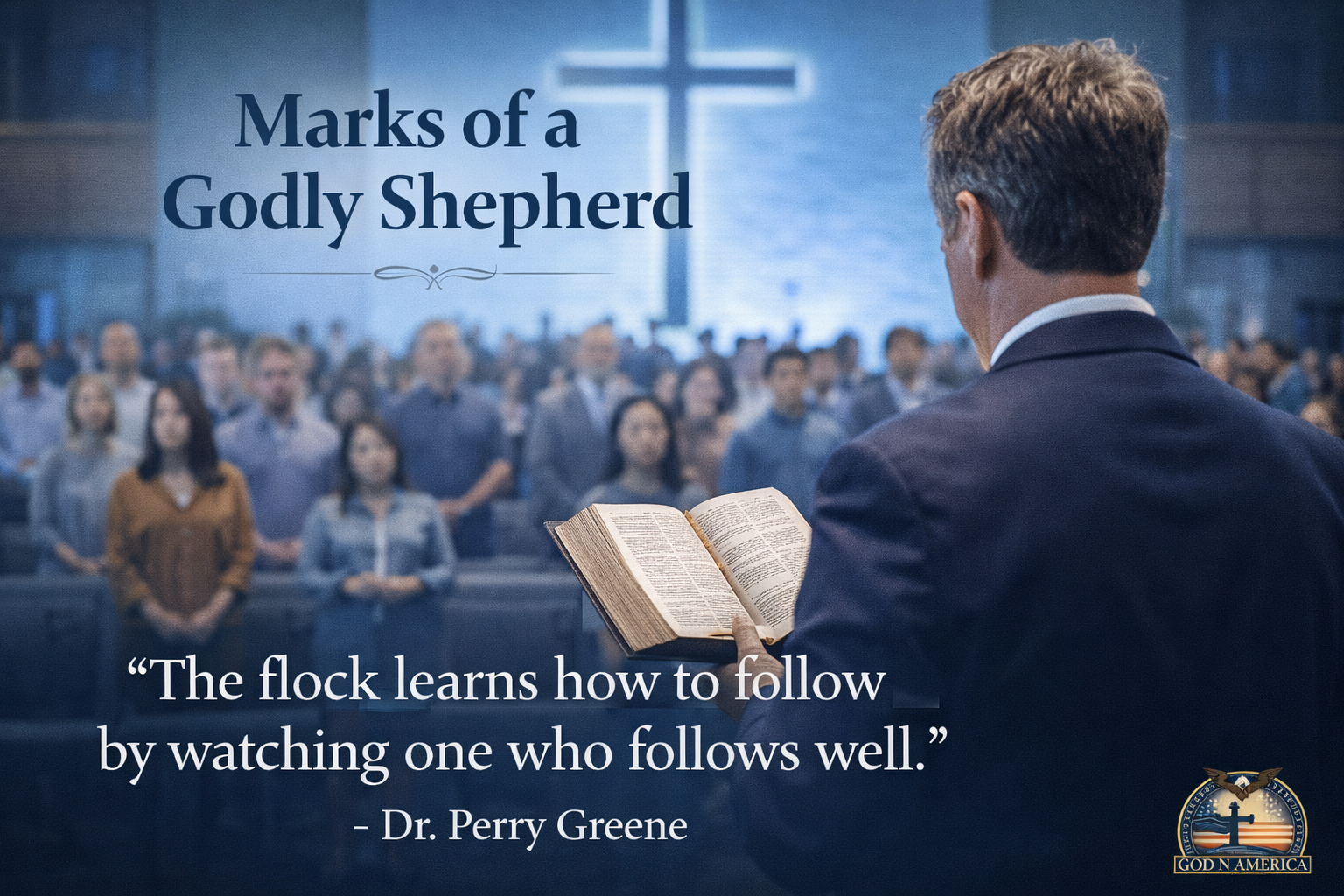
Marks of a Godly Shepherd
It All Begins Here
Faithful spiritual leadership shapes more than a congregation’s weekly routine. In this episode, Dr. Perry Greene contrasts unfaithful shepherds with the kind of leaders Christ calls to care for His church. By walking through six biblical marks of a godly shepherd, he shows why churches need leaders who feed, know, protect, model, pursue, and remain accountable to the Chief Shepherd.
Dr. Perry Greene opens with a vivid picture from shepherding life in the Middle East. A missionary notices one sheep with a small bell tied around its neck, and the shepherd explains that this is the sheep that stays closest to him. Wherever the shepherd goes, that sheep follows, and wherever that sheep goes, the rest of the flock follows as well. Dr. Greene uses that image to make a larger point about church life: people learn how to follow by watching those who follow faithfully. Leadership, in that sense, is not merely positional. It is instructive. It teaches by pattern, by nearness, and by visible example.
He places this message against the backdrop of God’s rebuke of unfaithful shepherds in Ezekiel 34. Instead of remaining with that picture of failure, Dr. Greene turns to the opposite question: what does faithful shepherding look like? His answer is both biblical and practical. He argues that Christ desires a certain kind of leadership for His church, and that the spiritual health of a people is closely connected to the faithfulness of those who guide them. That conviction gives the episode weight beyond church management. It frames shepherding as a serious calling with consequences for congregations, families, and the wider culture.
The first mark of a godly shepherd is that he feeds the flock. Drawing from John 21, where Jesus tells Peter to feed His lambs and sheep, Dr. Greene identifies spiritual nourishment as the shepherd’s central work. He defines that nourishment in clear biblical terms: Scripture, truth, doctrine, wisdom, and sound teaching. This is a direct challenge to leadership models that place the greatest emphasis on novelty, entertainment, or strategy. Dr. Greene does not present ministry as a search for the next technique. He presents it as a responsibility to nourish souls with the truth of God. In his words, where the Word is neglected, the flock will starve.
That emphasis explains why he points to early American ministers, especially Puritan pastors, who gave extensive time each week to the study of Scripture. Dr. Greene presents that pattern as a reminder that serious teaching is not optional if a church is going to be healthy. People are not strengthened by activity alone. They are strengthened when truth is taught clearly and faithfully. He draws a sharp contrast here: a shepherd who will not feed the people is not acting like a shepherd at all, but like a hireling. The difference is important because a hireling may carry a title without carrying the burden of the flock’s spiritual condition. A godly shepherd accepts that burden and serves from the Word.
The second mark is that a godly shepherd knows the sheep. Dr. Greene turns to John 10:14, where Jesus says that He knows His sheep and His sheep know Him. From there, he rejects the image of a distant leader who governs like a corporate executive from above. The shepherd he describes is present with the hurting, the wandering, the weak, the struggling, the faithful, and the fearful. That kind of knowledge is not merely administrative. It is personal and pastoral. It requires attentiveness, time, and a willingness to be near people in the realities of their lives.
To reinforce that point, Dr. Greene again points to earlier American pastors who visited homes, prayed with families, sat at bedsides, and walked long distances in order to care for people. His purpose is not simply to admire another era. It is to show that shepherding has historically involved real presence. A shepherd does not simply gather a crowd and call that success. He learns the condition of the flock so that care can be specific, not generic. In Dr. Greene’s framing, building a platform and shepherding a people are not the same thing. One may produce visibility. The other produces care.
The third mark is protection. In Acts 20:29–30, Paul warns the Ephesian elders that savage wolves will come in among the flock and that even some from within will rise up and distort the truth. Dr. Greene treats that warning as urgent and realistic. He notes that he, along with other sincere ministers, has experienced the damage done by harsh, power-hungry people who insist on controlling churches. That observation strengthens his larger point: danger is not always obvious, and it does not always come from outside. It can emerge through distortion, ambition, manipulation, and spiritual abuse from within.
Because of that reality, Dr. Greene says a godly shepherd protects the flock from false teaching, moral compromise, destructive influences, and spiritual predators. He defines courage carefully. The goal is not harshness, pride, or a domineering spirit. The goal is faithful defense. Some leaders fear upsetting people, but Dr. Greene argues that refusing to confront danger is not gentleness. It is negligence. His summary line is memorable because it captures the heart of the duty: protection is love in action. In a time of confusion, the shepherd must be willing to stand firm for the good of the flock.
The fourth mark is example. Citing 1 Peter 5:3, Dr. Greene says shepherds must be examples to the flock. Here he returns to the image of the bell sheep, the one whose close following teaches the rest of the flock how to move. The point is simple and searching. People rarely rise above the level of their leadership. If leaders walk in holiness, the flock learns godliness. If leaders walk in humility, the flock learns meekness. If leaders walk in truth, the flock learns certainty. Dr. Greene’s contrast is clear: the best leaders are not performers; they are patterns. They do not merely speak about the path. They show what it looks like to walk it.
The fifth mark is that a godly shepherd seeks the lost sheep. Dr. Greene draws from Luke 19:10 and emphasizes that Christ came to seek and to save the lost. He applies that mission to pastoral leadership by rejecting indifference toward the one who drifts away. A faithful shepherd does not shrug and console himself that overall attendance remains strong. He pursues the drifting, the discouraged, the wounded, and the forgotten. That pursuit reflects the heart of Christ. It also reflects a conviction that souls matter one by one, not only in the aggregate.
Dr. Greene again points to earlier American church life, where a straying person was not simply written off. Churches prayed, and pastors and elders went after the wandering with both compassion and conviction. He holds those two ideas together throughout the episode. Compassion without conviction can become passive sentiment, while conviction without compassion can become severity. A godly shepherd carries both. He is willing to walk the hills for one soul because he understands the worth of the person he is seeking and the seriousness of spiritual drift.
The sixth mark gathers all the others under one controlling truth: a godly shepherd lives under the Chief Shepherd. Dr. Greene cites 1 Peter 5:4 and reminds listeners that a pastor is not the owner of the flock. He is the steward. That distinction is essential because it places all ministry under the authority of Christ. Feeding, knowing, protecting, leading by example, and pursuing the lost only remain healthy when a shepherd remembers that the church belongs to Jesus. In Dr. Greene’s message, this is what guards against self-importance, control, and misuse of authority. The shepherd is accountable because Christ is supreme.
By the end of the episode, Dr. Greene has done more than describe pastoral responsibilities. He has also tied spiritual leadership to the health of a people. He argues that the nation’s future depends on the spiritual health of its people, and that the spiritual health of the people depends on the shepherds who guide them. His point is direct and practical: leadership matters because example matters, truth matters, and faithful care matters. Churches need shepherds who will stay close to Christ so that others learn how to follow Him well.
Application
For pastors and elders, Dr. Greene’s message is a call to measure ministry by faithfulness rather than by image. The question is not simply whether programs are running or crowds are gathering, but whether people are being fed from Scripture, known personally, protected from error, shown a faithful example, pursued when they drift, and led under Christ’s authority.
For church members, this message provides a biblical framework for prayer and discernment. Congregations should pray for shepherds who teach courageously and care personally. They should also recognize and encourage leaders who quietly do the work of shepherding without demanding applause. Churches are healthiest when the flock values the same marks Christ values.
For families and communities, Dr. Greene widens the lens. Faithful shepherding strengthens more than a Sunday routine. It helps form people who can live in truth, resist confusion, and walk with conviction. In that sense, the call for godly shepherds is also a call for churches to take spiritual health seriously, because strong public witness begins with strong spiritual care.
TL;DR
Dr. Perry Greene frames this episode around the contrast between unfaithful shepherds and the kind of leaders Christ desires for His church.
He begins with the image of a bell sheep to show that people learn how to follow by watching one who follows well.
A godly shepherd feeds the flock through Scripture, truth, doctrine, wisdom, and sound teaching.
A godly shepherd knows the sheep personally and stays present with people in their real needs and struggles.
A godly shepherd protects the flock from false teaching, spiritual predators, and destructive influences.
A godly shepherd leads by example, because the flock often reflects the character of its leadership.
A godly shepherd seeks the wandering, wounded, discouraged, and forgotten rather than ignoring those who drift.
A godly shepherd remembers that he is not the owner of the church, but a steward under Christ, the Chief Shepherd.
Dr. Greene ties faithful shepherding to the wider spiritual health of the church and the nation.
Discussion + Reflection
Discussion Questions
Which of the six marks of a godly shepherd feels most urgent in the church today, and why?
What is the difference between a church being spiritually fed and a church merely being kept busy or entertained?
Why is personal presence such an important part of shepherding, especially for the hurting, fearful, and struggling?
How can leaders show both compassion and conviction when confronting danger or pursuing someone who is drifting?
How does remembering Christ as the Chief Shepherd reshape the way pastors and congregations think about authority?
Apply It This Week
Read John 10, John 21, Acts 20, Luke 19, and 1 Peter 5, and note what each passage reveals about shepherding.
Pray specifically for pastors, elders, and ministry leaders to feed, know, protect, model, and pursue the flock faithfully under Christ.
Encourage one shepherding leader this week with a note, call, or conversation that names a specific way his faithfulness has helped others.
Reach out to one discouraged or drifting believer and offer prayer, presence, and a renewed invitation into fellowship.
Prayer Prompt
Lord, raise up shepherds who feed Your people with truth, know them with compassion, protect them with courage, lead them by example, seek the wandering, and serve faithfully under Christ, the Chief Shepherd. Amen.
Carpetbaggers Then and Now
It All Begins Here
In this episode of GodNAmerica, Dr. Perry Greene uses the image of the carpetbagger to examine a problem that reaches far beyond Reconstruction history. He explains how opportunistic leadership damages trust, weakens communities, and threatens the moral character required for a republic to endure. Readers will see how he connects the past to the present and why he argues that servant leadership, local accountability, and biblical discernment still matter today.
Dr. Perry Greene opens with a vivid story about a contractor who looked the part. The man arrived in spotless jeans, brand-new boots, and a shiny tool belt. He spoke confidently and promised big results, but one simple question exposed the truth: he had no proven work to show. For Dr. Greene, that image captures the heart of the carpetbagger problem. The issue is not presentation. The issue is motive. A polished appearance can hide a self-serving agenda.
That opening illustration leads into Dr. Greene’s historical discussion of the carpetbagger. He explains that an article written by Oklahoma GOP chair Charity Linch in November 2025 prompted him to investigate the origins of the term, the damage it caused, and the way the same mindset can still appear in modern politics. He places the discussion in the aftermath of the war between the states, noting that General Robert E. Lee surrendered the Army of Northern Virginia to Ulysses Grant on April 9, 1865, and that President Andrew Johnson later issued a proclamation on August 20, 1866, declaring the insurrection formally ended. In Dr. Greene’s telling, the South that emerged from that conflict was devastated and vulnerable.
Into that broken environment came northerners carrying suitcases made from carpet fabric. According to Dr. Greene, the luggage gave the carpetbagger his name, but the label came to describe much more than a travel bag. It became a symbol of outsiders who arrived in weakened communities not to serve, invest, or build, but to benefit themselves. He describes many of them as men who bought damaged land for pennies on the dollar, influenced Reconstruction governments, manipulated elections, and gained power in states they barely knew.
Dr. Greene’s description is less about relocation than exploitation. He argues that these men came to build their careers while presenting themselves as helpers. In his words, they were strangers pretending to be saviors. That kind of leadership, he says, deepened mistrust between the North and the South because local citizens suddenly saw government filled with outsiders who did not understand their culture, their history, or their struggles. The long-term effects, as he explains them, included political resentment, social division, and a lingering sense of having been used.
From there, Dr. Greene shifts from history to principle. His warning is straightforward: when leaders come for themselves rather than for the people, the nation suffers. That sentence becomes the central argument of the episode. The carpetbagger is not merely a figure from Reconstruction. In Dr. Greene’s view, the same spirit appears whenever a leader treats a community as a platform instead of a people to serve.
That is why he applies the term to the present. Dr. Greene defines the modern carpetbagger as a person who moves into a state simply to run for office, with no roots, no history with the community, no real investment in the people, and no intent to serve beyond personal gain. He is careful to make a distinction. The concern is not movement itself. As he puts it, “It’s not the moving that bothers the people, it’s the motives.” The real problem is ambition detached from accountability.
He says modern carpetbaggers often arrive with the same recognizable pattern: polished speeches, significant fundraising from outside the state, flashy promises, and very little understanding of the people they claim to represent. Their campaigns may look impressive, but image is not the same thing as integrity. Dr. Greene argues that Americans can smell that kind of ambition a mile away.
To show why this matters morally, Dr. Greene turns to Scripture. He points to Ezekiel 34:2–4, where selfish shepherds are condemned for caring for themselves while failing to strengthen the weak, tend the sick, or bind up the injured. He also points to Philippians 2, where Paul says, “Do nothing out of selfish ambition” and calls believers to look to the interests of others. In Dr. Greene’s message, those passages define the difference between false leadership and faithful leadership. God’s true leaders serve. They do not exploit. They love the flock, invest in the people, and act with humility.
Dr. Greene then connects that biblical vision to the American founding. He says the founders believed self-interest had to submit to virtue. George Washington stands as his clearest example. Washington walked away from power twice, refusing kingship, dictatorship, and a crown. Dr. Greene also cites John Adams, who said, “Public business must always be done by someone. If wise men refuse to serve, others will not.” For Dr. Greene, those examples point to a model of leadership that is sacrificial, rooted in community, accountable to God, and guided by Scripture. He does not present the founders as perfect men, but as men who understood that a republic cannot survive self-serving leaders.
The practical application of the episode is direct and concrete. Dr. Greene urges citizens to know their leaders by doing real homework. He says character, roots, service, and humility matter more than slogans. He calls for a rejection of opportunism, warning that leaders should love the people they represent rather than milk them for influence. He urges voters to value integrity over image, especially in a political climate where candidates often say the right words and repeatedly fail to follow through.
He also argues that strong local communities are one of the best defenses against exploitation. A community that is engaged and alert is harder to exploit. That is why discernment matters so much in his message. Dr. Greene calls on citizens to pray for wisdom, to ask God to raise up servants rather than opportunists, and to remain anchored in biblical truth rather than campaign image.
Taken as a whole, this episode is a warning against political image without integrity and a call back to moral seriousness in public life. Dr. Greene does not treat servant leadership as a sentimental ideal. He presents it as a civic necessity. A free people cannot afford to be careless about character. A republic depends on citizens who can recognize the difference between a shepherd and a self-serving leader.
That is why the title Carpetbaggers Then and Now carries more weight than a history lesson alone. Dr. Greene uses the past to sharpen discernment in the present. His conclusion is that America was never meant to be shaped by opportunists, but by servants. The burden of that message falls on both leaders and citizens. Leaders must come with humility, conviction, and genuine care for the people they serve. Citizens must stay awake, demand integrity, and protect freedom by insisting that public leadership remain tied to virtue.
TL;DR
Dr. Perry Greene uses the image of a polished but unproven contractor to illustrate how appearances can hide selfish motives.
He says the historical carpetbaggers entered the devastated South after the war between the states and often sought profit and power rather than restoration.
According to Dr. Greene, their actions deepened mistrust, increased resentment, and left lasting social and political division.
He argues that the same mindset still appears today when people move into a state only to run for office and gain influence.
The core issue, in his view, is not relocation but motive: whether a leader comes to serve or to exploit.
Dr. Greene points to Ezekiel 34:2–4 and Philippians 2 to show that biblical leadership is marked by humility, care, and service rather than selfish ambition.
He says the American founders understood that virtue must govern self-interest if a republic is going to survive.
Citizens, in his message, should examine roots, character, service, and integrity rather than polished speeches and campaign image.
Strong local communities and prayerful discernment make it harder for opportunists to gain power.
Dr. Greene’s central warning is that America cannot thrive under self-serving leaders and must be guarded by citizens anchored in biblical truth.
Discussion + Reflection
Discussion Questions
How does Dr. Greene use the image of the contractor to frame the larger issue of opportunistic leadership?
What kinds of damage does Dr. Greene say the original carpetbaggers caused in the South after the war between the states?
Why does Dr. Greene insist that motive matters more than image when evaluating a leader?
How do Ezekiel 34:2–4 and Philippians 2 deepen the moral weight of his argument about leadership?
What would it look like for a local community to value integrity, humility, and service more than political performance?
Apply It This Week
Research one local or state leader beyond campaign messaging and look closely at roots, record, and service.
Start one conversation in a church, family, or community setting about the difference between image and integrity in leadership.
Pray specifically for discernment regarding public officials, candidates, and emerging leaders.
Find one practical way to strengthen local community involvement, since engaged communities are harder to exploit.
Prayer Prompt
Lord, raise up leaders who serve with humility, integrity, and love for the people, and give citizens the wisdom to recognize truth, reject selfish ambition, and protect freedom with courage and discernment. Amen.

The Only Son
It All Begins Here
How the Bible’s only-child stories lead us to the heart of the gospel
There is something especially weighty about the story of an only child. A mother once told of tucking her only son into bed the night before he left for military training. She placed a small folded American flag on his pillow, the same one her father received when he came home from World War II. She wanted her son to remember how much one life can matter. After he left, she would pass his empty room and feel the combined ache of worry and pride. Then she said something I have not forgotten: she could not imagine what it must have been like for God to send His only Son.
As the father of an only child, I understand why that statement pierces the heart. Scripture contains several accounts involving an only son or an only daughter, and each one carries unusual emotional force. An only child is not merely a loved child. He or she often represents promise, future, inheritance, and the center of a parent’s earthly affection. When the Bible calls attention to that detail, it is teaching us something about love, vulnerability, and sacrifice.
At Christmas, we naturally reflect on the Father’s gift of His Son. After Easter, we should not quickly move on from that same truth. The story of God’s one-of-a-kind Son stands at the center of the Christian faith, and many of the Bible’s only-child narratives seem to prepare our hearts to understand it.
Isaac was Abraham’s only son of promise. Abraham had waited for decades to receive the child God had pledged to him. Isaac was not only a son; he was the miracle child, the covenant child, and the visible sign that God keeps His word. Then came the command that Abraham offer him back to God. The language of Scripture is intentionally sharp: “your son, your only son, whom you love.” Yet Isaac was spared. God stopped the sacrifice and provided a ram in his place. The son of promise was not lost.
The widow of Zarephath also knew the anguish bound up in an only child. In 1 Kings 17, her only son died, and with him seemed to die her security, her future, and her legacy. But through Elijah, God restored the boy to life. In Luke 7, Jesus encountered another grieving mother, the widow of Nain, as she walked in a funeral procession for her only son. Her sorrow was compounded by her vulnerability; she was a widow and now childless. Christ was moved with compassion, interrupted the procession, and raised the young man. Then, in Luke 8, Jairus came pleading for his dying daughter, and Luke notes that she was his only child, about twelve years old. Jesus restored her as well.
These stories move us because the bond feels so concentrated. When an only child is threatened, the reader senses the magnitude of what is at stake. Yet in every one of those biblical accounts, the child is spared, restored, or protected. Isaac lives. The widow’s son lives. Jairus’s daughter lives. Scripture allows us to feel the relief of divine mercy.
Then it confronts us with the great contrast: God did not spare His only Son.
That is the heart of the gospel. John 3:16 tells us that God so loved the world that He gave His one and only Son. Romans 8:32 declares that He did not spare His own Son, but gave Him up for us all. The earlier stories prepare us emotionally for this truth, but they do not resolve it. They sharpen it. What earthly parents long to prevent, the Father chose to endure for the salvation of the world. Isaac was spared, but Jesus was not. The widow’s son was restored, but Jesus was delivered over to death. Jairus’s daughter was raised from her bed, but the Son of God went willingly to the cross.
This is why the gospel is not merely the story of a good teacher, a moral example, or a religious martyr. It is the account of the Father giving His Son and the Son giving Himself. It is the supreme revelation of divine love. The cross is not accidental to Christianity; it is Christianity’s center. If we lose our wonder at that point, we have not merely lost a detail. We have lost the heartbeat of the faith.
I believe earlier generations in America understood this more clearly than many do now. Christianity was not treated as a cultural accessory but as a foundational truth. The Pilgrims carried the gospel across an ocean. Colonial households taught children to read so they could read Scripture for themselves. During the Great Awakening, preachers such as Jonathan Edwards and George Whitefield proclaimed Christ crucified and salvation through Him alone. Even in the political thought of the founding era, there was a broad assumption that liberty required moral and spiritual formation rooted in Christian truth. John Adams observed that the general principles behind American independence were the general principles of Christianity.
That does not mean early America was flawless, nor does it mean every person lived consistently with Christian conviction. It does mean that many understood a vital principle we are in danger of forgetting: freedom flourishes only when rooted in faith. A people who understand sacrifice, sin, redemption, and accountability before God are better equipped to preserve ordered liberty than a people determined to sever freedom from moral truth.
Today, we often treat the story of Jesus with a dangerous familiarity. We hear it so often that we may stop feeling its weight. Worship can be replaced with entertainment. Reverence can be displaced by routine. Gratitude can give way to assumption. In that condition, we may continue the outward motions of Christian faith while losing inward awe. The problem is not that the gospel has grown less glorious. The problem is that our hearts have grown dull.
The answer is not novelty. The answer is remembrance. We must place the cross before our eyes again and again. Just as that mother placed a folded flag on her son’s pillow as a reminder of sacrifice, we must set before ourselves the sacrifice of God’s only Son. We must remember what it cost. We must remember why it was necessary. We must remember that our salvation was not purchased cheaply.
When we recover that vision, gratitude begins to shape how we live, speak, and serve. We become more careful with worship, more serious about holiness, more patient in suffering, and more faithful in teaching those who come after us. A nation that forgets Christ forgets the source of its deepest blessing. A church that forgets the cost of redemption becomes weak in conviction and shallow in praise. But a people who remember the Father’s gift of His only Son will find in that truth both humility and strength.
Application
The first application is personal gratitude. I must not allow the gospel to become so familiar that I cease to marvel at it. The Father gave what no earthly parent would willingly surrender apart from divine purpose: His only Son. Remembering that truth should deepen worship and renew my sense of dependence upon God.
The second application is spiritual seriousness in the home and in the church. If earlier generations believed children should learn to read Scripture for themselves, then we should be equally intentional in teaching the next generation the story of Christ’s sacrifice. Faith does not endure by accident. It must be taught, modeled, and treasured.
The third application is public clarity. Freedom detached from God eventually becomes confusion rather than liberty. If we want a strong people, a stable culture, and a meaningful understanding of freedom, then we must recover the gospel truths that shaped conscience, responsibility, and reverence in the first place.
Devotional Questions
Have I grown so familiar with the story of Jesus that I no longer feel the weight of the Father giving His only Son?
Which biblical story of an only child most helps me understand the love and cost revealed at the cross?
In what ways have I allowed routine, distraction, or entertainment to replace reverent worship?
How am I teaching the next generation to understand and cherish the sacrifice of Christ?
Does my understanding of freedom begin with independence from God, or with dependence upon Him?
TL;DR
The Bible’s stories of only children help us feel the emotional weight of love, promise, and sacrifice. In each of those accounts, the child is spared or restored, but in the gospel God did not spare His only Son; He gave Him for the salvation of the world. Early Americans generally understood that Christian faith was foundational to both personal life and public liberty. Today, we must recover gratitude, reverence, and a renewed commitment to pass on the story of Christ’s sacrifice to the generations who follow.

Shepherds After God’s Own Heart
It All Begins Here
How Hosea reveals God’s grief, redeeming love, and the call for a wandering people to return
Jimmy Moore was a dying man. His heart was broken and failing, and the only thing that could save him was a new one. After he was admitted to Vanderbilt Hospital for a transplant, he eventually recovered well enough to run the Music City Triathlon. When he crossed the finish line, he wore a T-shirt that read, “I’ve had a change of heart.” That image stays with me because it provides a fitting way to begin thinking about Hosea. Sometimes the real problem is not simply what we have done, but what we have misunderstood about the heart itself.
For years, I lived under a misunderstanding of God’s nature. I assumed that when we violated His will, His primary disposition toward us was vindictive and ruthless. But when I read Hosea, I do not see justice alone. I see grief. I see the tears of a faithful God who has been rejected by the people He loves.
That is why the story of Hosea is so arresting. Hosea was told to marry a woman who would betray him, not to humiliate him, but to make visible the anguish of God. Israel’s sin was not presented merely as a legal problem. It was a covenantal, personal, and relational betrayal. God had delivered His people, provided for them, and blessed them, yet they still pursued false gods and false securities. In Hosea, sin is not reduced to rule-breaking. It is shown as heartbreak.
That distinction matters. When God’s people bowed to Baal, they were not only breaking commands; they were rejecting the One who had cared for them. When they trusted pagan alliances more than divine promises, they were not only acting unwisely; they were turning from the One who had already proven Himself faithful. Hosea forces me to reckon with the fact that sin does not merely offend God’s authority. It wounds His heart.
At the same time, Hosea refuses to leave the story there. One of the most remarkable features of this book is that divine grief does not harden into indifference. God does not become cold. He continues to pursue. Even when judgment comes, it comes from a heart that still intends healing. That is why Hosea can move from betrayal to tenderness, from exposure to restoration. The Lord does not ignore sin, but neither does He abandon the sinner without a call to return.
The clearest expression of that redeeming love appears in Hosea’s relationship with Gomer. Hosea does not simply forgive her from a distance. He redeems her. He pays the price to bring her home. That is why I said in the episode that this is the gospel in the Old Testament. It is one thing to speak of mercy in theory. It is another thing entirely to go into the place of slavery and bear the cost of restoration yourself. Hosea’s act points beyond itself to Christ, who demonstrates the love of God not after we clean ourselves up, but while we are still sinners.
That is also where this message presses into American life. Early Americans often compared their national story to Israel’s. They understood themselves as a people living under accountability before God. John Winthrop’s image of a city upon a hill reflected that sense of visibility and responsibility. In the episode, I argued that our problem today is not that we have become free of worship, but that we have redirected it. We no longer bow to carved idols, but we still attach ourselves to power, pleasure, progress, and the promise of security apart from God.
That shift has practical consequences. We begin to exchange prayer for pride. We replace dependence on God with dependence on systems, institutions, and the campaign class. We speak confidently about national renewal while ignoring the more difficult work of repentance. Hosea will not allow that kind of self-deception. He reminds us that the deepest crisis is not only rebellion, but forgetfulness. We have forgotten the One who loved us first.
Yet the center of this message is not condemnation. It is return. If God’s heart is grieved, it is grieved because His love remains active. If His people humble themselves, turn from sin, and return to Him, mercy is still not exhausted. The episode closes on that note because Hosea closes on that note. God’s broken heart is not the end of the story. It is the prelude to redemption.
That is also why the title matters to me. Shepherds after God’s own heart are not men and women who speak lightly about sin, nor are they people who speak of judgment without compassion. They are people who learn to feel what God feels. They tell the truth about idolatry, compromise, apathy, injustice, and exploitation, but they do so without losing sight of mercy. Hosea models that posture. He reflects a God who is faithful, wounded, pursuing, and willing to redeem.
In the end, this message is as personal as it is national. Many people live at a distance from God because they assume their sin has made them permanently unwelcome. Hosea says otherwise. The God who is grieved by our wandering is also the God who still speaks tenderly, still calls us back, and still receives the repentant. That is not sentimental religion. It is the steady logic of redeeming love.
Application
This message asks for honest self-examination. It requires us to identify the rival loyalties that quietly compete for trust, devotion, and dependence. In one life that may be pleasure. In another it may be power, ambition, self-protection, or the illusion that public strength can substitute for spiritual health. The point is not theatrical guilt. The point is truthful return.
It also asks Christians to recover a steadier kind of faithfulness. We should be clear about sin without becoming harsh, and serious about mercy without becoming vague. Hosea does not permit moral indifference, but neither does he permit a view of God that is detached, cold, or merely punitive. Faithful shepherding holds truth and tenderness together.
Finally, this message reorders hope. The healing of a people does not finally rest in personalities, campaigns, or policy agendas. Those things have their place, but they cannot do the work of repentance. Renewal begins when hearts return to the Lord, when homes relearn prayer, and when believers refuse to forget the God who loved them first.
Devotional Questions
What part of Hosea’s picture of God most challenges my assumptions about His character?
Where do I notice competing loyalties shaping my trust, attention, or dependence?
What would a concrete return to the Lord look like in one area of life right now?
How can truth and tenderness remain together when speaking about sin, compromise, or failure?
What signs reveal whether hope is resting in God’s mercy or in human power alone?
TL;DR
This post uses Jimmy Moore’s heart transplant story to introduce a larger question about the heart of God. In Hosea, God is not presented as indifferent or merely punitive, but as a faithful Redeemer grieved by the betrayal of His people and still committed to their restoration. The message applies that pattern to America’s spiritual drift, especially our tendency to trust power, pleasure, and public systems more than God. Its central claim is that return remains possible because divine grief is joined to redeeming love.
No Fooling, We Can Break God’s Heart
It All Begins Here
Some failures are loud. Others are quiet enough to pass as competence. In this episode of GodNAmerica, Dr. Perry Greene opens with a rancher’s story about a hired hand who could rope, ride, and fix a fence—but who did not care about the cattle. The young man rode past a sick calf three different times and never stopped to help. For Dr. Greene, that image becomes a picture of leadership without love: skill without shepherding, appearance without care.
From there, Dr. Greene turns to Ezekiel 34 and argues that God speaks to spiritual leaders in much the same way. The chapter is not a gentle nudge. It is a rebuke aimed at shepherds who fed themselves while neglecting the flock. This post traces Dr. Greene’s warning about self-serving leadership, his critique of modern church metrics, and the hope he finds in God’s promise to seek, heal, and feed His sheep Himself.
Dr. Greene begins with the rancher’s blunt conclusion: “I don’t need cowboys who just want to look good on a horse. I need shepherds who care about the cattle.” He uses that line to frame Ezekiel’s indictment. In Ezekiel 34:2, God says, “Woe to the shepherds of Israel who only take care of themselves.” For Dr. Greene, the charge is devastating because it exposes a betrayal of trust. The shepherds had the title and the benefits, but not the heart.
He walks through the details of the chapter carefully. These leaders fed themselves instead of feeding the sheep. They clothed themselves with the wool, but left the flock uncovered. They slaughtered the choice animals, but neglected the weak. They did not strengthen the sick, bind up the injured, bring back the strays, or seek the lost. Instead of ruling with compassion, they ruled harshly and brutally. The result was predictable: the sheep were scattered because no one truly cared for them.
Dr. Greene presents this as one of the strongest condemnations of spiritual leadership in all of Scripture. The problem was not merely weak administration. It was a heart problem. Leaders used God’s people to serve themselves. In his reading, that is what makes the chapter so sobering: God is not only concerned with whether leaders can manage religious structures. He watches how they treat the vulnerable, the wounded, and the wandering.
That is where the message turns uncomfortably modern. Dr. Greene says the same temptation still exists in churches today. Many congregations, he argues, are trained to measure success by what he calls “nickels and noses”—attendance totals, budget growth, larger buildings, and public applause. In that environment, leaders can begin chasing the platform more than the people, influence more than integrity, and growth more than godliness.
Dr. Greene’s critique is not aimed at every church or every pastor. He makes that clear. But he insists the danger is real enough to confront directly. In his words, using God’s people to build a leader’s ego is a form of spiritual abuse. When ministry becomes branding, when shepherding becomes stage management, and when image outruns intercession, the church starts to resemble the very shepherds Ezekiel condemns.
He presses the point further by describing what happens when metrics replace maturity. A church can look successful from a distance while souls are starving up close. Seats may be filled while discipleship remains thin. Money may come in while repentance remains rare. Leaders may be celebrated while the weak go unseen. In Dr. Greene’s framework, God is not fooled by visible momentum if the flock is still neglected.
Yet Ezekiel 34 does not end with judgment alone. Dr. Greene highlights what he sees as the heart-revealing center of the chapter: after condemning false shepherds, God says, “I myself will search for my sheep and look after them” (Ezekiel 34:11). For Dr. Greene, that promise is both comforting and corrective. It comforts the wounded because God does not abandon His flock to negligent leaders. It corrects the proud because God is fully willing to step over failed shepherds and care for His people Himself.
Dr. Greene lingers over the tenderness of God’s promise. God says He will bind up the injured, strengthen the weak, seek the lost, protect the vulnerable, and feed His flock with justice. That, in his telling, is what real shepherding looks like. It is not mainly about visibility. It is about patient care, truthful guidance, and sacrificial attention to people who cannot be treated as numbers.
He then connects Ezekiel’s vision to Jesus’ words in John 21. After the resurrection, Jesus did not tell Peter to build a brand, expand a platform, or chase applause. He told him, “Feed my sheep.” Dr. Greene treats that as the enduring mandate for every shepherding role in the church. The assignment is not celebrity. It is care. Not spectacle, but faithfulness. Not crowd management, but discipleship.
That is why Dr. Greene argues that church leaders today must recover the God-given task of shepherding. In practical terms, he says that means teaching the truth even when it is unpopular, protecting the vulnerable, confronting sin with grace, forming disciples instead of spectators, and loving people more than platforms. He urges leaders to ask different questions. Not simply, “How many people attended?” but “How many are growing?” Not merely, “How much money came in?” but “How much transformation is taking place?”
Dr. Greene also reaches back into early American church life to draw a contrast. Especially in the colonial and revolutionary eras, he argues, churches did not define success by attendance charts or budget expansion. They cared about moral character, biblical literacy, repentance, genuine conversion, and the spiritual condition of homes and communities. Pastors, in his description, preached with tears. Families worshiped beyond Sunday gatherings. Church discipline functioned not as cruelty, but as a serious form of shepherding.
He extends that contrast through the revivals of the First and Second Great Awakenings. In his telling, revival did not come because preachers mastered crowd-building techniques. It came because they sought God. Many early pastors walked long distances to visit families, prayed late into the night, and labored persistently for souls. Dr. Greene’s point is not nostalgia for its own sake; it is a challenge. If churches once measured fruit by holiness, repentance, and transformed lives, then modern churches should be willing to recover that standard.
But the message does not stop with leaders. Dr. Greene says church members also bear responsibility for what kind of ministry they accept and reward. If Christians settle for entertainment-driven religion, shallow teaching, and leaders who avoid difficult truths, then they should not be surprised when the flock remains weak. In his framework, congregations must learn to prize shepherds who love Scripture, walk humbly, pray consistently, live with integrity, serve sacrificially, and lead for God’s glory rather than their own.
That is where the title lands with force. In Dr. Greene’s reading, Ezekiel 34 shows that neglecting God’s people is not a small organizational problem. It grieves the heart of God. When the weak are ignored, the strays are left unpursued, and leaders use sheep for self-advancement, heaven does not shrug. God sees. God speaks. God judges. And still, remarkably, God also comes near to rescue.
So the message is both warning and invitation. It warns leaders not to confuse visibility with faithfulness. It warns churches not to confuse activity with spiritual health. And it invites every believer to look again at the Chief Shepherd, Jesus Christ, who does not exploit the flock but lays down His life for it. In Dr. Greene’s telling, the church’s strength will not come from better optics. It will come from godly shepherds, serious discipleship, and a renewed willingness to care for souls as if they truly belong to God—because they do.
Application
Dr. Greene treats Ezekiel 34 as a mirror for leaders, congregations, and families alike. The issue is not only whether a church appears active, but whether the weak are being strengthened, the wounded are being tended, and the wandering are being pursued.
A faithful response begins by evaluating leadership through the lens God uses. Charisma, polish, and growth can all be real strengths, but none of them can substitute for care. A shepherd must be measured by truthfulness, integrity, patience, courage, and a willingness to know and serve actual people.
Dr. Greene also calls churches to reject the habit of reducing spiritual life to statistics. Counting people is easy; forming them is slow. But if the church rewards only visible scale, it will tempt leaders to build what can be displayed rather than what can endure.
That same standard can be practiced at home. Parents, teachers, small-group leaders, and mentors all shape souls in some way. To shepherd well in ordinary life means paying attention to the discouraged, correcting with grace, telling the truth without cruelty, and refusing to let convenience replace care.
Finally, Dr. Greene’s emphasis on God Himself seeking the sheep offers hope to those who have been neglected or bruised by poor leadership. Ezekiel 34 does not leave wounded people at the mercy of failed shepherds. It points them to the God who sees, searches, heals, and gathers.
Measure leadership by care, not by optics alone.
Ask whether a church is forming disciples, not merely attracting crowds.
Strengthen shepherding habits at home through prayer, Scripture, and patient care.
Refuse entertainment-driven faith that avoids truth and maturity.
Take comfort in God’s promise to seek, heal, and feed His sheep with justice.
TL;DR
Dr. Perry Greene opens with a rancher’s story about a skilled hired hand who did not care for the cattle.
He uses that story to introduce Ezekiel 34 and God’s rebuke of self-serving shepherds.
In Ezekiel 34:2, God warns the shepherds of Israel for caring for themselves instead of the flock.
Dr. Greene highlights the chapter’s charges: the weak were neglected, the sick were not strengthened, the injured were not bound up, the strays were not brought back, and the lost were not sought.
He argues that many modern churches face the same temptation when success is measured by “nickels and noses,” budgets, buildings, and applause.
Dr. Greene says leaders can chase platform over people, influence over integrity, and growth over godliness.
He calls the use of God’s people to build a leader’s ego a form of spiritual abuse.
He emphasizes the hope of Ezekiel 34:11, where God says, “I myself will search for my sheep and look after them.”
Dr. Greene connects that promise to Jesus’ command in John 21: “Feed my sheep.”
He argues that faithful ministry is about discipleship, truth, protection, and care—not celebrity or machinery.
He contrasts that with early American churches, which he says emphasized character, biblical literacy, repentance, and genuine conversion.
He calls church leaders and members alike to seek godly shepherding and reject shallow, entertainment-driven religion.
Discussion Questions
Why does Dr. Greene begin with the rancher and the sick calf, and how does that story prepare the listener for Ezekiel 34?
Which part of God’s indictment of the shepherds in Ezekiel 34 feels most urgent for churches today?
Dr. Greene criticizes “nickels and noses” as a way of measuring success. What healthier measures of church health should replace that mindset?
How does God’s promise in Ezekiel 34:11 change the way wounded or neglected believers should think about their future?
What would it look like for a church to prize shepherding, truth, and maturity more than image, ease, or crowd size?
Apply It This Week
Read Ezekiel 34 slowly and write down every action God condemns in false shepherds and every action He promises to do for His sheep.
Pray specifically for pastors, elders, teachers, and ministry leaders to love people more than platforms and truth more than approval.
Identify one place in your church, home, or community where someone weak, overlooked, or wandering needs care—and take one concrete step toward them.
Ask one honest question about spiritual growth this week: not “What looked successful?” but “What helped someone become more faithful to Christ?”
Prayer Prompt
Lord, forgive leaders and churches for the times we have loved appearance more than faithfulness and numbers more than souls. Raise up shepherds who feed the flock, protect the weak, seek the wandering, and speak Your truth with humility and courage. Heal those wounded by neglect, strengthen homes and churches in holiness, and teach Your people to follow the Chief Shepherd, Jesus Christ, with sincerity and love. Amen.
Lydia Darragh: Quiet Courage and the Whisper That Helped Save the Continental Army
It All Begins Here
Dr. Perry Greene presents Lydia Darragh as an overlooked patriot whose courage did not announce itself with noise, force, or recognition. In this episode, he explains why her hidden act of vigilance mattered, how her faith and resolve shaped her response, and what her example teaches about responsibility, truth, and the defense of liberty today.
Dr. Perry Greene opens this episode with a modern story about a grandmother who saved her family from a house fire with a whisper instead of a shout. That illustration sets the tone for the entire message. In Dr. Greene's telling, courage is not always dramatic, loud, or publicly celebrated. Sometimes it appears in calm decisions made under pressure. Sometimes it sounds like a quiet warning given at the right moment. He uses that opening picture to frame Lydia Darragh as a woman whose strength was steady, hidden, and deeply intentional.
From there, Dr. Greene introduces Lydia Darragh as an unsung hero of the American Revolution. He places her story in 1777, when the British army occupied Philadelphia and General Howe established his headquarters directly across the street from the Darragh home. He describes Lydia as a devout Quaker and a mother of five who lived under constant suspicion because she and her husband refused to support the Crown. According to Dr. Greene, British officers often used her home for meetings because they saw her as a harmless, quiet, middle-aged woman whose faith emphasized peace. That assumption becomes one of the central tensions in the episode. Dr. Greene argues that the British confused quietness with weakness and overlooked the conviction that was already present in Lydia's heart.
The turning point comes when British officers order Lydia to leave her home while they hold a secret meeting. Dr. Greene recounts that instead of withdrawing passively, she hid in a linen closet with her ear pressed to the wall and listened carefully. What she heard was a plan for a surprise attack on General Washington's forces at White Marsh between December 5 and 8, 1777. In Dr. Greene's presentation, the danger was immediate and severe: an entire American force could be destroyed unless someone carried a warning. He compares Lydia's moment to Esther's, emphasizing that she recognized a responsibility placed directly in front of her. The episode treats that realization as more than an emotional impulse. It is a decision to act when silence would have been easier and safer.
Dr. Greene then describes Lydia's response in simple but striking terms. Under the guise of buying flour, she passed through British lines, delivered the message to an American officer, and returned home without attracting suspicion. Three days later, when the British marched toward White Marsh, they found Washington prepared and fortified. The attack failed. Dr. Greene concludes that Lydia's whisper of courage changed the course of a battle and possibly the war. He does not present her as someone who commanded troops or stood in public prominence. Instead, he presents her as a woman whose awareness, discernment, and timely obedience made a decisive difference.
That understanding leads Dr. Greene into the spiritual heart of the episode. He argues that God often works through people who appear least likely to alter events. He connects Lydia's story to 1 Samuel 16:7, repeating the line, "man looks on the outward appearance, but the Lord looks on the heart." In his framing, the British misread Lydia because they judged her by appearance, age, demeanor, and expectations about peace. God, however, saw readiness, moral clarity, and courage. Dr. Greene uses that contrast to underscore a recurring biblical theme: hidden faithfulness still matters, and unnoticed obedience is not unnoticed by God.
He reinforces that point with Proverbs 31:27, saying that Lydia looked well to the ways of her household and did not eat the bread of idleness. In this episode, that verse becomes a way of describing watchfulness as a form of service. Lydia was not idle, detached, or careless. Dr. Greene presents her as attentive to both her family and her country's future. He also cites 1 Corinthians 1:27, where Paul writes that God chose the weak things of the world to shame the strong. By pairing Lydia's story with that passage, Dr. Greene argues that influence does not begin with visible power. In his message, one determined woman, one dangerous walk, and one faithful decision become evidence that ordinary people can be used for extraordinary purposes.
Another major theme in the episode is Dr. Greene's definition of patriotism. He explicitly says that patriotism is not measured by speeches or medals. Sometimes, he says, it is measured in secret steps and quiet decisions. That line explains why Lydia's story matters so much in his broader message about faith and freedom. Her contribution was not public recognition or battlefield glory. It was informed action rooted in conviction. Dr. Greene also highlights the tension inside her Quaker background. Although her faith emphasized peace, he says she understood that allowing evil to triumph is not peace, but surrender. In other words, he presents peace as something deeper than passivity. It is not the avoidance of conflict at any cost. It is the refusal to cooperate with what destroys truth, justice, and liberty.
Dr. Greene then broadens Lydia's story into a principle of personal responsibility. Not everyone fights on a battlefield, he says, but everyone can play a role in defending liberty. He names intelligence, vigilance, conviction, prayer, and discernment as forms of protection that matter. That practical expansion is important because it moves the episode beyond a single moment in Revolutionary history. In Dr. Greene's application, Lydia's courage begins at home. She risked her life, not for applause, but to protect her family's future. He uses that example to argue that freedom is sustained by households that understand what is at stake and by parents who refuse to become careless about the moral and civic world their children will inherit.
The final movement of the episode presses that responsibility into the present. Dr. Greene asks whether people are alert, whether they pay attention to what is happening around them, and whether they assume someone else will act. He also asks whether people are willing to speak the truth when doing so is costly. His language here is direct: sometimes a whisper of truth in a culture of lies is the bravest act of all. That statement brings the opening illustration full circle. The same kind of quiet courage that can save a family from a fire, in his argument, can also preserve a nation from moral drift when faithful people refuse silence.
Dr. Greene closes by warning that freedom is rarely lost all at once. It fades when good people stop acting. That conclusion gives Lydia Darragh's story its lasting force in this episode. He presents her as a model of what it looks like to answer the moment God places before someone, even when the action is small in scale and hidden from public view. His message is that truth, righteousness, and freedom endure when faithful people act out of conviction. In Lydia's case, that conviction took the form of listening carefully, moving wisely, and refusing to let danger go unanswered. In the lives of readers, Dr. Greene's application is clear: stay alert, act with integrity, protect what God has entrusted, and do not underestimate the power of obedient courage.
TL;DR
Dr. Perry Greene presents Lydia Darragh as a Revolutionary-era example of quiet courage.
He places her story in British-occupied Philadelphia in 1777, with General Howe's headquarters across from her home.
According to Dr. Greene, Lydia overheard a British plan to attack Washington's forces at White Marsh and carried a warning through enemy lines.
He argues that her action helped leave Washington prepared and the Continental Army preserved.
Dr. Greene connects Lydia's story to 1 Samuel 16:7, emphasizing that God sees the heart even when others misjudge by appearances.
He also uses Proverbs 31:27 and 1 Corinthians 1:27 to show that God honors diligence and often works through ordinary people.
A major theme of the episode is that patriotism is not always public; it can be expressed through vigilance, discernment, and quiet decisions.
Dr. Greene says courage begins at home and that protecting liberty includes truth-telling, prayer, and personal responsibility.
He warns that freedom fades when good people stop acting.
The episode calls readers to stand for truth, righteousness, and freedom with faithful conviction.
Discussion + Reflection
Discussion Questions
Why does Dr. Greene begin Lydia Darragh's story with the image of a whispered warning instead of a dramatic rescue?
What does this episode suggest about the difference between quietness and weakness?
How does Dr. Greene use Lydia's story to connect faith, family responsibility, and the preservation of liberty?
What does it mean to defend truth and freedom through vigilance, discernment, and prayer rather than public recognition?
Where might silence feel easier than conviction in daily life, and how does Dr. Greene challenge that instinct?
Apply It This Week
Identify one area at home, at church, or in the community where greater vigilance is needed, and take one practical step instead of assuming someone else will handle it.
Speak one truthful, needed word in a setting where silence has become more comfortable than courage.
Set aside time to pray specifically for discernment, moral clarity, and the protection of future generations.
Reflect on one responsibility already placed in front of you and choose a faithful response that is immediate, wise, and intentional.
Prayer Prompt
Lord, give faithful hearts the courage to act, the wisdom to discern what is true, and the conviction to protect what You have entrusted. Help homes, churches, and communities stand firmly for truth, righteousness, and liberty with quiet obedience and steady faith. Amen.
When Lies Become Loud
It All Begins Here
In this episode, Dr. Perry Greene examines how propaganda works when distortion is amplified by volume, repetition, and emotional pressure. He explains why that pattern matters in spiritual life, public life, and family life, and he shows readers how Scripture trains people to test messages, love truth, renew the mind, and resist manipulation.
Dr. Perry Greene opens with a simple but unsettling picture. A historian recalled moderating a debate between two public figures and later concluded that the winner was not the man with the truth, but the man with the microphone. In Dr. Greene's telling, one speaker used calm reasoning while the other relied on volume, repetition, and emotional triggers. The crowd did not carefully weigh the arguments. It followed the stronger voice. That opening frame sets the theme for the entire episode: the danger is not only in lies, but in loud lies.
Dr. Greene defines propaganda as more than distortion. He describes it as the amplification of distortion through persuasion, manipulation, and narrative shaping. In his view, propaganda is part of a larger battle for the human mind. It does not always arrive through evidence or careful reasoning. Instead, it often works by creating a story people feel before they ever evaluate it. That is why he treats propaganda not only as a cultural or political tool, but as a spiritual problem that Scripture repeatedly addresses.
He traces that pattern all the way back to Genesis 3:1. There, he says, Satan launched the first disinformation campaign by asking Eve, "Did God really say?" Dr. Greene notes that the enemy did not answer God's command with evidence, logic, or a serious counterargument. Instead, he introduced a rival narrative. He cast doubt on God's motives, reframed the command, presented sin as freedom, and appealed to emotion and desire. Dr. Greene summarizes the process in four words: redefine, repackage, reframe, repeat. In that reading of Eden, deception did not succeed because truth had been disproved. It succeeded because truth had been emotionally recast.
That point matters in the way Dr. Greene explains persuasion. Eve, he says, was not persuaded logically. She was persuaded emotionally. For that reason, he treats propaganda as a force that reshapes perception before it ever wins a formal argument. The issue is not merely whether a claim is spoken, but how it is framed, repeated, and made attractive. A message can gain power because it is emotionally effective even when it is spiritually false.
Dr. Greene then turns to Numbers 13, where ten spies returned from Canaan with what he calls fear-based propaganda. Their message was not simply a report of obstacles. It was a narrative designed to overwhelm the people with dread: "We are grasshoppers in their sight," and "the land devours its inhabitants." Dr. Greene emphasizes that these statements were emotionally engineered, and he points to the biblical description that they "spread a bad report." He explains that the Hebrew term carries the idea of causing decay or ruin. In other words, false messaging does more than misinform. It can produce spiritual damage. In Dr. Greene's argument, propaganda was powerful enough in that moment to keep an entire nation out of the promised land.
The same pattern appears in the book of Nehemiah. Dr. Greene describes the campaign against Nehemiah as a coordinated smear effort built on false accusations, rumor, intimidation, and public messaging. He highlights Nehemiah 6:5, where a letter is sent "open in the hand." He explains that this meant the message was designed to be intercepted, read, and spread. It was written for circulation. In that example, propaganda functioned as a tool of public pressure, intended to shape opinion and stop the rebuilding of Jerusalem before the work could be completed.
He also points to 1 Kings 22, where Ahab surrounded himself with 400 false prophets while Micaiah stood alone with the truth. Dr. Greene stresses the contrast. The propaganda machine was large, coordinated, and persuasive. The truthful witness was singular and unwelcome. Micaiah did not fit the preferred story, so he was ignored. Dr. Greene's point is plain: propaganda does not simply promote a message. It punishes dissent. Numbers, repetition, and approval can create the impression of certainty even when truth is standing in the minority.
Dr. Greene extends that pattern into the New Testament. He notes that Jesus was targeted by false testimony at His trial and by rumors after the resurrection. He says that Paul's ministry also drew this kind of response, as enemies stirred crowds, spread accusations, and manipulated public feeling wherever he preached. In his telling, propaganda follows truth like a shadow. Wherever truth is proclaimed, distortion often rises beside it in an attempt to redirect attention, control reaction, and crowd out faithful witness.
After showing the biblical pattern, Dr. Greene turns to resistance. The first response he gives is testing every message. As John taught, believers are to test the spirits rather than accept every claim at face value. For Dr. Greene, that means refusing to surrender judgment to volume, momentum, or emotional force. A message does not become trustworthy because it is repeated, amplified, or popular. It must be examined.
The second response is to love the truth. Dr. Greene cites 2 Thessalonians 2:10 and says people perish because they refuse to love the truth. That wording is important in his argument. Truth is not only something to know. It is something to cherish. A person can notice facts and still fail to be anchored by them. In Dr. Greene's framework, resistance to propaganda requires more than information. It requires affection for what is true.
The third response is the renewal of the mind. Referring to Romans 12, Dr. Greene says the mind must be trained, not manipulated. That statement captures one of the episode's central contrasts. Propaganda seeks control. Scripture seeks transformation. One works by pressure, framing, and emotional steering. The other works by renewal, discipline, and obedience to God. Dr. Greene adds Proverbs 4:7 to the discussion and says that understanding disarms deception. Wisdom is not ornamental in this episode. It is protective.
Dr. Greene then broadens the message to the life of the nation. He says the founders feared manipulative messaging because they understood that liberty depends on a well-informed people. He points to George Washington's warning about "the impostures of pretended patriotism," John Adams's insistence that liberty requires an informed public, and Alexis de Tocqueville's warning about "soft despotism," a subtle control of opinion through narrative management. Dr. Greene does not argue that the founders anticipated modern media technology in its present form. His point is that they understood the danger behind it: a republic weakens when narrative replaces truth.
He adds that Edward Bernays did not invent propaganda, but modernized it. That observation fits the larger line of the episode. The technology may change, but the deeper method remains familiar. Distortion is framed attractively, repeated forcefully, and made emotionally compelling. Whether the setting is Eden, ancient Israel, first-century opposition, or modern public life, Dr. Greene sees the same contest over perception and belief.
In practical terms, Dr. Greene's message pushes daily life in a clear direction. Readers are urged to slow down before accepting the loudest voice. They are warned to question narratives built only on emotional appeal. They are instructed to search the Scriptures before searching the headlines. They are also urged to teach children how persuasion works, so that identity is anchored in Christ rather than in messaging. Those applications are not presented as political techniques. Dr. Greene presents them as habits of discipleship and discernment.
A few of the practical habits he points toward are easy to identify:
Pause before repeating a claim that is fueled mainly by fear, outrage, or emotional pressure.
Compare public narratives with Scripture instead of assuming that repetition equals truth.
Make wisdom and understanding active household disciplines rather than occasional concerns.
Teach children and younger believers how framing, repetition, and intimidation can shape perception.
Remember that standing on truth may mean standing apart from the preferred story.
Dr. Greene closes the episode with a series of contrasts that summarize the whole argument. Propaganda seeks to control the mind, but Scripture seeks to renew it. Propaganda seeks crowds, but Christ seeks disciples. Propaganda manipulates emotions, but God strengthens convictions. For that reason, the issue is larger than media criticism. It is a question of spiritual formation. In Dr. Greene's message, the health of a people depends on whether they can still discern truth from noise, light from shadow, and the voice of God from the voices that clamor for control. His closing charge is fitting: keep the light of godly discernment burning.
TL;DR
Dr. Perry Greene argues that the danger is not only in lies, but in loud lies.
He defines propaganda as the amplification of distortion through persuasion, manipulation, and narrative shaping.
He traces propaganda back to Genesis 3:1, where Satan introduced doubt, reframed God's command, and appealed to desire.
In Numbers 13, he presents the ten spies as an example of fear-based propaganda powerful enough to keep a nation out of the promised land.
He shows that Nehemiah, Micaiah, Jesus, and Paul all faced forms of false accusation, rumor, and crowd manipulation.
He warns that propaganda does not just promote a preferred story. It also punishes dissent.
He says believers must test messages, love the truth, renew the mind, and seek understanding.
He connects discernment to the health of a republic, arguing that public freedom weakens when narrative replaces truth.
He urges families to search Scripture before headlines and to teach children how persuasion works.
He concludes that propaganda seeks crowds, but Christ seeks disciples.
Discussion Questions
Why does Dr. Greene say the deepest danger lies not only in lies, but in loud lies?
What does Genesis 3 reveal about the role of doubt, reframing, and desire in deception?
How does the report of the ten spies in Numbers 13 show the power of fear-based messaging?
What stands out in the contrast between 400 false prophets and the solitary witness of Micaiah?
What habits can help a household search Scripture before headlines and resist emotional manipulation?
Apply It This Week
Read Genesis 3:1 and ask how doubt and reframing are used to challenge truth.
Revisit Numbers 13 or Nehemiah 6:5 and identify how fear or rumor is used to shape public response.
Pause before sharing a story or claim that seems designed mainly to provoke outrage or panic.
Set aside time with family or a small group to discuss how repetition and emotional pressure can influence belief.
Prayer Prompt
Lord, strengthen hearts to love the truth, renew the mind through Your Word, and give clear discernment to resist every loud lie.

The Bridge Builders America Needs
It All Begins Here
In this episode of GodNAmerica, Dr. Perry Greene uses a simple image—a bridge built for people the builder may never meet—to describe the kind of faith and civic courage America needs right now. He connects a well-known “bridge builder” story to Scripture and early American history, then urges believers to live in ways that make the road easier for children and grandchildren. Readers will learn how Dr. Greene defines bridge building, why he ties it to the Christian life and the American experiment, and what everyday faithfulness looks like when the culture rewards comfort more than conviction.
Dr. Greene opens with the memory of a retired engineer who once revisited a bridge he had helped build. Standing at the rail while cars sped overhead, the engineer watched ordinary people cross—a young mother with children, a construction worker, and a couple heading home after work. None of them knew his name. None of them knew the hours, setbacks, and storms that threatened to stop the project. But the engineer smiled, because the purpose of a bridge is not to congratulate the builder; it is to carry others safely to the other side.
From that picture, Dr. Greene turns to the classic “Bridge Builder” idea popularized in a poem often attributed to Will Allen Dromgoole. In the poem, an older man crosses a dangerous gap and then does something unexpected: instead of moving on, he turns back to build a bridge over the chasm. When questioned about why he would do the work when he has already made it across, the old man explains that a young traveler is coming behind him, and what was not a stumbling block for the older man could become a deadly trap for the one who follows. Dr. Greene highlights the heart of that message in a single line: “Good friend, I’m building this bridge for him.”
Dr. Greene frames that posture—building for the next traveler—as both Christian and deeply American at its best. He describes it as the spirit of a life that refuses to make faith a private possession or a short-term comfort. In his telling, bridge building is not self-focused spirituality. It is legacy-minded discipleship: living today with tomorrow’s people in view.
Although the poem itself does not quote the Bible, Dr. Greene argues that the concept is biblical. He points to the Psalms and emphasizes the responsibility of one generation to prepare the way for the next. He cites Psalm 86:6 as a reminder that believers live with future generations in mind, and he echoes the idea that the next generation should know and be ready to tell their children. He also cites Psalm 102:18, quoting its forward-looking purpose: “Let this be recorded for a generation to come so that a people yet to be created may praise the Lord.” And he points to Proverbs 13:22, summarizing generational responsibility in practical terms: “A good man leaves an inheritance to his children’s children.”
In Dr. Greene’s message, that “inheritance” is more than money. It includes what he calls bridges of:
Faith that is visible and transferable
Character that holds steady under pressure
Courage that refuses to bow to evil
Truth that does not dissolve for the sake of comfort
To show what that kind of bridge building can look like in history, Dr. Greene moves to the early settlers at Plymouth in 1620. He emphasizes that, in their own self-understanding, they were not chasing applause. They saw themselves as forerunners and servants—people laying foundations they might never enjoy fully. He recalls Governor William Bradford describing them as willing to “be stepping stones for others to follow.” Dr. Greene highlights the cost they endured: brutal weather, sickness, scarcity, grief, and the fear of an unknown future. He argues that their sacrifices were not merely personal achievements, but the laying down of a path.
Dr. Greene then describes what he believes those early communities sought to build: self-governing local life, covenant-based societies, education rooted in Scripture, homes centered on family and worship, and a moral framework that shaped American heritage. In his framing, their bridge was built through faithfulness—choosing conviction when a softer route would have been easier.
From there, Dr. Greene “fast-forwards” to the founding generation and treats them as carrying the same sense of responsibility. He cites John Adams writing to his wife Abigail with a warning for later generations: “Posterity, you will never know how much it cost this generation to preserve your freedom.” Dr. Greene uses that line to underline a contrast. Comfort talks about what is convenient now. Responsibility asks what it will cost to keep the path open for those who are not yet old enough to vote, speak, or protect themselves.
This is where Dr. Greene’s challenge becomes direct. He describes a modern temptation among believers: staying silent instead of resisting evil, choosing comfort over courage, and withdrawing from the kinds of moral and civic conflicts that shape a nation’s future. He argues that this is precisely the moment America needs bridge builders—men and women who act not only for themselves, but for the generation still coming behind them.
In Dr. Greene’s view, the stakes are not abstract. He points specifically to children and grandchildren. They need more than slogans; they need models. They need examples of integrity. They need homes that honor Scripture. They need adults who resist tyranny with love and conviction rather than fear or apathy. In his words, today’s courage becomes tomorrow’s freedom.
At the same time, Dr. Greene insists that bridge building is not always dramatic. Not every bridge is a public monument. Some are quiet, daily structures built through repeated faithfulness—choosing truth in conversation, building stability in a home, refusing to normalize what Scripture calls wrong, and standing firm when silence would be easier. But he also cautions that there are moments when “small” faithfulness must grow into “big” faithfulness—when the times demand more than private belief.
Dr. Greene presses the point with a set of questions aimed at conscience: if this generation will not build, who will? If believers will not preserve freedom, who can? He does not direct that responsibility toward politicians or schools as a substitute for personal conviction. Instead, he places the burden where he believes it belongs: on people of faith who understand that their choices shape the road their children will inherit.
He closes with a call for a specific kind of American identity—an America in which faith shaped freedom, and freedom thrived because it remained anchored in faith. In that closing, his vision is not nostalgia as decoration; it is legacy as duty. The light must stay lit. The bridge must be built. And the reason is simple: someone else is going to cross after this generation is gone.
Application
Dr. Greene’s bridge-building challenge is both personal and generational. In practical terms, his message points toward habits that strengthen faith and preserve freedom over time—especially in the places that shape children long before they understand politics or culture.
Think in generations, not headlines. Dr. Greene frames faithful living as “recording” something for people “yet to be created.” That shifts decision-making from short-term convenience to long-term stewardship.
Build a home culture that honors Scripture. He connects bridge building to households marked by worship, moral formation, and integrity that children can observe and imitate.
Practice courage with a calm spirit. His call to resist evil is not presented as rage, but as conviction—standing firm with love rather than surrendering to fear.
Treat integrity as infrastructure. Bridges hold weight because they are built to carry burdens. In his framing, character functions the same way: it quietly supports others when storms hit.
Refuse the comfort of silence. Dr. Greene warns against choosing ease over courage. His message presses believers to speak and act faithfully when silence would leave the next generation with fewer safe crossings.
Stay faithful, stay strong, stay courageous. He ends with a steady refrain, presenting endurance—not theatrics—as the way a bridge gets built and kept.
TL;DR
Dr. Perry Greene uses a bridge-building story to describe generational responsibility.
He highlights a “bridge builder” poem image: an older traveler builds for someone coming behind him.
He argues that the concept is biblical and cites Psalm 86:6, Psalm 102:18, and Proverbs 13:22.
He defines bridge building as leaving others a safer path through faith, character, courage, and truth.
He points to the Plymouth settlers (1620) as people willing to be “stepping stones” for future generations.
He cites John Adams warning that later generations may not realize what freedom cost.
He cautions that many believers choose comfort over courage and stay silent instead of resisting evil.
He says children and grandchildren need models of integrity and homes that honor Scripture.
He emphasizes that bridge building can be quiet daily faithfulness, and sometimes must become “big” when needed.
His closing claim: today’s courage becomes tomorrow’s freedom.
Discussion Questions
In Dr. Greene’s bridge image, what “chasm” might the next generation face that this generation is tempted to ignore?
What does it look like to build bridges of faith, character, courage, and truth in ordinary routines?
Dr. Greene warns against the “comfort of silence.” Where is silence most tempting right now, and why?
How does Dr. Greene connect the idea of spiritual inheritance (Proverbs 13:22) to daily choices in a home?
What would change if decisions were measured by whether they help “a people yet to be created” (Psalm 102:18)?
Apply It This Week
Choose one daily habit that strengthens “bridge” qualities—truthfulness, patience, courage, or consistency—and practice it intentionally for seven days.
Name one younger person (child, grandchild, student, neighbor) and do one concrete act that makes their path easier: encouragement, mentoring, a note, a shared meal, or consistent prayer.
Identify one area where silence has replaced conviction, and respond with a calm, truthful next step (a conversation, a boundary, a refusal to compromise, or a commitment to show up).
Talk as a household about what kind of “inheritance” is being built—beyond finances—and write down one legacy goal.
Prayer Prompt
Lord, help this generation build bridges of faith, character, courage, and truth so that those who come after will have a safer path to walk and a clearer reason to praise You. Amen.

The Courage to Say No
It All Begins Here
Dr. Perry Greene opens this episode of GodNAmerica with a sobering reminder: tyrants do not mind killing patriots. From Nazi Germany to colonial America, he traces what happens when ordinary people decide they will not cooperate with evil.
Using the story of Mildred Harnack, the colonial response to the Stamp Act, and Patrick Henry’s famous call for liberty, Dr. Greene highlights a single moral skill that keeps showing up in moments of crisis—the courage to say no.
This post explains the historical moments he points to, the Scripture passages he connects to them, and the practical ways he urges believers to stand firm when pressure mounts to compromise truth, faith, and conscience.
Dr. Greene begins with Mildred Harnack, an American born in Milwaukee who moved to Germany at age 26 to pursue a PhD. As a graduate student in Berlin, she watched Germany move swiftly from democracy into a fascist dictatorship. In response, she and her husband began holding secret meetings in their apartment and intentionally recruited working-class Germans into the resistance.
He describes their resistance as active and costly: they helped Jews escape, plotted acts of sabotage, and worked with others to write leaflets that denounced Hitler and called for revolution. Dr. Greene notes that the Gestapo arrested Mildred on September 7, 1942. Post-war testimonies, he says, describe daily interrogations and torture endured by Mildred and others connected to the group.
According to Dr. Greene, Mildred and 75 German co-conspirators were forced into a mass trial at the highest military court in Nazi Germany. The court sentenced her to six years in a prison camp, but Hitler overturned that decision and ordered her execution by guillotine. Dr. Greene frames the lesson plainly: death by tyrants is a risk for patriots.
From there, he turns to two March dates that he calls forever linked in the American story of liberty—March 23, 1765 and March 23, 1775. Ten years apart, these moments show different forms of resistance: one economic and collective, the other verbal and prophetic. In both, Dr. Greene emphasizes conscience—the inner moral awareness that recognizes when compliance becomes complicity.
On March 23, 1765, Dr. Greene explains, the British Parliament passed the Stamp Act. It required colonists to purchase and affix stamps to printed materials such as newspapers, contracts, licenses, and even playing cards. He stresses that the issue was not merely revenue. In his framing, the Stamp Act represented control: Parliament taxing the colonies directly without their consent, violating the principle of “no taxation without representation.”
Dr. Greene highlights how the colonists responded without surrendering their principles or their resolve. On November 1, 1765—the day the Stamp Act was scheduled to take effect—New York merchants launched a boycott. They signed an agreement refusing to buy or sell goods from Britain until the Act was repealed. Dr. Greene points to the seriousness of their pledge and the moral clarity beneath it: this was peaceful, principled defiance.
He notes that the boycott did not remain isolated. It spread to Philadelphia, Boston, and other colonies. Within a year, Parliament repealed the Stamp Act. Dr. Greene calls this outcome more than a political victory; he describes it as the seeds of revolution being sown through a moral stand for liberty. In other words, the “no” was not mere negativity—it was a protective boundary around what the colonists believed was right.
Ten years later, on March 23, 1775, Dr. Greene shifts to Patrick Henry, a Virginian who spoke before the House of Burgesses in St. John’s Church in Richmond. He describes a new stage of oppression. The threat was no longer focused on taxation alone, but on troops and force. British troops occupied Boston, and tensions were boiling.
Dr. Greene emphasizes that Henry understood the cost of speaking openly in that moment. His words could brand him a traitor, yet Dr. Greene says conviction burned in his heart. He quotes Henry’s warning that people may cry, “peace, peace,” while reality points in a different direction, and he highlights Henry’s climactic resolve: “give me liberty or give me death.”
In Dr. Greene’s interpretation, Henry’s words were not reckless; they were righteous. He argues that Henry recognized submission to tyranny as submission to sin. Liberty, in this view, is not merely a human preference or political convenience. Dr. Greene presents it as a divine right that must be defended, connecting Henry’s moral seriousness to the biblical call to stand firm.
He cites Galatians 5:1 as both spiritual truth and civic principle: “Stand fast, therefore, in the liberty by which Christ has made us free, and do not be entangled again with a yoke of bondage.” Dr. Greene’s point is that freedom—once given—must be guarded. The pressure to return to bondage can come through fear, comfort, or slow moral compromise.
He also cites Romans 12:2: “Do not be conformed to this world, but be transformed by the renewing of your mind.” In Dr. Greene’s framing, resistance begins internally before it becomes external. A renewed mind refuses to accept a redefined truth simply because it is popular, powerful, or expensive to challenge.
Dr. Greene then draws the line from those historical examples to the present day. Tyranny, he says, can change costumes. It may no longer wear the red coat or carry a musket, but it can arrive as moral compromise, congressional corruption, and spiritual apathy. He warns that when anyone tries to redefine truth, suppress faith, or silence conscience, a moment eventually arrives when God’s people must stand up and say, “enough.”
He adds an important note of realism: not everything can be boycotted. Still, he argues that people can refuse to “buy the lies.” In practice, that means holding steady when the world demands bending—especially in matters of truth and conscience.
Dr. Greene reinforces that courage with Proverbs 25:2: “The fear of man brings a snare, but whoever trust in the Lord shall be safe.” The fear of man, in his presentation, traps people into cooperation with what they know is wrong. Trust in the Lord loosens that trap and makes principled “no” possible.
To tie it together, Dr. Greene describes a shared spiritual engine in all three stories: Mildred Harnack’s resistance, the colonists’ boycott, and Patrick Henry’s speech. He argues that their courage was born from faith that God governs the affairs of men and that obedience to Him is the highest freedom of all.
He closes by insisting that liberty is a gift from God, not a grant from government. He observes that Americans have grown weary of corrupt government and elite privilege and describes the nation as being in a “wait and see” stage of history. Even so, his conclusion is not passive: the God-given right to liberty must never be relinquished.
Application
Treat “no” as a moral boundary, not a mood. Dr. Greene frames conscience-driven refusal as protection of principle, not personal preference.
Choose principled defiance where it is possible. His example of the 1765 boycott highlights peaceful resistance that does not surrender conviction.
Refuse mental surrender before resisting externally. Romans 12:2, as he uses it, places the renewing of the mind at the center of faithful courage.
Expect pressure to compromise truth, faith, and conscience, and name it for what it is. Dr. Greene describes modern tyranny as moral compromise, corruption, and apathy rather than uniforms and muskets.
Replace fear of man with trust in the Lord. Proverbs 25:2, in his application, warns that fear becomes a trap, while trust creates steadiness.
TL;DR
Dr. Perry Greene opens with Mildred Harnack’s resistance to Nazi Germany and the deadly cost of defying tyrants.
He connects that courage to two linked March dates in American history: March 23, 1765 and March 23, 1775.
He describes the Stamp Act as a move to tax and control the colonies without consent, violating “no taxation without representation.”
He highlights the November 1, 1765 merchant boycott as peaceful, principled defiance that helped lead to the Act’s repeal within a year.
He points to Patrick Henry’s March 23, 1775 speech as a courageous stand for liberty in the face of British troops and rising conflict.
Dr. Greene argues that Henry’s call for liberty was righteous, rooted in the belief that submission to tyranny is submission to sin.
He links liberty to Scripture, citing Galatians 5:1, Romans 12:2, and Proverbs 25:2.
He warns that modern tyranny often shows up as moral compromise, corruption, and spiritual apathy.
He urges believers to refuse “buying the lies” and to stand firm when conscience is pressured to bend.
He closes by insisting liberty is a gift from God, not a grant from government—and it must be guarded.
Discussion Questions
Where does Dr. Greene draw the line between peaceful resistance and passive compliance, and what does that suggest for daily decision-making?
In the episode, what makes the colonists’ boycott “principled defiance” instead of simple protest?
How does Dr. Greene connect Galatians 5:1 to both spiritual freedom and civic liberty?
What are examples of “fear of man” becoming a snare in the modern world, using Dr. Greene’s categories of moral compromise, corruption, and apathy?
What does it look like to “refuse to buy the lies” while also keeping a renewed mind (Romans 12:2) and steady trust (Proverbs 25:2)?
Apply It This Week
Identify one area where pressure to compromise truth or conscience is showing up, and write down what a clear, calm “no” would sound like.
Choose one daily input (news, entertainment, social media, workplace messaging) and evaluate whether it is shaping the mind toward conformity or renewal (Romans 12:2).
Practice one act of principled restraint—refusing to participate in something that trains apathy or rewards moral compromise.
Pray specifically against the fear of man, asking for steadiness to trust the Lord when consequences feel costly (Proverbs 25:2).
Prayer Prompt
Lord, strengthen hearts to stand fast in the liberty You give, renew minds against conformity, and replace the fear of man with trust in You. Grant courage to say “no” to what is evil and steadiness to hold to what is true. Amen.
Discerning the Truth in a Propaganda Age
It All Begins Here
Discerning the Truth in a Propaganda Age
Dr. Perry Greene opens this episode with a foggy-harbor story: when every shoreline light blurs together, the only safe guide is the lighthouse—the one light that does not move. He uses that image to frame a modern problem. The world is overflowing with information but starving for truth, and engineered narratives can make every “light” look equally urgent.
This post explains how Dr. Greene defines propaganda, the Christian tests he says help expose it, and the biblical disciplines he recommends for staying anchored to Christ—the fixed “lighthouse” in a shifting media storm.
A sailor once described returning to harbor in thick fog and seeing dozens of lights along the shoreline—so many that they blended into a confusing blur. Dr. Perry Greene retells that moment to make a point about discernment. The sailor remembered a rule: ignore the floodlights and look for the lighthouse, because the lighthouse is the only light that will not move. Once that fixed beam came into view, the rest of the lights lost their power to confuse.
Dr. Greene uses the lighthouse as a picture of truth. The lighthouse does not shout, blink, or compete. It simply stays true. He argues that truth works the same way: it does not need to be artificially amplified, and it has a way of revealing counterfeits by contrast. In a world of headlines, algorithms, and carefully engineered narratives, he believes Christians must learn to stop chasing every “blurry light” and fix their eyes on the one fixed standard.
In Dr. Greene’s framing, the central challenge is not a lack of information. It is the presence of propaganda—messages designed to shape behavior while disengaging critical thinking. He stresses that propaganda is not limited to obvious falsehood. It often works through selective facts, half-truths, emotional triggers, repeated claims, and the constant framing and reframing of events to steer an audience toward a preset conclusion. He also points to identity-based appeals, echo chambers, name calling, and artificially amplified voices that make certain messages feel unavoidable or universally agreed upon.
To clarify what Dr. Greene is describing, many of these tactics function less like an argument and more like a reflex-training system. Emotional triggers aim to produce a reaction before reflection. Repetition can make a claim feel familiar, and familiarity can be mistaken for truth. Selective facts and half-truths can be used to build a story that sounds plausible while leaving out what would change the meaning. Framing chooses the angle that determines what “counts” as the point of the story. Echo chambers narrow a person’s inputs so that one narrative becomes the only narrative. In Dr. Greene’s view, the result is a public trained to respond—fast, loud, and on cue—rather than to reason.
He connects this modern environment to the early church. Christians in the first centuries lived under an empire saturated with manipulation, rhetoric, and imperial messaging. According to Dr. Greene, they survived because they learned to “test everything.” He presents three historic Christian tests that he believes are essential for today’s propaganda age: the source test, the Scripture test, and the fruit test.
The first is the source test: who is speaking? Dr. Greene says Scripture ties truth to the character of the speaker. He points to Jesus’ teaching that a tree is known by its fruit. Applied to modern media and modern messengers, his point is straightforward: integrity matters. He urges listeners to ask whether a person or outlet is known for accuracy, whether there is accountability, and whether there is an agenda. He also presses a deeper question: does the speaker benefit from fear, anger, or outrage in the audience? When a messenger gains influence, money, or power by keeping people emotionally inflamed, Dr. Greene argues that the audience should be alert to manipulation. In his words, sources without integrity cannot deliver truth.
The second is the Scripture test: does the message align with God’s Word? Dr. Greene argues that truth is not determined by popularity, emotion, volume, or repetition. Truth is fixed—like the lighthouse—regardless of how loudly competing “lights” flash. For him, this is not a call to use Scripture as a prop for partisan talking points. It is a call to treat Scripture as the standard that measures every other claim. He insists that if a claim contradicts Scripture, it fails the test no matter how persuasive it sounds.
The third is the fruit test: what does the message produce? Dr. Greene again points to Jesus’ discernment tool—“by their fruits you will know them.” He recommends evaluating the outcomes a message creates in a person and in a community. Does it produce wisdom or confusion? Humility or pride? Peace or chaos? Dr. Greene draws a sharp contrast between propaganda and truth. He says propaganda produces anxiety, division, despair, and reaction. Truth, by contrast, produces clarity, courage, discernment, unity, and righteousness.
The fruit test is especially important in an age where information travels faster than evaluation. Dr. Greene’s categories focus attention on results rather than hype. A message can be technically “interesting” and still be spiritually corrosive. It can be politically energizing and still be morally deforming. The fruit test asks what kind of person and what kind of people a narrative is shaping. If the output is panic, hostility, and cynicism, Dr. Greene argues that something is wrong at the root.
Dr. Greene then widens the lens from church history to American history. He argues that the founders understood the dangers of manipulated public opinion. In his telling, George Washington warned against “the impostures of pretended patriotism”—narratives that sound righteous while being built on deceit. Dr. Greene says Thomas Jefferson argued that liberty depends on an enlightened people, not a swayed people. He also cites John Adams as writing that liberty cannot be preserved without a general knowledge among the people. The common thread, as Dr. Greene presents it, is that the American experiment assumed a population capable of reasoning, evaluating, and discerning.
He believes the current “dumbed down” propaganda age threatens that foundation. When people are trained to react instantly, they become easier to steer. When the public is divided into rival echo chambers, persuasion gets replaced by manipulation. When identity becomes the main lever, truth becomes optional. Dr. Greene’s argument is that a republic cannot remain healthy if its citizens cannot evaluate claims, and Christians cannot remain faithful if they cannot test messages.
To move from diagnosis to practice, Dr. Greene gives five biblical disciplines aimed at strengthening discernment in a noisy world.
First, he says to slow down. Propaganda demands instant reaction; truth invites reflection. Dr. Greene points to James’ instruction to be “quick to listen, slow to speak, slow to become angry.” Slowing down is not passivity in his framework. It is a refusal to be herded by emotional urgency. It creates room to ask basic questions, verify details, and consider whether a response is righteous or merely reactive.
Second, Dr. Greene says to make Scripture the default filter, not mainstream media. He quotes Psalm 119:160: “the sum of your word is truth.” In practice, this means the standard is not whatever is trending, repeated, or emotionally compelling. The standard is what God has revealed. Dr. Greene’s lighthouse metaphor fits here: when the shoreline is full of moving lights, the only reliable reference is the fixed one.
Third, he urges listeners to diversify information sources. He quotes Proverbs 18:17: “the first to state his case seems right until another examines him.” Dr. Greene’s point is that a single stream of information can make even a weak claim feel airtight. Discernment often requires hearing competing accounts, asking what is missing, and letting a matter be examined rather than merely consumed.
Fourth, Dr. Greene tells Christians to guard their emotions. He argues that propaganda thrives on emotion over reason. He summarizes Paul’s instruction as setting the mind “on things above.” In Dr. Greene’s framework, emotions are not the enemy, but unmanaged emotions are vulnerable. When fear, outrage, and pride are constantly provoked, they become handles that can be pulled by anyone skilled in messaging.
Fifth, he says to anchor identity in Christ, not culture. Dr. Greene quotes 2 Corinthians 10:5: “take every thought captive to obey Christ.” He describes propaganda as seeking to manipulate minds, while Christ seeks to renew them. When identity is rooted in Christ, outside messages are less able to control a person by flattering the ego or threatening the tribe. In that sense, anchoring identity is not merely personal comfort; it is spiritual resistance.
Taken together, Dr. Greene’s argument is that discernment is both spiritual and practical. It involves evaluating speakers and incentives, testing claims against Scripture, and watching for the fruit a message produces. It also involves habits—slowing down, filtering through Scripture, seeking broader examination, disciplining emotional responses, and keeping identity anchored in Christ. For Dr. Greene, these practices are not optional extras. They are part of Christian faithfulness in an environment he sees as saturated with propaganda.
Application
A simple way to apply Dr. Greene’s approach is to treat every high-emotion message as “fog” and run it through a lighthouse process before responding.
Pause on purpose (slow down). Refuse instant reaction. Read carefully, then wait long enough for the initial emotional surge to settle.
Run the source test. Identify who is speaking and what they gain. Look for integrity markers such as accuracy over time and meaningful accountability.
Run the Scripture test. Compare the claim and the implied values to God’s Word. If it contradicts Scripture, Dr. Greene says it fails—no matter how persuasive it sounds.
Run the fruit test. Notice what the message produces in the heart and in relationships: clarity or confusion, humility or pride, peace or chaos.
Seek examination (diversify). Bring in another credible perspective so that the “first case” can be examined, as Proverbs 18:17 describes.
Respond as a disciple, not a reactor. Aim for a response that reflects courage, unity, righteousness, and obedience to Christ rather than anxiety, division, and despair.
Dr. Greene closes with the same steady image he began with: the lighthouse of truth does not flicker, fade, or move. His call is for Christians to fix their eyes on Christ, guard their minds with discernment, and stand firm in the truth that sets people free.
TL;DR
TL;DR
Dr. Perry Greene compares truth to a lighthouse: fixed, steady, and able to expose counterfeits in a fog of competing lights.
He defines propaganda as messaging designed to shape behavior while disengaging critical thinking, not merely obvious lies.
He highlights propaganda tactics such as emotional triggers, repetition, selective facts, half-truths, framing, echo chambers, name calling, and artificially amplified voices.
He points to the early church’s habit of testing everything as a model for Christians today.
He recommends three historic Christian tests: the source test, the Scripture test, and the fruit test.
He contrasts propaganda’s fruit (anxiety, division, despair, reaction) with truth’s fruit (clarity, courage, discernment, unity, righteousness).
He cites founders who warned about manipulated public opinion and argued that liberty depends on an informed, discerning people.
He offers five biblical disciplines: slow down; filter through Scripture (Psalm 119:160); diversify sources (Proverbs 18:17); guard emotions; anchor identity in Christ (2 Corinthians 10:5).
Discussion Questions
Discussion Questions
In Dr. Greene’s lighthouse metaphor, what “blurry lights” most often compete for attention in everyday life?
Which propaganda tactics Dr. Greene lists show up most frequently in current headlines and social media feeds?
How does the source test change the way information is evaluated, especially when a message is emotionally charged?
What does it look like to run the Scripture test without letting politics or popularity become the standard?
When using the fruit test, what are practical signs that a message is producing anxiety and division rather than clarity and righteousness?
Apply It This Week
Choose one recurring news source or social feed and intentionally slow down the next time it provokes anger or fear; delay any response until reflection has happened.
Practice the three tests on one major claim encountered this week: identify the source, compare it with Scripture, and evaluate the fruit it produces.
Add one additional credible information source that does not simply echo the usual perspective, and use it to “examine” what first seemed obvious.
Memorize one of the passages Dr. Greene cites (Psalm 119:160, Proverbs 18:17, or 2 Corinthians 10:5) and use it as a daily filter for what gets believed and repeated.
Prayer Prompt
Lord Jesus, give clear discernment in a noisy world. Guard the mind from manipulation, steady the heart against fear and outrage, and keep identity anchored in Christ so that every thought and response obeys You. Amen.

The Cure for a Nation
It All Begins Here
Dr. Perry Greene frames national health as a question of direction: when a people lose their moral compass, they lose their way. In this episode of GodNAmerica, he points to Noah Webster’s warning about neglecting Scripture and explains why he believes the Bible remains essential for virtue, liberty, and renewal. Readers will learn how Dr. Greene connects Webster’s ideas to key passages of Scripture and what he urges families and communities to do to rebuild what he calls the nation’s foundations.
Dr. Perry Greene opens with an image that is simple, modern, and unsettling: a hiker in the Blue Ridge Mountains steps off the main trail and walks into thick fog. Visibility drops until the landscape offers no clear reference points. Every direction looks the same. The terrain feels unfamiliar. The hiker does have a compass, but the tool that should provide direction fails because it has been neglected. Dr. Greene explains that the compass had been left unchecked for years, and when the hiker finally pulled it out, the needle “just spun.” Without calibration, the instrument could not guide.
The hiker later summed up his experience with a line Dr. Greene treats as the whole lesson in miniature: “I wasn’t lost because the path changed. I was lost because I stopped checking the compass.” In Dr. Greene’s telling, the danger is not merely getting turned around in the woods. The deeper danger is assuming that guidance will still function after long neglect, and then discovering that, in the moment of crisis, the tool is no longer trusted, aligned, or used.
From that story, Dr. Greene turns to a historical voice he believes saw the same pattern at the national level: Noah Webster. Many Americans, he notes, recognize Webster for the dictionary that bears his name, but Dr. Greene emphasizes that Webster was also a teacher and educator with strong convictions about morality and citizenship. In this episode, Dr. Greene presents Webster as someone who did not treat education as the transfer of information alone. He describes Webster as believing that education must form character, because a free nation depends on people who can govern themselves inwardly.
Dr. Greene highlights a warning he attributes to Webster, presented as both diagnosis and caution. Webster wrote, “all the miseries and evils which men suffer from vice, crime, ambition, injustice, oppression, slavery, and war proceed from their despising or neglecting the precepts contained in the Bible.” Dr. Greene treats that statement as a national “fog” forecast. In his framework, decline begins with one act: neglecting what God has provided as guidance.
He also points to a line he attributes to Webster’s educational writing: “education is useless without the Bible.” Dr. Greene’s point is not that schooling has no value in any form. His argument is about what happens when instruction is disconnected from moral direction. In the same way the hiker’s compass needle spins when it is not calibrated, Dr. Greene argues that a nation’s moral needle spins when Scripture is removed from the place of authority it once held. The result, he says, is confusion about what to call right and wrong, and instability about what should be honored.
To show that Webster’s warning is not merely a personal opinion, Dr. Greene connects it to what he describes as a consistent biblical pattern: when people reject God’s direction, trouble follows. He underscores that national strength is not merely a matter of resources, influence, or force. He points instead to righteousness, clarity, and choice.
Dr. Greene anchors this point with three passages he calls key:
Proverbs 14:34: “Righteousness exalts a nation, but sin is a reproach to any people.” He interprets this as a statement that national flourishing is built on righteousness, not merely wealth or military strength.
Psalm 119:105: “Your word is a lamp to my feet and a light to my path.” Dr. Greene uses this to describe Scripture as a practical guide, providing direction step by step rather than abstract inspiration.
Deuteronomy 30:19: “I’ve set before you life and death… choose life.” In Dr. Greene’s presentation, a nation’s trajectory is shaped by what it chooses to honor and obey.
Dr. Greene then places these ideas into an American context. He describes early settlers—pilgrims, Puritans, and pioneers—as building communities around the Bible. He portrays Scripture as shaping law, education, and public life, and he argues that the Bible was not treated as an accessory to national identity but as a guiding reference point. In that historical frame, the Bible functions like the compass in the hiker’s pocket: a tool meant to regulate direction when the environment is confusing, dangerous, or uncertain.
In contrast, Dr. Greene describes the present as a time when many people have “set aside their compass.” He lists what he sees as the predictable results of that neglect: rising crime, moral confusion, injustice, division, instability, the redefinition of right and wrong, and spiritual apathy. His claim is not that truth has vanished. His claim is that truth has been ignored. In his words, “Truth hasn’t disappeared. People have simply stopped checking the compass.”
At this point, Dr. Greene asks a question drawn from Psalm 11:3: “If the foundations are destroyed, what can the righteous do?” He answers with a clear directive: rebuild the foundations. The way forward, in his approach, is not nostalgia or panic. It is repair—returning to what he believes is the original standard, and restoring it to daily use.
To illustrate the possibility of rebuilding, Dr. Greene points to an Old Testament pattern: when the Jews returned from Babylonian captivity, they rebuilt their cities, their temple, and their religious life. He treats that return as an example of restoration after collapse—starting again on God’s foundation rather than trying to stabilize life on what had already failed. Dr. Greene applies that analogy to the American moment by arguing that renewal begins when a people re-center themselves on Scripture and live by it intentionally.
Application
Dr. Greene offers practical steps that he presents as a path back to “higher ground.” His emphasis is not on a single dramatic gesture, but on purposeful, repeated choices that recalibrate the moral compass.
Return to the Word of God as authority. Dr. Greene urges Scripture to be treated as authoritative again in homes, churches, and decision-making. In his framework, recalibration happens when the Bible is not only referenced but obeyed, shaping priorities, speech, and conduct.
Teach the next generation. Dr. Greene emphasizes that liberty is preserved when children are trained in biblical truth. He frames this as a long-term investment: character formed early becomes citizenship practiced later.
Model truth in public life. Dr. Greene argues that integrity and character spread through imitation. Instead of waiting for cultural agreement, he urges believers to embody honesty, consistency, and moral courage in visible ways.
Pray for national renewal. Dr. Greene describes renewal as something that begins “in quiet places” before it spreads across a land. In his view, prayer is not a retreat from responsibility, but a request for awakening that reshapes hearts and, eventually, communities.
Dr. Greene also draws a line between power and permanence. Nations, he argues, do not ultimately fall because they lose armies. They fall because they lose faith, morality, and truth. His conclusion is both warning and invitation: neglecting the Bible leads to ruin, but embracing it leads to renewal. He closes by calling listeners to “pick up the compass again” and to lead the nation back toward the principles that once anchored it.
TL;DR
Dr. Perry Greene uses a hiker’s broken, uncalibrated compass as a picture of what happens when guidance is neglected.
He presents Noah Webster as an educator who believed a free nation requires a virtuous people.
Dr. Greene quotes Webster’s warning that many evils flow from neglecting biblical precepts.
He argues that removing Scripture as moral authority leads to confusion and instability, like a compass needle that spins.
Dr. Greene connects Webster’s warning to Scripture’s teaching about national righteousness and direction.
He highlights Proverbs 14:34, Psalm 119:105, and Deuteronomy 30:19 as key passages for national life.
He describes America’s early communities as historically shaped around the Bible’s influence.
He lists present-day symptoms he believes come from setting aside Scripture: moral confusion, division, and spiritual apathy.
Dr. Greene answers Psalm 11:3’s foundation question with a call to rebuild through Scripture, teaching, integrity, and prayer.
Discussion Questions
In Dr. Greene’s compass illustration, what does “calibration” represent in everyday life?
Why does Dr. Greene connect national freedom to personal virtue rather than to laws or institutions alone?
How do the three passages Dr. Greene cites (Proverbs 14:34, Psalm 119:105, Deuteronomy 30:19) shape his view of national direction?
What does Dr. Greene mean when he says truth has not disappeared, but people have stopped checking the compass?
Which of Dr. Greene’s four rebuilding steps seems most urgent in the reader’s own household or community, and why?
Apply It This Week
Set aside a specific time to read and discuss one of the passages Dr. Greene cites (Proverbs 14:34; Psalm 119:105; Deuteronomy 30:19; Psalm 11:3) and identify one concrete way to apply it.
Choose one area where moral “spinning” shows up most often—speech, media choices, finances, conflict—and use Scripture as the deciding reference point.
Look for one opportunity to model integrity publicly this week: keep a promise, tell the truth when it costs, or repair a wrong quickly.
Pray daily for renewal at three levels Dr. Greene emphasizes: in the home, in the church, and in the nation.
Prayer Prompt
Lord, bring renewal by turning hearts back to Your Word. Restore clarity where there is confusion, strengthen faith where there is apathy, and help homes and communities live with truth, righteousness, and courage. Amen.
The High Ground and the Boston Deliverance of 1776
It All Begins Here
The High Ground and the Boston Deliverance of 1776
In this episode, Dr. Perry Greene returns to March 17, 1776, the day British forces evacuated Boston. He frames the moment as a decisive lesson in both strategy and faith: courage matters, but position can change everything. By revisiting the night Dorchester Heights was fortified and the city was freed, readers will learn how Dr. Greene connects ingenuity, providence, and stewardship - and why he believes "the high ground" still matters in spiritual battles today.
Dr. Perry Greene opens with a story a park ranger once told at Dorchester Heights. Standing on the hill overlooking Boston Harbor, the ranger gestured toward the water and explained that battles are often won by courage, but sometimes they are won by position. Dr. Greene uses that scene to introduce a turning point from the early months of the American Revolution: for months in 1776, British forces held Boston with troops on the ground, ships in the harbor, and the confidence that comes with a fortified town.
According to Dr. Greene, Boston endured nearly a year under occupation. Daily life was constricted and uncertain. Families were rationed to necessities, food was scarce, churches were disrupted, and freedom felt distant - more like a memory than a reality. Outside the city, George Washington's new Continental Army was struggling as well. Dr. Greene describes an army with too little ammunition, no real uniforms, poor training, and - most critically for what came next - almost no artillery.
To change the situation, Dr. Greene explains that the Americans needed cannons. He points to providence as the turning point, highlighting Henry Knox, a studious bookseller who became an artillery commander. Knox undertook what Dr. Greene calls one of the most incredible journeys in American military history, retrieving cannons from Fort Ticonderoga and dragging them roughly 300 miles through frozen rivers and snow-choked trails. Washington later called the effort a "miracle of logistics," and Dr. Greene emphasizes that those cannons became the key to unlocking Boston.
With the artillery in place, Dr. Greene describes Washington's decisive move on the night of March 4, 1776. Under the cover of darkness, Continental soldiers carried timbers, tools, and Knox's cannons up Dorchester Heights. They laid hay along the roads to muffle the sound and worked with urgency - and, as Dr. Greene notes, they worked "feverishly and prayerfully." By morning, the British faced a reality that had not existed the night before: the heights were fortified, and artillery was aimed down toward the harbor and the fleet.
Dr. Greene explains that British General William Howe recognized what this new position meant. Howe looked up and saw the impossible: a fortified high ground that threatened British strength in the harbor. Dr. Greene notes Howe's admission that the position was "impregnable." In Dr. Greene's telling, the British were left with only two options: attempt a suicidal assault on the heights or evacuate the city. They chose evacuation.
Dr. Greene centers the episode on March 17, 1776, when the British boarded ships - along with loyalist supporters - and sailed out of Boston Harbor. Boston was free for the first time in almost a year. Dr. Greene notes that the impact of this deliverance was so significant that Massachusetts still marks March 17 as Evacuation Day. He also stresses that many colonists viewed the victory as more than a clever military maneuver. Pastors preached thanksgiving sermons, and Dr. Greene highlights Psalm 18:33 as a fitting frame for the moment: "He makes my feet like the feet of a deer and sets me securely on the heights."
For Dr. Greene, Dorchester Heights was not merely a hill. It became a symbol - a physical reminder of what he describes as God placing His people into a position of advantage for His purposes. He offers another verse to underline the theme of divine action in the midst of human effort: Exodus 14:14, "The Lord will fight for you, you need only to be still." In the episode, Dr. Greene holds both realities together. Washington's men worked diligently, but God was at work behind the scenes, turning what should have been impossible into a victory that helped ignite a revolution.
From that historical account, Dr. Greene draws a present-day parallel. Just as Washington seized the physical high ground, he argues that believers must take the high ground spiritually. In his phrasing, "the high ground still wins battles." Dr. Greene connects this to trust when circumstances look overwhelming. Washington's army, as he describes it, had every reason to fail. Yet the victory came anyway, and Dr. Greene presents that as evidence of God's ability to turn weakness into strength and to prepare a "high place" for those facing daunting odds.
Dr. Greene also emphasizes the role of quiet faithfulness. The soldiers labored in the dark, and the results became visible in daylight. He uses that pattern to explain how God can use unseen obedience and steady perseverance to produce breakthroughs that eventually become public and undeniable. In other words, the work that seems hidden may be exactly the work that makes a turning point possible.
The episode ends with a warning and an encouragement about liberty. Dr. Greene calls freedom a stewardship - a gift worth defending, preserving, and handling responsibly. He points to Psalm 127:1: "Unless the Lord watches over the city, the guards stand watch in vain." For Dr. Greene, the lesson is that freedom detached from God becomes fragile, while freedom grounded in God becomes resilient. The same God who, in his telling, set the colonists "securely on the heights" is the God he asks listeners to trust for strength, courage, and confidence in today's battles as well.
Application
Dr. Greene's focus on Dorchester Heights is both historical and practical. He presents a pattern worth carrying forward into daily life.
Identify the "battle" at hand. Dr. Greene describes Boston as a city under pressure and Washington's army as under-resourced; the first step is naming the struggle honestly rather than pretending it is not there.
Seek spiritual positioning, not only raw effort. Dr. Greene's point is not that courage is irrelevant, but that position can change outcomes. Spiritually, he frames this as taking the high ground through trust and obedience when circumstances feel stacked against success.
Combine diligent work with prayerful dependence. Dr. Greene notes that the soldiers worked "feverishly and prayerfully," holding together effort and reliance on God rather than choosing one and neglecting the other.
Practice quiet faithfulness. Dr. Greene draws attention to work done in darkness that later produces daylight results; faithfulness that feels unnoticed may still be preparing a decisive shift.
Treat freedom as a responsibility. By connecting liberty to Psalm 127:1, Dr. Greene presents security and stability as ultimately dependent on God, calling believers to steward freedom with humility and gratitude.
TL;DR
Dr. Perry Greene revisits March 17, 1776, when the British evacuated Boston.
He highlights Dorchester Heights as a strategic "high ground" that changed the outcome without a direct assault.
Boston, in his telling, suffered nearly a year of occupation marked by scarcity, disruption, and hardship.
Washington's army faced severe limitations, especially a lack of artillery.
Dr. Greene describes Henry Knox's journey to bring cannons from Fort Ticonderoga as a "miracle of logistics."
Continental soldiers fortified Dorchester Heights overnight, muffling sound with hay and working "feverishly and prayerfully."
British General William Howe judged the new position "impregnable," leading the British to evacuate rather than attack.
Dr. Greene connects the victory to God's providence and cites Psalm 18:33 and Exodus 14:14 as spiritual framing.
He urges believers to "take the high ground" spiritually through trust, quiet faithfulness, and stewardship of freedom.
He closes with Psalm 127:1, warning that freedom without God is fragile.
Discussion Questions
In Dr. Greene's telling, what made Dorchester Heights more decisive than a direct confrontation?
How does Dr. Greene describe the condition of Boston under occupation, and why does that context matter for understanding the victory?
What stands out in Dr. Greene's description of Henry Knox and the effort to bring cannons from Fort Ticonderoga?
Dr. Greene cites Exodus 14:14 alongside a story that includes intense human labor. How does he hold together "be still" with diligent work?
What does Dr. Greene mean by calling freedom a stewardship, and how does Psalm 127:1 shape that claim?
Apply It This Week
Write down one situation that feels "under occupation" - a persistent pressure point that has disrupted peace or stability - and name it clearly.
Choose one quiet act of faithfulness to do consistently for seven days, even if nobody notices.
Set aside a short moment each day for stillness and trust, reflecting on Exodus 14:14 without rushing past it.
Express gratitude for freedom in a concrete way (a prayer of thanks, a note of encouragement, or a responsible act of service), remembering Dr. Greene's emphasis on stewardship.
Prayer Prompt
Lord, give strength and wisdom to take the high ground in faith. Teach steady obedience in the unseen places, and guard homes and communities as only You can. Help freedom be stewarded with gratitude, humility, and courage. Amen.

Deborah Sampson: Disguise, Courage, and Calling in America’s Founding
It All Begins Here
Dr. Perry Greene explores the Revolutionary War story of Deborah Sampson, a Massachusetts woman who served 17 months in the Continental Army after disguising herself as the soldier Robert Shurtliff. He uses her life to highlight how ordinary people sometimes rise to extraordinary courage—and how faith frames human worth and calling beyond social categories.
Dr. Perry Greene opens with a scene from a small historical museum. A guide points to a World War II display that includes a gas mask and argues that masks are only partially about protection. They are also about concealment. In the guide’s view, concealment can shape behavior: when people mask their identity, they often feel braver, more capable, and more determined. Dr. Greene connects that idea to what he says has been seen with ICE agents, and he adds a broader observation—people sometimes rise to extraordinary heights precisely because they step into a role larger than themselves.
With that frame in place, Dr. Greene introduces the focus of the episode: Deborah Sampson, the Massachusetts woman who disguised herself as the soldier Robert Shurtliff and served 17 months in the Continental Army. Dr. Greene emphasizes that Sampson did not wear a literal mask, but she did assume an identity that allowed her to serve in a role denied to women by law, culture, and custom. In his words, the uniform became a gateway to courage.
Dr. Greene explains the late 18th-century constraints plainly. Women were legally prohibited from enlisting in the military. Their involvement in wartime life was generally limited to support roles such as camp followers, nurses, or cooks, while formal combat roles were considered unthinkable. (In general terms, “camp followers” refers to civilians who traveled with armies and provided practical support services.) Yet by 1782, after years of brutal conflict, the Continental Army faced severe manpower shortages. Recruitment was difficult and morale was strained. Dr. Greene presents Sampson’s choice to serve as taking place inside that pressured moment.
According to Dr. Greene, Sampson was a young woman of humble background—intelligent, physically strong, and determined to serve in the fight for independence. To make that possible, she bound her chest, altered her clothing, adopted the male name Robert Shurtliff, and enlisted in the 4th Massachusetts Regiment. Dr. Greene says her disguise succeeded remarkably well.
Dr. Greene notes that primary accounts indicate Sampson participated in various skirmishes and patrols. He then focuses on the physical cost of her service. Sampson’s most famous injury occurred during a confrontation when a musket ball struck her thigh. Dr. Greene presents the wound as an immediate, life-altering dilemma:
Seeking medical care could have led to immediate discovery.
Treating the wound herself risked infection or death.
Dr. Greene says Sampson chose secrecy. She extracted one musket ball using a pin knife and a sewing needle. A second musket ball remained lodged deep in the muscle for the rest of her life. In Dr. Greene’s explanation, the concern was not merely personal modesty. It was the fear that, once exposed, her identity would nullify her service, dishonor her comrades, and end the role she believed God and country required of her.
Eventually, Dr. Greene explains, a later illness led a doctor to uncover her identity, and she was honorably discharged in 1783. He presents this part of the story as the closing of her military service, not the erasing of it.
At this point, Dr. Greene draws out a theological theme he sees running through the account. Deborah Sampson’s story, he argues, illustrates an ancient truth: God does not assign worth according to societal categories. To underscore this, he references Galatians 3:28, Acts 10:34, and 1 Corinthians 12:4. In his use of these passages, Dr. Greene highlights that God shows no partiality and that different gifts come from the same Spirit.
Dr. Greene applies that framework directly to Sampson. He describes her as having the gifts of courage, resilience, and patriotism, and he argues that her outward identity did not define her contribution—her heart did. He then broadens the lens to the American founding itself. Just as Paul teaches that the body of Christ is composed of many members with diverse abilities, Dr. Greene says the American founding was shaped by individuals with diverse talents, backgrounds, and genders, each contributing to a common cause.
Dr. Greene continues Sampson’s story into the post-war years. She married Benjamin Gannett and lived in Massachusetts. Economic hardship followed, but her reputation grew. Dr. Greene says she became one of the first American women to give public lectures about personal military service. He also notes that she became the first woman to receive a military pension for service in the War of Independence—an acknowledgment by Congress that her sacrifice was legitimate and honorable. (In simple terms, a military pension is an ongoing payment meant to recognize and support someone’s service and sacrifice.)
Dr. Greene closes by connecting Sampson’s life to the present. He highlights several practical conclusions: character matters more than category labels, service requires sacrifice, patriotism sometimes happens quietly, and freedom requires participation. He reiterates a core message of the program—faith reveals equal worth before God, and freedom calls people to use that worth in service to the nation. In Dr. Greene’s final summary, liberty is safeguarded not only by soldiers in uniform, but also by hearts willing to answer God’s call with courage, humility, and conviction.
Application
Dr. Greene presents Deborah Sampson as an example of courage expressed through service, even when cultural expectations made that service difficult or forbidden. His takeaways can be applied in several practical ways:
Measure character before categories. Dr. Greene’s emphasis is that worth and calling are not decided by social labels. The episode encourages evaluating people by integrity, courage, and faithfulness.
Take responsibility for participation. When Dr. Greene says freedom requires participation, his point is that liberty is not self-sustaining. It is maintained through engaged, sacrificial service in the roles available.
Use gifts for the common good. By referencing 1 Corinthians 12:4, Dr. Greene frames ability and calling as gifts to be stewarded. The episode encourages applying those gifts toward shared needs and responsibilities.
Practice quiet patriotism. Dr. Greene stresses that devotion to faith and freedom is often expressed through steady, sometimes unseen commitments, not only public visibility.
Respond with courage and conviction. Sampson’s willingness to endure hardship rather than abandon her post is presented as a model of determination under pressure—especially when doing what is right comes at personal cost.
(Illustrative example: Dr. Greene’s “participation” principle could include taking responsibility in a family, serving in a local church, helping neighbors in practical ways, or supporting community institutions through consistent, constructive service.)
TL;DR
Dr. Perry Greene opens with a museum example showing how concealment can shape courage and determination.
He tells the story of Deborah Sampson, a Massachusetts woman who disguised herself as Robert Shurtliff.
Sampson served 17 months in the Continental Army.
Dr. Greene notes that women were legally prohibited from enlisting, making her service extraordinary for the era.
By 1782, manpower shortages and strained morale formed the wartime context he describes.
She enlisted in the 4th Massachusetts Regiment and took part in skirmishes and patrols, according to accounts Dr. Greene references.
After being wounded by a musket ball, she treated herself to avoid discovery; one musket ball remained in her leg for life.
A later illness led a doctor to uncover her identity, and she was honorably discharged in 1783.
Dr. Greene connects her story to Scripture (Galatians 3:28; Acts 10:34; 1 Corinthians 12:4) to emphasize God’s impartiality and diverse gifts.
He concludes that character matters more than labels, service requires sacrifice, patriotism can be quiet, and freedom requires participation.
Discussion Questions
How does Dr. Greene use the museum example about masks and concealment to frame Deborah Sampson’s decision to assume a new identity?
What risks did Sampson face in Dr. Greene’s account, and what do those risks reveal about the cost of service?
Why does Dr. Greene emphasize the contrast between outward identity and the heart in explaining Sampson’s contribution?
How do the Scripture references (Galatians 3:28; Acts 10:34; 1 Corinthians 12:4) shape Dr. Greene’s view of courage and worth?
What might “freedom requires participation” look like in ordinary life, based on the principles Dr. Greene highlights?
Apply It This Week
Identify one area where service is needed (home, church, community, workplace) and take one concrete step to participate rather than stay passive.
Evaluate a recent decision or conflict through Dr. Greene’s principle that character matters more than category labels.
Write down personal strengths and opportunities to use them for the common good, connecting the idea to the “different gifts” theme Dr. Greene references.
Choose one act of “quiet patriotism” that reflects steady commitment—service, encouragement, prayer, or support for those who carry heavy responsibilities.
Prayer Prompt
God, thank You for showing no partiality and for giving diverse gifts to Your people. Grant courage, humility, and conviction to serve faithfully, and help devotion to faith and freedom remain steady in everyday life. Amen.

When a Nation Forgets God
It All Begins Here
A nation rarely loses its way in one dramatic moment. In this episode of GodNAmerica, Dr. Perry Greene describes national decline as a slow drift—small, repeated decisions that move a people farther from their moral and spiritual center. This post explains the pattern he highlights in Scripture and history, and it summarizes the path he says remains open: repentance, remembrance, and return.
A park ranger once told Dr. Greene about a hiker who got lost in the Rocky Mountains. The man was not careless. He simply passed a single trail marker without noticing it—just one. That small mistake led him farther and farther off course. By the time rescuers found him, he was exhausted, dehydrated, and confused. The ranger’s point was striking: the mountain did not change and the trail did not change; the hiker changed because he stopped paying attention.
Dr. Greene uses that story as a picture of how nations lose their way. A country does not typically collapse overnight in one headline-making event. It drifts—one missed marker at a time. In his framing, the most significant marker any nation can ignore is God. Forgetting God is not merely a private spiritual issue, he argues; it shows up publicly in moral confusion, weakened homes, and an unstable understanding of freedom.
To ground that claim, Dr. Greene points to a pattern he says Scripture repeats. When a nation remembers God, it rises. When it forgets Him, it cracks from within. He cites Deuteronomy 8:11 as a direct warning: “Beware that you do not forget the Lord your God.” He also references Psalm 9:17 as a sobering consequence, explaining that nations that forget God face ruin. For Dr. Greene, the biblical storyline is not only about individuals; it also describes what happens when whole peoples lose their center.
Dr. Greene then reads from a message he attributes to Chad Prather, shared in November, because he believes it captures America’s moment with clarity. In that message, Prather argues that a civilization cannot survive “two competing moral authorities.” Dr. Greene highlights Prather’s warning that “a nation cannot walk two roads” and “a people cannot honor two masters.” He points to this as a diagnosis of divided moral allegiance. Prather argues that when a country treats diversity itself as an object of devotion, unity is traded for tribalism; and when a culture elevates inclusion above truth, conviction is traded for confusion.
In Dr. Greene’s telling, the message also describes collapse as self-inflicted. When a generation “throws down the center,” Prather argues, God does not need to destroy them; they destroy themselves. Dr. Greene connects that to visible social symptoms he believes are already present: truth decays, families fracture, cities crumble from within, and children grow up without a stable anchor. Leaders continue to speak, but they do not guide. Institutions continue to stand, but they do not hold. The overall picture is a society with plenty of activity and noise, but little moral direction.
That is why Dr. Greene underscores the message’s call to “return to the center.” He clarifies that this is not a call to the political center or the cultural center, but to a moral center—a divine center. In his view, a nation can welcome many people, but it cannot survive many gods. Unity and peace, he argues, are not sustained by slogans alone; they are sustained by shared submission to God’s truth.
From there, Dr. Greene states his central claim plainly: a nation does not fall first to its enemies; it falls to forgetfulness. History, he concludes, mirrors Scripture. When God is forgotten, morality collapses into confusion. Right and wrong soften into preferences. Leaders trust themselves instead of God. Pride replaces humility. Division replaces wisdom. Families weaken, and the home—what Dr. Greene calls God’s first institution—loses its spiritual anchor.
This emphasis on the home is not incidental in his argument. Dr. Greene repeatedly links national stability to household spiritual health. When the home loses its anchor, he suggests, the surrounding culture loses a stabilizing force that no policy can fully replace. In that environment, freedom itself erodes because freedom was designed, in his view, to operate within moral limits rather than outside them.
To highlight that connection, Dr. Greene quotes John Adams: the Constitution was made “only for a moral and religious people.” Dr. Greene argues that America’s current chaos reflects a mismatch between a God-based constitutional order and a people who have, by design and practice, largely ceased being moral and religious. When God is forgotten, he says, national identity falls apart and unity dissolves into factions, anger, and chaos. He stresses that these patterns are not unique to Israel or Rome. He says they happen to every nation that loses its center, and America is not exempt.
Dr. Greene then names the specific trades he believes have occurred in public life. God has been removed from public life, he says. Wisdom has been traded for emotional outrage. Self has been elevated above Scripture. Truth has been replaced by “your truth.” In his framework, these are not small cultural preferences. They are markers of drift, and the drift produces predictable conditions: low trust, high anger, hurting families, unraveling cities, and children who feel lost and anxious.
Even with that diagnosis, Dr. Greene does not end in despair. He insists that God gives a path forward that is “clear, simple, and powerful.” He cites Jesus’ words in Mark 1:15 and applies them directly: it is time to “repent and believe the gospel.” Importantly, Dr. Greene places the start of healing away from national political centers. Healing does not start in Washington, D.C., he argues. It begins in living rooms, prayer closets, churches, and hearts.
In practical terms, Dr. Greene frames renewal as a three-part movement: remember God, return to God, and trust that God restores. America cannot thrive on politics alone, he says, but it can revive through repentance, remembrance, and return. Remembering God, in his usage, is not sentimental nostalgia. It is deliberate re-anchoring—turning attention back to the marker that was ignored and ordering life around God’s authority again.
To make that concrete, Dr. Greene lists visible marks of remembrance that can begin immediately:
Anchoring individuals and families in Scripture
Praying for wisdom and revival
Telling the truth even when it is unpopular
Teaching children who God is
Honoring God openly
Living with integrity in a confused culture
Dr. Greene closes by describing how he believes God’s justice and mercy operate across time. God rewards and punishes individuals in eternity, he says, and nations in time. For that reason, he presents faith as the guardian of freedom. When a nation remembers God, it stands firm. When it forgets God, it falls into what he calls “the wilderness of its own making.” Yet he ends with hope: America can remember again. God has not forgotten in mercy, and God can lift the nation back to strength if the people return to the center that made them “one people under God.” He closes with a call to stay grounded, stay prayerful, and keep the light of the One who blessed the land burning.
Application
Dr. Greene’s application is not mainly institutional; it is personal and communal. He describes national drift as something that happens when people stop paying attention to the most important marker. The corrective, in his telling, starts the same way: paying attention again—deliberately and consistently.
A practical way to reflect his emphasis is to treat “repent, believe, remember, and return” as a regular rhythm rather than a one-time moment.
Repentance, as Dr. Greene uses it, is not vague regret. It is honest moral inventory and a real change of direction. If self has been elevated above Scripture, repentance includes naming specific patterns—in habits, speech, entertainment, priorities, and relationships—and turning away from them.
Believing the gospel is the daily act of re-centering. Dr. Greene’s use of Mark 1:15 frames belief as more than agreement; it is trust that shapes decisions. That can be practiced through consistent prayer, Scripture reading, and worship that is not treated as optional or secondary.
Remembering God, in Dr. Greene’s framework, involves leadership in the home. Because he links national stability to the strength of families, remembrance can include reading Scripture with children, praying together, and teaching that rights and identity are grounded in God rather than in shifting cultural trends.
Returning to the center shows up in public integrity. Dr. Greene calls listeners to tell the truth even when it is unpopular and to honor God openly. In daily life, that can mean refusing to trade conviction for convenience, rejecting emotional outrage as a substitute for wisdom, and choosing humility over pride in conversations and conflicts.
A simple way to start this week—without waiting on institutions to change—can include:
Setting a daily time for Scripture and prayer
Rebuilding a family routine that keeps faith visible (even if it starts small)
Practicing truth-telling with integrity in one conversation or decision
Praying for wisdom, revival, and unity rooted in moral clarity
Illustrative examples of “healing in the living room” can be quiet but meaningful: steadier relationships, restored patterns of honest communication, children who see consistent faith at home, and churches that regain the confidence to speak with moral clarity. In Dr. Greene’s view, renewal begins there—at the level of hearts and households—before it shows up in national life.
TL;DR
Dr. Perry Greene compares national decline to a hiker who drifts miles off course after missing a single trail marker.
He argues nations lose their way “one missed marker at a time,” and the most significant marker is God.
He cites Deuteronomy 8:11 as a warning not to forget the Lord, and he references Psalm 9:17 as a warning about what happens to nations that forget God.
Dr. Greene reads from a message he attributes to Chad Prather about the danger of divided moral authority and the social results of moral confusion.
In his view, nations fall first to forgetfulness, not to enemies—leading to pride, division, and weakened families.
He highlights the home as God’s first institution and links spiritual drift in the home to cultural instability.
Dr. Greene quotes John Adams to argue that constitutional freedom depends on a moral and religious people.
He describes current symptoms—low trust, high anger, and anxious children—as outcomes of replacing truth with “your truth.”
His path forward is Mark 1:15 applied nationally: repent and believe the gospel.
He says healing begins in living rooms, prayer closets, churches, and hearts through repentance, remembrance, and return.
Discussion Questions
In Dr. Greene’s hiker illustration, what “missed markers” can lead a person, family, or church gradually off course?
Dr. Greene describes forgetting God as a slow drift rather than a single event. What signs of drift are most common in everyday routines?
Dr. Greene calls for a return to the moral and divine center. What does that look like in practice at home and in community life?
Dr. Greene links freedom to morality and faith. How does that connection show up in the way communities handle conflict, truth, and responsibility?
Dr. Greene says healing does not start in Washington, D.C. What would it mean for a home, church, or neighborhood to treat renewal as its own responsibility?
Apply It This Week
Set a daily time to read a short passage of Scripture and pray for wisdom, humility, and revival.
Identify one area where “your truth” has replaced truth, and practice repentance by naming it and turning from it.
Strengthen the home’s spiritual anchor through family prayer, shared Scripture reading, or a conversation about faith.
Tell the truth with integrity in a situation where silence or compromise would be easier.
Pray specifically for unity grounded in moral clarity, not merely cultural or political agreement.
Prayer Prompt
Lord, bring repentance and renewal to hearts, homes, and churches. Help this nation remember You, return to Your truth, and live with humility and integrity. Restore what has been fractured, and guide the people back to the center that honors You. Amen.